
Leviticus 11:18

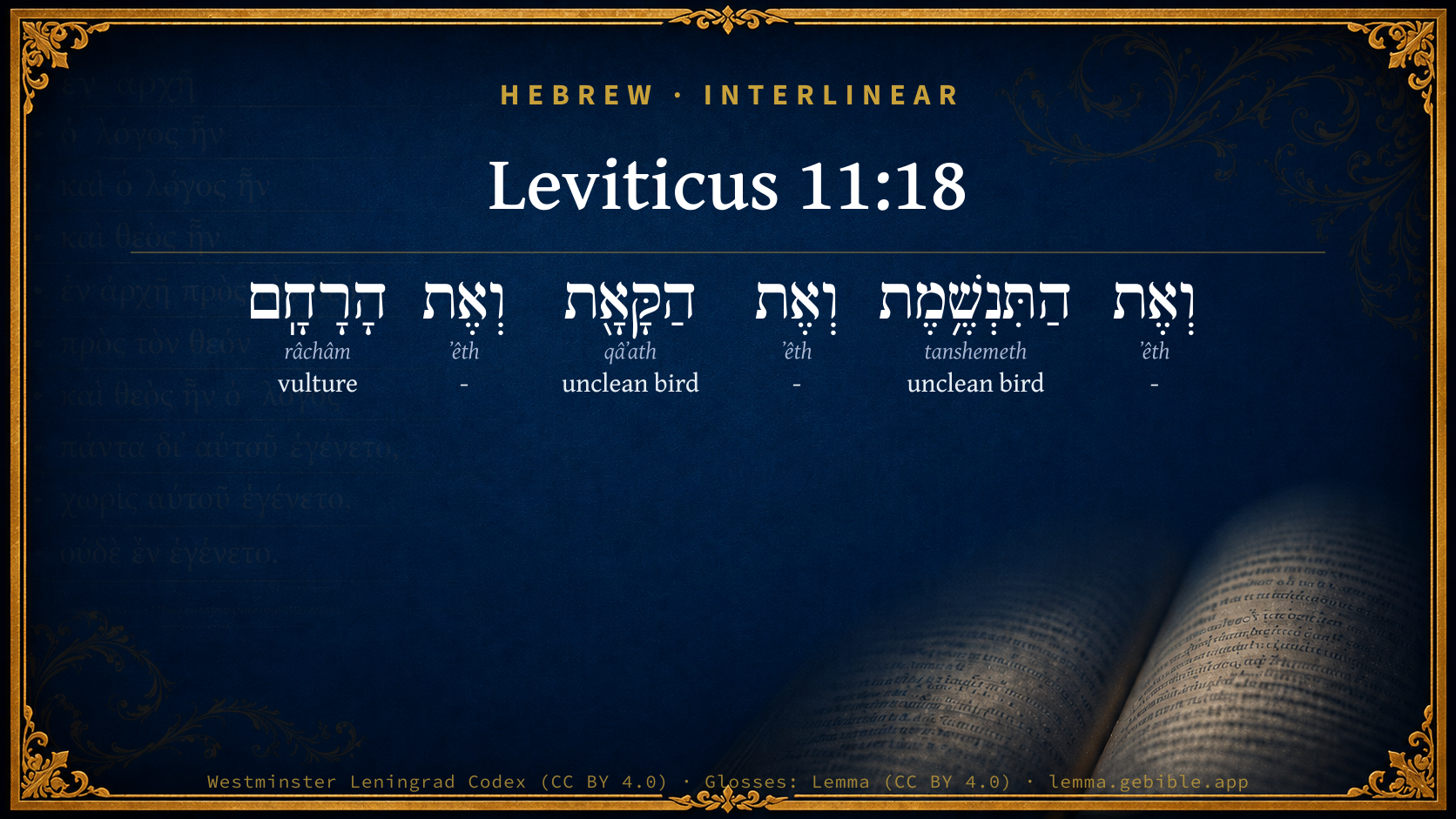
Hebrew (Westminster Leningrad Codex) Leviticus 11:18 appears in the Hebrew Old Testament. The text above is from the Westminster Leningrad Codex. Each word links to its Strong’s number, a concise gloss, and parsing drawn from the Open Scriptures Hebrew Bible morphology. Click any word for its full Brown-Driver-Briggs (BDB) entry.
Download image
Cite this verse

Leviticus 11:18 (World English Bible). Public Domain. Lemma interlinear Bible study tool, https://lemma.gebible.app/v/leviticus/11/18.

Show BibTeX & RIS
BibTeX
RIS
English Translation
the white owl, the desert owl, the osprey,
World English Bible · Public Domain
Highlights
  • 3 first appearances in the Hebrew Bible
Full analysis ↓
Download a study sheet

One document with this verse’s original text, its word-by-word gloss line, the meaning frame, cross-references with their text, attributed commentary, and full source and license credits — printable, and it pastes into notes with its structure intact.

This verse Autodidact and up

Study sheet (.html) Plain text (.txt)

A passage Seminary Student

Up to 50 verses in one chapter. A passage sheet keeps up to 6 commentary sources and 12 cross-references per verse, in the order this page ranks them, and says so on the sheet whenever that leaves anything out. Ask for a single verse and you get the Autodidact verse sheet above.

Everything on this page stays free to read, with no account — the sheet is a download of what is already on screen, not access to it.

Want to remove ads? Support Godless Engineer
Compare translations 3

The same verse in 3 English versions, stacked beneath the original-language interlinear above. Click any original word for its lexicon entry.

Each is an independent rendering of the whole verse — the interlinear is not word-aligned to these translations.

Highlighted words mark where these versions differ — a whole-verse word diff, not a word-by-word alignment.

  • World English Bible Public Domain
    the white owl, the desert owl, the osprey,
  • King James Version Public Domain
    And the swan, and the pelican, and the gier eagle,
  • unfoldingWord Literal Text CC BY-SA 4.0
    and the waterhen and the pelican and the ibis

unfoldingWord Literal Text — © unfoldingWord, licensed CC BY-SA 4.0. Word-aligned USFM3 via Door43 (git.door43.org/unfoldingWord/en_ult).

Versions to compare (up to 4)

3 of 4 selected

Show all 18 translations

Every available English version of this verse, each an independent rendering of the whole verse.

  • World English Bible Public Domain
    the white owl, the desert owl, the osprey,
  • Berean Standard Bible Public Domain
    the white owl, the desert owl, the osprey,
  • Majority Standard Bible Public Domain
    the white owl, the desert owl, the osprey,
  • King James Version Public Domain
    And the swan, and the pelican, and the gier eagle,
  • American Standard Version (1901) Public Domain
    and the horned owl, and the pelican, and the vulture,
  • Revised Version (1885) Public Domain
    and the horned owl, and the pelican, and the vulture;
  • Geneva Bible (1599) Public Domain
    Also the redshanke and the pelicane, and the swanne:
  • Douay-Rheims (1899) Public Domain
    And the swan, and the bittern, and the porphyrion,
  • Young's Literal Translation Public Domain
    and the swan, and the pelican, and the gier eagle,
  • Literal Standard Version CC BY-SA 4.0
    and the waterhen, and the pelican, and the Egyptian vulture,
  • Unlocked Literal Bible CC BY-SA 4.0
    the white owl and the barn owl, the osprey,
  • unfoldingWord Literal Text CC BY-SA 4.0
    and the waterhen and the pelican and the ibis
  • Darby Bible Public Domain
    and the swan, and the pelican, and the carrion vulture,
  • World Messianic Bible Public Domain
    the white owl, the desert owl, the osprey,
  • Webster's Bible Public Domain
    And the swan, and the pelican, and the gier-eagle,
  • Free Bible Version CC BY-SA 4.0
    barn owl, desert owl, Egyptian vulture,
  • Bible in Basic English Public Domain
    And the water-hen and the pelican and the vulture;
  • JPS Tanakh (1917) Public Domain
    and the horned owl, and the pelican, and the carrion-vulture;

Literal Standard Version (2020), Covenant Press — licensed CC BY-SA 4.0. Text via the HelloAO Bible API (eBible.org). Unlocked Literal Bible (unfoldingWord) — licensed CC BY-SA 4.0. Text via the HelloAO Bible API (eBible.org). unfoldingWord Literal Text — © unfoldingWord, licensed CC BY-SA 4.0. Word-aligned USFM3 via Door43 (git.door43.org/unfoldingWord/en_ult). Free Bible Version, Dr. Jonathan Gallagher — licensed CC BY-SA 4.0. Text via the HelloAO Bible API (eBible.org).

Word by word

More ways to search: Search by grammar → Find every occurrence → Compare this word →

Practice this passage: Drill this verse → Learn its vocabulary →

About this verse

These counts appear in no published source. They are computed here, from the morphology-tagged text and Lemma’s own curated glosses. What Lemma adds →

6
words
4
distinct lemmas
Pentateuch
section

Notable vocabulary

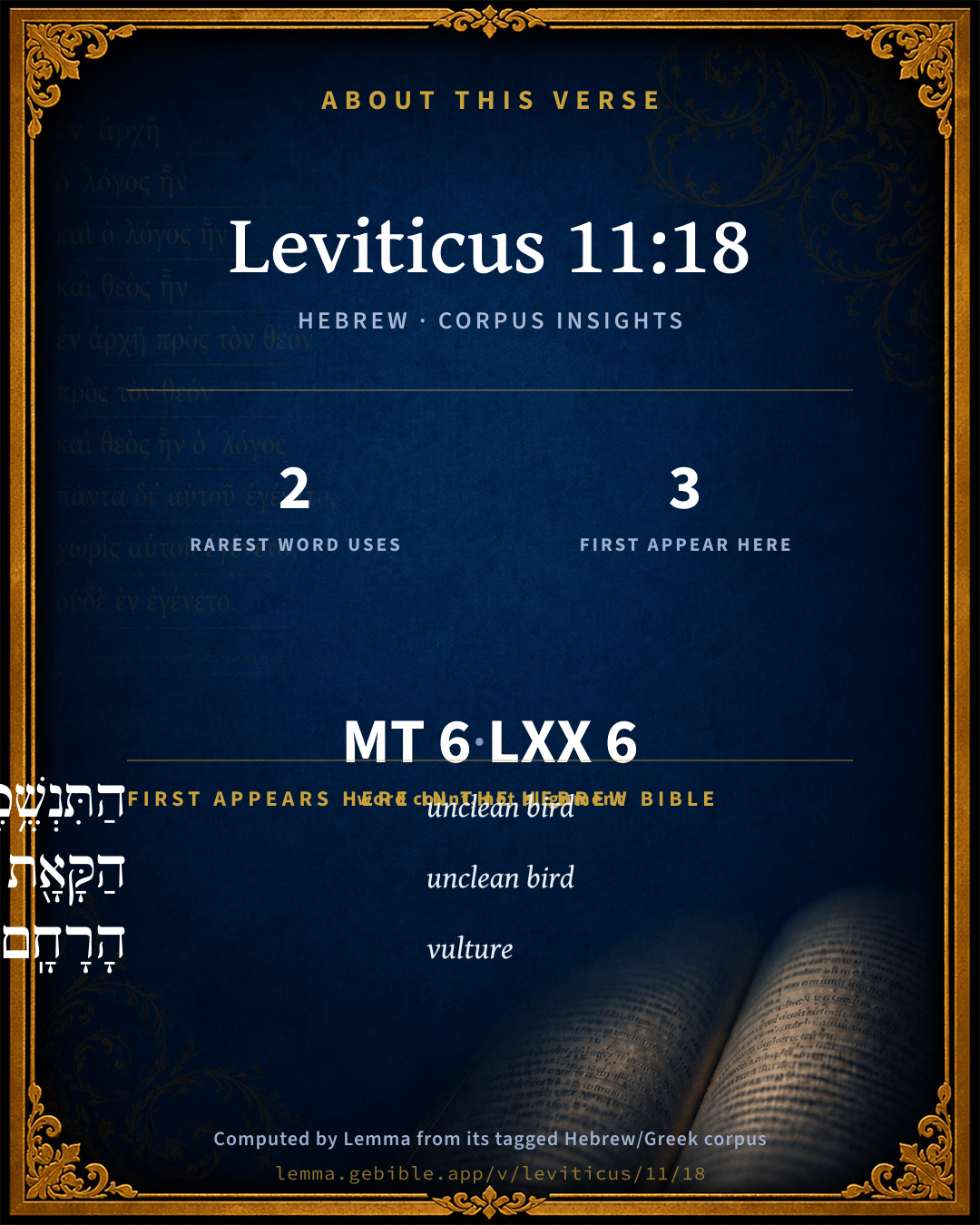
The rarest word here is הָרָחָֽם vulture H7360 — appearing just 2 times in the whole Hebrew Bible.

First appearance in Scripture

These words make their first canonical appearance in the Hebrew Bible here:

  • הַתִּנְשֶׁ֥מֶת unclean bird H8580
  • הַקָּאָ֖ת unclean bird H6893
  • הָרָחָֽם vulture H7360

Shared distinctive vocabulary

הָרָחָֽם vulture H7360 occurs in 2 verses of the Hebrew Bible. Also found in:

Grammatical profile

  • 3 nouns
  • 3 particles

Hebrew & Septuagint length

In English translation the verse runs 8 words from the Hebrew and 8 from the Septuagint (LXX English) — the same length.

A rough comparison of the two English renderings, which tokenize alike — not a word-level alignment.

Word counts can differ between the Hebrew and the Greek without any difference in meaning — e.g. the Hebrew direct-object marker אֵת has no separate Greek word, and Greek often adds the article ὁ.

In the original languages it is 6 Hebrew tokens and 6 Greek tokens — but the two are counted differently (Hebrew bundles its prefixes and suffixes into one token; the Greek is in lemma form), so that isn’t a like-for-like length.

Hebrew and Greek witnesses Masoretic Hebrew ↔ Greek Septuagint

The same verse in the two great witnesses to the Old Testament, shown verse-for-verse.

These are two independent witnesses, not word-aligned to each other, and the Septuagint is shown in lemma (dictionary) form.

Hebrew Leviticus 11:18 Masoretic · Westminster Leningrad Codex

וְאֶת הַתִּנְשֶׁ֥מֶת וְאֶת הַקָּאָ֖ת וְאֶת הָרָחָֽם

the white owl, the desert owl, the osprey,

World English Bible · Public Domain

Greek LXX Leviticus 11:18 Septuagint · lemma form

καί πορφυρίων καί πελεκάν καί κύκνος

and the red-bill, and the pelican, and swan,

LXX2012 (modern English Septuagint) · Public Domain

On this verse, John Gill's Exposition discusses the Septuagint’s reading. Read the note in Commentary ↓

Hebrew: Westminster Leningrad Codex (CC BY 4.0). Greek: Septuagint (public domain); English from LXX2012 (modern English Septuagint) (Public Domain). How the Septuagint differs from the Hebrew →

Targum (Aramaic paraphrase)

2

The Targum is the ancient Jewish Aramaic paraphrase of the Hebrew Scriptures — an interpretive translation, not the Hebrew text itself. Onkelos (literal) and Pseudo-Jonathan (expansive) render the Torah, and Jonathan the Prophets. Coverage is partial: where no permissively-licensed English translation exists for a verse, only the Aramaic is shown. This is verse-level text, not a word-by-word alignment to the Hebrew.

  1. Targum Onkelos Torah (Genesis–Deuteronomy)
    וּבַוְתָא וְקָתָא וִירַקְרֵקָא

    (no public-domain English translation for this verse)

    Targum Onkelos — Aramaic: “Onkelos Genesis” (public domain); “Onkelos Exodus” (public domain); “Onkelos Leviticus” (public domain); “Onkelos Numbers” (public domain); “Onkelos Deuteronomy” (public domain). English: “Sefaria Community Translation” (CC0 1.0 (public-domain dedication)); “J.W. Etheridge. The Targums of Onkelos and Jonathan Ben Uzziel on the Pentateuch. London: Longmans, Green, 1862” (public domain). Text via Sefaria.

  2. Targum Pseudo-Jonathan Torah (Genesis–Deuteronomy)
    וְיַת אוּתְיָא וְיַת קָקָא וְיַת שַׁרְקָרְקָא

    and the bustard, and the cuckoo, and the woodpecker,

    Targum Pseudo-Jonathan — Aramaic: “Targum Jonathan on Genesis” (public domain); “Targum Jonathan on Exodus” (public domain); “Targum Jonathan on Leviticus” (public domain); “Targum Jonathan on Numbers” (public domain); “Targum Jonathan on Deuteronomy” (public domain). English: “The Targum of Jonathan ben Uzziel, trans. J. W. Etheridge, London, 1862” (public domain). Text via Sefaria.

Commentary

Notes on Leviticus 11:18 from classic Christian and Jewish commentators (each source and its license shown beneath its notes). The classic Christian expositions comment on the surrounding passage and are grouped to its opening verse, so a note may address several verses; the Jewish commentaries on the Tanakh (Rashi and others) are per-verse, so they appear only where the commentator wrote on this verse.

Lemma curates 59 commentaries, every one of them public domain or Creative Commons licensed, each selected and text-cleaned for this edition rather than reprinted as found. About our sources →

John Gill's Exposition

And the swan,.... This is a bird well known to us, but it is a question whether it is intended by the word here used; for though it is so rendered in the Vulgate Latin, it is differently rendered by many others: the Targums of Jonathan and Jerusalem call it "otia", which seems to be the same with the "otus" of Aristotle (n), who says it is like an owl, having a tuft of feathers about its ears (from whence it has its name); and some call it "nycticorax", or the owl; and here, by Bochart (o), and others, the owl called "noctua" is thought to be meant; and with which agrees the account some Jewish writers give of it, as Aben Ezra and Baal Hatturim, who say it is a bird, which every one that sees is astonished at it, as other birds are at the owl, are frightened at the sight of it, and stupefied. But as the same word is used Lev 11:30 among the creeping things, for a mole, what Jarchi observes is worthy of consideration, that this is "calve (chauve) souris" (the French word for a bat), and is like unto a mouse, and flies in the night; and that which is spoken of among the creeping things is like unto it, which hath no eyes, and they call it "talpa", a mole. The Septuagint version renders it by "porphyrion", the redshank; and so Ainsworth; and is thought to be called by the Hebrew name in the text, from the blowing of its breath in drinking; for it drinks biting, as Aristotle says (p):

and the pelican; which has its name in Hebrew from vomiting; being said by Aben Ezra and Baal Hatturim to be a bird that vomits its food; and it is observed by several naturalists (q), of the pelican, that it swallows down shellfish, and after they have lain some time in its stomach, it vomits them up again; where having been heated, the shells open, and it picks out the meat:

and the gier eagle; or vulture eagle, the "gypoeetos" of Aristotle (r), and who says it is called also "oripelargos", or the mountain stork; and which Pliny (s) also makes to be an eagle of the vulture kind. Dr. Shaw says (t), that near Cairo there are several flocks of the "ach bobba" (white father, differing little from the stork but in its colour), the "percnopterus" or "oripelargos", which like the ravens about London feed upon carrion, and nastiness that is thrown without the city; this the Arabs call "rachama", the same with Lev 11:18 and in Deu 14:17 and whatever bird is here meant, it must be one that is tender toward its young, as its name signifies, as Aben Ezra and Baal Hatturim observe; and though both the eagle and the vulture are rapacious birds, yet have a great regard to their young; of the eagle see Deu 32:11 and the vulture, with the Egyptians, was an "hieroglyphic" of a tender mother, or any merciful person; it being reported of it, that during the one hundred twenty days its young are under its care, it very rarely flies from them, being so solicitous of nourishing them; and that by making incisions in its thigh, it lets out a bloody flow of milk, when it has nothing else to support them (u). The Talmudists (w) say, that the bird "racham", as it is here called, is the same with "serakrak", and is by the Targum of Jonathan, and in the Syriac version, here rendered "serakraka", so called from which signifies to "squall"; and, according to Munster (x), is thought by some to be the "pica", magpie, or rather the jay; and Dr. Shaw (y) observes, that by a small transmutation of letters, that and the "shagarag" of the Arabs are the same; which he says is of the size and shape of a jay, though with a smaller bill, and shorter legs; the back is brownish; the head, neck, and belly, of a light green; and upon the wings and tail there are several spots or ringlets of a deep blue; it makes a "squalling" noise; and, he adds, it has no small affinity both in voice and plumage with the jay. The Septuagint version renders the word by the "swan"; which if not intended by the first word in this text, may by this, being kind to its young, though otherwise reckoned a cruel and unmerciful bird, as Bochart (z) observes; some think the woodpecker is meant, so called from its love to its parents (a).

(n) Hist. Animal. l. 8. c. 12. Vid. Plin. l. 10. c. 23. (o) Ut supra, (Apud Bochard Hierozoic. par. 2. l. 2.) c. 23. (p) Ut supra, (Hist. Animal. l. 8.) c. 6. so Plin. l. 10. c. 46. (q) Aristot. Hist. Animal. l. 9. c. 10. Aelian. de Animal. l. 3. c. 20, Plin. Nat. Hist. l. 10. c. 40. (r) Hist. Animal. l. 9. c. 32. (s) Nat. Hist. l. 10. c. 3. (t) Travels, p. 449. Ed. 2. (u) Horns Apollo & Pisidas apud Bochart. ut supra, (o)) c. 27. col. 388. (w) T. Bab. Cholin, fol. 63. 1. (x) Dictionar. Chald. p. 4. 18. (y) Travels, p. 183. (z) Ut supra (o)), c. 25. col. 300. (a) Plin. l. 10. c. 33.

John Gill's Exposition of the Whole Bible (1746–1763) — public domain (CC PDM 1.0). Text via the HelloAO Bible API.

Trapp's Complete Commentary

John Trapp

Lev 11:18 And the swan, and the pelican, and the gier eagle,

Ver. 18. And the swan.] Whose white feathers, but black skin under them, might serve to set forth the hatefulness of hypocrisy.

John Trapp, A Commentary or Exposition upon All the Books of the Old and New Testament (1647–1656) — public domain. Text from a community e-Sword module.

Geneva Bible (1599)

Geneva Bible translators

Or, porphyrio.

Geneva Bible (1599) marginal notes — public domain. Text via Bolls.life.

Jamieson, Fausset & Brown

Robert Jamieson, A. R. Fausset & David Brown

the swan--found in great numbers in all the countries of the Levant. It frequents marshy places--the vicinity of rivers and lakes. It was held sacred by the Egyptians, and kept tame within the precincts of heathen temples. It was probably on this account chiefly that its use as food was prohibited. MICHAELIS considers it the goose.

the pelican--remarkable for the bag or pouch under its lower jaw which serves not only as a net to catch, but also as a receptacle of food. It is solitary in its habits and, like other large aquatic birds, often flies to a great distance from its favorite haunts.

the gier eagle--Being here associated with waterfowl, it has been questioned whether any species of eagle is referred to. Some think, as the original name racham denotes "tenderness," "affection," the halcyon or kingfisher is intended [CALMET]. Others think that it is the bird now called the rachami, a kind of Egyptian vulture, abundant in the streets of Cairo and popularly called "Pharaoh's fowl." It is white in color, in size like a raven, and feeds on carrion; it is one of the foulest and filthiest birds in the world. [See on Deu 14:17.]

Jamieson, Fausset & Brown — Commentary Critical and Explanatory on the Whole Bible (1871) — public domain (CC PDM 1.0). Text via the HelloAO Bible API.

Adam Clarke's Commentary

Verse 18. The swan] תנשמת tinshemeth. The Septuagint translate the word by πορφυριωνα, the porphyrion, purple or scarlet bird. Could we depend on this translation, we might suppose the flamingo or some such bird to be intended. Some suppose the goose to be meant, but this is by no means likely, as it cannot be classed either among ravenous or unclean fowls. Bochart thinks the owl is meant.

The pelican] קאת kaath. As קאת kaah signifies to vomit up, the name is supposed to be descriptive of the pelican, who receives its food into the pouch under its lower jaw, and, by pressing it on its breast with its bill, throws it up for the nourishment of its young. Hence the fable which represents the pelican wounding her breast with her bill, that she might feed her young with her own blood; a fiction which has no foundation but in the above circumstance. Bochart thinks the bittern is meant, vol. iii., col. 292.

The gier eagle] רחם racham. As the root of this word signifies tenderness and affection, it is supposed to refer to some bird remarkable for its attachment to its young; hence some have thought that the pelican is to be understood. Bochart endeavours to prove that it means the vulture, probably that species called the golden vulture. - Bochart, vol. iii., col. 303.

Adam Clarke's Commentary on the Bible (1810–1826) — public domain. Text from a community e-Sword/MySword module.

Ellicott's Commentary for English Readers

(18) And the swan.—The word here translated “swan,” which, besides the parallel list in Deut., also occurs in Lev_11:30, among the names of the lizards, denotes, according to tradition, another variety of the owl. Whatever difficulty there may be about the true import of the word, it is certainly not the swan. It has, however, also been translated “ibis,” “bat,” “purple water-hen,” “heron,” “pelican,” and “goose.”

And the pelican.—The pelican is one of the largest and most voracious of the web-footed birds. It fills its capacious pouch with fish almost to suffocation, which it disgorges either for its own future consumption, or for the nourishment of its young, by pressing the under mandible against the neck and breast to assist the vomiting up of the contents. Hence its Hebrew name, which denotes “the vomiter.” During this operation the red nail of the upper mandible comes in contact with the breast, thus imparting to it the appearance of blood, which is most probably the origin of the fable that it feeds its young with its own life-blood. The pelican often builds in deserted places as far as twenty miles from the shore. When it has filled its expansive pouch with prey, it retires to its lonely place of repose, where it remains with its head leaning against its breast almost motionless till impelled by hunger to fly to the water in search for a fresh store of victims. It is to this melancholy attitude of lonely desolation that the Psalmist refers when he says, “I am like a pelican of the wilderness” (Psa_102:6), and it is to its habit of building in deserted places that the prophets allude when they describe the desolation of Edom and Nineveh by saying that “the pelican shall possess” them (Isa_34:11; Zep_2:14). In the last two passages the Authorised Version, which wrongly translates it “cormorant” in the text, has rightly pelican in the margin.

And the gier eagle.—As the name of a bird, this word (racham), which is here in the masculine form, and denotes “the merciful,” only occurs again in the parallel passage, Deu_14:17, where, however, it is in the feminine (rachamah). The species here intended is most probably the Gyps, called alternately the sacred or Egyptian vulture and Pharaoh’s hen, which is often figured on the ancient Egyptian monuments. It was regarded with religious veneration in Egypt, both because it prevented epidemics by acting as scavenger, and because of its extreme devotion and tenderness to its young, since it was believed to watch over its offspring a hundred and twenty days every year, and to feed them, if necessary, with the blood of its thighs. Hence it was used to denote both “mother” and “merciful” in Egyptian, and hence, too, its name “merciful” in Hebrew. The ancients also believed that there were no male vultures, and that the females conceived through the wind. It was probably to counteract this superstitious belief that the lawgiver uses here the masculine form and the feminine form in the parallel passage in Deu_14:17. The vulture is most loathsome in its habits, and feeds upon the foulest carrion, for which reason it is put in the list of unclean birds.

A Bible Commentary for English Readers, edited by Charles John Ellicott (1878–1897) — public domain. Text from a community e-Sword module.

The Cambridge Bible for Schools and Colleges

gen. ed. J. J. S. Perowne

18. the horned owl] (swan A.V. and R.V. mg.) another kind of owl. The Heb. root (also used in Lev_11:30 for the chameleon [mole A.V.]) suggests a bird that makes a snorting sound, or breathes hard. The LXX. trans. πορφυρίων. Tristram (Nat. Hist. of the Bible, p. 249) and Driver (Deut. in loc.) ‘the water hen.’

the pelican] In the lists and Psa_102:6 [Hebrews 7] (‘a pelican of the wilderness’); Isa_34:11; Zep_2:14 (cormorant A. V.) it is used of a bird inhabiting desolate places.

the vulture] (the gier-eagle A.V.) It is distinguished by zoologists as vultur percnopterus.

The cormorant follows in Deut. at the close of Lev_14:17.

The Cambridge Bible for Schools and Colleges (gen. ed. J. J. S. Perowne; Cambridge University Press, 1878–1918) — public domain. Text from a community e-Sword module.

Haydock's Catholic Bible Commentary

Bittern, onocrotalum. See ver. 17. Protestant version has "pelican and the gier-eagle," for porphyrion. (Haydock) --- Its beak and long legs are red. (Pliny, [Natural History?] x. 46.) Bochart understands the vulture, and the Samaritan version the pelican; both of which are remarkable for the care they take of their young. Reme may be derived from rem, "mercy."

George Leo Haydock (1774–1849), Haydock's Catholic Family Bible and Commentary, 1859 edition — public domain. Excludes Psalms (Douay-Rheims chapter numbering differs from Protestant) and Deuterocanonical books (Catholic canon only).

Whedon's Commentary on the Bible

Daniel D. Whedon

18. The swan — Hebrew tinshemeth. It is found only in the two catalogues. The Samaritan version sustains the Seventy in rendering it πορφυριων, Vulgate, porphyrio ibis, the purple water-hen. Tristram thinks that these versions are right. Furst insists that it is an owl, perhaps the screech-owl; Onkelos, the horn-owl; the Jerusalem Targum favours the owl; the Syriac, the night owl, which is followed by Rashi and Kimchi. The weight of authority is for the owl of some species. It is not probable that the swan was sufficiently known to the Israelites to obtain a place in this list, nor is it an unclean bird.

The pelican — It derives its Hebrew name, kaath, from vomiting the shells and fish it has stored in its capacious pouch, to feed its young, or to enable it to fly when suddenly alarmed. It abides in the swamps of the desert and on the sea-shore.

The gier eagle — Hebrew racham. It occurs only in the catalogues, and is identical in reality as it is in name with the racham of the Arabs, the Egyptian vulture, or Pharaoh’s hen, which, according to Tristram, is common in Palestine, and breeds prolifically in the valley of the Kedron. It is an efficient scavenger.

Daniel D. Whedon (gen. ed.), Commentary on the Old and New Testaments (1874–1909) — public domain. Text from a community e-Sword module.

Rashi

Rabbi Shlomo Yitzchaki (Rashi)

תנשמת — This is the chauvesouris in O. F.: it is similar to a mouse which flies about at night (a “bat”). The תנשמת mentioned among the creeping things (v. 30) is somewhat like it but it has no eyes, and it is called “talpa”, (English = mole) (cf. Chullin 63a).

Rashi on the Tanakh — English translations: “The Judaica Press complete Tanach with Rashi, translated by A. J. Rosenberg” (CC BY 4.0); “Pentateuch with Rashi's commentary by M. Rosenbaum and A.M. Silbermann, 1929-1934” (public domain); “The Metsudah Tanach series, Lakewood, N.J” (CC BY 4.0); and “The Book of Joshua, Metsudah Publications, 1997” (CC BY 4.0). Text via Sefaria.

Lesson kit

Teaching starters — assembled from the data on this page, not authored interpretation. Every prompt links to the verse data it draws on. Edit before teaching.

Leviticus, in the Pentateuch, opens this verse with 6 words (4 distinct Hebrew lemmas). Its most distinctive word is râchâm (“vulture”). A historical commentator’s framing appears above. Read the whole chapter for the surrounding context.

Discussion questions

  1. How does “vulture” (râchâm) shape what this verse is saying?
  2. 3 words make their first appearance in Scripture here. What does this debut establish?
  3. How does Deuteronomy 14:17, which shares the word «vulture», read alongside this verse?
  4. These translations render this verse differently. What is at stake in choosing one wording over another?
  5. Compare how John Gill's Exposition and Trapp's Complete Commentary read this verse. Where do they agree or differ?

Things to notice

Reading settings

Reading text

Shown beneath each verse's original-language words.

Old Testament
Old Testament edition

Read the OT as the Masoretic Hebrew (MT) or the Greek Septuagint (LXX).

English shown for the Greek Septuagint (in the Hebrew ↔ Greek comparison).

Comparing translations? Open the Compare panel on any verse page to stack up to four side by side.