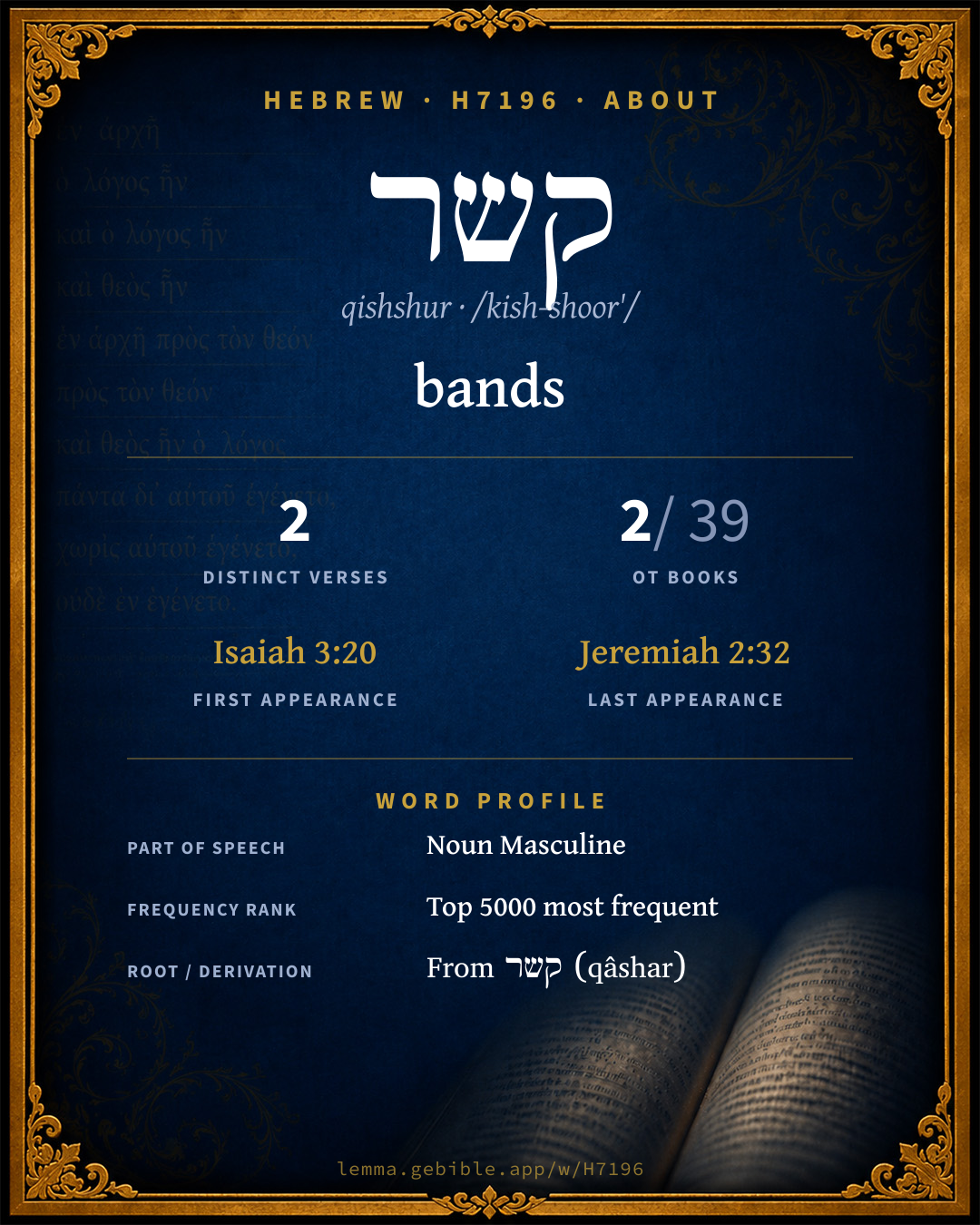
קִשֻּׁרִים
bands
also: sashes, headbands fuller range ↓
Full lexicon entry — Brown-Driver-Briggs (BDB)
From Brown-Driver-Briggs (BDB)
Where this word appears
See every Absolute-state word in the Hebrew Bible →
Grammar key — what these labels mean
Part of speech
- Noun
- A naming word — a person, place, thing, or idea.
Noun type
- Common
- A common noun — a general class of person, place, or thing (“king,” “city,” “water”), not a specific name.
State
- Absolute
- The independent form of a noun, not bound to a following word.
- Construct
- A noun bound to a following noun in a possessive / “of” relationship (the construct chain).
Gender
- Masculine
- Grammatically masculine.
Number
- Plural
- More than one (in Hebrew, generally three or more).
1 distinct verse where H7196 appears in the Construct state, across 1 book. Filtered view — show all forms. Click any verse to open its interlinear word-by-word view. Verse text shown in the World English Bible for context — . Each verse’s Hebrew form is shown with its reference; the English is not keyword-highlighted, since the data carries no word-level English alignment. Use “Compare translations” on any verse to read it across multiple English versions. This concordance covers the Hebrew Bible; Septuagint (Greek Old Testament) occurrences are not indexed here.
Jeremiah 1 verse
About this entry
At a glance — auto-summarized from this page’s data, not written by a person. Every figure links to its source below. This summary describes the numbers; it doesn’t interpret them.
The Hebrew noun קשר centers on the idea of “bands.” It is rare — just 2 verses in the entire Hebrew Bible. Isaiah dominates its distribution — 1 of 2 verses. Its earliest occurrence is Isaiah 3:20. Lexicons map it across 2 senses — beyond “bands” it also covers “sashes” and “headbands”. For the data behind this summary, explore the sense tree and the renderings breakdown below.
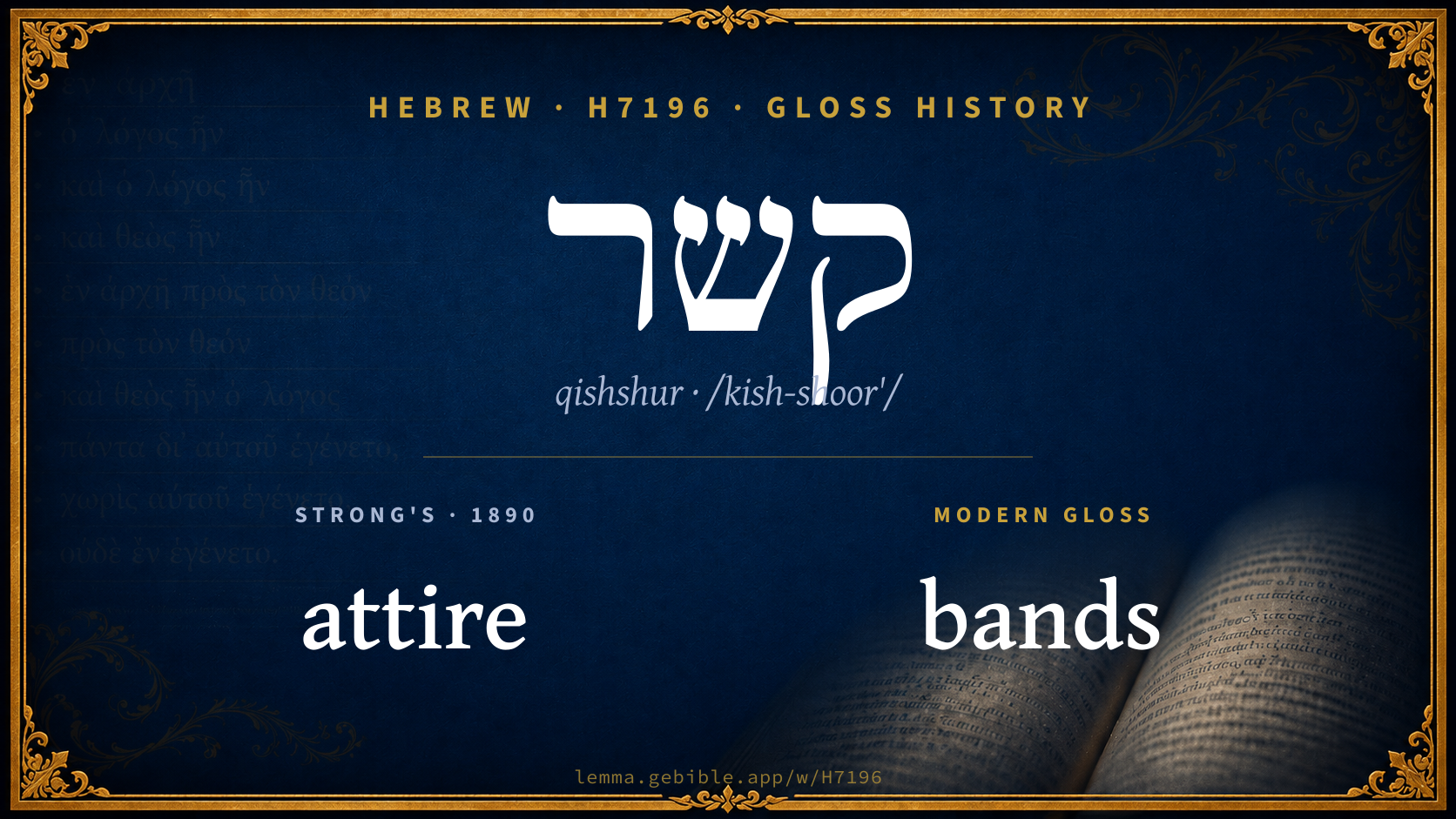
Gloss history
Strong's 1890 vs modern scholarship
About this word
Strong's H7196 catalogs a Hebrew word from the Hebrew Old Testament.
These counts are not copied from any lexicon or concordance. They are computed here, from the morphology-tagged Hebrew Old Testament. What Lemma adds →
- 2
- distinct verses
- The word appears in 2 distinct verses.
- 2 / 39
- OT books
- The word appears in 2 of 39 Old Testament books.
- #4,807
- by frequency
- Top 5000 most frequent Hebrew words (rank 4,807 of 8,640 Hebrew words by occurrence).
View all 2 occurrences in the concordance →
By traditional corpus
Conventional, traditional groupings — biblical authorship is debated, so this is a traditional corpus grouping, not an authorship claim. Each share is this word’s portion of its verses in that division of the Hebrew canon. Each figure is a share of the word’s 2 distinct verses.
- Prophets (Nevi'im) 2 verses · 100%
How translations render this word
Counts come from each version’s own published word-to-Strong’s tagging or interlinear alignment — an approximate guide to how each version renders this word, not a word-level alignment the data otherwise carries. Because each total is that version’s own tagged count, the per-version totals vary from one another and need not match the appearance or distinct-verse counts above. These counts may also differ from a printed concordance because Lemma counts each distinctly tagged rendering and does not collapse phrase taggings into a single head-word total. This is a fixed set of word-tagged versions (KJV, ASV, BSB, ULT) and does not change with the reading translation you choose elsewhere. Each version’s license is shown beside its name below (and on Sources).
- King James Version: Attire 1×, Headbands 1×
- American Standard Version: Attire 1×, Chains 1×
- Berean Standard Bible: Sashes 1×, Wedding sash 1×
- unfoldingWord Literal Text: Sashes 2×
King James Version Public Domain
Renders H7196 across 2 tagged occurrences — most commonly:
American Standard Version Public Domain
Renders H7196 across 2 tagged occurrences — most commonly:
Berean Standard Bible Public Domain
Renders H7196 across 2 tagged occurrences — most commonly:
unfoldingWord Literal Text CC BY-SA 4.0
Renders H7196 across 2 tagged occurrences — most commonly:
Senses in BDB
The 2 senses BDB distinguishes for this word, in lexicon order (not ranked by frequency or importance). The full entry — with sub-senses — is in the Lexicon Entry tab.
- bands, sashes, headbands
- ornaments that are bound on
Word origin
קִשֻּׁרִים n.[m.]pl. bands, sashes, or other woman's ornament that is bound on
— Brown-Driver-Briggs (Oxford 1906, public domain), digitized via Sefaria, supplemented by the OpenScriptures HebrewLexicon (CC BY 4.0). See Sources.
Derived from קשר (qâshar) (H7194) — to bind.
Jastrow Dictionary
A second Hebrew/Aramaic lexicon for comparison, covering Aramaic and post-biblical (Talmudic, Targumic, Midrashic) usage that the biblical-Hebrew BDB does not. Matched by lemma rather than by Strong’s number, so a lemma may carry more than one Jastrow headword (shown separately below), and the entries cover usage well beyond the Bible.
קָשַׁר
- (b. h.) [to strengthen, v. Gen. XXX, 41, sq.] to join, knot, tie; to fold. Sabb. VII, 2 הקוֹשֵׁר והמתיר he that makes a knot or unties it. Y. ib. 10ᶜ שהיו קוֹשְׁרִין וכ׳ they knotted the ropes (of the Tabernacle). Ib. נפסק היה קוֹשְׁרוֹ when a thread was broken (in weaving), one knotted it. Y. Gitt. VIII, end, 49ᵈ אפי׳ קושר וכ׳ even if he folds (the document) up, and then has it signed. Ib. בשׁקְשָׁרוֹ וחתמו וכ׳ when he folded it and had it signed inside; a. fr.—Trnsf. a) (cmp. חָרַז) to compose and arrange (a funeral song or eulogy). Y. Yoma I, 38ᵇ קָשְׁרוּ הספידו they arranged his eulogy. Lam. R. introd. (R. Joḥ. 1), v. מִסְפֵּד; a. fr.—b) conceive, form an affection. Pesik. B’shallaḥ, p. 80ᵃ הוא קושר לו אהבה וכ׳ he acquires love and affection for him; Gen. R. s. 54; Yalk. Prov. 954; a. e.—Part. pass. קָשׁוּר; f. קְשׁוּרָה &c. Y. Nidd. I, 49ᵇ top אילו יהושע שהיה ק׳ למשה וכ׳ a Joshua who was tied to Moses (his constant attendant) could not have spoken so (that Moses had not said a certain thing), and he says so (of R. Jeremiah)? Erub. II, 1 קְשׁוּרוֹת, v. נָתַר. Y. Yeb. XVI, 15ᵈ top, v. הֶסְפֵּד; a. e. e.g. Genesis 30:41
- same, esp. to fold a document, to write a portion and fold it and have witnesses signed on the fold, and so continue to the end of the document. Y. Gitt. l. c. היה מְקַשֵּׁר ראשון ראשון if he folded up the signatures one by one; a. e.—Part. pass. מְקוּשָּׁר. מק׳ (גט) a folded document, opp. פָּשׁוּט. B. Bath. X, 1 גט פשוט … ומק׳ עדיו אחוריו a plain document has its signatures of witnesses inside, a folded one, on its back. Ib. 160ᵃ sq. (ref. to Jer. XXXII, 44) וכתוב … וחתום זה מק׳ ‘and write the deed’, this refers to the plain document, ‘and sign’, this means the folded document; Y. ib. X, beg. 17ᶜ (ref. to Jer. ib. 11) את החתום זה המק׳ ואת הגלוי זה הפשוט שבמק׳ ‘the sealed’ means the folded, ‘and the open’ means the plain document which goes with the folded. Ib. bot. טופס שטרות מְקוּשָּׁרוֹת וכ׳ such is the formula of folded documents; a. fr. e.g. Jeremiah 32:44
- 1. to be tied. Snh. 108ᵇ כלב נ׳ the dog was doomed to be tied.
- 2. to be joined, harden, become knotty. Shebi. III, 1 משׁיִקָּשֵׁר (Mish. ed. משיקשור, incorr.) when the mathoḳ (v. מָתוֹק II) gets knotty excrescences; (R. S.: when the dung in its juice becomes bound, begins to harden); expl. Y. ib. 34ᶜ top משיעשה קשרין קשרין when it gets full of knotty excrescences; ib. מכיון שנקשר בו קשר וכ׳ R. S. to Shebi. l. c. (ed. שנִתְקַשֵּׁר) as soon as the uppermost protuberance is formed, it begins to dry up.
- same, to become knotty; to become thick. Y. Shebi. l. c., v. supra. Taan. 20ᵃ נִתְקַשְּׁרוּ שמים וכ׳, v. עָב II.
- to be tied, joined. Lev. R. s. 30 יוּקְשְׁרוּ כולם אגודה וכ׳ let all of them be tied together with one band (of brotherhood; Yalk. ib. 651 יֵעָשׂוּ כולן וכ׳).
קֶשֶׁר
- preced.)
- 1. knot, band, loop. Sabb. XV, 1 ק׳ הגמלין a knot like that which the camel drivers make (v. זְמָמָא); ק׳ הספנין the sailors’ knot (v. אִיסְטְרִידָא). Ib. 111ᵇ ק׳ שאינו של קיימא a knot which is not intended to be permanent, a temporary knot. Ber. 7ᵃ ק׳ של תפלין the knot in the band of the T’fillin (resting on the back of the head); a. v. fr.—Trnsf. union, conspiracy. Snh. 26ᵃ (ref. to Is. VIII, 12) ק׳ רשעים הוא וק׳ רשעים אינו וכ׳ it is a council of wicked men &c., v. מִנְיָן.—Pl. קְשָׁרִים, קְשָׁרִין. Sabb. XV, 1. Bekh. 30ᵇ; Ab. Zar. 39ᵃ קִשְׁרֵי מוכס, v. מוֹכֵס. Mikv. X, 3 קשרי העני the knots in the poor man’s garment. Tanḥ. Korah 12 ח׳ חוטין וה׳ ק׳ eight threads (of the show fringe) and five knots; Num. R. s. 18 ח׳ גרורין וה׳ קִשּׁוּרִין. Sabb. VI, 9 הבנים יוצאין בק׳ children may go out (on the Sabbath) with garlands, v. פּוּאָה; a. fr.—Sot. VIII, 5 קשרי המלחמה the joined ranks in battle (Y. ed. קישוי, corr. acc.); Y. ib. VIII, end, 23ᵃ קִישְׁרֵי המלחמות.—2) protuberance, joint. Y. Shebi. III, 34ᶜ top, v. preced. Gen. R. s. 10 (ref. to Job XXXVIII, 31) כסיל מושך בין ק׳ לק׳ the planet K’sil draws (the connection) between bud and bud (v. עָדַן Hif.); a. e.—Pl. as ab. Y. Shebi. l. c., v. preced. Nidd. 52ᵇ קשרי אצבעותיה של יד the joints of her fingers; של רגל of her toes. Y. Ber. VIII, 12ᵃ bot. עד קישרי אצבעותיו to the second joints of the fingers, contrad. to פֶּרֶק, q. v.; a. e. e.g. Isaiah 8:12
- 3. fold of a document, plicature. B. Bath. 160ᵇ בין ק׳ לק׳ the witnesses sign between the folds; a. fr.—Pl. as ab. Ib. מתוך שנתרבה בקְשָׁרָיו וכ׳ because it has many folds, it must have many witnesses. Gitt. VIII, 10 (expl. גט קרח, v. קֵרֵחַ) כל שקשריו מרובין וכ׳ which has more folds than signatures of witnesses; a. fr.
A Dictionary of the Targumim, the Talmud Babli and Yerushalmi, and the Midrashic Literature (Marcus Jastrow; London, Luzac, 1903) — Public Domain. Digitized via Sefaria. Digitized via Sefaria. Full attribution on Sources.
Forms in the corpus
The 2 distinct written forms H7196 takes in the Hebrew Bible, most frequent first — each parse links to that state’s occurrences in the concordance. Hebrew forms include their vowel points and cantillation, so a single lemma takes many written forms.
| Form | Parsing | Example | Uses |
|---|---|---|---|
| וְ/הַ/קִּשֻּׁרִ֔ים | Noun, Common, Masculine, Plural, Absolute | Isaiah 3:20 | 1 |
| קִשֻּׁרֶ֑י/הָ | Noun, Common, Masculine, Plural, Construct | Jeremiah 2:32 | 1 |
Same root — word family
Other BDB entries built from the same root as H7196, grouped by Strong’s listed origin. These share a root / origin per the lexicon — not necessarily a shared meaning. Each links to that word’s own entry.
Derives from
Shares the same root
Compare all same-root words → They share a root, not necessarily a meaning.
Septuagint verse parallels
This word appears in 2 verses that also exist in the Greek Old Testament (Septuagint), out of the 2 Hebrew verses it occurs in. You can read those verses in Greek by switching the Old Testament edition to the Septuagint.
Read these verses in the Septuagint
This is a verse-level parallel only — the same verses exist in both the Hebrew and Greek Old Testaments. No word-level Hebrew↔Greek correspondence is claimed: the data carries no such alignment, so no Greek word is shown as this Hebrew word’s translation. Coverage is not total — the Septuagint omits the deuterocanon and renumbers the Psalms, so some Hebrew verses have no direct Greek parallel.