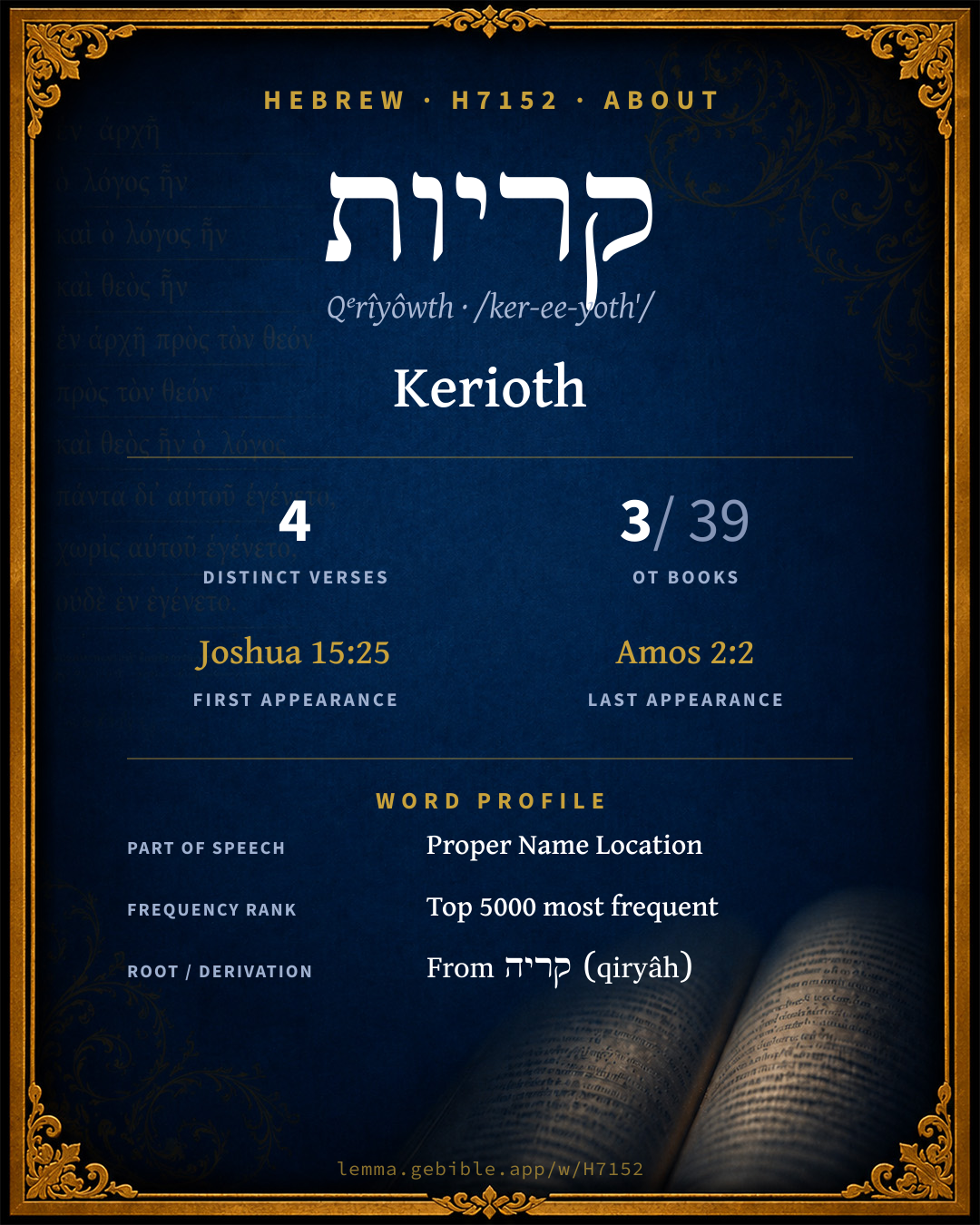
קְרִיּוֹת
Kerioth
BDB lists 3 entries for ‘Kerioth’ fuller range ↓
Full lexicon entry — Brown-Driver-Briggs (BDB)
From Brown-Driver-Briggs (BDB)
Where this word appears
Grammar key — what these labels mean
Part of speech
- Noun
- A naming word — a person, place, thing, or idea.
Noun type
- Proper
- A name of a specific person, place, or people (e.g. Abraham, Zion, Israel).
- Common
- A common noun — a general class of person, place, or thing (“king,” “city,” “water”), not a specific name.
State
- Absolute
- The independent form of a noun, not bound to a following word.
Gender
- Feminine
- Grammatically feminine.
Number
- Plural
- More than one (in Hebrew, generally three or more).
Every verse where H7152 appears in the Book of Jeremiah — 2 distinct verses. Click any verse to open its interlinear word-by-word view. Verse text shown in the World English Bible for context — . Each verse’s Hebrew form is shown with its reference; the English is not keyword-highlighted, since the data carries no word-level English alignment. Use “Compare translations” on any verse to read it across multiple English versions. This concordance covers the Hebrew Bible; Septuagint (Greek Old Testament) occurrences are not indexed here.
Jeremiah
- Jeremiah 48:24 קְרִיּ֖וֹת n Proper and on Kerioth, and on Bozrah, and on all the cities of the land of Moab, far or near.
- Jeremiah 48:41 הַ/קְּרִיּ֔וֹת ptcl def.art + n c fp Kerioth is taken, and the strongholds are seized, and the heart of the mighty men of Moab at that day shall be as the heart of a woman in her pangs.
About this entry
At a glance — auto-summarized from this page’s data, not written by a person. Every figure links to its source below. This summary describes the numbers; it doesn’t interpret them.
The Hebrew name קריות centers on the idea of “Kerioth.” With only 4 verses it sits in the long tail of Hebrew Bible vocabulary. Jeremiah dominates its distribution — 2 of 4 verses. Its earliest occurrence is Joshua 15:25. Dig into 4-verse concordance and the renderings breakdown below.
Gloss history
Strong's 1890 vs modern scholarship
About this word
Strong's H7152 catalogs a Hebrew word from the Hebrew Old Testament.
These counts are not copied from any lexicon or concordance. They are computed here, from the morphology-tagged Hebrew Old Testament. What Lemma adds →
- 4
- distinct verses
- The word appears in 4 distinct verses.
- 3 / 39
- OT books
- The word appears in 3 of 39 Old Testament books.
- #3,696
- by frequency
- Top 5000 most frequent Hebrew words (rank 3,696 of 8,640 Hebrew words by occurrence).
View all 4 occurrences in the concordance →
By section of the Old Testament
By traditional corpus
Conventional, traditional groupings — biblical authorship is debated, so this is a traditional corpus grouping, not an authorship claim. Each share is this word’s portion of its verses in that division of the Hebrew canon. Each figure is a share of the word’s 4 distinct verses.
- Prophets (Nevi'im) 4 verses · 100%
How translations render this word
Counts come from each version’s own published word-to-Strong’s tagging or interlinear alignment — an approximate guide to how each version renders this word, not a word-level alignment the data otherwise carries. Because each total is that version’s own tagged count, the per-version totals vary from one another and need not match the appearance or distinct-verse counts above. These counts may also differ from a printed concordance because Lemma counts each distinctly tagged rendering and does not collapse phrase taggings into a single head-word total. This is a fixed set of word-tagged versions (KJV, ASV, BSB, ULT) and does not change with the reading translation you choose elsewhere. Each version’s license is shown beside its name below (and on Sources).
BDB lists this Strong’s number as 2 distinct words (homographs). Each count above pools all of them and is not split by sense — see the Senses section below. A low-frequency rendering may belong to a different one of those words, not the primary meaning.
- King James Version†: Kerioth 4×
- American Standard Version†: Kerioth 4×
- Berean Standard Bible†: Kerioth 2×
- unfoldingWord Literal Text†: Kerioth 1×, Kerioth hezron 1×
King James Version Public Domain
Renders H7152 across 4† tagged occurrences — most commonly:
American Standard Version Public Domain
Renders H7152 across 4† tagged occurrences — most commonly:
Berean Standard Bible Public Domain
Renders H7152 across 4† tagged occurrences — most commonly:
Plus 2 renderings that appear only once — usually multi-word phrases or single function words the recovered tagging swept in, not distinct renderings.
unfoldingWord Literal Text CC BY-SA 4.0
Renders H7152 across 2† tagged occurrences — most commonly:
Senses in the full BDB
What do BDB’s symbols mean?
BDB uses these scholarly abbreviations:
| Symbol | Meaning |
|---|---|
| 𝔊 | the Septuagint (the ancient Greek translation, LXX) |
| 𝔙 | the Vulgate (the Latin translation) |
| 𝔖 | the Syriac version (the Peshitta) |
| 𝔗 | the Targum (the Aramaic translation) |
| ψ | the Psalms |
| √ | root (the underlying root or stem) |
| ‖ | parallel passage (a synonymous or contrasted parallel) |
| † | the dagger: every passage where the word occurs is cited |
The 2 senses and sub-senses the full Brown-Driver-Briggs lexicon distinguishes for this word, in lexicon order (not ranked by frequency), with BDB’s own verbatim wording and sub-sense lettering. Shown in Hebrew script with BDB’s own scholarly abbreviations. The condensed entry is in the Lexicon Entry tab. See also the Forms in the corpus table below.
- 1. in Judah Jos 15:25 (αἱ πόλεις; whence, as supposed, Judas אִישׁ קְרִיּוֹת), perhaps Ḳaryatên, c. 12 m. S. of Hebron, BuhlGeogr. 182. e.g. Joshua 15:25
- 2. in Moab, Καριωθ, αἱ πόλεις; MI13 קרית: Je 48:24, הַקּ׳ v 41 Am 2:2; perhaps = Ραββαθ Μωαβ = Μοαβ = Αρεοπολις (Euseb., v. LagOnom. 227, 60 al.), mod. Rabba, c. 11 m. S. of Arnon, cf. BuhlGeogr. 270. e.g. Jeremiah 48:24
Senses from the full Brown-Driver-Briggs lexicon (Brown, Driver, Briggs; Oxford 1906 — public domain), digitized via Sefaria, supplemented by the OpenScriptures HebrewLexicon (CC BY 4.0). Full attribution on Sources.
Word origin
n.pr.loc. (formed as pl. intens. from קִרְיָה?);—
— Brown-Driver-Briggs (Oxford 1906, public domain), digitized via Sefaria, supplemented by the OpenScriptures HebrewLexicon (CC BY 4.0). See Sources.
Derived from קריה (qiryâh) (H7151) — city.
Jastrow Dictionary
A second Hebrew/Aramaic lexicon for comparison, covering Aramaic and post-biblical (Talmudic, Targumic, Midrashic) usage that the biblical-Hebrew BDB does not. Matched by lemma rather than by Strong’s number, so a lemma may carry more than one Jastrow headword (shown separately below), and the entries cover usage well beyond the Bible.
קְרִיאָה
- (קָרָא)
- 1. call. Sifra Vayikra, Par. 1 (ref. to Lev. I, 1) הקדים ק׳ לדיבור the Lord sent the call in advance of the speech. Ib. על כל ק׳ הוא אומר הנני to every call he responded with ‘here am I.’ Deut. R. s. 11, beg. חתם יצחק בק׳ Isaac closed his blessings with a call (Gen. XXVIII, 1); אני … אלא בק׳ I will commence with a call (ib. XLIX, 1); a. fr. e.g. Leviticus 1:1
- 2. reading esp. from the Scriptures. קְרִיאַת שמע (קְרִיַּת) (abbrev. ק"ש), or ק׳ (sub. שמע) the recitation of Sh’mʿa (Deut. VI, 4-9; XI, 13-21; Num. XV, 37-41) in the morning and in the evening prayer. Ber. 13ᵇ מצות ק׳ the duty of reciting, contrad. to מצות כונה, v. כַּוָּנָה. Ib. זו ק"ש של ר׳ וכ׳ this (the verse Deut. VI, 4) was all that R. Judah han-Nasi read (when engaged in teaching); a. fr.—V. שְׁמַע II.—קריאת המגלה the recitation of the Book of Esther. Meg. I, 4; a. fr.—Ib. 14ᵃ קְרִיָּיתָהּ זו הלילא (not קרייתא), v. הַלֵּלָא.—Macc. 18ᵇ הראויין לק׳ those first-fruits which are fit for reciting over them (Deut. XXVI, 3 sq.); a. fr.—Pl. קְרִיאוֹת, קְרִיּוֹת. Deut. R. s. 4, beg. מהו לקרות … בק׳ הרבה how about reading ‘the reproofs’ (תּוֹכָחָה) by several calls (by calling up several persons successively). Ib. אם יקראו … ק׳ הרבה וכ׳ if they do read … by several calls, each called-up person should not recite the benediction before and after &c.—Cmp. קְרוּיוֹת. e.g. Deuteronomy 6:4
קִרְיָה I
- a. II) town, settlement, fort. Lam. R. introd. (R. Naḥman) (ref. to Is. XXIX, 1) ק׳ שחנה וכ׳ the town in which David put up his camp; ק׳ דלא חניא וכ׳ the place where &c., v. חַנְיָא. Ib. ק׳ שעשה וכ׳, v. קְסִרְקִיטוֹן; Yalk. Is. 302. Tanḥ. K’dosh. 9 מעשה היה בקִרְיָתֵנוּ it happened in our place; Lev. R. s. 24, beg. בקרתני (corr. acc.; Yalk. Ps. 680 בעירנו).—Pl. קִרְיוֹת. Y. Snh. I, 18ᶜ bot. מעשה … ק׳ וכ׳ it happened with (representatives of) 24 townships belonging to the house of Rabbi, that they were assembled to proclaim an intercalation at Lydda.—[Y. B. Bath. IX, 17ᵃ קריות, read קרנות, v. קָרוֹן.] e.g. Isaiah 29:1
A Dictionary of the Targumim, the Talmud Babli and Yerushalmi, and the Midrashic Literature (Marcus Jastrow; London, Luzac, 1903) — Public Domain. Digitized via Sefaria. Digitized via Sefaria. Full attribution on Sources.
Forms in the corpus
The 4 distinct written forms H7152 takes in the Hebrew Bible, most frequent first — each parse links to that state’s occurrences in the concordance. Hebrew forms include their vowel points and cantillation, so a single lemma takes many written forms.
| Form | Parsing | Example | Uses |
|---|---|---|---|
| הַ/קְּרִיּ֑וֹת | Noun, Proper | Amos 2:2 | 1 |
| הַ/קְּרִיּ֔וֹת | Noun, Common, Feminine, Plural, Absolute | Jeremiah 48:41 | 1 |
| וּ/קְרִיּ֔וֹת | Noun, Proper | Joshua 15:25 | 1 |
| קְרִיּ֖וֹת | Noun, Proper | Jeremiah 48:24 | 1 |
Same root — word family
Other BDB entries built from the same root as H7152, grouped by Strong’s listed origin. These share a root / origin per the lexicon — not necessarily a shared meaning. Each links to that word’s own entry.
Derives from
Shares the same root
Proper names from this root
People and places named from this root — a name, not an additional meaning of the word.
- קרית ארבע Qiryath ʼArbaʻ H7153 Kirjath-arba
- קרית בעל Qiryath Baʻal H7154 Kirjath-baal
- קרית חצות Qiryath Chutsôwth H7155 Kirjath-huzoth
- קריתים Qiryâthayim H7156 Kiriathaim
- קרית יערים Qiryath Yᵉʻârîym H7157 Kirjath-jearim
- קרית סנה Qiryath Çannâh H7158 Kirjath-sepher
Compare all same-root words → Showing 4 of 9 — not the complete family. 6 of the same-root words are proper names (people or places). They share a root, not necessarily a meaning.
Bible dictionary
Public-domain dictionary articles matched to this entry by name (Kerioth). A biblical name can be shared by more than one person or place, so an article may treat several.
Easton's Bible Dictionary · M. G. Easton, 1897
Cities. (1.) A town in the south of Judah (Josh. 15:25). Judas the traitor was probably a native of this place, and hence his name Iscariot. It has been identified with the ruins of el-Kureitein, about 10 miles south of Hebron. (See HAZOR ).
(2.) A city of Moab (Jer. 48:24, 41), called Kirioth (Amos 2:2).
Smith's Bible Dictionary · William Smith, 1863
(cities).
+ A name which occurs among the lists of the towns in the southern district of Judah. (Joshua 15:25) Supposed by some to have been the birthplace of Judas Iscariot. + A city of Moab, named by Jeremiah only, (Jeremiah 48:24)
Hitchcock's Bible Names Dictionary · Roswell D. Hitchcock, 1869
the cities; the callings
Classic public-domain reference works; full attribution on Sources.
Septuagint verse parallels
This word appears in 2 verses that also exist in the Greek Old Testament (Septuagint), out of the 4 Hebrew verses it occurs in. You can read those verses in Greek by switching the Old Testament edition to the Septuagint.
Read these verses in the Septuagint
This is a verse-level parallel only — the same verses exist in both the Hebrew and Greek Old Testaments. No word-level Hebrew↔Greek correspondence is claimed: the data carries no such alignment, so no Greek word is shown as this Hebrew word’s translation. Coverage is not total — the Septuagint omits the deuterocanon and renumbers the Psalms, so some Hebrew verses have no direct Greek parallel.