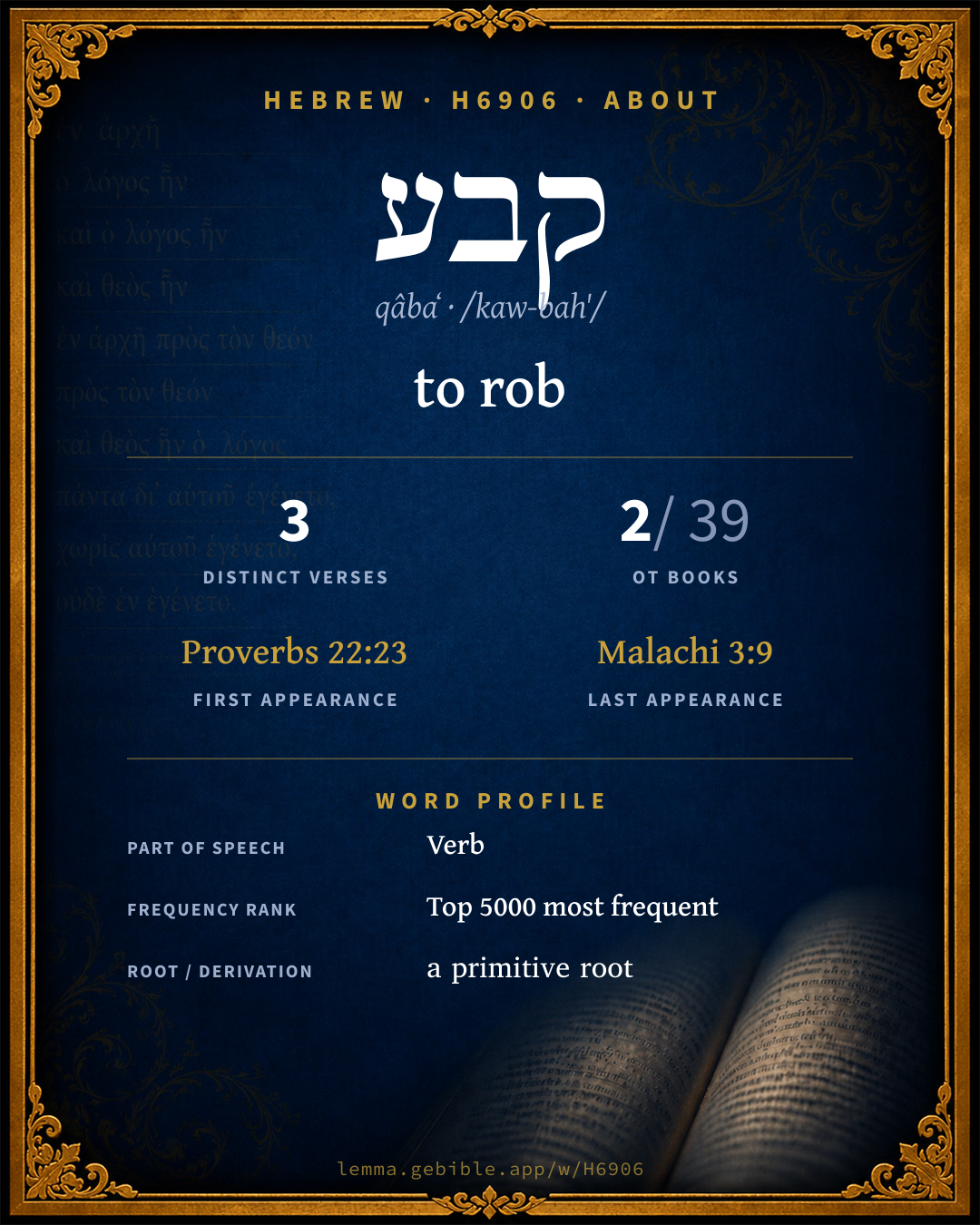
קָבַע
to rob
‘to rob’ is one of 2 main senses fuller range ↓
Full lexicon entry — Brown-Driver-Briggs (BDB)
From Brown-Driver-Briggs (BDB)
Where this word appears
Grammar key — what these labels mean
Part of speech
- Verb
- An action or state-of-being word.
Stem
- Qal
- The basic, simple active stem — the plain form of the verb (“he wrote”).
Form
- Participle Active
- A verbal adjective expressing ongoing or characteristic action (“writing / one who writes”).
- Sequential Perfect
- A perfect with prefixed waw continuing a preceding imperfect or command (waw-consecutive perfect).
- Imperfect
- An incomplete, ongoing, or future action (“he will / would write”).
- Perfect
- A completed action or state — Hebrew marks aspect (completeness) more than strict tense (“he wrote”).
State
- Absolute
- The independent form of a noun, not bound to a following word.
- Construct
- A noun bound to a following noun in a possessive / “of” relationship (the construct chain).
Person
- 3rd Person
- The one spoken about (“he / she / it / they”).
- 1st Person
- The speaker (“I / we”).
Gender
- Masculine
- Grammatically masculine.
- Common
- Either gender — not distinguished for this form.
Number
- Plural
- More than one (in Hebrew, generally three or more).
- Singular
- One.
Every verse where H6906 appears in the Book of Malachi — 2 distinct verses. Click any verse to open its interlinear word-by-word view. Verse text shown in the World English Bible for context — . Each verse’s Hebrew form is shown with its reference; the English is not keyword-highlighted, since the data carries no word-level English alignment. Use “Compare translations” on any verse to read it across multiple English versions. This concordance covers the Hebrew Bible; Septuagint (Greek Old Testament) occurrences are not indexed here.
Malachi
- Malachi 3:8 הֲ/יִקְבַּ֨ע קֹבְעִ֣ים קְבַעֲנ֑וּ/ךָ ptcl inter + Qal impf 3ms Qal ptcp.act mp Qal pf 1cp + sfx pers 2ms Will a man rob God? Yet you rob me! But you say, 'How have we robbed you?' In tithes and offerings.
- Malachi 3:9 קֹבְעִ֑ים Qal ptcp.act mp You are cursed with the curse; for you rob me, even this whole nation.
About this entry
At a glance — auto-summarized from this page’s data, not written by a person. Every figure links to its source below. This summary describes the numbers; it doesn’t interpret them.
קבע (qâbaʻ) is a Hebrew verb most often rendered “to rob.” A scarce word — 3 verses in all of the Hebrew Bible. It clusters heavily in Malachi, which alone accounts for 67% of its uses. Scripture first uses it in Proverbs 22:23. Ranging over 2 senses, it is not a single-sense word. For the data behind this summary, explore the sense tree and the renderings breakdown below.
Gloss history
Strong's 1890 vs modern scholarship
About this word
Strong's H6906 catalogs a Hebrew word from the Hebrew Old Testament.
These counts are not copied from any lexicon or concordance. They are computed here, from the morphology-tagged Hebrew Old Testament. What Lemma adds →
- 3
- distinct verses
- The word appears in 3 distinct verses.
- 2 / 39
- OT books
- The word appears in 2 of 39 Old Testament books.
- #3,040
- by frequency
- Top 5000 most frequent Hebrew words (rank 3,040 of 8,640 Hebrew words by occurrence).
View all 3 occurrences in the concordance →
By traditional corpus
Conventional, traditional groupings — biblical authorship is debated, so this is a traditional corpus grouping, not an authorship claim. Each share is this word’s portion of its verses in that division of the Hebrew canon. Each figure is a share of the word’s 3 distinct verses.
- Prophets (Nevi'im) 2 verses · 67%
- Writings (Ketuvim) 1 verse · 33%
How translations render this word
Counts come from each version’s own published word-to-Strong’s tagging or interlinear alignment — an approximate guide to how each version renders this word, not a word-level alignment the data otherwise carries. Because each total is that version’s own tagged count, the per-version totals vary from one another and need not match the appearance or distinct-verse counts above. These counts may also differ from a printed concordance because Lemma counts each distinctly tagged rendering and does not collapse phrase taggings into a single head-word total. This is a fixed set of word-tagged versions (KJV, ASV, BSB, ULT) and does not change with the reading translation you choose elsewhere. Each version’s license is shown beside its name below (and on Sources).
- King James Version: Ye have robbed 2×
- American Standard Version: Ye rob 2×
- Berean Standard Bible: Are robbing 1×, Are still robbing me 1×, Do we rob you 1×
- unfoldingWord Literal Text: Are robbing 2×
King James Version Public Domain
Renders H6906 across 6 tagged occurrences — most commonly:
Plus 4 renderings that appear only once — usually multi-word phrases or single function words the recovered tagging swept in, not distinct renderings.
American Standard Version Public Domain
Renders H6906 across 6 tagged occurrences — most commonly:
Plus 4 renderings that appear only once — usually multi-word phrases or single function words the recovered tagging swept in, not distinct renderings.
Berean Standard Bible Public Domain
Renders H6906 across 6 tagged occurrences — most commonly:
unfoldingWord Literal Text CC BY-SA 4.0
Renders H6906 across 7 tagged occurrences — most commonly:
Plus 5 renderings that appear only once — usually multi-word phrases or single function words the recovered tagging swept in, not distinct renderings.
Senses in BDB
The 2 senses BDB distinguishes for this word, in lexicon order (not ranked by frequency or importance). The full entry — with sub-senses — is in the Lexicon Entry tab.
- (Qal) to rob
- meaning dubious
Word origin
קָבַע vb. dub., perhaps rob
— Brown-Driver-Briggs (Oxford 1906, public domain), digitized via Sefaria, supplemented by the OpenScriptures HebrewLexicon (CC BY 4.0). See Sources.
Origin: a primitive root
Jastrow Dictionary
A second Hebrew/Aramaic lexicon for comparison, covering Aramaic and post-biblical (Talmudic, Targumic, Midrashic) usage that the biblical-Hebrew BDB does not. Matched by lemma rather than by Strong’s number, so a lemma may carry more than one Jastrow headword (shown separately below), and the entries cover usage well beyond the Bible.
קָבַע I
- (b. h.) [to cover, press,]
- 1. to overpower, rob. Tanḥ. T’rumah 9 (ref. to Mal. III, 8) לשון ערבי … מה אתה קוֹבְעֵנִי it is an Arabic expression; when an Arab argues with his neighbor and wants to say, why wilt thou rob me?, he says, why art thou ḳob’ʿeni?; Yalk. Mal. 587 (read גוזלני for גמלני). e.g. Malachi 3:8
- 2. to prevent. Yad. IV, 3 קוֹבֵעַ אתה … מלהוריד וכ׳ (by allowing the priests’ share to be given to the poor) thou preventest the heaven from sending down dew and rain.
קְבַע
- R. Hash. 26ᵃ sq. a man came to Levi and said קַבְעַן פלניא וכ׳ that man is a ḳabʿan, and he (Levi) did not know what it meant; (on asking at college, he was told) גזלן פלניא וכ׳ it means that man is a robber &c. (ref. to Mal. III, 8 היקבע). Ib. אי הוינא … היכי קַבְעָךְ במאי קבעך ואמאי קבעך had I been there, I should have said to the man (using the same expression), how did he ḳ’bʿa thee?, wherewith?, and wherefore?, and thus I should have found out what it meant. e.g. Malachi 3:8
קָבַע II
- (preced.) [to squeeze in, make a hole,]
- 1. to insert, drive in; to fix. B. Bath. 7ᵇ קְבַע וכ׳, v. מַסְמָר. Tanḥ. B’haʿal. 15 (ref. to Koh. XII, 11 משמרות) אם קָבַעְתָּ אותם כמ̇ס̇מ̇ר̇ בלבך הן מ̇ש̇מ̇ר̇ין אותך if thou hast driven them (the words of the Law) like a nail into thy heart, they will guard thee. Lev. R. s. 5 (ref. to Is. XXII, 16) אפי׳ איזה מסמר קבעת כאן what nail hast thou driven into it (to acquire ownership)? Tosef. Kel. B. Mets. X, 6 אע"פ שקְבָעָן וכ׳ (not שקבאן) although he fastened them with nails; a. fr.—Part. pass. קָבוּעַ; f. קְבוּעָה &c. Ib. צריך אדם … יתד ק׳ וכ׳ a man ought to have a nail or a peg fixed in the burial ground so as to take possession and be sure to be buried in the designated place. Y. Maas. Sh. V, beg. 55ᵈ אבן ק׳ a stone affixed to the ground, stationary, opp. תלושה; a. fr.—Trnsf. to fix, appoint, make permanent. Ber. 6ᵇ כל הקוֹבֵעַ מקום וכ׳ he who designates a certain place where to pray regularly; ib. 7ᵇ. Sabb. 31ᵇ קָבַעְתָּ וכ׳, v. עֵת. Meg. 7ᵃ בתחלה קְבָעוּהָ וכ׳ at first they instituted the feast of Purim for Shushan, and afterwards for the whole world. Ib. שלחה … קִבְעוּנִי לדורות Esther sent word to the scholars, Appoint my memory to be celebrated for all generations. Ab. III, 2 הקב"ה קובע לו שכר the Lord will determine his reward. Bets. 20ᵃ בקשו לִקְבּוֹעַ הלכה וכ׳ they attempted (by vote) to establish the law in agreement with their opinion; Tosef. Ḥag. II, 11; a. fr.—Part. pass. as ab. Tosef. Ab. Zar. I, 1 אידין הקְבוּעִין regular (annual) festivals. Ab. Zar. 11ᵇ חמשה בתי ע"ז ק׳ הן five idolatrous temples (and the fairs connected therewith) are permanent; expl. ib. לעולם תדירא וכ׳ permanent, regular, and all the year through &c. B. Bath. l. c. הלכות קְבוּעוֹת הן they are established laws; a. fr. e.g. Ecclesiastes 12:11
- 2. (denom. of קֶבַע) to impart the character of a regular appointed meal. Bets. 34ᵇ שבת מהו שתִּקְבַּע מוקצה למעשר does the Sabbath give, to fruit not yet ready for regular use, the character of an appointed meal with reference to the duty of tithing (so that you dare not eat of them on the Sabbath even as a luncheon, אכילת עראי)? Ib. שבת קוֹבַעַת וכ׳ the Sabbath gives that character, whether the food you partake of be sufficiently ready for consumption or not. Pes. 105ᵃ כשם שהשבת … קובעת לקידוש as the Sabbath makes every meal an appointed one with regard to tithes, so does it with reference to Ḳiddush (that you dare not taste anything before reciting the Ḳiddush, v. קִידּוּשׁ). Ib. קָבְעָה להבדלה the exit of the Sabbath makes every meal an appointed one as regards the Habdalah (v. הַבְדָּלָה); a. fr.
- to wedge in, set. Sabb. 67ᵇ המְקַבַּעַת Rashi Var., v. בָּקַע.—Part. pass. מְקוּבַּע; f. מְקוּבַּעַת. Num. R. s. 12 כעטרה הזאת שמק׳ באבנים וכ׳ like the royal crown which is beset with precious stones and pearls.
- to be appointed, established. Tosef. Ḥag. II, 11 נִקְבְּעָה הלכה כדברי וכ׳ the law was established (by vote) in accordance with the opinion of &c.; (Bets. 20ᵇ וקבעו וכ׳). Y. Yoma V, beg. 42ᵇ שאין … נִקְבָּעִין אלא וכ׳ congregational sacrifices are designated as such only by the act of slaughtering. Ḥall. IV, 11 שלא יִקָּבַע הרבר חובה that this usage may not become an established obligation; a. e.
קְבַע ²
- 1. to stick into, fix. Targ. I Sam. II, 14. Ib. XIX, 10. Targ. Y. Ex. XXV, 7; a. e.—Part. pass. קָבִיעַ; f. קְבִיעָא &c. Targ. Y. Gen. XXVIII, 12. Targ. Y. II, Ex. XX, 21. Targ. Cant. IV, 9 (engraven); a. e.—Y. Ḥag. III, 78ᵈ, v. מַסְמְרָא. Y. Pes. V, 32ᵇ top; Y. Yeb. XIII, 13ᶜ top; v. מַסְמְרָא; a. e.
- 2. to fix, appoint, establish. Targ. Y. II, Deut. XXXII, 8. Targ. Y. Ex. XII, 2; a. fr.—Part. pass. as ab. Ib. 3; a. e.—Ab. Zar. 11ᵇ חגתא … דלא קביעא an Arabian fair which has no fixed date. Ber. 43ᵇ, v. עִידָּנָא; a. e.—Ker. 18ᵃ, v. infra.
- 3. to impart the character of an appointed meal. Pes. 105ᵃ נפסיק ונִקְבְּעֵיה לשבתא let us interrupt our meal, and (resuming it) appoint it as a Sabbath meal; לא … שבתא קָבְעָה נפשה you need not interrupt your meal, the Sabbath itself makes it an appointed meal. Bets. 34ᵇ כיון דאמר … ק׳ ליה עילויה as soon as he says, ‘from here I will take to eat to-morrow’, he makes it an appointment (and it is subject to tithes); a. e.
- to set, garnish with.—Part. pass. מְקַבַּע; pl. מְקַבְּעִין. Targ. Y. I Deut. XXXIII, 21 מ׳ אבנין וכ׳ (not מִקְבַּע) beset with precious stones; Y. II מקבעין אבנין וכ׳ precious stones are set (in it). Targ. Esth. VIII, 15. Targ. II Esth. I, 2 מְקוּבַּע, מְקוּבָּעִין some eds. (Hebr. forms).
- same, to set, fasten. B. Bath. 6ᵃ אַקְבּוּעֵי Ms. R. a. Rashi, v. קַבְעָתָא.
- to be appointed, established. Targ. Y. Num. XIV, 1.—Ker. 18ᵃ שתי חתיכות א׳ איסורא לא קבעה וכ׳ where there are two pieces (one forbidden and one permitted) the presence of a prohibited element is established; one piece (of doubtful quality) does not establish the presence of a prohibited thing; Naz. 23ᵃ. Sabb. 86ᵇ, sq., v. יַרְחָא; a. e.
קֶבַע
- (preced.) appointment, permanency, institution; regular, perfunctory act. Y. Ber. II, 4ᶜ bot. אכילת ק׳ a regular meal; שינת ק׳ a regular sleep, v. עַרְאַי. Yoma 10ᵇ, v. דִּירָה I. Ber. IV, 1 תפלת … אין לה ק׳ for the evening prayer there is no fixed law, expl. ib. 27ᵇ רשות it is optional. Ib. IV, 4 העושה … ק׳ וכ׳ the prayer of one who treats it as a perfunctory obligation, is not a means of grace. Ab. II, 13 אל … ק׳ אלא רחמים וכ׳ make not thy prayer a perfunctory act, but a means of mercy and grace. Ib. I, 15 עשה תורתך ק׳ make thy study of the Law a regular engagement. Num. R. s. 2, beg. משם … ק׳ שמתפללים וכ׳ from this the institution of three daily prayers is derived; a. fr.
A Dictionary of the Targumim, the Talmud Babli and Yerushalmi, and the Midrashic Literature (Marcus Jastrow; London, Luzac, 1903) — Public Domain. Digitized via Sefaria. Digitized via Sefaria. Full attribution on Sources.
Forms in the corpus
The 6 distinct written forms H6906 takes in the Hebrew Bible, most frequent first — each parse links to that stem’s occurrences in the concordance. Hebrew forms include their vowel points and cantillation, so a single lemma takes many written forms.
| Form | Parsing | Example | Uses |
|---|---|---|---|
| הֲ/יִקְבַּ֨ע | Verb, Qal, Imperfect, 3rd Person, Masculine, Singular | Malachi 3:8 | 1 |
| וְ/קָבַ֖ע | Verb, Qal, Sequential Perfect, 3rd Person, Masculine, Singular | Proverbs 22:23 | 1 |
| קְבַעֲנ֑וּ/ךָ | Verb, Qal, Perfect, 1st Person, Common, Plural | Malachi 3:8 | 1 |
| קֹבְעִ֑ים | Verb, Qal, Participle Active, Masculine, Plural, Absolute | Malachi 3:9 | 1 |
| קֹבְעִ֣ים | Verb, Qal, Participle Active, Masculine, Plural, Absolute | Malachi 3:8 | 1 |
| קֹבְעֵי/הֶ֣ם | Verb, Qal, Participle Active, Masculine, Plural, Construct | Proverbs 22:23 | 1 |
Same root — word family
Other BDB entries built from the same root as H6906, grouped by Strong’s listed origin. These share a root / origin per the lexicon — not necessarily a shared meaning. Each links to that word’s own entry.
Derived from this word
Compare all same-root words → They share a root, not necessarily a meaning.
Septuagint verse parallels
This word appears in 3 verses that also exist in the Greek Old Testament (Septuagint), out of the 3 Hebrew verses it occurs in. You can read those verses in Greek by switching the Old Testament edition to the Septuagint.
Read these verses in the Septuagint
This is a verse-level parallel only — the same verses exist in both the Hebrew and Greek Old Testaments. No word-level Hebrew↔Greek correspondence is claimed: the data carries no such alignment, so no Greek word is shown as this Hebrew word’s translation. Coverage is not total — the Septuagint omits the deuterocanon and renumbers the Psalms, so some Hebrew verses have no direct Greek parallel.