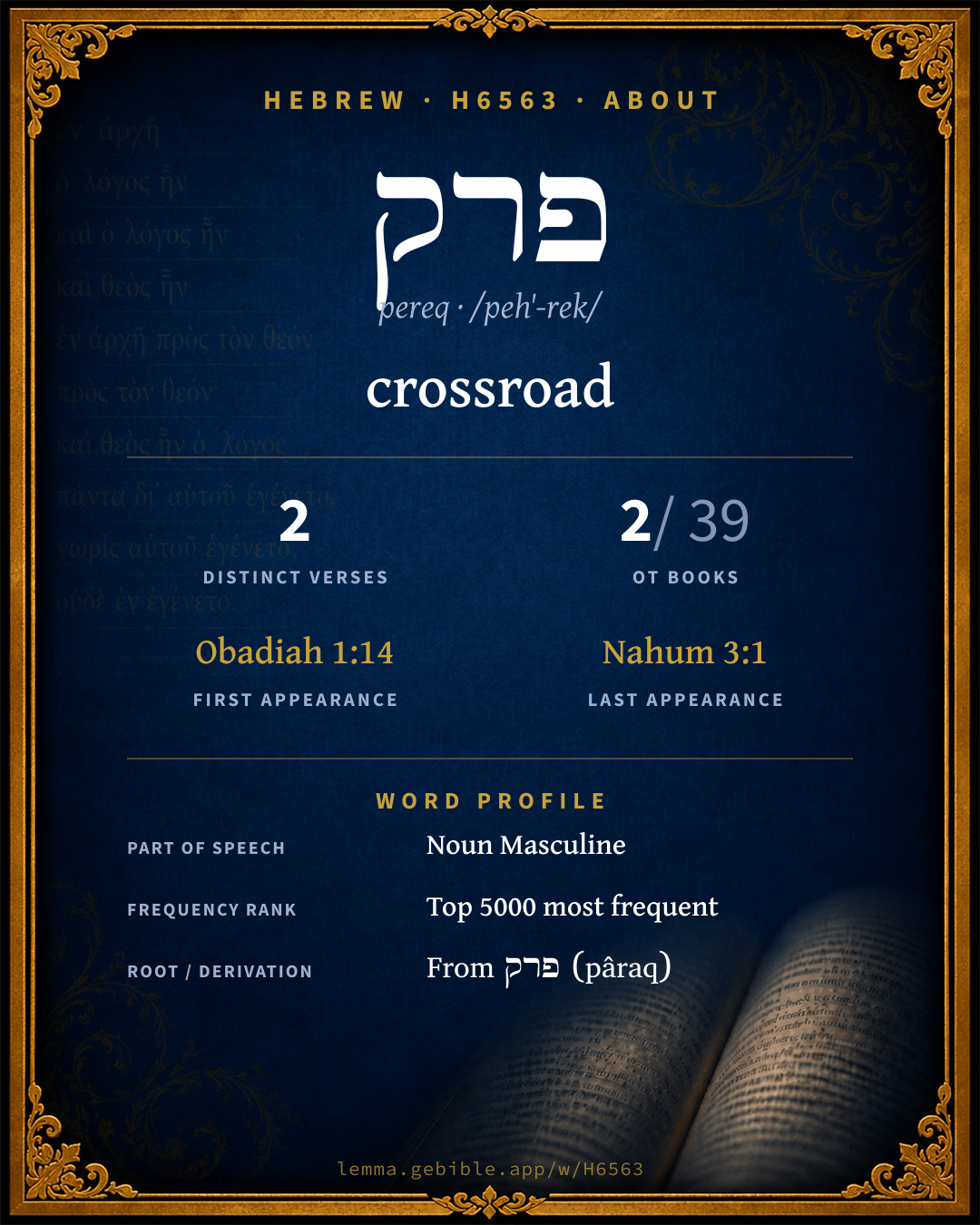
פֶּ֫רֶק
crossroad
Full lexicon entry — Brown-Driver-Briggs (BDB)
From Brown-Driver-Briggs (BDB)
Where this word appears
Grammar key — what these labels mean
Part of speech
- Noun
- A naming word — a person, place, thing, or idea.
Noun type
- Common
- A common noun — a general class of person, place, or thing (“king,” “city,” “water”), not a specific name.
State
- Absolute
- The independent form of a noun, not bound to a following word.
Gender
- Masculine
- Grammatically masculine.
Number
- Singular
- One.
Every verse where H6563 appears in the Book of Obadiah — 1 distinct verse. Click any verse to open its interlinear word-by-word view. Verse text shown in the World English Bible for context — . Each verse’s Hebrew form is shown with its reference; the English is not keyword-highlighted, since the data carries no word-level English alignment. Use “Compare translations” on any verse to read it across multiple English versions. This concordance covers the Hebrew Bible; Septuagint (Greek Old Testament) occurrences are not indexed here.
Obadiah
About this entry
At a glance — auto-summarized from this page’s data, not written by a person. Every figure links to its source below. This summary describes the numbers; it doesn’t interpret them.
“crossroad” is the headline sense of the Hebrew noun פרק (pereq). A scarce word — 2 verses in all of the Hebrew Bible. It clusters heavily in Obadiah, which alone accounts for 50% of its uses. Scripture first uses it in Obadiah 1:14. From the same root come פרק, מפרקת and פרק. See the sense tree, 2-verse concordance, and the renderings breakdown below.
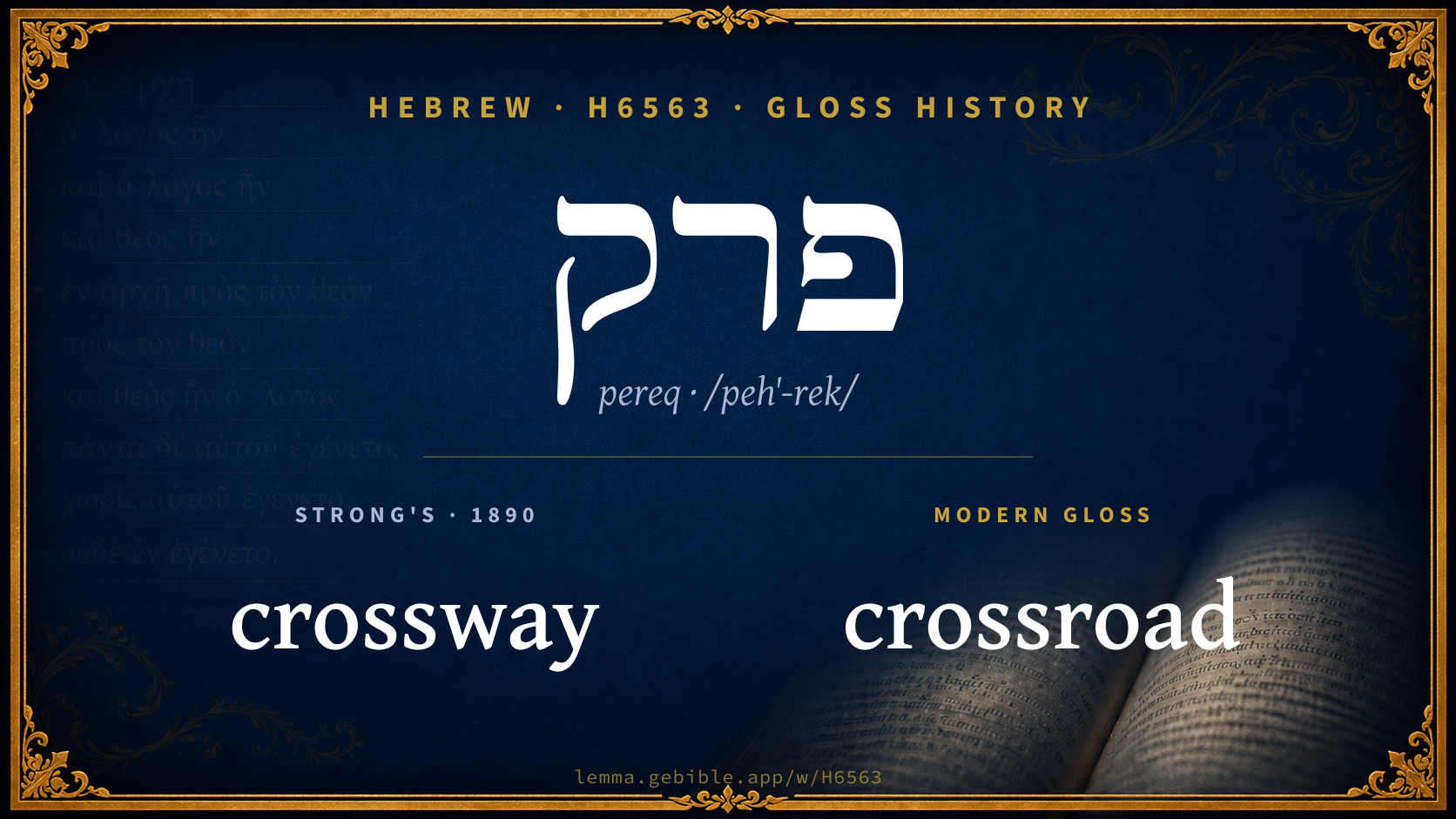
Gloss history
Strong's 1890 vs modern scholarship
About this word
Strong's H6563 catalogs a Hebrew word from the Hebrew Old Testament.
These counts are not copied from any lexicon or concordance. They are computed here, from the morphology-tagged Hebrew Old Testament. What Lemma adds →
- 2
- distinct verses
- The word appears in 2 distinct verses.
- 2 / 39
- OT books
- The word appears in 2 of 39 Old Testament books.
- #4,807
- by frequency
- Top 5000 most frequent Hebrew words (rank 4,807 of 8,640 Hebrew words by occurrence).
View all 2 occurrences in the concordance →
By traditional corpus
Conventional, traditional groupings — biblical authorship is debated, so this is a traditional corpus grouping, not an authorship claim. Each share is this word’s portion of its verses in that division of the Hebrew canon. Each figure is a share of the word’s 2 distinct verses.
- Prophets (Nevi'im) 2 verses · 100%
How translations render this word
Counts come from each version’s own published word-to-Strong’s tagging or interlinear alignment — an approximate guide to how each version renders this word, not a word-level alignment the data otherwise carries. Because each total is that version’s own tagged count, the per-version totals vary from one another and need not match the appearance or distinct-verse counts above. These counts may also differ from a printed concordance because Lemma counts each distinctly tagged rendering and does not collapse phrase taggings into a single head-word total. This is a fixed set of word-tagged versions (KJV, ASV, BSB, ULT) and does not change with the reading translation you choose elsewhere. Each version’s license is shown beside its name below (and on Sources).
- King James Version: Crossway 1×, Robbery 1×
- American Standard Version: Rapine 1×, Thou not in the crossway 1×
- Berean Standard Bible: Crossroads 1×, Plunder 1×
- unfoldingWord Literal Text: Crossroads 1×, Plunder 1×
King James Version Public Domain
Renders H6563 across 2 tagged occurrences — most commonly:
American Standard Version Public Domain
Renders H6563 across 2 tagged occurrences — most commonly:
Berean Standard Bible Public Domain
Renders H6563 across 2 tagged occurrences — most commonly:
unfoldingWord Literal Text CC BY-SA 4.0
Renders H6563 across 2 tagged occurrences — most commonly:
Senses in the full BDB
What do BDB’s symbols mean?
BDB uses these scholarly abbreviations:
| Symbol | Meaning |
|---|---|
| 𝔊 | the Septuagint (the ancient Greek translation, LXX) |
| 𝔙 | the Vulgate (the Latin translation) |
| 𝔖 | the Syriac version (the Peshitta) |
| 𝔗 | the Targum (the Aramaic translation) |
| ψ | the Psalms |
| √ | root (the underlying root or stem) |
| ‖ | parallel passage (a synonymous or contrasted parallel) |
| † | the dagger: every passage where the word occurs is cited |
The 2 senses and sub-senses the full Brown-Driver-Briggs lexicon distinguishes for this word, in lexicon order (not ranked by frequency), with BDB’s own verbatim wording and sub-sense lettering. Shown in Hebrew script with BDB’s own scholarly abbreviations. The condensed entry is in the Lexicon Entry tab. See also the Forms in the corpus table below.
- 1. parting of ways, Ob 14. e.g. Obadiah 1:14
- 2. plunder (as snatched away), Na 3:1. e.g. Nahum 3:1
Senses from the full Brown-Driver-Briggs lexicon (Brown, Driver, Briggs; Oxford 1906 — public domain), digitized via Sefaria, supplemented by the OpenScriptures HebrewLexicon (CC BY 4.0). Full attribution on Sources.
Word origin
Derived from פרק (pâraq) (H6561) — to tear away.
Jastrow Dictionary
A second Hebrew/Aramaic lexicon for comparison, covering Aramaic and post-biblical (Talmudic, Targumic, Midrashic) usage that the biblical-Hebrew BDB does not. Matched by lemma rather than by Strong’s number, so a lemma may carry more than one Jastrow headword (shown separately below), and the entries cover usage well beyond the Bible.
פָּרַק
- (b. h.) to break, separate; to untie, loosen; to unload. Sabb. 138ᵃ וילון … ומותר לפוֹרְקוֹ it is permitted (on the Sabbath) to stretch a curtain and also to untie (remove) it. Ib.ᵇ top. Y. Shebi. III, beg. 34ᶜ לא יִפְרוֹק וכ׳, v. מִשְׁפֶּלֶת. [Ib. לא יַפְרִיק Hif., v. infra.] Cant. R. to I, 5 טוענת ופוֹרֶקֶת she loads (becomes pregnant) and unloads (delivers); a. fr.—Trnsf. to redeem, deliver. Gen. R. s. 44 אני פוֹרְקָן I shall redeem them; a. e.—פ׳ עול to untie the yoke, cast off an obligation. Ab. III, 5, v. עוֹל. Tosef. Sot. XIV, 4 פָּרְקוּ מהם עול וכ׳ they cast off the heavenly yoke, and made flesh and blood rule over them; a. fr.—Tanḥ. Ḥuck. 25 אינן פּוֹרְקִין יראה they do not cast off the fear (of having lost the divine grace through their sins); Yalk. Num. 765 אין פורקין יראה מהם; Num. R. s. 19 אין פּוֹרְקִים ביראה (corr. acc.).—Part. pass. פָּרוּק; f. פְּרוּקָה; pl. פְּרוּקִים, פְּרוּקִין; פְּרוּקוֹת. Y. B. Kam. III, 3ᵈ אחד פ׳ ואחד טעון וכ׳ if (on meeting on the road) one animal is without a load, and the other is laden, the unladen must make room for the laden; היו שניהן … פ׳ if both are laden or both unladen. Ib. שתיהן פ׳ if both wagons are without a load; a. fr.—Esp. to help to unload an animal broken down under its burden (Ex. XXIII, 5). B. Mets. II, 10 מצוה … לִפְרוֹק, v. טָעַן II. Ib. אם רצונך לפרוק פְּרוֹק if thou desirest to unload, do so (without my assistance); a. fr. e.g. Exodus 23:5
- to sever, strip; to take off, release; to take apart. Shebi. II, 2 מְפָרְקִין you may release (trees in the Sabbatical year); Y. ib. 33ᵈ top מפ׳ בעלין ‘release’ refers to (a too luxuriant growth of) leaves. Ukts. II, 5 התחיל לְפָרֵק when he has begun to strip (vegetables). Tosef. ib. II, 13 התחיל לפרק באגוזים when he has begun to strip nuts (of their burrs). Sabb. 88ᵃ ירדו … ופֵירְקוּם one hundred and twenty myriads of angels of destruction came down and took them (the crowns) off their heads. Ib. בחורב … פֵּרְקוּ (Rashi פירקו) at Horeb they loaded (angels put crowns on their heads), and at Horeb they unloaded (angels took their crowns off). Men. 8ᵃ; 9ᵇ עד שלא פֵרְקָהּ before he took it (the pile of the show bread) apart. Y. Yoma I, 38ᶜ top מעמירו ומְפָרְקוֹ put it (the Tabernacle) up and broke it up again; העמידו ולא פירקו put it up and did not break it up again; Num. R. s. 13, beg.; Sifra Tsav, Milluim, Par. 1 end.—Y. M. Kat. I, 80ᵇ bot. מְפָרְקִין את המנעול וכ׳ you may take the shoe off the block. Y. Ab. Zar. III, 43ᵇ, v. פַּצִּים; a. fr.—Sabb. 95ᵃ חולב חייב משום מפרק one milking (on the Sabbath) is guilty of an act resembling unloading; Keth. 60ᵃ יונק מפרק כלאחר יד releasing the cow by sucking is unloading in an unusual way (v. אַחַר). Lev. R. s. 13 עמד ופֵרְקוּם לישראל he rose and took them off the back of the gentiles, and put them on Israel.—Sabb. 156ᵃ לְפָרֵק to take food from before one animal and place it before another, Rashi; [Tosaf.: to empty from vessel to vessel in order to procure a thorough mixture; other defin., v. Ar. s. v.].—Part. pass. מְפוֹרָק a) unloaded. B. Mets. 33ᵃ (ref. to Ex. l. c.) ‘under its burden’, ולא מפ׳ but not when it is unloaded (and the owner requires assistance to load it again). Ib. לא מפ׳ בחנם when it is unloaded, one need not assist in loading without remuneration.—b) taken apart, broken up. Tanḥ. P’kudé 11 והיה מונח ומפ׳ וכ׳ and it (the Tabernacle) lay in parts (uncombined) during &c.
- 1. to be taken apart, broken up. Y. Yoma l. c. Sabb. XVII, 1 אע"פ שנִתְפָּרְקוּ although the doors are detached (when the piece of furniture is moved). Tosef. Kel. B. Mets. III, 2 נִתְפָּרְקָה זו וכ׳ ed. Zuck. (missing in eds.) if the blades of scissors are separated, each may become unclean for itself; a. fr.—Gen. R. s. 36 (ref. to Gen. IX, 24) נתפ׳ יינו מעליו the load of his wine was taken from him (he became sober). e.g. Genesis 9:24
- 2. to be loose, movable like a link or joint (v. פֶּרֶק). Yoma 72ᵃ מִתְפָּרְקִין ואין וכ׳ they (the bars in the ring) were movable but could not slip off. Nidd. 9ᵃ (of a woman after confinement) איבריה מתפרקין וכ׳ her limbs are loose (shaky), and her full strength does not return to her before &c.; Bekh. 6ᵇ איבריה מתפרקין הימנה she feels as tho’ her limbs were dropping off. Yalk. Num. 708 תהא מִתְפָּרֶקֶת איברים איברים she shall lose limb after limb; Num. R. s. 9 מתרפקת (corr. acc.); a. e.—[Yalk. Cant. 986 מתפרקות some ed., read: מתרפקות, v. רָפַק.]
- (denom. of פֶּרֶק)
- 1. to be out of joint, dislocated, sprained. Sabb. XXII, 6 מי שנִפְרְקָה ידו וכ׳ he who sprained his arm or foot.
- 2. to be removed. Tosef. ib. XIII (XIV), 5 שיִפָּרְקוּ ed. Zuck. (Var. שימחו) that they be removed (cut out).—[Hif. הִפְרִיק as Kal and Pi. Tosef. Ber. II, 7 שיַפְרִיק ed. Zuck. (Var. שיְפָרֵק). Y. Shebi. III, beg. 34ᶜ, v. supra; prob. to be read: יְפָרֵיק.]
פְּרַק
- 1. to separate, remove, take off. Targ. Ex. XXXII, 2 sq. (O. ed. Berl. Pa.). Targ. Y. Num. IV, 5 (O. Pa.); a. fr.—V. פְּרִיקָא II.—
- *2. to fall apart. B. Mets. 86ᵃ פ׳ אשיתא the frame wall fell apart (v., however, infra).
- 3. to untie; to redeem, deliver. Targ. Ex. XXI, 8 (O. ed. Amst. וְיַפְרְ׳, read: וְיִ׳). Targ. Lev. XXVII, 13. Targ. Ps. XXXIV, 23 פָּרֵיק Ms. (ed. פרוק, corr. acc.); a. fr.—Part. pass. פָּרִיק; f. פְּרִיקָא; pl. פְּרִיקִין, פְּרִיקַיָּא; פְּרִיקָן. Targ. Y. Lev. XXV, 42; 55. Targ. Is. XXXV, 9; a. fr.—Keth. IV, 8 (in a marriage contract) אם תשתבאי אֶפְרְקִינָךְ if thou art captured, I shall redeem thee; ib. 51ᵇ. Ib. 47ᵃ מימנע ולא פָרֵיק he might refuse to redeem her. Y. Maas. Sh. IV, 55ᵃ bot. אֶפְרוֹק לך וכ׳ I will redeem it for thee with this Sela; a. fr.
- 1. to remove, take off. Targ. O. Ex. XXXII, 2; a. fr.; v. supra.—Trnsf. to alienate. Targ. Prov. XVII, 9 (h. text מפריד; ib. XVI, 28 מעריק).
- 2. to divide, split, strip. Targ. O. Lev. I, 17. Targ. Y. II, Deut. XXXIII, 20 (some ed. מַפְרַק, corr. acc.). Targ. I Kings XIX, 11; a. e.—Ḥull. 93ᵃ, v. infra.
- 3. [to break,] to solve a problem; to reply, opp. אקשי. B. Mets. 84ᵃ מְפָרִיקְנָא וכ׳, v. פֵּירוּקָא. Sabb. 145ᵃ הוא מותיב … מְפָרֵק לה he raise an objection, and himself answered it. Ab. Zar. 50ᵇ דִּיפָרְקִינָהּ, v. נַגָּרָא; a. fr.
- 4. to redeem. Y. Maas. Sh. IV, 54ᵈ מְפָרֵק על פומיה redeems according to his estimation; a. fr.
- to cause a falling off of limbs. Gitt. 69ᵇ דמַפְרִיק because it causes &c.
- 1. to be broken, fall apart. Ber. 54ᵃ אִתְפָּרְקָא ליה אשיתא וכ׳ (v. supra) the frame wall fell apart before him, and he went in.
- 2. to be redeemed, released, delivered. Targ. Lev. XIX, 20. Targ. Ps. XXXIII, 16; a. fr.—Yalk. Esth. 1046 כיון … ולא אִיפְּרִיקוּ … לא מִיפְּרִיקוּ when he (Ahasver) saw that the seventy years were full, and they were not delivered, he thought, since they are not now delivered, they will never be delivered; Meg. 11ᵇ אִיתְפְּרוּק … מִיפָּרְקֵי Ms. M. (v. Rabb. D. S. a. l. note); a. e.
- 3. to be out of joint, dislocated. Ḥull. 93ᵃ בהמה … פָּרוּקֵי מִפָּרְקָא (or מְפָרְקָא part. pass. Pa.) an animal while alive makes movements by which the limbs are temporarily dislocated.
פֶּרֶק
- preced.) [division, section; (b. h.) cross-road,]
- 1. period (of time), period of maturity, season. Keth. 59ᵇ סמוך לפִירְקָהּ near her period of puberty. Y. Yeb. XIII, 13ᵈ bot. עד שתגדיל ותגיע לפ׳ וכ׳ until she be grown up and arrive at a marriageable age and be married. Taan. 16ᵃ ופִרְקוֹ נאה whose youth is becoming, expl. ib. 16ᵇ שלא יצא וכ׳ whose youth is of unblemished repute; Tosef. Ḥag. II, 9 ופרקו טוב Var. (ed. Zuck. ופרק). Pes. 117ᵃ על כל פ׳ ופ׳ at every important epoch. Ib. 43ᵃ top שהגיעו לפִרְקָן וכ׳ who have reached puberty but not the legal age (prematurely developed). Tosef. R. Hash. I, 12 פ׳ שעורים the season of the barley crop; פ׳ גשמים the rainy season. Deut. R. s. 9 הגיע פרקו ליטול וכ׳ his (the child’s) time has come to be taken away (he is destined to die) at the age of thirty days. Ib. הראה לי את פִּרְקִי show me my time (when I am to die); a. fr.—Pl. פְּרָקִים; constr. פִּרְקֵי, פִּי׳. R. Hash. 35ᵃ ברכות … ושל פ׳ prayers for the New Year, the Day of Atonement and periodical prayers (for feasts, fasts &c.). Ib. כיון … כפ׳ רמי as he prayed only once in thirty days, it was to him like a periodical prayer. Shek. III, 1 בשלשה פ׳ at three periods of the year. Y. Shebi. I, beg. 33ᵃ שני פ׳ הראשונים the two beginning periods (shortly before the beginning of the Sabbatical year, and before the beginning of the new Sabbatical period); ib. III, end, 34ᵈ. Y. Shek. III, beg. 47ᵇ פירקי לידה the seasons when animals give birth. Gen. R. s. 70, a. e. נשיקה של פ׳ the kiss on meeting after a period of separation; a. fr.
- 2. (of writings) section, chapter. R. Hash. 30ᵇ מפני שחוזר וכופל את הפ׳ because in that case he would have to recite the same psalm again on the same day. Ber. 14ᵃ בין פ׳ לפ׳ פוסק וכ׳ between one section (of the Hallel) and another he may interrupt himself, but in the middle of a section he must not do so. Ab. VI הלומד … פ׳ אחד וכ׳ he that learns from his neighbor one chapter or one halakhah. Erub. 54ᵇ ושנה לו משה פִּירְקוֹ Moses taught him (Aaron) his lesson; ושנה להם … פִּירְקָן taught them their lesson; a. v. fr.—Pl. as ab. Ber. II, 1 בפ׳ שואל וכ׳ between the sections (of the Sh’mʿa) one may interrupt one’s self to extend a greeting &c. Ib. 2 אלו הן בין הפ׳ these are the pauses between the sections: between the first and the second benediction (preceding the Sh’mʿa) &c. Ḥag. 13ᵃ ראשי פ׳ the headings of chapters (or subjects, leading words). R. Hash. 31ᵃ מה ראה ר"ע לחלק בין הפ׳ הללו Ms. M. (ed. ראו חכמים) what reason had R. ʿA. to make a distinction between these psalms (by referring six of them to past events and the seventh to the hereafter)?; a. fr.
- 3. link, limb, joint. Ḥull. 106ᵃ sq. נטילת ידים לחולין עד הפ׳ וכ׳ washing of hands for secular food must be done up to the (second) joint (of the fingers), for T’rumah to the (third) joint; קידוש … עד הפ׳ sanctification of hands (and feet) up to the joint (of the hand); Arakh. 19ᵇ; Tosef. Yad. II, 1; Yad. II, 3; Y. Ber. VIII, 12ᵃ. Ḥull. X, 4 מן הפ׳ של ארכובה וכ׳ from the joint of the knee to the shoulder-blade of the forefoot. Ib. הפ׳ של לחי the joint of the jawbone. Sifra Tsav, Milluim, Par. 1 פ׳ האמצעי the middle joint (of the thumb); a. fr.—Pl. as ab. Tosef. Kel. B. Mets. III, 2, v. מִסְפֶּרֶת. Deut. R. s. 3 beg. מנורה שעשויה פ׳ פ׳ a candlestick made of separable links (v. חוּלְיָא I). Ab. Zar. 43ᵃ בין פְּרָקָיו, expl. בין פִּרְקֵי צואר between the joints of its neck. Y. Ber. l. c. bot. (שולחן) של פ׳ a table that can be taken apart; a. fr.
- 4. *load. Pl. as ab. Yalk. Lam. 1000 ושני פ׳ יש עליו וכ׳ and the camel has two loads (hanging down on its sides), one of wine, and one of vinegar (Lam. R. to I, 1 רבתי (חד מתינס 6) טעניה תרין זיקין).—[פרק אונסין, Esth. R. to I, 6, v. אינסין.]
A Dictionary of the Targumim, the Talmud Babli and Yerushalmi, and the Midrashic Literature (Marcus Jastrow; London, Luzac, 1903) — Public Domain. Digitized via Sefaria. Digitized via Sefaria. Full attribution on Sources.
Forms in the corpus
The 2 distinct written forms H6563 takes in the Hebrew Bible, most frequent first — each parse links to that state’s occurrences in the concordance. Hebrew forms include their vowel points and cantillation, so a single lemma takes many written forms.
| Form | Parsing | Example | Uses |
|---|---|---|---|
| הַ/פֶּ֔רֶק | Noun, Common, Masculine, Singular, Absolute | Obadiah 1:14 | 1 |
| פֶּ֨רֶק֙ | Noun, Common, Masculine, Singular, Absolute | Nahum 3:1 | 1 |
Same root — word family
Other BDB entries built from the same root as H6563, grouped by Strong’s listed origin. These share a root / origin per the lexicon — not necessarily a shared meaning. Each links to that word’s own entry.
Derives from
Shares the same root
Compare all same-root words → Showing 4 of 5 — not the complete family. They share a root, not necessarily a meaning.
Septuagint verse parallels
This word appears in 2 verses that also exist in the Greek Old Testament (Septuagint), out of the 2 Hebrew verses it occurs in. You can read those verses in Greek by switching the Old Testament edition to the Septuagint.
Read these verses in the Septuagint
This is a verse-level parallel only — the same verses exist in both the Hebrew and Greek Old Testaments. No word-level Hebrew↔Greek correspondence is claimed: the data carries no such alignment, so no Greek word is shown as this Hebrew word’s translation. Coverage is not total — the Septuagint omits the deuterocanon and renumbers the Psalms, so some Hebrew verses have no direct Greek parallel.