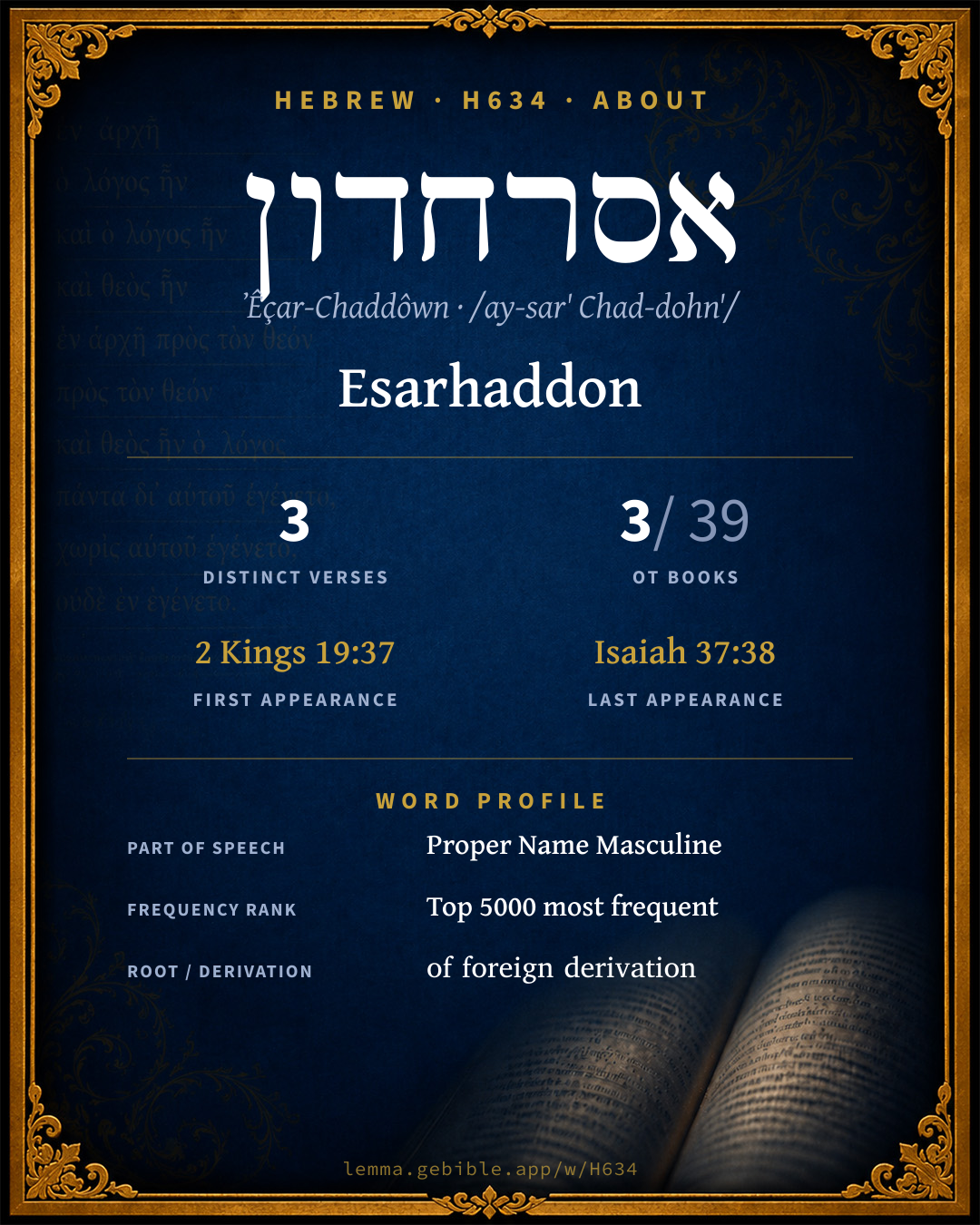
אֵסַר־חַדּוֹן
Esarhaddon
BDB lists 2 entries for ‘Esarhaddon’ fuller range ↓
Full lexicon entry — Brown-Driver-Briggs (BDB)
From Brown-Driver-Briggs (BDB)
Where this word appears
Grammar key — what these labels mean
Part of speech
- Noun
- A naming word — a person, place, thing, or idea.
Noun type
- Proper
- A name of a specific person, place, or people (e.g. Abraham, Zion, Israel).
Every verse where H634 appears in the Book of Isaiah — 1 distinct verse. Click any verse to open its interlinear word-by-word view. Verse text shown in the World English Bible for context — . Each verse’s Hebrew form is shown with its reference; the English is not keyword-highlighted, since the data carries no word-level English alignment. Use “Compare translations” on any verse to read it across multiple English versions. This concordance covers the Hebrew Bible; Septuagint (Greek Old Testament) occurrences are not indexed here.
Isaiah
About this entry
At a glance — auto-summarized from this page’s data, not written by a person. Every figure links to its source below. This summary describes the numbers; it doesn’t interpret them.
At its core, אסרחדון (ʼÊçar-Chaddôwn) means “Esarhaddon.” A scarce word — 3 verses in all of the Hebrew Bible. The word gravitates to 2 Kings (33%), then Ezra and Isaiah. First canonically at 2 Kings 19:37, it enters the text early. Dig into 3-verse concordance and the renderings breakdown below.
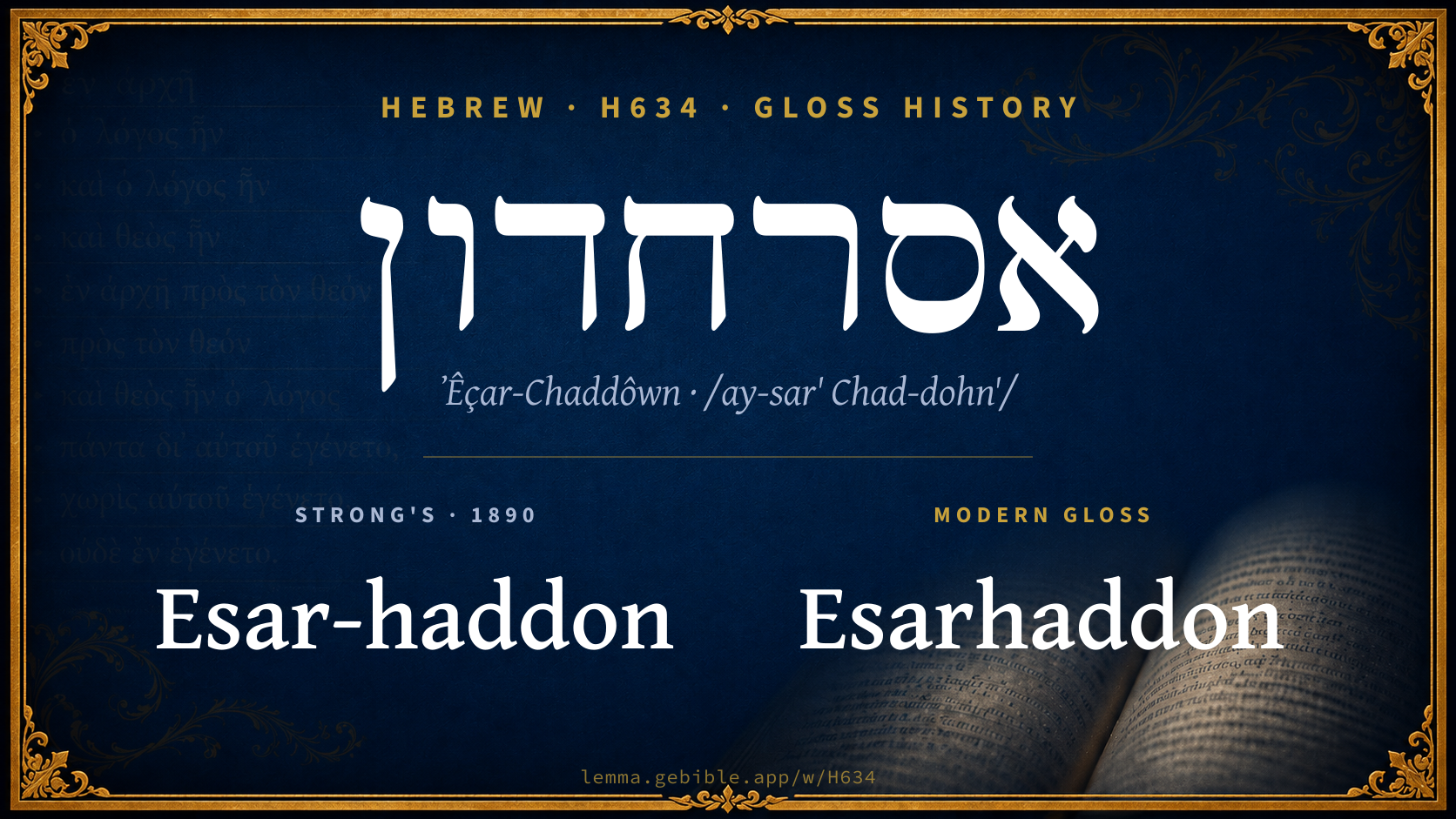
Gloss history
Strong's 1890 vs modern scholarship
About this word
Strong's H634 catalogs a Hebrew word from the Hebrew Old Testament.
These counts are not copied from any lexicon or concordance. They are computed here, from the morphology-tagged Hebrew Old Testament. What Lemma adds →
- 3
- distinct verses
- The word appears in 3 distinct verses.
- 3 / 39
- OT books
- The word appears in 3 of 39 Old Testament books.
- #3,040
- by frequency
- Top 5000 most frequent Hebrew words (rank 3,040 of 8,640 Hebrew words by occurrence).
View all 3 occurrences in the concordance →
By section of the Old Testament
By traditional corpus
Conventional, traditional groupings — biblical authorship is debated, so this is a traditional corpus grouping, not an authorship claim. Each share is this word’s portion of its verses in that division of the Hebrew canon. Each figure is a share of the word’s 3 distinct verses.
- Prophets (Nevi'im) 2 verses · 67%
- Writings (Ketuvim) 1 verse · 33%
How translations render this word
Counts come from each version’s own published word-to-Strong’s tagging or interlinear alignment — an approximate guide to how each version renders this word, not a word-level alignment the data otherwise carries. Because each total is that version’s own tagged count, the per-version totals vary from one another and need not match the appearance or distinct-verse counts above. These counts may also differ from a printed concordance because Lemma counts each distinctly tagged rendering and does not collapse phrase taggings into a single head-word total. This is a fixed set of word-tagged versions (KJV, ASV, BSB, ULT) and does not change with the reading translation you choose elsewhere. Each version’s license is shown beside its name below (and on Sources).
- King James Version: Esarhaddon 3×
- American Standard Version: Esar-haddon 3×
- Berean Standard Bible: Esar-haddon 3×
- unfoldingWord Literal Text: Esarhaddon 6×
King James Version Public Domain
Renders H634 across 3 tagged occurrences — most commonly:
American Standard Version Public Domain
Renders H634 across 3 tagged occurrences — most commonly:
Berean Standard Bible Public Domain
Renders H634 across 3 tagged occurrences — most commonly:
Not rendered by a distinct English word in 2 further occurrences.
unfoldingWord Literal Text CC BY-SA 4.0
Renders H634 across 6 tagged occurrences — most commonly:
Senses in BDB
The 2 senses BDB distinguishes for this word, in lexicon order (not ranked by frequency or importance). The full entry — with sub-senses — is in the Lexicon Entry tab.
- Esarhaddon = "Ashur has given a brother"
- king of Assyria in the seventh-century BC
Word origin
אֵסַרְחַדֹּן n.pr.m. Esarhaddon king of Assyria B.C. 681-668, son & successor of Sennacherib
— Brown-Driver-Briggs (Oxford 1906, public domain), digitized via Sefaria, supplemented by the OpenScriptures HebrewLexicon (CC BY 4.0). See Sources.
Origin: of foreign derivation
Forms in the corpus
The 4 distinct written forms H634 takes in the Hebrew Bible, most frequent first — each parse links to that state’s occurrences in the concordance. Hebrew forms include their vowel points and cantillation, so a single lemma takes many written forms.
| Form | Parsing | Example | Uses |
|---|---|---|---|
| אֵֽסַר | Noun, Proper | 2 Kings 19:37 | 2 |
| חַדֹּ֥ן | Noun, Proper | 2 Kings 19:37 | 2 |
| אֵסַ֤ר | Noun, Proper | Ezra 4:2 | 1 |
| חַדֹּן֙ | Noun, Proper | Ezra 4:2 | 1 |
Bible dictionary
Public-domain dictionary articles matched to this entry by name (Esarhaddon). A biblical name can be shared by more than one person or place, so an article may treat several.
Easton's Bible Dictionary · M. G. Easton, 1897
Assur has given a brother, successor of Sennacherib (2 Kings 19:37; Isa. 37:38). He ascended the throne about B.C. 681. Nothing further is recorded of him in Scripture, except that he settled certain colonists in Samaria (Ezra 4:2). But from the monuments it appears that he was the most powerful of all the Assyrian monarchs. He built many temples and palaces, the most magnificent of which was the south-west palace at Nimrud, which is said to have been in its general design almost the same as Solomon's palace, only much larger (1 Kings 7:1-12).
In December B.C. 681 Sennacherib was murdered by two of his sons, who, after holding Nineveh for forty-two days, were compelled to fly to Erimenas of Ararat, or Armenia. Their brother Esarhaddon, who had been engaged in a campaign against Armenia, led his army against them. They were utterly overthrown in a battle fought April B.C. 680, near Malatiyeh, and in the following month Esarhaddon was crowned at Nineveh. He restored Babylon, conquered Egypt, and received tribute from Manasseh of Judah. He died in October B.C. 668, while on the march to suppress an Egyptian revolt, and was succeeded by his son Assur-bani-pal, whose younger brother was made viceroy of Babylonia.
Smith's Bible Dictionary · William Smith, 1863
(victor), one of the greatest of the kings of Assyria, was the son of Sennacherib, (2 Kings 19:37) and the grandson of Sargon, who succeeded Shalmaneser. He appears by his monuments to have been one of the most powerful, if not the most powerful, of all the Assyrian monarchs. He is the only one of them whom we find to have actually reigned at Babylon, where he built himself a palace, bricks from which have been recently recovered bearing his name. His Babylonian reign lasted thirteen years, from B.C. 680 to B.C. 667; and it was doubtless within this space of time that Manasseh king of Judah, having been seized by his captains at Jerusalem on a charge of rebellion, was brought before him at Babylon, (2 Chronicles 33:11) and detained for a time as prisoner there. As a builder of great works Esar-haddon is particularly distinguished. Besides his palace at Babylon, he built at least three others in different parts of his dominions, either for himself or his sons, and thirty temples.
Hitchcock's Bible Names Dictionary · Roswell D. Hitchcock, 1869
that closes the point; joy; cheerfulness
Classic public-domain reference works; full attribution on Sources.
Septuagint verse parallels
This word appears in 3 verses that also exist in the Greek Old Testament (Septuagint), out of the 3 Hebrew verses it occurs in. You can read those verses in Greek by switching the Old Testament edition to the Septuagint.
Read these verses in the Septuagint
This is a verse-level parallel only — the same verses exist in both the Hebrew and Greek Old Testaments. No word-level Hebrew↔Greek correspondence is claimed: the data carries no such alignment, so no Greek word is shown as this Hebrew word’s translation. Coverage is not total — the Septuagint omits the deuterocanon and renumbers the Psalms, so some Hebrew verses have no direct Greek parallel.