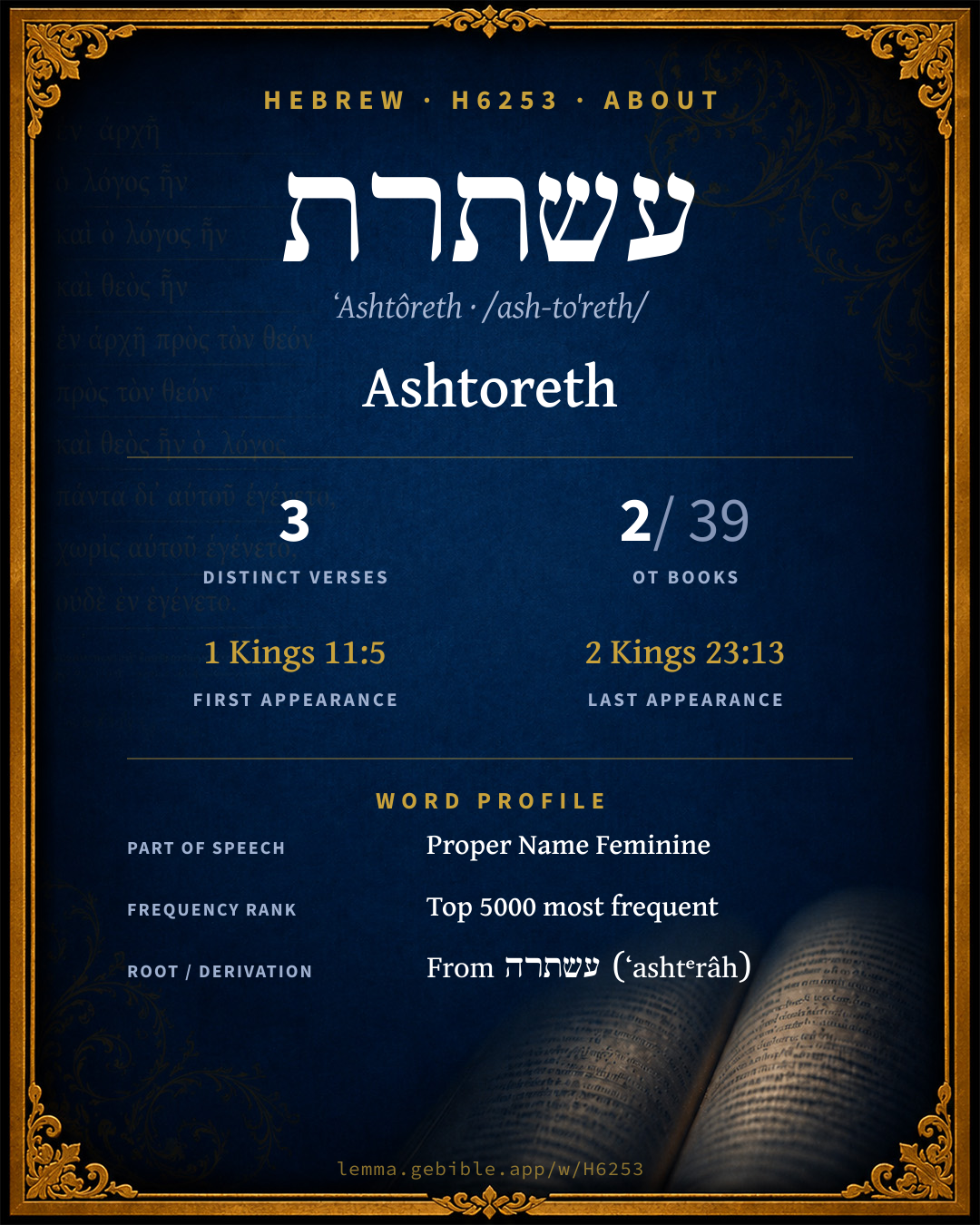
עַשְׁתֹּ֫רֶת
Ashtoreth
BDB lists 2 entries for ‘Ashtoreth’ fuller range ↓
Full lexicon entry — Brown-Driver-Briggs (BDB)
From Brown-Driver-Briggs (BDB)
Where this word appears
Grammar key — what these labels mean
Part of speech
- Noun
- A naming word — a person, place, thing, or idea.
Noun type
- Proper
- A name of a specific person, place, or people (e.g. Abraham, Zion, Israel).
Every verse where H6253 appears in the Book of 1 Kings — 2 distinct verses. Click any verse to open its interlinear word-by-word view. Verse text shown in the World English Bible for context — . Each verse’s Hebrew form is shown with its reference; the English is not keyword-highlighted, since the data carries no word-level English alignment. Use “Compare translations” on any verse to read it across multiple English versions. This concordance covers the Hebrew Bible; Septuagint (Greek Old Testament) occurrences are not indexed here.
1 Kings
- 1 Kings 11:5 עַשְׁתֹּ֔רֶת n Proper For Solomon went after Ashtoreth the goddess of the Sidonians, and after Milcom the abomination of the Ammonites.
- 1 Kings 11:33 לְ/עַשְׁתֹּרֶת֮ prep + n Proper because that they have forsaken me, and have worshiped Ashtoreth the goddess of the Sidonians, Chemosh the god of Moab, and Milcom the god of the children of Ammon; and they have not walked in my ways, to do that which is right in my eyes, and [to keep] my statutes and my ordinances, as did David his father.
About this entry
At a glance — auto-summarized from this page’s data, not written by a person. Every figure links to its source below. This summary describes the numbers; it doesn’t interpret them.
“Ashtoreth” is the headline sense of the Hebrew name עשתרת (ʻAshtôreth). With only 3 verses it sits in the long tail of Hebrew Bible vocabulary. More than two-thirds of its appearances fall in 1 Kings. First canonically at 1 Kings 11:5, it enters the text early. The sections below give every occurrence and version rendering.
Gloss history
Strong's 1890 vs modern scholarship
About this word
Strong's H6253 catalogs a Hebrew word from the Hebrew Old Testament.
These counts are not copied from any lexicon or concordance. They are computed here, from the morphology-tagged Hebrew Old Testament. What Lemma adds →
- 3
- distinct verses
- The word appears in 3 distinct verses.
- 2 / 39
- OT books
- The word appears in 2 of 39 Old Testament books.
- #4,179
- by frequency
- Top 5000 most frequent Hebrew words (rank 4,179 of 8,640 Hebrew words by occurrence).
View all 3 occurrences in the concordance →
By traditional corpus
Conventional, traditional groupings — biblical authorship is debated, so this is a traditional corpus grouping, not an authorship claim. Each share is this word’s portion of its verses in that division of the Hebrew canon. Each figure is a share of the word’s 3 distinct verses.
- Prophets (Nevi'im) 3 verses · 100%
How translations render this word
Counts come from each version’s own published word-to-Strong’s tagging or interlinear alignment — an approximate guide to how each version renders this word, not a word-level alignment the data otherwise carries. Because each total is that version’s own tagged count, the per-version totals vary from one another and need not match the appearance or distinct-verse counts above. These counts may also differ from a printed concordance because Lemma counts each distinctly tagged rendering and does not collapse phrase taggings into a single head-word total. This is a fixed set of word-tagged versions (KJV, ASV, BSB, ULT) and does not change with the reading translation you choose elsewhere. Each version’s license is shown beside its name below (and on Sources).
- King James Version: Ashtoreth 3×
- American Standard Version: Ashtoreth 2×
- Berean Standard Bible: Ashtoreth 3×
- unfoldingWord Literal Text: Ashtoreth 3×
King James Version Public Domain
Renders H6253 across 3 tagged occurrences — most commonly:
American Standard Version Public Domain
Renders H6253 across 3 tagged occurrences — most commonly:
Plus 1 rendering that appears only once — usually multi-word phrases or single function words the recovered tagging swept in, not distinct renderings.
Berean Standard Bible Public Domain
Renders H6253 across 3 tagged occurrences — most commonly:
unfoldingWord Literal Text CC BY-SA 4.0
Renders H6253 across 3 tagged occurrences — most commonly:
Senses in BDB
The 2 senses BDB distinguishes for this word, in lexicon order (not ranked by frequency or importance). The full entry — with sub-senses — is in the Lexicon Entry tab.
- Ashtoreth = "star"
- the principal female deity of the Phoenicians worshipped in war and fertility
Word origin
n.pr.deae. ʿAštōreth, ʿAštart, ʿAštéreth (v. infr.) (MI17 עשתר כמש; Ph. עשתרת (+ often in n. pr.), n. pr. עבד עשתר Cook Acad. Jan. 18, 1896 Sab. n. pr. dei עתֿתר v. especially OsZMG xx (1866), 279 f. DHM ib. xxxvii (1883), 376 FellSab. Götternamen, ZMG liv (1900), 231 ff., especially 237 ff.; Assyrian Ištar; Old Aramaic Palm. עתר (= עתֿתר) in n. pr.; in Egyptian ʿastirati WMMAs. u. Eur. 313; Gk. Ἀστάρτη; on other Gk. equivalents (e.g. Ἀφροδίτη) cf. LewyFremdw. 148, 186 f. 250);——ֶֹ prob. artificial, to suggest בֹּשֶׁת, orig. -תַּרְתְּ, -תֶּרֶת, cf. Ištar, Ασταρτη, etc.; ע׳ 1 K 11:5 + 2 times; pl. -תָּרוֹת Ju 2:13 + 3 times + -רֹת 1 S 7:4; 1 S 31:10 read prob. sg. (Dr al.);—ʿAštart, ʿAštereth (Ασταρτη, pl. Ασταρται, but Ju 10:6; 1 S 7:4 Ασταρωθ), ancient Sem. goddess (with male counterpart in Moab., Sab. and appar. Ph.); Phoenician diety, עשׁתרת אֱלֹהֵי צִדֹנִים 1 K 11:5, 33, ע׳ שִׁקֻּץ צ׳ 2 K 23:13; so prob. בֵּית ע׳ 1 S 31:10 (reading sg.; v. especially Dr); elsewhere pl., of various local goddesses, called עַשְׁתָּרוֹת (cf. Assyrian ilâni u ištarat = gods and Ištars (i.e. goddesses), usually + בעל(ים), as Canaanitish deities Ju 2:13; 10:6; 1 S 7:4; 12:10; ‖ אֱלֹהֵי הַנֵּכָר 7:3.—Vid. especially Dr Ashtoreth in HastDB; on Ištar JastrRel. Bab. pass. especially 202 f.; on ʿAthtar BaeRel. 117 f.; on Ph. ʿAštart Pietschm Gesch. Phön. 184 f.; on ʿAshtoreth Barton JBL x (1891), 73 ff. GFM Ency. Bib.
— Brown-Driver-Briggs (Oxford 1906, public domain), digitized via Sefaria, supplemented by the OpenScriptures HebrewLexicon (CC BY 4.0). See Sources.
Derived from עשתרה (ʻashtᵉrâh) (H6251) — ewe.
Forms in the corpus
The 3 distinct written forms H6253 takes in the Hebrew Bible, most frequent first — each parse links to that state’s occurrences in the concordance. Hebrew forms include their vowel points and cantillation, so a single lemma takes many written forms.
| Form | Parsing | Example | Uses |
|---|---|---|---|
| לְ/עַשְׁתֹּ֣רֶת | Noun, Proper | 2 Kings 23:13 | 1 |
| לְ/עַשְׁתֹּרֶת֮ | Noun, Proper | 1 Kings 11:33 | 1 |
| עַשְׁתֹּ֔רֶת | Noun, Proper | 1 Kings 11:5 | 1 |
Same root — word family
Other BDB entries built from the same root as H6253, grouped by Strong’s listed origin. These share a root / origin per the lexicon — not necessarily a shared meaning. Each links to that word’s own entry.
Derives from
Proper names from this root
People and places named from this root — a name, not an additional meaning of the word.
Compare all same-root words → 2 of the same-root words are proper names (people or places). They share a root, not necessarily a meaning.
Bible dictionary
Public-domain dictionary articles matched to this entry by name (Ashtoreth). A biblical name can be shared by more than one person or place, so an article may treat several.
Easton's Bible Dictionary · M. G. Easton, 1897
The moon goddess of the Phoenicians, representing the passive principle in nature, their principal female deity; frequently associated with the name of Baal, the sun-god, their chief male deity (Judg. 10:6; 1 Sam. 7:4; 12:10). These names often occur in the plural (Ashtaroth, Baalim), probably as indicating either different statues or different modifications of the deities. This deity is spoken of as Ashtoreth of the Zidonians. She was the Ishtar of the Accadians and the Astarte of the Greeks (Jer. 44:17; 1 Kings 11:5, 33; 2 Kings 23:13). There was a temple of this goddess among the Philistines in the time of Saul (1 Sam. 31:10). Under the name of Ishtar, she was one of the great deities of the Assyrians. The Phoenicians called her Astarte. Solomon introduced the worship of this idol (1 Kings 11:33). Jezebel's 400 priests were probably employed in its service (1 Kings 18:19). It was called the "queen of heaven" (Jer. 44:25).
Smith's Bible Dictionary · William Smith, 1863
(a star) the principal female divinity of the Phoenicians, called Ishtar by the Assyrians and Astarte by the Greeks and Romans. She was by some ancient writers identified with the moon. But on the other hand the Assyrian Ishtar was not the moon-goddess, but the planet Venus; and Astarte was by many identified with the goddess Venus (or Aphrodite), as well as with the plant of that name. It is certain that the worship of Astarte became identified with that of Venus, and that this worship was connected with the most impure rites is apparent from the close connection of this goddess with Asherah. (1 Kings 11:5,33; 2 Kings 23:13)
Classic public-domain reference works; full attribution on Sources.
Septuagint verse parallels
This word appears in 3 verses that also exist in the Greek Old Testament (Septuagint), out of the 3 Hebrew verses it occurs in. You can read those verses in Greek by switching the Old Testament edition to the Septuagint.
Read these verses in the Septuagint
This is a verse-level parallel only — the same verses exist in both the Hebrew and Greek Old Testaments. No word-level Hebrew↔Greek correspondence is claimed: the data carries no such alignment, so no Greek word is shown as this Hebrew word’s translation. Coverage is not total — the Septuagint omits the deuterocanon and renumbers the Psalms, so some Hebrew verses have no direct Greek parallel.