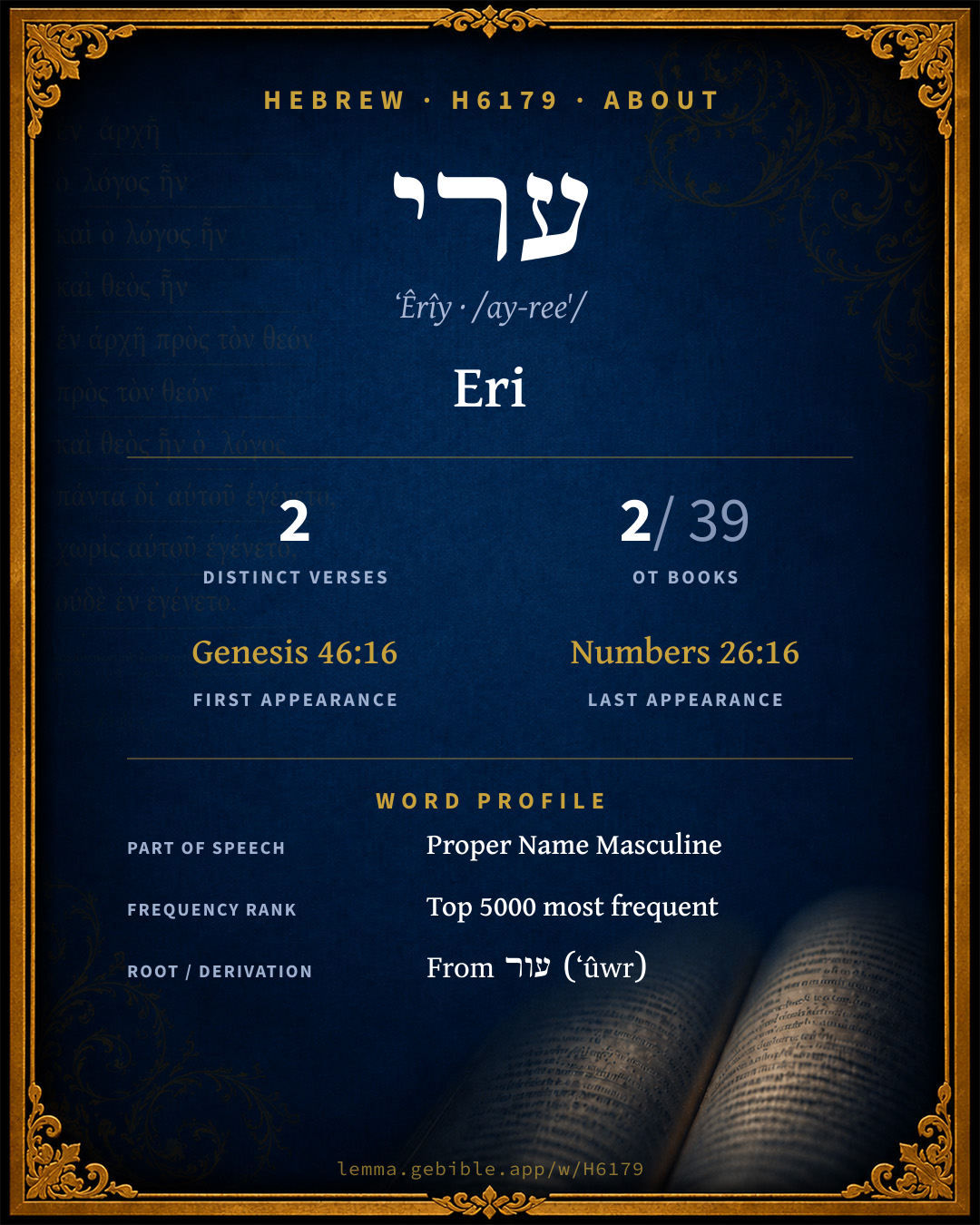
עֵרִי
Eri
BDB lists 2 entries for ‘Eri’ fuller range ↓
Full lexicon entry — Brown-Driver-Briggs (BDB)
From Brown-Driver-Briggs (BDB)
Where this word appears
Grammar key — what these labels mean
Part of speech
- Noun
- A naming word — a person, place, thing, or idea.
Noun type
- Proper
- A name of a specific person, place, or people (e.g. Abraham, Zion, Israel).
Every verse where H6179 appears in the Book of Genesis — 1 distinct verse. Click any verse to open its interlinear word-by-word view. Verse text shown in the World English Bible for context — . Each verse’s Hebrew form is shown with its reference; the English is not keyword-highlighted, since the data carries no word-level English alignment. Use “Compare translations” on any verse to read it across multiple English versions. This concordance covers the Hebrew Bible; Septuagint (Greek Old Testament) occurrences are not indexed here.
Genesis
About this entry
At a glance — auto-summarized from this page’s data, not written by a person. Every figure links to its source below. This summary describes the numbers; it doesn’t interpret them.
The Hebrew name ערי centers on the idea of “Eri.” It is rare — just 2 verses in the entire Hebrew Bible. The word gravitates to Genesis (50%), then Numbers. Its earliest occurrence is Genesis 46:16. Dig into 2-verse concordance and the renderings breakdown below.
Gloss history
Strong's 1890 vs modern scholarship
About this word
Strong's H6179 catalogs a Hebrew word from the Hebrew Old Testament.
These counts are not copied from any lexicon or concordance. They are computed here, from the morphology-tagged Hebrew Old Testament. What Lemma adds →
- 2
- distinct verses
- The word appears in 2 distinct verses.
- 2 / 39
- OT books
- The word appears in 2 of 39 Old Testament books.
- #4,807
- by frequency
- Top 5000 most frequent Hebrew words (rank 4,807 of 8,640 Hebrew words by occurrence).
View all 2 occurrences in the concordance →
By traditional corpus
Conventional, traditional groupings — biblical authorship is debated, so this is a traditional corpus grouping, not an authorship claim. Each share is this word’s portion of its verses in that division of the Hebrew canon. Each figure is a share of the word’s 2 distinct verses.
- Torah (Pentateuch) 2 verses · 100%
How translations render this word
Counts come from each version’s own published word-to-Strong’s tagging or interlinear alignment — an approximate guide to how each version renders this word, not a word-level alignment the data otherwise carries. Because each total is that version’s own tagged count, the per-version totals vary from one another and need not match the appearance or distinct-verse counts above. These counts may also differ from a printed concordance because Lemma counts each distinctly tagged rendering and does not collapse phrase taggings into a single head-word total. This is a fixed set of word-tagged versions (KJV, ASV, BSB, ULT) and does not change with the reading translation you choose elsewhere. Each version’s license is shown beside its name below (and on Sources).
BDB lists this Strong’s number as 2 distinct words (homographs). Each count above pools all of them and is not split by sense — see the Senses section below. A low-frequency rendering may belong to a different one of those words, not the primary meaning.
- King James Version†: Eri 2×
- American Standard Version†: Eri 2×
- Berean Standard Bible†: Eri 2×
- unfoldingWord Literal Text†: Eri 2×
King James Version Public Domain
Renders H6179 across 2† tagged occurrences — most commonly:
American Standard Version Public Domain
Renders H6179 across 2† tagged occurrences — most commonly:
Berean Standard Bible Public Domain
Renders H6179 across 2† tagged occurrences — most commonly:
unfoldingWord Literal Text CC BY-SA 4.0
Renders H6179 across 2† tagged occurrences — most commonly:
Senses in the full BDB
What do BDB’s symbols mean?
BDB uses these scholarly abbreviations:
| Symbol | Meaning |
|---|---|
| 𝔊 | the Septuagint (the ancient Greek translation, LXX) |
| 𝔙 | the Vulgate (the Latin translation) |
| 𝔖 | the Syriac version (the Peshitta) |
| 𝔗 | the Targum (the Aramaic translation) |
| ψ | the Psalms |
| √ | root (the underlying root or stem) |
| ‖ | parallel passage (a synonymous or contrasted parallel) |
| † | the dagger: every passage where the word occurs is cited |
The 0 senses and sub-senses the full Brown-Driver-Briggs lexicon distinguishes for this word, in lexicon order (not ranked by frequency), with BDB’s own verbatim wording and sub-sense lettering. Shown in Hebrew script with BDB’s own scholarly abbreviations. The condensed entry is in the Lexicon Entry tab. See also the Forms in the corpus table below.
ערי I m. a son of Gad Gn 46
ערי II of i. עֵרִי, c. art. as subst. coll. הָעֵרִי Nu 26
Senses from the full Brown-Driver-Briggs lexicon (Brown, Driver, Briggs; Oxford 1906 — public domain), digitized via Sefaria, supplemented by the OpenScriptures HebrewLexicon (CC BY 4.0). Full attribution on Sources.
Word origin
I. n.pr.m. a son of Gad Gn 46:16 Nu 26:16, Αηδις, Αδδει.
II. adj.gent. of i. עֵרִי, c. art. as subst. coll. הָעֵרִי Nu 26:16, Αδδει.
— Brown-Driver-Briggs (Oxford 1906, public domain), digitized via Sefaria, supplemented by the OpenScriptures HebrewLexicon (CC BY 4.0). See Sources.
Derived from עור (ʻûwr) (H5782) — to awake.
Jastrow Dictionary
A second Hebrew/Aramaic lexicon for comparison, covering Aramaic and post-biblical (Talmudic, Targumic, Midrashic) usage that the biblical-Hebrew BDB does not. Matched by lemma rather than by Strong’s number, so a lemma may carry more than one Jastrow headword (shown separately below), and the entries cover usage well beyond the Bible.
עָרָא II
- 1. bay-tree. Gitt. 69ᵇ טרפא דע׳ Ar. (ed. אטרפא דערא׳; Rashi דארעא, expl. עלה של עץ ארא) bay-leaves (v. Löw, Pfl.,ע׳ăronim p. 299).
- 2. a species of cedar, pine.—Pl. עָרֵי. B. Bath. 81ᵃ; R. Hash. 23ᵃ (ערונים) ארונים ע׳ ãronim (v. אֹרֶן) is (in Ch.) ʿaré (Rashi: laurel tree); (Yalk. Is. 314 ארמונים ערובי׳).
ערי
- to uncover. Gen. R. s. 83, end שהוא עתיד לַעֲרוֹת וכ׳ ‘Rashi’ he will uncover treasures &c., v. עָרַם I.—Denom. עֶרְוָה, עֶרְיָה.
ערי ²
- to stir up.
- 1. to stimulate, esp. to excite the sexual organ by contact (as the first stage of sexual connection), v. הַעֲרָאָה. Ker. II, 4 כל העריות עשה בהן את המַעֲרֶה כגומר in all illicit connections the text makes him who passes through the first stage as punishable as him that finishes. Y. Keth. III, 27ᵈ הֶעֱרוּ בה עשרה וכ׳ if ten persons came in carnal contact with her, and one of them consummated. Sot. 42ᵇ (play on מע̇ר̇ות, I Sam. XVII, 23) שהכל הע̇ר̇ו באמו all the world had taken liberties with his mother; a. fr. e.g. 1 Samuel 17:23
- 2. to intermix. Y. Yoma V, 42ᵈ top (צריך) זקוק להַעְרוֹת he must mix (the blood of the bull with that of the goat), v. Pi
- to be interwoven, entangled, caught. Y. Peah I, 16ᵃ bot. בסירה הוּעֲרַת it (the skirt) was caught &c., v. עָדָה I; ib. הוּעֲרוּ; Y. Sot. I, 17ᵇ (also הָעֳרַת).
- to intermix (of liquids), pour; to interweave, intertwine. Yoma V, 4 עי׳ דם הפר לתוך וכ׳ he poured the blood of the bullock to that of the goat, and put the full bowl in the empty one; expl. ib. 58ᵃ עי׳ מזרק מלא וכ׳ he poured the contents of the filled bowl into the empty bowl … in order to mix them thoroughly. Y. ib. V, 42ᵈ top (interch. with בָּלַל a. עָרַב). Y. Maasr. I, end, 49ᵇ לעָרוֹת וכ׳ to pour into &c. (interch. with להַעֲרוֹת, Hif.); Y. Sabb. III, 6ᵇ. Nidd. X, 6 היתה מְעָרָה מים לפסח was permitted to pour water from vessel to vessel for Passover purposes (to wash the Passover meat without touching the water). Ab. Zar. V, 7 המְעָרֶה מכלי אל כלי if a Jew pours wine from one vessel into another (held by a gentile), את שעי׳ ממנו מותר the wine remaining in the vessel from which he poured is permitted; a. fr.—Sifra K’dosh., Par. 2, ch. V עי׳ כל הפרשה כולה לכי וכ׳ the writer intended to join the whole paragraph (concerning emancipation) to ‘for she has not been set free’ (Lev. XIX, 20), to intimate that emancipation is consummated by a document only; (Gitt. 39ᵇ אוֹרְעָה וכ׳ (fr. אָרַע I) the whole paragraph has been joined &c. B. Bath. 113ᵇ אורעה … להיות דין, v. אָרַע II, a. corr. acc.) Y. Kidd. I, 58ᵈ bot. (ref. to Deut. XXV, 5) ת"ל ויבמה עי׳ הפרשה כולה לייבום וכ׳ the text says, v’yibb’mah (‘and thus he shall be her levir’); the whole paragraph is connected with yibbum (the word ויבמה), intimating that marital connection only consummates the levirate marriage; Y. Yeb. II, beg. 3ᶜ עודה (Rabad to Sifra l. c. quotes עורה, corr. acc.). Y. Snh. VII, 24ᵈ עֵרָה את כל וכ׳ the whole paragraph depends on the word mother.—Part. pass. מְעוּרֶה; f. מְעוּרָה; pl. מְעוּרִים, מְעוּרִין; מְעוּרוֹת intertwined, interwoven; mixed up. T’bul Yom III, 1 אוכל שנפרס ומע׳ מקצת if an eatable part of a fruit is broken off but partly hangs on (is not entirely severed). Ukts. III, 8 יחור של … ומע׳ בקליפה a shoot of a fig tree which is torn off but is still attached to the tree by the rind; Tosef. Kel. B. Kam. I, 13. Yoma 54ᵃ הכרובים שהיו מע׳ זה בזה the cherubs (in the Temple) whose bodies were intertwisted with one another. Ib. sq. (expl. כמער איש וליות, I Kings VII, 36) כאיש המע׳ בלויה שלו like a man embracing his companion (wife). Ḥull. 127ᵇ ומע׳ בחוט השערה attached by a hair’s breadth. Bets. 7ᵃ; a. fr. e.g. Leviticus 19:20
- to be intertwined, come into intimate contact. Ruth R. to I, 14 (ref. to מערית, v. supra) ממאה … שנִתְעָרוּ בה וכ׳ on one hundred … that were in contact with her the whole night (interch. with נתערבו).
A Dictionary of the Targumim, the Talmud Babli and Yerushalmi, and the Midrashic Literature (Marcus Jastrow; London, Luzac, 1903) — Public Domain. Digitized via Sefaria. Digitized via Sefaria. Full attribution on Sources.
Forms in the corpus
The 2 distinct written forms H6179 takes in the Hebrew Bible, most frequent first — each parse links to that state’s occurrences in the concordance. Hebrew forms include their vowel points and cantillation, so a single lemma takes many written forms.
| Form | Parsing | Example | Uses |
|---|---|---|---|
| לְ/עֵרִ֕י | Noun, Proper | Numbers 26:16 | 1 |
| עֵרִ֥י | Noun, Proper | Genesis 46:16 | 1 |
Same root — word family
Other BDB entries built from the same root as H6179, grouped by Strong’s listed origin. These share a root / origin per the lexicon — not necessarily a shared meaning. Each links to that word’s own entry.
Derives from
Shares the same root
Proper names from this root
People and places named from this root — a name, not an additional meaning of the word.
Compare all same-root words → Showing 4 of 10 — not the complete family. 4 of the same-root words are proper names (people or places). They share a root, not necessarily a meaning.
Bible dictionary
Public-domain dictionary articles matched to this entry by name (Eri). A biblical name can be shared by more than one person or place, so an article may treat several.
Smith's Bible Dictionary · William Smith, 1863
(watchful), son of Gad, (Genesis 46:16) and ancestor of the Erites. (Numbers 26:16)
Hitchcock's Bible Names Dictionary · Roswell D. Hitchcock, 1869
my city
Classic public-domain reference works; full attribution on Sources.
Septuagint verse parallels
This word appears in 2 verses that also exist in the Greek Old Testament (Septuagint), out of the 2 Hebrew verses it occurs in. You can read those verses in Greek by switching the Old Testament edition to the Septuagint.
Read these verses in the Septuagint
This is a verse-level parallel only — the same verses exist in both the Hebrew and Greek Old Testaments. No word-level Hebrew↔Greek correspondence is claimed: the data carries no such alignment, so no Greek word is shown as this Hebrew word’s translation. Coverage is not total — the Septuagint omits the deuterocanon and renumbers the Psalms, so some Hebrew verses have no direct Greek parallel.