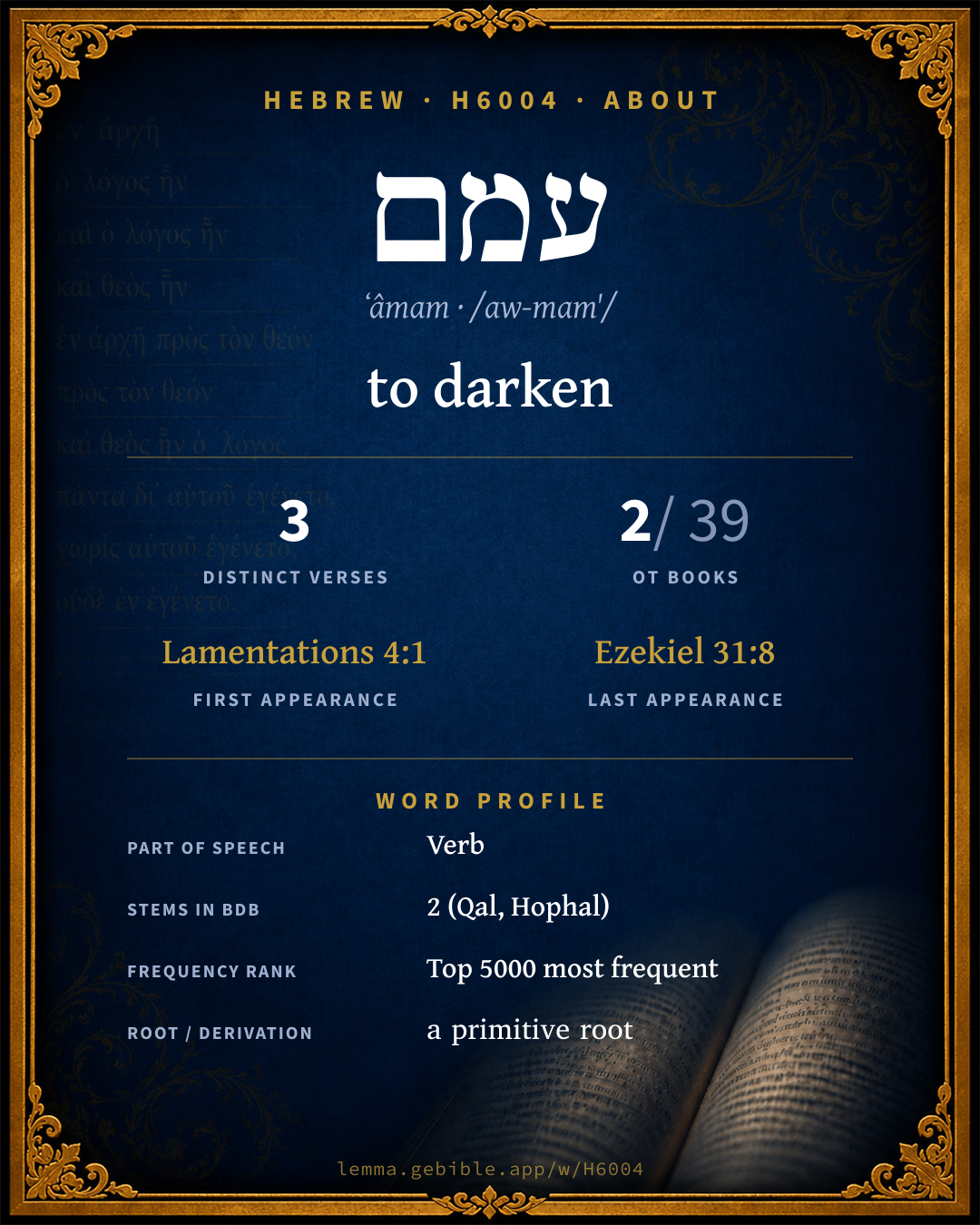
עָמַם
to darken
‘to darken’ is one of 3 main senses fuller range ↓
Full lexicon entry — Brown-Driver-Briggs (BDB)
From Brown-Driver-Briggs (BDB)
Where this word appears
Grammar key — what these labels mean
Part of speech
- Verb
- An action or state-of-being word.
Stem
- Hophal
- The passive counterpart of the Hiphil (“he was caused to…”).
- Qal
- The basic, simple active stem — the plain form of the verb (“he wrote”). Here: ‘did’
Form
- Imperfect
- An incomplete, ongoing, or future action (“he will / would write”).
- Perfect
- A completed action or state — Hebrew marks aspect (completeness) more than strict tense (“he wrote”).
Person
- 3rd Person
- The one spoken about (“he / she / it / they”).
Gender
- Masculine
- Grammatically masculine.
- Common
- Either gender — not distinguished for this form.
Number
- Singular
- One.
- Plural
- More than one (in Hebrew, generally three or more).
Every verse where H6004 appears in the Book of Ezekiel — 2 distinct verses. Click any verse to open its interlinear word-by-word view. Verse text shown in the World English Bible for context — . Each verse’s Hebrew form is shown with its reference; the English is not keyword-highlighted, since the data carries no word-level English alignment. Use “Compare translations” on any verse to read it across multiple English versions. This concordance covers the Hebrew Bible; Septuagint (Greek Old Testament) occurrences are not indexed here.
Ezekiel
- Ezekiel 28:3 עֲמָמֽוּ/ךָ Qal pf 3cp + sfx pers 2ms behold, you are wiser than Daniel; there is no secret that is hidden from you;
- Ezekiel 31:8 עֲמָמֻ/הוּ֮ Qal pf 3cp + sfx pers 3ms The cedars in the garden of God could not hide it; the fir trees were not like its boughs, and the plane trees were not as its branches; nor was any tree in the garden of God like it in its beauty.
About this entry
At a glance — auto-summarized from this page’s data, not written by a person. Every figure links to its source below. This summary describes the numbers; it doesn’t interpret them.
“to darken” is the headline sense of the Hebrew verb עמם (ʻâmam). A scarce word — 3 verses in all of the Hebrew Bible. It clusters heavily in Ezekiel, which alone accounts for 67% of its uses. Scripture first uses it in Lamentations 4:1. As a verb its force shifts by stem, across 2 stems (Qal, Hophal, and more). See the sense tree, 3-verse concordance, and the renderings breakdown below.
Gloss history
Strong's 1890 vs modern scholarship
About this word
Strong's H6004 catalogs a Hebrew word from the Hebrew Old Testament.
These counts are not copied from any lexicon or concordance. They are computed here, from the morphology-tagged Hebrew Old Testament. What Lemma adds →
- 3
- distinct verses
- The word appears in 3 distinct verses.
- 2 / 39
- OT books
- The word appears in 2 of 39 Old Testament books.
- #4,179
- by frequency
- Top 5000 most frequent Hebrew words (rank 4,179 of 8,640 Hebrew words by occurrence).
View all 3 occurrences in the concordance →
Most concentrated in
- Ezekiel 2 verses 67%
- Lamentations 1 verse 33%
By section of the Old Testament
By traditional corpus
Conventional, traditional groupings — biblical authorship is debated, so this is a traditional corpus grouping, not an authorship claim. Each share is this word’s portion of its verses in that division of the Hebrew canon. Each figure is a share of the word’s 3 distinct verses.
- Prophets (Nevi'im) 2 verses · 67%
- Writings (Ketuvim) 1 verse · 33%
How translations render this word
Counts come from each version’s own published word-to-Strong’s tagging or interlinear alignment — an approximate guide to how each version renders this word, not a word-level alignment the data otherwise carries. Because each total is that version’s own tagged count, the per-version totals vary from one another and need not match the appearance or distinct-verse counts above. These counts may also differ from a printed concordance because Lemma counts each distinctly tagged rendering and does not collapse phrase taggings into a single head-word total. This is a fixed set of word-tagged versions (KJV, ASV, BSB, ULT) and does not change with the reading translation you choose elsewhere. Each version’s license is shown beside its name below (and on Sources).
- King James Version: Become dim 1×, Could not hide 1×, They can hide 1×
- American Standard Version: Become dim 1×, Could not hide 1×
- Berean Standard Bible: Has become tarnished 1×, Is hidden from you 1×, Rival it 1×
- unfoldingWord Literal Text: Is tarnished 1×, Matched 1×, Secret 1×
King James Version Public Domain
Renders H6004 across 3 tagged occurrences — most commonly:
American Standard Version Public Domain
Renders H6004 across 2 tagged occurrences — most commonly:
Berean Standard Bible Public Domain
Renders H6004 across 3 tagged occurrences — most commonly:
unfoldingWord Literal Text CC BY-SA 4.0
Renders H6004 across 3 tagged occurrences — most commonly:
Senses in the full BDB
Hebrew verbs can shift meaning by stem (binyan): Qal is the basic action, Niphal is often passive or reflexive, Piel often intensifies or makes it factitive, and Hiphil is typically causative. The senses below are grouped under the stem BDB assigns to each. This entry also uses Hophal (the passive of Hiphil).
What do BDB’s symbols mean?
BDB uses these scholarly abbreviations:
| Symbol | Meaning |
|---|---|
| 𝔊 | the Septuagint (the ancient Greek translation, LXX) |
| 𝔙 | the Vulgate (the Latin translation) |
| 𝔖 | the Syriac version (the Peshitta) |
| 𝔗 | the Targum (the Aramaic translation) |
| ψ | the Psalms |
| √ | root (the underlying root or stem) |
| ‖ | parallel passage (a synonymous or contrasted parallel) |
| † | the dagger: every passage where the word occurs is cited |
The 2 senses and sub-senses the full Brown-Driver-Briggs lexicon distinguishes for this word, in lexicon order (not ranked by frequency), with BDB’s own verbatim wording and sub-sense lettering. Shown in Hebrew script with BDB’s own scholarly abbreviations. The condensed entry is in the Lexicon Entry tab. See also the Forms in the corpus table below.
Qal
- Pf. 3 pl. sf. עֲמָמֻהוּ Ez 31:8 dub., but prob. (as Thes) cedars did not eclipse him; עֲמָמוּךָ 28:3 no secret do they hold dark (= is held dark) for thee (Ges § 117 x). e.g. Ezekiel 31:8
Hophal
- . Impf. 3 ms. יוּעַם זָהָב La 4:1 (fig.) how is the gold dimmed! cf. Bu. e.g. Lamentations 4:1
Senses from the full Brown-Driver-Briggs lexicon (Brown, Driver, Briggs; Oxford 1906 — public domain), digitized via Sefaria, supplemented by the OpenScriptures HebrewLexicon (CC BY 4.0). Full attribution on Sources.
Word origin
[ עָמַם ] vb. darken, dim (NH id.; Arabic cover, veil, conceal; 𝔗 עֲמַם grow dark );—
— Brown-Driver-Briggs (Oxford 1906, public domain), digitized via Sefaria, supplemented by the OpenScriptures HebrewLexicon (CC BY 4.0). See Sources.
Origin: a primitive root
Jastrow Dictionary
A second Hebrew/Aramaic lexicon for comparison, covering Aramaic and post-biblical (Talmudic, Targumic, Midrashic) usage that the biblical-Hebrew BDB does not. Matched by lemma rather than by Strong’s number, so a lemma may carry more than one Jastrow headword (shown separately below), and the entries cover usage well beyond the Bible.
אָמַם
- to grow dim, (in b. h. also to obscure, excel; v. infra). Sabb. 77ᵇ; Ber. 53ᵇ; Pes. 75ᵇ גחלים אוֹמְמוֹת (or עוֹמְמוֹת) dying coals (question as to spelling decided in favor of ע by reference to Ezek. XXXI, 8 ‘the cedars did not obscure him, i.e. excel his beauty). e.g. Ezekiel 31:8
עָמַם
- v. אָמַם)
- 1. [to be pressed,] to be dim. Tosef. Sabb. III, 2 גחלים שעָמְמוּ coals which have become dim (ceased to flame). Pes. 75ᵇ; a. e.—Ib.; Sabb. 77ᵇ, a. e. עוֹמְמוֹת, v. אָמַם.
- 2. to press, quench. Part. pass. עָמוּם; f. עֲמוּמָה, pl. עֲמוּמוֹת. Lev. R. s. 26 (ref. to Ez. X, 2). ששה … גחלים ע׳ בידו וכ׳ for six years these coals were kept quenched in Gabriel’s hand. e.g. Ezekiel 10:2
- to become dim. Y. Orl. III, 63ᵃ bot. גחלי ערלה שעוּמְּמוּ וכ׳ (not גידולי … שעיממו) embers of Orlah wood are permitted for use.
- 1. (with (with על) to cover up, supress a case; to disregard the late, act irregularly (in an emergency). Y. Sot. IX, 23ᵈ bot. ולא … ועִימְעַמְנוּ על דינו and that having seen the murderer we have not let him go, or quashed his case. Num. R. s. 9; Tanḥ. Naso 7; Sifré Num. 7 (ref. to ונעלם, Num. V, 13) שלא … ומְעַמְעֵם not that her husband saw (her improper conduct) and covered it up (connived at it). Y. R. Hash. III, beg. 58ᶜ מְעַמְעֲמִין על הנראה לעברו ואין מעמעמין וכ׳ we may act irregularly (ignore the testimony), when the new moon has been seen (on the night of the twenty-ninth to the thirtieth day), if it is necessary to intercalate a day, but we must not ignore the law, when the new moon has not been seen in due time, in order to proclaim the New Moon Day (on the thirtieth day). Y. Shebi. VIII, 38ᵃ bot.; Y. Sabb. I, 3ᶜ bot., a. e. עִימְעֲמוּ עליה והתירוה they disregarded the law, and permitted it (the bread); עמעמו עליה ואסרוה they ignored the law (that permitted it), and forbade it. e.g. Numbers 5:13
- 2. (cmp. הִבְהֵב) to be like embers; trnsf. a) to be undecided. Y. Snh. V, end, 23ᵃ שלא ייראה דין זה יוצא מעמעם that the verdict in this case should not appear to go forth undecided (because the jury could not arrive at a majority of two against the defendant; Bab. Snh. 42ᵃ כדי שלא יצאו מבית דין מעורבבין).—b) to nod consent without showing anxiety. Y. Ber. V, 9ᶜ bot., v. הִבְהֵב.
עֲמַם I
- , to be dim, v. עֲמֵי.
- to be made or become dim. Targ. Koh. XII, 2, sq.
- to make dim. Targ. Is. VI, 10 (ed. Lag. טַמְטֵם), v. טְמַם.
עֲמָם
- = עַם, people.—Pl. עֲמָמִים, עֲמָמִין gentiles, esp. the seven nations of Canaan. Gen. R. s. 41, v. אֱמוֹרִי; Tosef. Sabb. VII (VIII), 23. Ib. 25 ואין לך בכל הע׳ מתון וכ׳ of all the (seven) nations none is so patient as the Emorite. Y. Shebi. VII, 36ᵇ bot. אבותיך ירשו ארץ של שבעה ע׳ וכ׳ thy ancestors inherited a land of seven nations, and thou shalt conquer a land of ten nations. Y. Sot. I, 17ᵇ top בשבעה … לאסור שבעה ע׳ in seven passages it is said, ‘thou shalt not make marriages with them’, … to prohibit the seven Canaanitish nations; Num. R. s. 9; a. fr.
עֲמַם II
- , esp. (= גּוֹי) gentile. Lam. R. to I, 1 רבתי (חד מאת׳ 7) גמלא ע׳ the camel driver is a gentile.—Pl. עַמְּמַיָּא, עַמְּמִין, עַמְּמֵי. Targ. Deut. XXXII, 8 (Y. II אומיא). Ib. XIV, 2 (ed. Berl. עַמְ׳, without Dagesh). Targ. Ps. LXIX, 9 עממין (ed. Lag. a. oth. עַמִּין). Targ. I Kings VIII, 41; 43; a. fr.—Yoma 71ᵇ (alluding to Sh’maya and Abtalion who were said to be descendants of Sennacherib) ייתון בני ע׳ לשלם may the sons of gentiles go in peace; a. e.
A Dictionary of the Targumim, the Talmud Babli and Yerushalmi, and the Midrashic Literature (Marcus Jastrow; London, Luzac, 1903) — Public Domain. Digitized via Sefaria. Digitized via Sefaria. Full attribution on Sources.
Forms in the corpus
The 3 distinct written forms H6004 takes in the Hebrew Bible, most frequent first — each parse links to that stem’s occurrences in the concordance. Hebrew forms include their vowel points and cantillation, so a single lemma takes many written forms.
| Form | Parsing | Example | Uses |
|---|---|---|---|
| יוּעַ֣ם | Verb, Hophal, Imperfect, 3rd Person, Masculine, Singular | Lamentations 4:1 | 1 |
| עֲמָמֻ/הוּ֮ | Verb, Qal, Perfect, 3rd Person, Common, Plural | Ezekiel 31:8 | 1 |
| עֲמָמֽוּ/ךָ | Verb, Qal, Perfect, 3rd Person, Common, Plural | Ezekiel 28:3 | 1 |
Same root — word family
Other BDB entries built from the same root as H6004, grouped by Strong’s listed origin. These share a root / origin per the lexicon — not necessarily a shared meaning. Each links to that word’s own entry.
Derived from this word
Compare all same-root words → They share a root, not necessarily a meaning.
Septuagint verse parallels
This word appears in 3 verses that also exist in the Greek Old Testament (Septuagint), out of the 3 Hebrew verses it occurs in. You can read those verses in Greek by switching the Old Testament edition to the Septuagint.
Read these verses in the Septuagint
This is a verse-level parallel only — the same verses exist in both the Hebrew and Greek Old Testaments. No word-level Hebrew↔Greek correspondence is claimed: the data carries no such alignment, so no Greek word is shown as this Hebrew word’s translation. Coverage is not total — the Septuagint omits the deuterocanon and renumbers the Psalms, so some Hebrew verses have no direct Greek parallel.