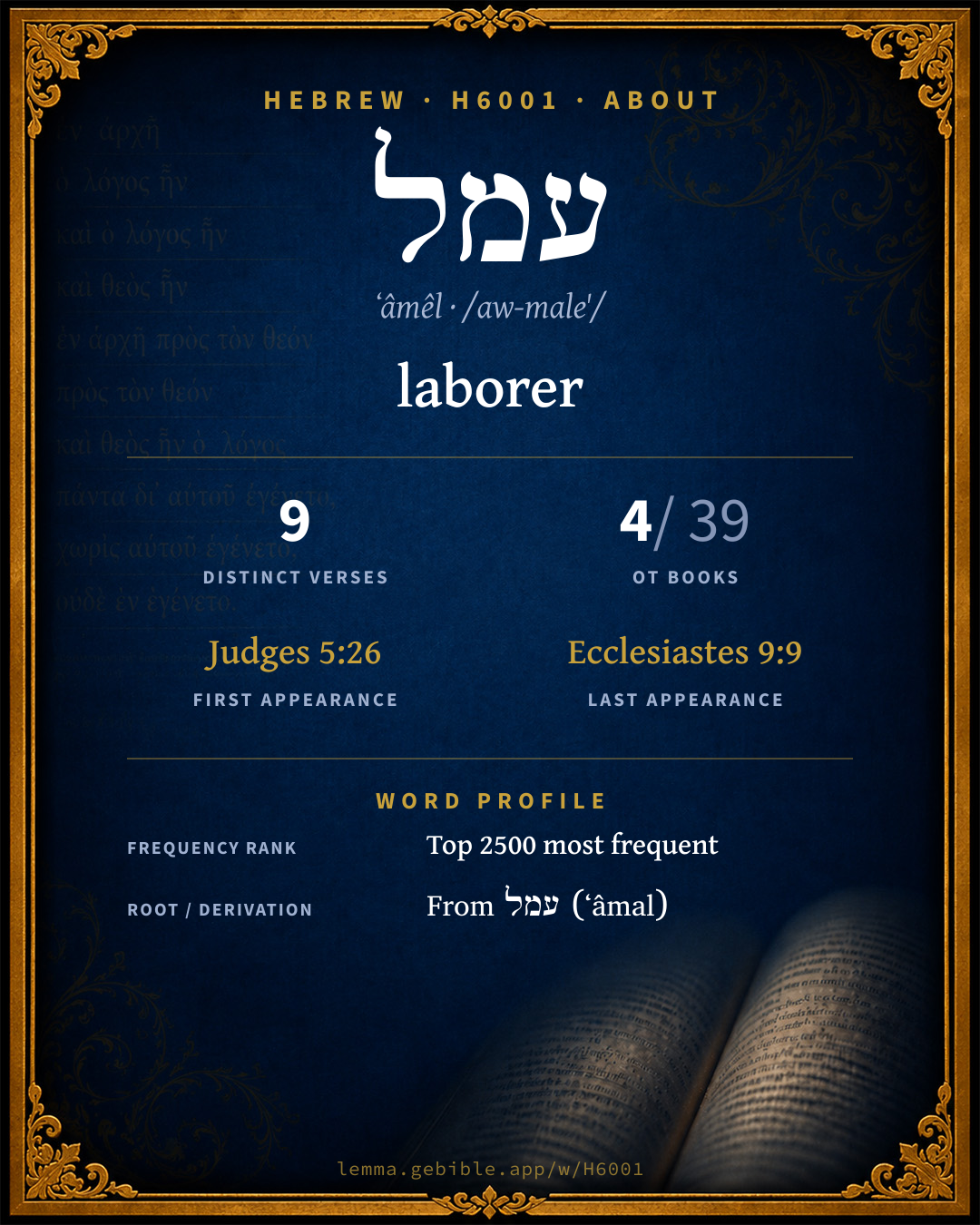
עָמֵל
laborer
‘laborer’ is one of 2 main senses fuller range ↓
Full lexicon entry — Brown-Driver-Briggs (BDB)
From Brown-Driver-Briggs (BDB)
Where this word appears
Grammar key — what these labels mean
Part of speech
- Adjective
- A word that describes or qualifies a noun.
- Noun
- A naming word — a person, place, thing, or idea.
Noun type
- Common
- A common noun — a general class of person, place, or thing (“king,” “city,” “water”), not a specific name.
State
- Absolute
- The independent form of a noun, not bound to a following word.
Gender
- Masculine
- Grammatically masculine.
Number
- Singular
- One.
- Plural
- More than one (in Hebrew, generally three or more).
Every verse where H6001 appears in the Book of Proverbs — 1 distinct verse. Click any verse to open its interlinear word-by-word view. Verse text shown in the World English Bible for context — . Each verse’s Hebrew form is shown with its reference; the English is not keyword-highlighted, since the data carries no word-level English alignment. Use “Compare translations” on any verse to read it across multiple English versions. This concordance covers the Hebrew Bible; Septuagint (Greek Old Testament) occurrences are not indexed here.
Proverbs
About this entry
At a glance — auto-summarized from this page’s data, not written by a person. Every figure links to its source below. This summary describes the numbers; it doesn’t interpret them.
עמל (ʻâmêl) is a Hebrew word most often rendered “laborer.” Ecclesiastes dominates its distribution — 5 of 9 verses. Spanning 9 verses in 4 books, it ranks among the uncommon words of the Hebrew Bible. It first appears in Judges 5:26. It is not a single-sense word — see its full sense range. For the data behind this summary, explore the sense tree and the renderings breakdown below.
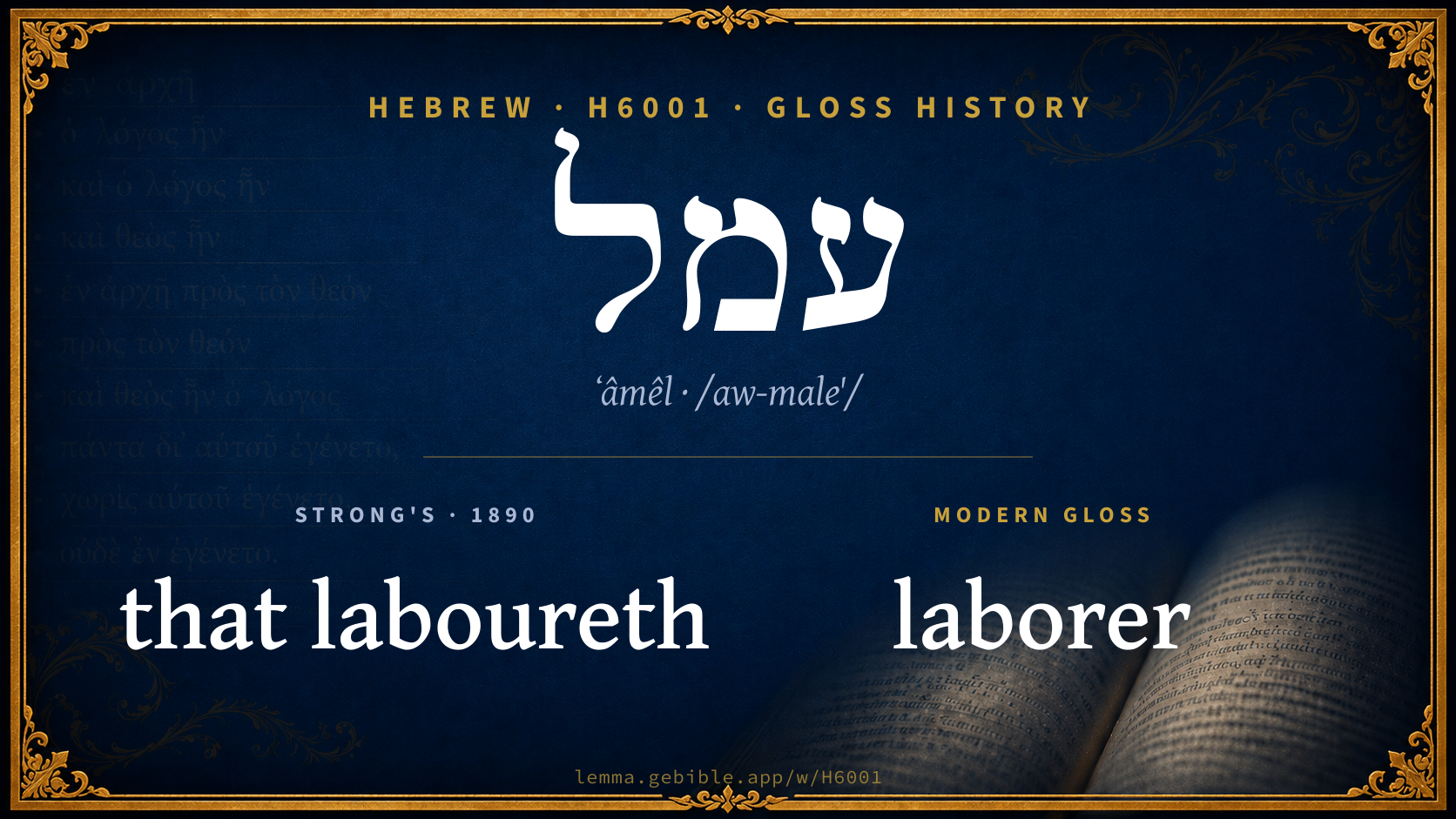
Gloss history
Strong's 1890 vs modern scholarship
About this word
Strong's H6001 catalogs a Hebrew word from the Hebrew Old Testament.
These counts are not copied from any lexicon or concordance. They are computed here, from the morphology-tagged Hebrew Old Testament. What Lemma adds →
- 9
- distinct verses
- The word appears in 9 distinct verses.
- 4 / 39
- OT books
- The word appears in 4 of 39 Old Testament books.
- #2,481
- by frequency
- Top 2500 most frequent Hebrew words (rank 2,481 of 8,640 Hebrew words by occurrence).
View all 9 occurrences in the concordance →
Most concentrated in
- Ecclesiastes 5 verses 56%
- Job 2 verses 22%
- Judges 1 verse 11%
By section of the Old Testament
By traditional corpus
Conventional, traditional groupings — biblical authorship is debated, so this is a traditional corpus grouping, not an authorship claim. Each share is this word’s portion of its verses in that division of the Hebrew canon. Each figure is a share of the word’s 9 distinct verses.
- Writings (Ketuvim) 8 verses · 89%
- Prophets (Nevi'im) 1 verse · 11%
How translations render this word
Counts come from each version’s own published word-to-Strong’s tagging or interlinear alignment — an approximate guide to how each version renders this word, not a word-level alignment the data otherwise carries. Because each total is that version’s own tagged count, the per-version totals vary from one another and need not match the appearance or distinct-verse counts above. These counts may also differ from a printed concordance because Lemma counts each distinctly tagged rendering and does not collapse phrase taggings into a single head-word total. This is a fixed set of word-tagged versions (KJV, ASV, BSB, ULT) and does not change with the reading translation you choose elsewhere. Each version’s license is shown beside its name below (and on Sources).
BDB lists this Strong’s number as 2 distinct words (homographs). Each count above pools all of them and is not split by sense — see the Senses section below. A low-frequency rendering may belong to a different one of those words, not the primary meaning.
- King James Version†: He hath laboured 1×, He laboureth 1×, I had taken 1×
- American Standard Version†: He laboreth 2×
- Berean Standard Bible†: Toil 2×
- unfoldingWord Literal Text†: Am 1×, Are a toiler 1×, Had toiled 1×
King James Version Public Domain
Renders H6001 across 9† tagged occurrences — most commonly:
American Standard Version Public Domain
Renders H6001 across 9† tagged occurrences — most commonly:
Plus 7 renderings that appear only once — usually multi-word phrases or single function words the recovered tagging swept in, not distinct renderings.
Berean Standard Bible Public Domain
Renders H6001 across 7† tagged occurrences — most commonly:
Plus 5 renderings that appear only once — usually multi-word phrases or single function words the recovered tagging swept in, not distinct renderings. Not rendered by a distinct English word in 2 further occurrences.
unfoldingWord Literal Text CC BY-SA 4.0
Renders H6001 across 10† tagged occurrences — most commonly:
Senses in the full BDB
What do BDB’s symbols mean?
BDB uses these scholarly abbreviations:
| Symbol | Meaning |
|---|---|
| 𝔊 | the Septuagint (the ancient Greek translation, LXX) |
| 𝔙 | the Vulgate (the Latin translation) |
| 𝔖 | the Syriac version (the Peshitta) |
| 𝔗 | the Targum (the Aramaic translation) |
| ψ | the Psalms |
| √ | root (the underlying root or stem) |
| ‖ | parallel passage (a synonymous or contrasted parallel) |
| † | the dagger: every passage where the word occurs is cited |
The 2 senses and sub-senses the full Brown-Driver-Briggs lexicon distinguishes for this word, in lexicon order (not ranked by frequency), with BDB’s own verbatim wording and sub-sense lettering. Shown in Hebrew script with BDB’s own scholarly abbreviations. The condensed entry is in the Lexicon Entry tab. See also the Forms in the corpus table below.
עמל I
- 1. labourer, workman: Ju 5:26 Pr 16:26. e.g. Judges 5:26
- 2. sufferer, Jb 3:20 (‖ מָרֵי נֶפֶשׁ), 20:22. e.g. Job 3:20
עמל II verb. toiling, only Ec, as pred.
Senses from the full Brown-Driver-Briggs lexicon (Brown, Driver, Briggs; Oxford 1906 — public domain), digitized via Sefaria, supplemented by the OpenScriptures HebrewLexicon (CC BY 4.0). Full attribution on Sources.
Word origin
I. n.m. Pr 16:26 labourer, sufferer;—ע׳ Pr 16:26 + 2 times; pl. עֲמֵלִים Ju 5:26;—
II. adj. verb. toiling, only Ec, as pred.;—Ec 2:18, 22; 3:9; 4:8; 9:9.
— Brown-Driver-Briggs (Oxford 1906, public domain), digitized via Sefaria, supplemented by the OpenScriptures HebrewLexicon (CC BY 4.0). See Sources.
Derived from עמל (ʻâmal) (H5998) — to labor.
Jastrow Dictionary
A second Hebrew/Aramaic lexicon for comparison, covering Aramaic and post-biblical (Talmudic, Targumic, Midrashic) usage that the biblical-Hebrew BDB does not. Matched by lemma rather than by Strong’s number, so a lemma may carry more than one Jastrow headword (shown separately below), and the entries cover usage well beyond the Bible.
עָמֵל I
- (b. h.) to labor, take pains; to be wearied. Deut. R. s. 11 זו היא שילום … שעָמַלְתִּי וכ׳ is this the payment for the service of forty years during which I worked hard, until they became a holy and faithful people? Yalk. Prov. 950 מדבר בעוֹמְלֵי תורה it refers to those studying the Law industriously; Tanḥ. ed. Bub., Mick. 2 בעֲמֵלֵי; a. fr.—Part. or adj. עָמֵל; f. עֲמֵלָה; pl. עֲמֵלִים, עֲמֵלִין; עֲמֵלוֹת. Cant. R. to I, 2 מה המים … כל מי שהוא ע׳ בהן וכ׳ as water raises plants, so the words of the Law raise him who works at (studies) them sufficiently. Deut. R. l. c. ולא אמר בעֲמֵלֶיהָ … בעושיה and he (Moses) did not say (in his blessing, blessed be who delights) in those laboring to study it, or in those who meditate on it, but in those who do it. Ber. 28ᵇ אני ע׳ והם ע׳ I wear myself out (in study), and they wear themselves out (in vanities). Ab. II, 2 כל הע׳ עם הצבור יהיו ע׳ וכ׳ (Var. העוסקים … עוסקים) all those who are engaged in public affairs must do their work for the sake of heaven (disinterestedly); a. fr.
- to work through, knead, esp. to stimulate and heat the body (v. Hithpa.). Sabb. 147ᵇ מפני שמְעַמֶּלֶת ומרפא (read with Alf.: ומרפאת, v. Rabb. D. S. a. l. note 10) because it (the mud of Dimsith) exercises the body and loosens (the bowels).
- 1. to be kneaded, have massage. Ib. XXII, 6 סכין … אבל לא מִתְעַמְּלִים וכ׳ you may have yourself ointed and rubbed on the Sabbath, but not kneaded or scraped.
- 2. to wear one’s self out, esp. to exercise (and heat) the body. Tosef. Peah IV, 10 Hillel bought for a poor man of good breeding סוס שהיה מִתְעַמֵּל בו a horse on which to take exercise; Y. ib. VIII, 21ᵃ bot. להִתְעַמֵּל בו; (Keth. 67ᵇ לרכיב עליו). Tosef. Sabb. XVI (XVII), 22 אין רצין בשבת כדי להִתְעַמֵּל וכ׳ you must not run on the Sabbath for the sake of exercise, but you may walk in an ordinary way the entire day.
עֲמַל I
- Targ. Jon. IV, 13.
עָמֵל II
- m., v. עָמֵל I
עָמָל
- preced. wds.) toil, trouble; fruit of labor, achievement. Midr. Till. to Ps. XC, 10 אפי׳ מלכותו ע׳ ואוו even man’s rulership is toil and vanity; Yalk. ib. 841. Ber. 17ᵃ אשרי מי … ועֲמָלוֹ בתורה blessed he that has been reared in the Law, and whose toil is in the Law. Gen. R. s. 31 שהיתה … בעמלו של רשע a curse rested on the wicked man’s labor. Ex. R. s. 22 שלא היה בעמלו גזל in whose acquired property there was no robbery; a. fr.—Gen. R. s. 39 בית הע׳, v. דָּהוֹן.
עֲמַל II
- Targ. Gen. III, 17 (h. text עצבין). Targ. O. Deut. XXVI, 7. Targ. Ps. VII, 17 Ms. (ed. לעותא); a. e.—Esp. acquisition, income, rent. B. Bath. 67ᵃ מגבינן אפי׳ מע׳ דבתי we used to collect (the daughter’s share, v. עִישּׂוּר) even from house rents; Keth. 69ᵃ (not דביתי; Rashi: דבֵיתֵיה).—Pl. עַמְלִין. B. Mets. 15ᵃ אינון ועַמְלֵיהוֹן וכ׳ Rashi a. Tosaf. (ed. ועמיליהון) (I vouch for) themselves (the lands), and the income from them and eventual improvements; [Ar. a. Tosaf. עמליהון the cost of acquisition, original value].
A Dictionary of the Targumim, the Talmud Babli and Yerushalmi, and the Midrashic Literature (Marcus Jastrow; London, Luzac, 1903) — Public Domain. Digitized via Sefaria. Digitized via Sefaria. Full attribution on Sources.
Forms in the corpus
The 7 distinct written forms H6001 takes in the Hebrew Bible, most frequent first — each parse links to that state’s occurrences in the concordance. Hebrew forms include their vowel points and cantillation, so a single lemma takes many written forms.
| Form | Parsing | Example | Uses |
|---|---|---|---|
| עָמֵ֖ל | Adjective, Adjective, Masculine, Singular, Absolute | Ecclesiastes 2:18 | 3 |
| לְ/עָמֵ֣ל | Adjective, Adjective, Masculine, Singular, Absolute | Job 3:20 | 1 |
| עֲמֵלִ֑ים | Noun, Common, Masculine, Plural, Absolute | Judges 5:26 | 1 |
| עָ֭מֵל | Adjective, Adjective, Masculine, Singular, Absolute | Proverbs 16:26 | 1 |
| עָמֵ֗ל | Adjective, Adjective, Masculine, Singular, Absolute | Ecclesiastes 4:8 | 1 |
| עָמֵ֣ל | Adjective, Adjective, Masculine, Singular, Absolute | Job 20:22 | 1 |
| עָמֵֽל | Adjective, Adjective, Masculine, Singular, Absolute | Ecclesiastes 3:9 | 1 |
Same root — word family
Other BDB entries built from the same root as H6001, grouped by Strong’s listed origin. These share a root / origin per the lexicon — not necessarily a shared meaning. Each links to that word’s own entry.
Derives from
Shares the same root
Compare all same-root words → They share a root, not necessarily a meaning.
Septuagint verse parallels
This word appears in 9 verses that also exist in the Greek Old Testament (Septuagint), out of the 9 Hebrew verses it occurs in. You can read those verses in Greek by switching the Old Testament edition to the Septuagint.
Read these verses in the Septuagint
This is a verse-level parallel only — the same verses exist in both the Hebrew and Greek Old Testaments. No word-level Hebrew↔Greek correspondence is claimed: the data carries no such alignment, so no Greek word is shown as this Hebrew word’s translation. Coverage is not total — the Septuagint omits the deuterocanon and renumbers the Psalms, so some Hebrew verses have no direct Greek parallel.