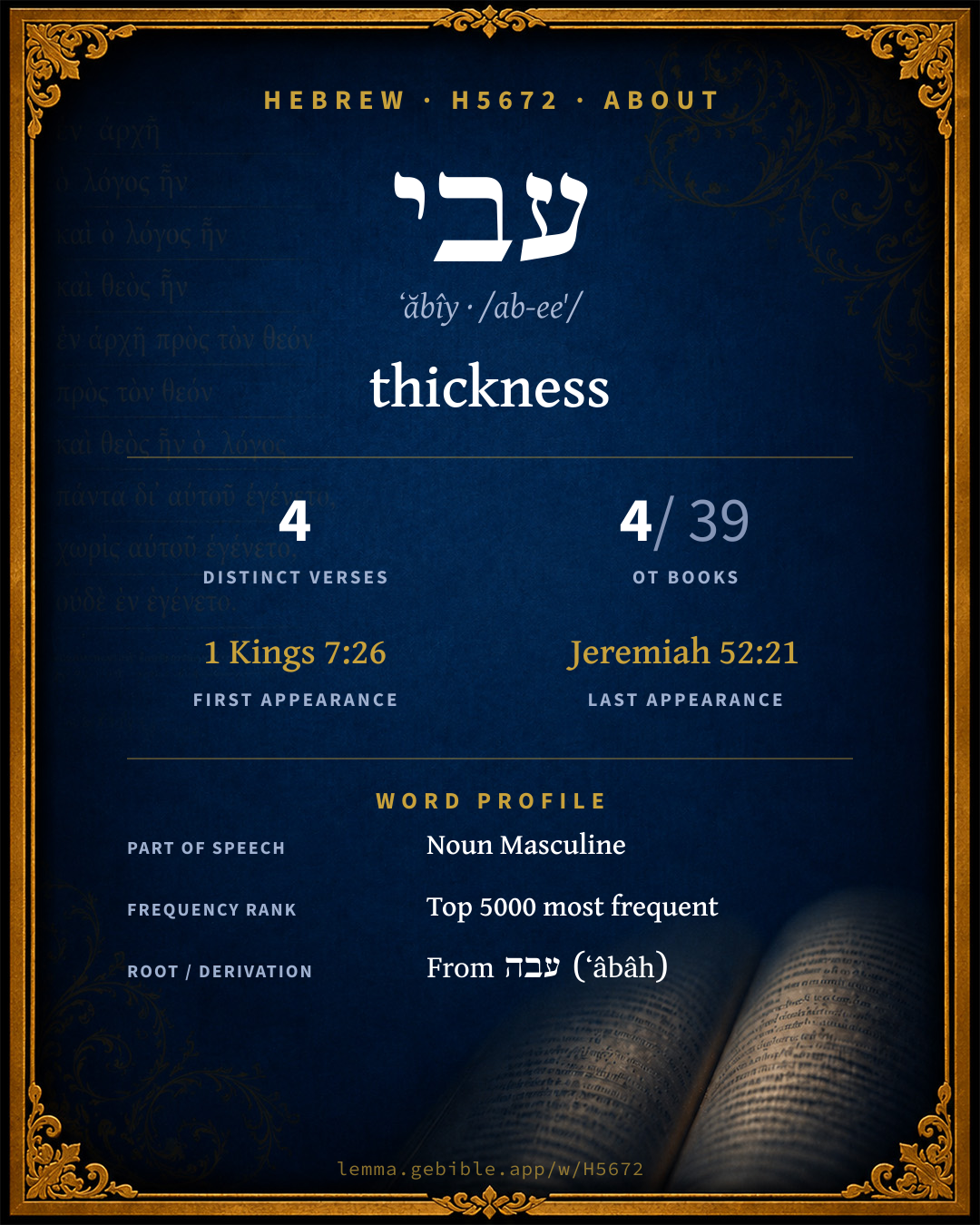
עֲבִי
thickness
Full lexicon entry — Brown-Driver-Briggs (BDB)
From Brown-Driver-Briggs (BDB)
Where this word appears
Grammar key — what these labels mean
Noun type
- Common
- A common noun — a general class of person, place, or thing (“king,” “city,” “water”), not a specific name.
State
- Construct
- A noun bound to a following noun in a possessive / “of” relationship (the construct chain).
Gender
- Masculine
- Grammatically masculine.
Number
- Singular
- One.
Every verse where H5672 appears in the Book of 1 Kings — 1 distinct verse. Click any verse to open its interlinear word-by-word view. Verse text shown in the World English Bible for context — . Each verse’s Hebrew form is shown with its reference; the English is not keyword-highlighted, since the data carries no word-level English alignment. Use “Compare translations” on any verse to read it across multiple English versions. This concordance covers the Hebrew Bible; Septuagint (Greek Old Testament) occurrences are not indexed here.
1 Kings
About this entry
At a glance — auto-summarized from this page’s data, not written by a person. Every figure links to its source below. This summary describes the numbers; it doesn’t interpret them.
The Hebrew noun עבי centers on the idea of “thickness.” A scarce word — 4 verses in all of the Hebrew Bible. The word gravitates to 1 Kings (25%), then 2 Chronicles and Job. First canonically at 1 Kings 7:26, it enters the text early. It clusters with עבה and מעבה under a shared root. Dig into 4-verse concordance and the renderings breakdown below.
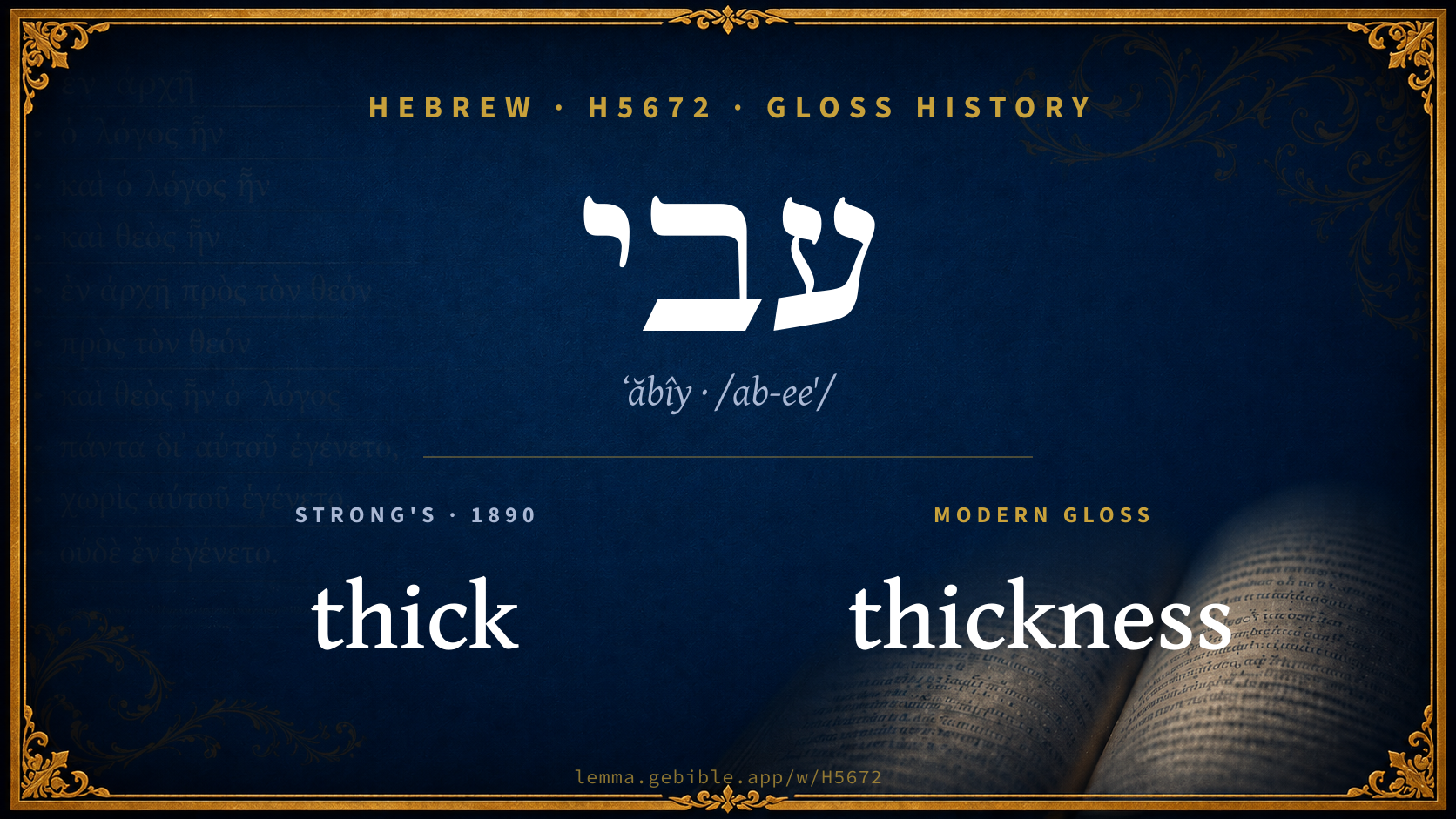
Gloss history
Strong's 1890 vs modern scholarship
About this word
Strong's H5672 catalogs a Hebrew word from the Hebrew Old Testament.
These counts are not copied from any lexicon or concordance. They are computed here, from the morphology-tagged Hebrew Old Testament. What Lemma adds →
- 4
- distinct verses
- The word appears in 4 distinct verses.
- 4 / 39
- OT books
- The word appears in 4 of 39 Old Testament books.
- #3,696
- by frequency
- Top 5000 most frequent Hebrew words (rank 3,696 of 8,640 Hebrew words by occurrence).
View all 4 occurrences in the concordance →
Most concentrated in
- 1 Kings 1 verse 25%
- 2 Chronicles 1 verse 25%
- Job 1 verse 25%
By section of the Old Testament
By traditional corpus
Conventional, traditional groupings — biblical authorship is debated, so this is a traditional corpus grouping, not an authorship claim. Each share is this word’s portion of its verses in that division of the Hebrew canon. Each figure is a share of the word’s 4 distinct verses.
- Prophets (Nevi'im) 2 verses · 50%
- Writings (Ketuvim) 2 verses · 50%
How translations render this word
Counts come from each version’s own published word-to-Strong’s tagging or interlinear alignment — an approximate guide to how each version renders this word, not a word-level alignment the data otherwise carries. Because each total is that version’s own tagged count, the per-version totals vary from one another and need not match the appearance or distinct-verse counts above. These counts may also differ from a printed concordance because Lemma counts each distinctly tagged rendering and does not collapse phrase taggings into a single head-word total. This is a fixed set of word-tagged versions (KJV, ASV, BSB, ULT) and does not change with the reading translation you choose elsewhere. Each version’s license is shown beside its name below (and on Sources).
- King James Version: Thick 2×, Thickness 2×
- American Standard Version: Thick 3×
- Berean Standard Bible: Thick 4×
- unfoldingWord Literal Text: Thickness 2×
King James Version Public Domain
Renders H5672 across 4 tagged occurrences — most commonly:
American Standard Version Public Domain
Renders H5672 across 4 tagged occurrences — most commonly:
Plus 1 rendering that appears only once — usually multi-word phrases or single function words the recovered tagging swept in, not distinct renderings.
Berean Standard Bible Public Domain
Renders H5672 across 4 tagged occurrences — most commonly:
Not rendered by a distinct English word in 1 further occurrence.
unfoldingWord Literal Text CC BY-SA 4.0
Renders H5672 across 3 tagged occurrences — most commonly:
Plus 1 rendering that appears only once — usually multi-word phrases or single function words the recovered tagging swept in, not distinct renderings.
Senses in BDB
The 1 sense BDB distinguishes for this word, in lexicon order (not ranked by frequency or importance). The full entry — with sub-senses — is in the Lexicon Entry tab.
- thickness
Word origin
Derived from עבה (ʻâbâh) (H5666) — to be fat.
Jastrow Dictionary
A second Hebrew/Aramaic lexicon for comparison, covering Aramaic and post-biblical (Talmudic, Targumic, Midrashic) usage that the biblical-Hebrew BDB does not. Matched by lemma rather than by Strong’s number, so a lemma may carry more than one Jastrow headword (shown separately below), and the entries cover usage well beyond the Bible.
עבי
- to be thick, dense, dark.
- to become thick, swell. Tanḥ. Vaëra 3 ובלען … ולא נ׳ יותר וכ׳ Aaron’s staff swallowed them up and yet was not thicker than before.
- same. Tosef. Kil. III, 4 הֶעֱבוּ ונעשו מכוונות (not העבן) if the plants on growing denser appeared to form a straight line; Y. ib. V, beg. 29ᵈ העבות (R. S. to Kil. V, 1 היו עבים; corr. acc.).
- to make thick; to condense, darken; to facilitate growth. Y. Taan. III, 66ᶜ מְעַבֶּה, v. עָב II. M. Kat. II, 5 מְחַפִּין … אף מְעַבִּין (during the festive week) you may cover up the cut figs with straw; … you may even &c.; expl. ib. 13ᵇ מחפין אקלושי מעבין אסמוכי by m’ḥappin is meant a loose covering, by m’ʿabbin a dense, packed covering; (anoth. opin.) מחפין … מע׳ … כמין כרי m’ḥappin means a loose or a dense covering, m’ʿabbin means bringing the figs close together so as to form a pile. Y. Peah III, 17ᶜ בשעי׳ על מנת להדל if he set the plants close together with the intention of thinning them afterwards. Ib. VII, 20ᵇ מתוך שהוא מְעַבָּן וכ׳ because he strengthens the remaining plants (by thinning the field), they produce more fruit the next year (and thus he benefits also the poor). Y. Shebi. I, beg. 33ᵃ מעבה את הכורת he advances the growth of the ramification, opp. מתיש כוחה. Y. Bets. IV, 62ᶜ top בשלא נתכוין לעַבֹּותָהּ when (in putting wood on the booth) he had not had the intention to cover it more densely; a. e.—Tosef. Peah IV, 14 המעבה את שוקיו (ed. Zuck. המקפח) he who contracts his shoulders (simulating a hump), v. קָפַח.—Part. pass. מְעוּבֶּה, q. v.
עֲבֵי
- , to be thick, rough, strong. Ḥull. 38ᵃ, v. עֲמֵי.
עָבֵי
- (preced.) thick, rough. Ḥull. 79ᵃ ע׳ קליה וכ׳ if the voice of a mule is rough, its dam is an ass, if shrill (צניף), a horse.
עֳבִי
- , v. עוֹבִי
עוֹבִי
- thickness, diameter. Y. Ber. I, 2ᶜ bot. עוֹבְיוֹ של רקיע וכ׳ the thickness (diameter) of the heavens is equal to a journey of 500 years; עוֹבְיָהּ של ארץ the diameter of the earth; Gen. R. s. 4; Pes. 94ᵃ. Gen. R. s. 42 בעל קורה טעין בעוביה the owner of the beam must put his shoulder to the thickest part of it; Ber. 64ᵃ בעָבְיָהּ וכ׳, v. כַּאַן. Tanḥ. Sh’moth 3 נותן עביה של תקרה זו בצד ראשה וכ׳ he places the thick side (trunk) of one beam by the side of the top (the thinner part) of the other beam; Ex. R. s. 1. Ohol. XVI, 1 בע׳ המרדע measured by the diameter of the handle of a plough; Sabb. 17ᵃ מרדע שאמרו אין בעָבְיוֹ וכ׳ the handle of which they speak is less than a handbreadth in diameter, but is a handbreadth in circumference; a. e.
עִיבִידָא
- fr. (עֲבַד)
- 1. labor, work, trade, occupation. Targ. Lev. XVI, 29. Targ. Ex. XXXI, 5; a. fr.—B. Mets. 91ᵃ בעֲבִידְתֵּיה טריד his attention is absorbed by his business. Y. Taan. IV, 69ᵇ bot. מיעבד עִיבִידְתֵּיה to follow his pursuit (as a washer). Y. Sabb. II, 4ᵈ top, v. עוֹבַדְתָּא; a. fr.
- 2. beasts of labor, v. עוֹבַדְתָּא.
A Dictionary of the Targumim, the Talmud Babli and Yerushalmi, and the Midrashic Literature (Marcus Jastrow; London, Luzac, 1903) — Public Domain. Digitized via Sefaria. Digitized via Sefaria. Full attribution on Sources.
Forms in the corpus
The 3 distinct written forms H5672 takes in the Hebrew Bible, most frequent first — each parse links to that state’s occurrences in the concordance. Hebrew forms include their vowel points and cantillation, so a single lemma takes many written forms.
| Form | Parsing | Example | Uses |
|---|---|---|---|
| וְ/עָבְי֣/וֹ | Noun, Common, Masculine, Singular, Construct | 1 Kings 7:26 | 2 |
| בַּ֝/עֲבִ֗י | Noun, Common, Masculine, Singular, Construct | Job 15:26 | 1 |
| וְ/עָבְי֛/וֹ | Noun, Common, Masculine, Singular, Construct | Jeremiah 52:21 | 1 |
Same root — word family
Other BDB entries built from the same root as H5672, grouped by Strong’s listed origin. These share a root / origin per the lexicon — not necessarily a shared meaning. Each links to that word’s own entry.
Derives from
Shares the same root
Compare all same-root words → They share a root, not necessarily a meaning.
Septuagint verse parallels
This word appears in 4 verses that also exist in the Greek Old Testament (Septuagint), out of the 4 Hebrew verses it occurs in. You can read those verses in Greek by switching the Old Testament edition to the Septuagint.
Read these verses in the Septuagint
This is a verse-level parallel only — the same verses exist in both the Hebrew and Greek Old Testaments. No word-level Hebrew↔Greek correspondence is claimed: the data carries no such alignment, so no Greek word is shown as this Hebrew word’s translation. Coverage is not total — the Septuagint omits the deuterocanon and renumbers the Psalms, so some Hebrew verses have no direct Greek parallel.