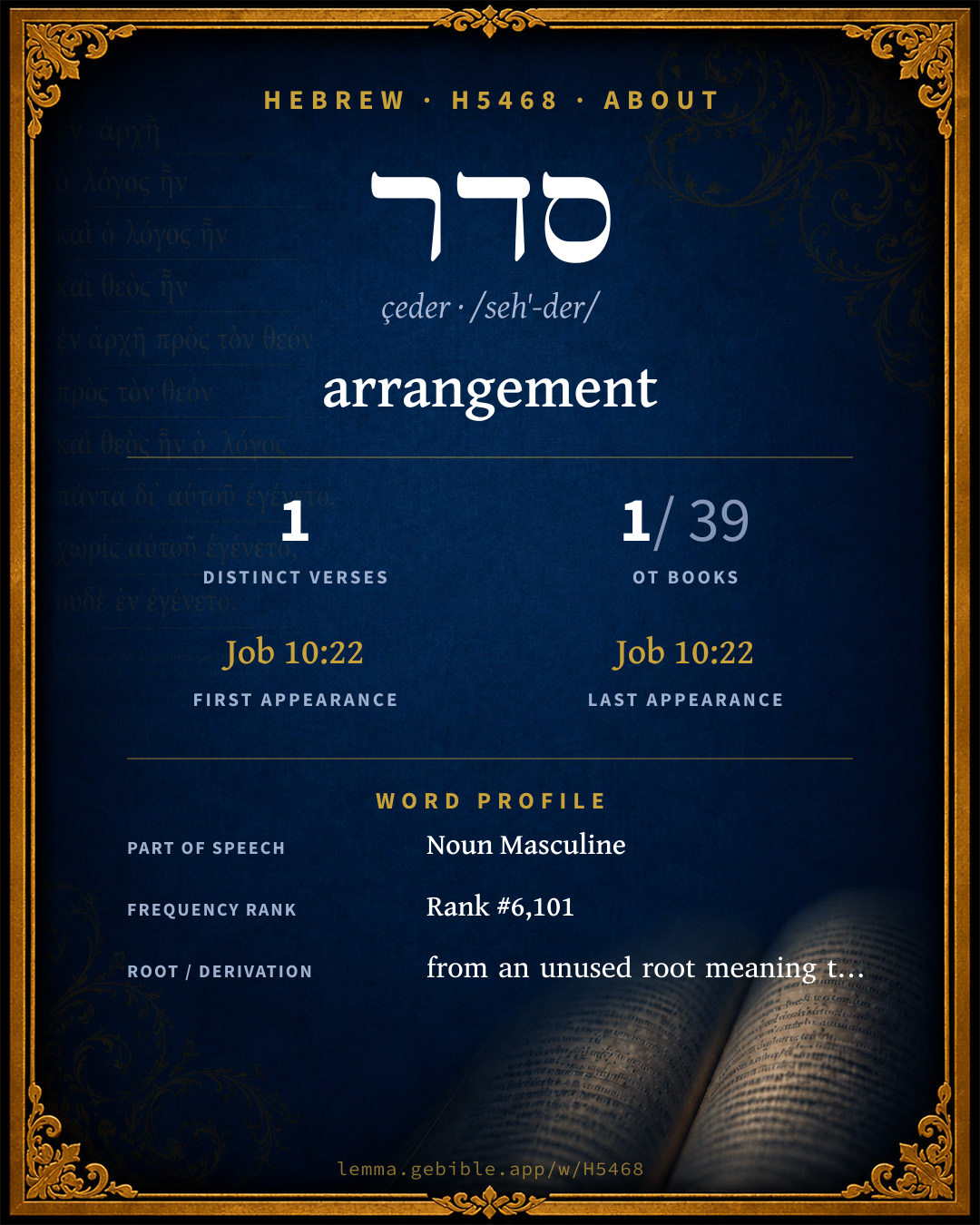
סֵ֫דֶר
arrangement
Full lexicon entry — Brown-Driver-Briggs (BDB)
From Brown-Driver-Briggs (BDB)
Where this word appears
Grammar key — what these labels mean
Part of speech
- Noun
- A naming word — a person, place, thing, or idea.
Noun type
- Common
- A common noun — a general class of person, place, or thing (“king,” “city,” “water”), not a specific name.
State
- Absolute
- The independent form of a noun, not bound to a following word.
Gender
- Masculine
- Grammatically masculine.
Number
- Plural
- More than one (in Hebrew, generally three or more).
Every verse where H5468 appears — 1 distinct verse across 1 book. Click any verse to open its interlinear word-by-word view. Verse text shown in the World English Bible for context — . Each verse’s Hebrew form is shown with its reference; the English is not keyword-highlighted, since the data carries no word-level English alignment. Use “Compare translations” on any verse to read it across multiple English versions. This concordance covers the Hebrew Bible; Septuagint (Greek Old Testament) occurrences are not indexed here.
Job 1 verse
About this entry
At a glance — auto-summarized from this page’s data, not written by a person. Every figure links to its source below. This summary describes the numbers; it doesn’t interpret them.
“arrangement” is the headline sense of the Hebrew noun סדר (çeder). It occurs a mere 1 verse across Scripture. More than three-quarters of its appearances fall in Job. It occurs only once, in Job 10:22. It shares a root with מסדרון. See the sense tree, 1-verse concordance, and the renderings breakdown below.
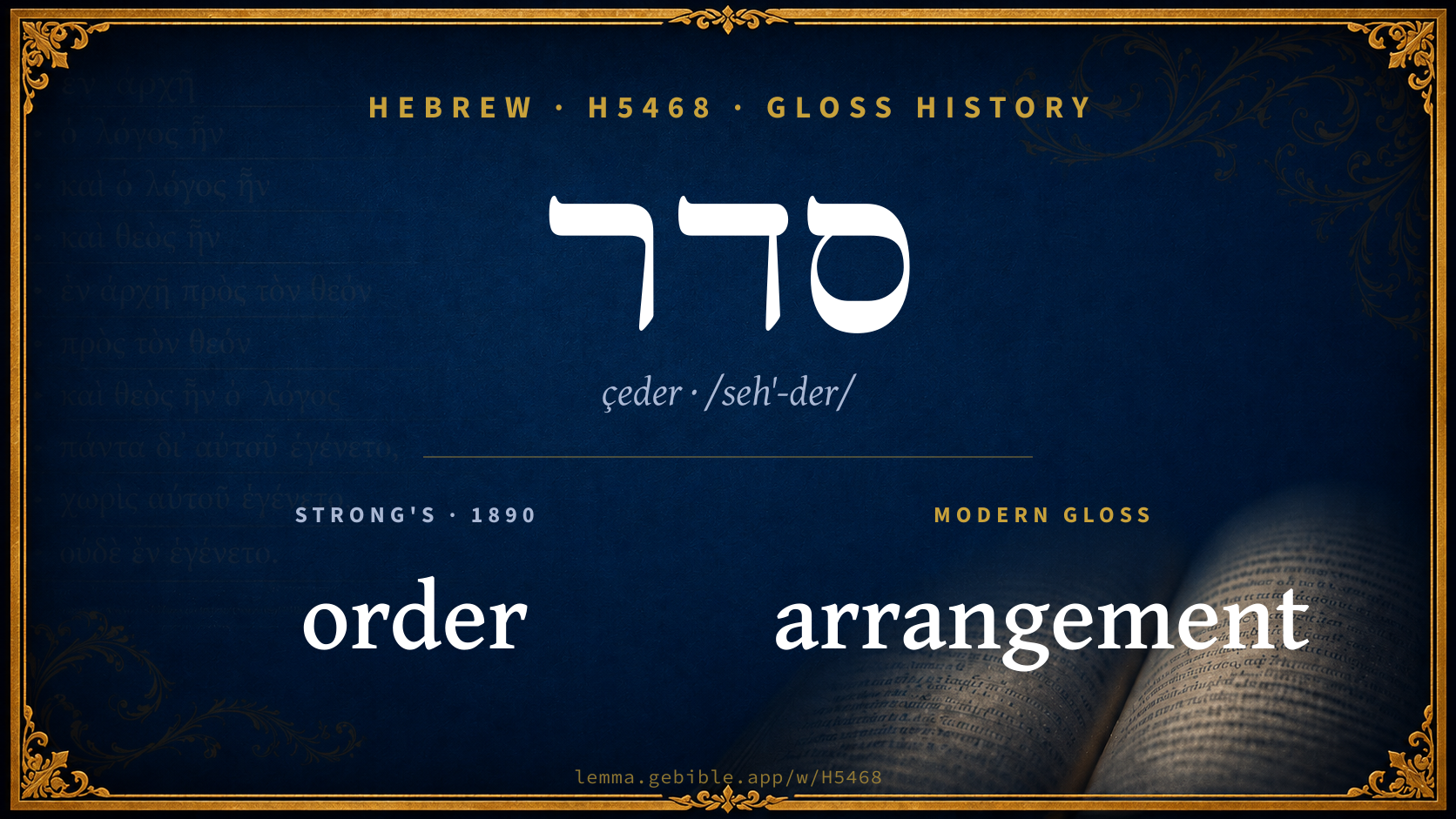
Gloss history
Strong's 1890 vs modern scholarship
About this word
Strong's H5468 catalogs a Hebrew word from the Hebrew Old Testament.
These counts are not copied from any lexicon or concordance. They are computed here, from the morphology-tagged Hebrew Old Testament. What Lemma adds →
- 1
- distinct verses
- The word appears in 1 distinct verse.
- 1 / 39
- OT books
- The word appears in 1 of 39 Old Testament books.
- #6,101
- by frequency
- Rank #6,101 (rank 6,101 of 8,640 Hebrew words by occurrence).
View all 1 occurrence in the concordance →
Most concentrated in
- Job 1 verse 100%
By section of the Old Testament
By traditional corpus
Conventional, traditional groupings — biblical authorship is debated, so this is a traditional corpus grouping, not an authorship claim. Each share is this word’s portion of its verses in that division of the Hebrew canon. Each figure is a share of the word’s 1 distinct verse.
- Writings (Ketuvim) 1 verse · 100%
How translations render this word
Counts come from each version’s own published word-to-Strong’s tagging or interlinear alignment — an approximate guide to how each version renders this word, not a word-level alignment the data otherwise carries. Because each total is that version’s own tagged count, the per-version totals vary from one another and need not match the appearance or distinct-verse counts above. These counts may also differ from a printed concordance because Lemma counts each distinctly tagged rendering and does not collapse phrase taggings into a single head-word total. This is a fixed set of word-tagged versions (KJV, ASV, BSB, ULT) and does not change with the reading translation you choose elsewhere. Each version’s license is shown beside its name below (and on Sources).
- King James Version: Without any order 1×
- American Standard Version: Without any order 1×
- Berean Standard Bible: not separately translated
- unfoldingWord Literal Text: Order 1×
King James Version Public Domain
Renders H5468 across 1 tagged occurrence — most commonly:
American Standard Version Public Domain
Renders H5468 across 1 tagged occurrence — most commonly:
Berean Standard Bible Public Domain
Does not render H5468 with a distinct English word (not separately translated in its 1 tagged occurrence).
unfoldingWord Literal Text CC BY-SA 4.0
Renders H5468 across 1 tagged occurrence — most commonly:
Senses in BDB
The 1 sense BDB distinguishes for this word, in lexicon order (not ranked by frequency or importance). The full entry — with sub-senses — is in the Lexicon Entry tab.
- arrangement, order
Word origin
סֵ֫דֶר n.[m.] arrangement, order;—only pl. Jb 10:22
— Brown-Driver-Briggs (Oxford 1906, public domain), digitized via Sefaria, supplemented by the OpenScriptures HebrewLexicon (CC BY 4.0). See Sources.
Origin: from an unused root meaning to arrange
Jastrow Dictionary
A second Hebrew/Aramaic lexicon for comparison, covering Aramaic and post-biblical (Talmudic, Targumic, Midrashic) usage that the biblical-Hebrew BDB does not. Matched by lemma rather than by Strong’s number, so a lemma may carry more than one Jastrow headword (shown separately below), and the entries cover usage well beyond the Bible.
סָדַר
- (Saf. of דּוּר) to arrange, order (corresp. to b. h. ערך). Pes. 54ᵃ סוֹדְרָן על הכוס he pronounces them (the benedictions) in successive order over the cup. Yoma 45ᵇ top שסודרן ע"ג המזבח that he must place them in order on the altar; שסודרן על הכבש … וסודרן that he must arrange them on the bridge or on the rim of the altar, until a large pile (of wood) is formed, when he must put them in order (on the altar); Tam. II, 1; a. fr.—Part. pass. סָדוּר; f. סְדוּרָה &c. Taan. 8ᵃ בשביל משנתו שאינה ס׳ עליו it is because his learning is not properly systematised in his mind. Ber. 57ᵃ עונותיו ס׳ לו his sins are arranged before him; מאי ס׳ ס׳ לימחל what does this mean? It means that they are arranged (ready) to be forgiven; Yoma 88ᵃ. B. Bath. 69ᵃ אבנים הס׳ לגדר stones arranged for erecting a fence, contrad. to צבורות piled up (v. סָוַר); a. fr.
- 1. same Tam. II, 3 same Tam. II, 3 לסַדֵּר אש המערכה to arrange the pyre, v. מַעֲרָכָה. Num. R. s. 4 כיצד מְסַדְּרִין לחם וכ׳ how did they arrange the showbread?; ib. also מַסְדִּירִים, מַסְדִּירִין (Hif.); a. fr.—ס׳ שבח (cmp. ערך, Ps. V, 4, a. e.) to offer praise. Ab. Zar. 7ᵇ; Ber. 32ᵃ לעולם יְסַדִּר אדם וכ׳ one should always offer praise to the Lord first, and then pray (for what he needs). Ib. 34ᵃ ראשונות דומה לעבד שמְסַדֵּר וכ׳ in the first three benedictions of the T’fillah one is like a servant that offers praise to his master; a. fr.—Part. pass. מְסוּדָּר. Men. 95ᵃ במס׳ when everything in the Tabernacle was arranged, opp. במסולק when arrangements for moving were being made. e.g. Psalms 5:4
- 2. (corresp. to העריך, Lev. XXVII, 8) to assess a person’s value with reference to the vower’s ability to pay, whence: to exempt from seizure (bed, tools &c.; v. Arakh. VI, 3, sq.). B. Mets. 113ᵇ כדרך שמסדרין בערכין כך מסדרין בבעל חוב as well as we allow an exemption from seizure in cases of vows, so we allow it in cases of debt; [Rashi quotes a Var. משרדין, v. שָׂרַד]. Ned. 65ᵇ שמעת מינה אין מסדרין וכ׳ (Var. משיירין) from this you may deduce that no exemption is granted the debtor; B. Mets. 114ᵃ מהו שיְסַדְּרוּ וכ׳ is a debtor allowed an exemption? Y. B. Kam. IX, 7ᵃ top על מנת שלא לסַדֵּר מה וכ׳ with the condition that what my wife or my child wears is not to be exempted from seizure. Ib. אין מסדרין לו מאותו החפץ this special object is not exempted; a. e. e.g. Leviticus 27:8
- to arrange, establish the order of. Num. R. l. c., v. supra. Ber. 28ᵇ; Meg. 17ᵇ ה׳ … על הסדר וכ׳ arranged the eighteen benedictions before Rabbi in the order in which they are to be recited. Sifra Tsav, Mill. כשם שה׳ משה וכ׳ as Moses arranged the service of the Tabernacle, so he arranged &c.; a. e.
סְדַר
- Targ. Y. II, Ex. XL, 23 (Y. I a. O. סַדַּר, some ed. סָדַר). Targ. Y. ib. XII, 39; a. e.—Part. pass. סְדִיר; f. סְדִירָא. Targ. Ps. VII, 13 ranged
- 1. same. Targ. Gen. XXII, 9 (Y. ed. Vien. סָדר). Ib. XIV, 8 (O. ed. Amst. סְדָרוּ). Targ. Job XIII, 18 (ed. Wil. סְדַר); a. fr.—Targ. Ps. V, 4 (v. preced.).—Part. pass. מְסַדַּר. Targ. Y. Lev. XXIV, 6 (not מְסַדֵּר). Targ. Y. Ex. XXXIX, 18; 37.—Ber. 13ᵃ התם נביא הוא דקא מְסַדֵּר לשבחיה וכ׳ there (Neh. IX, 7 where Abram is used instead of Abraham) the prophet praises the Lord by referring to the past. Yoma 38ᵇ דהוה מְסַדֵּר אגדתא קמיה who reviewed before him the homiletic sayings according to a certain system; a. fr.—Y. Ab. Zar. V, 44ᵈ נקרוץ נְסַדֵּר לאילין וכ׳ let us get up early and set in order those thorn-bushes (meaning, let us kill those men).—Shebu. 30ᵇ דמחזי כמאן דמְסַדַּר דיניה Ms. M. (ed. דסַדַּר ליה לדיניה) he has the appearance of one whose case has been prearranged (with the judge; ed.: of one who has prearranged his case). e.g. Nehemiah 9:7
- 2. to allow exemption from seizure (v. preced.). B. Mets. 113ᵇ השתא … סַדּוּרֵי מְסַדְּרִינָן ליה since we order his pledge (which consists of necessaries) to be sold for his debt, how can we allow him an exemption (so as to leave him a certain amount from the money realized by the sale)?
- to be arranged, (of prayers) to be offered. Targ. Job XXXVI, 19.
סַדָּר
- , v. סָרָד
סֵדֶר
- סְדָרִים pl.; סָדַר) row, pile, arrangement, order, succession. Num. R. s. 4 ו׳ חלות לס׳ זה וכ׳ six cakes in one pile and six in the other. Yoma V, 7 כל … האמור על הס׳ וכ׳ as to all the acts for the Day of Atonement here told in their consecutive order, if he advanced (changed the order) &c. Sifra Tsav, Mill. הסדיר את הקרבנות כסִידְרָן the text arranges the sacrificial functions in their proper succession. Yoma 73ᵃ sq. דוד שאל שלא כס׳ David did not put his questions (I Sam. XXIII, 11) in their natural order. Meg. III, 4 חוזרין לכסִדְרָן the regular reading (interrupted during the four distinguished Sabbaths, v. פָּרָשָׁה) is resumed. Ib. 30ᵇ לס׳ פרשיות הוא חוזר the regular order of the Pentateuch sections is resumed; לס׳ הפטרות וכ׳ the regular order of Haftaroth is resumed; a. v. fr.—ס׳ זרעים the Order of Seeds, the first Order of the Mishnah; ס׳ מועד the Order of Festivals, the second Order of the Mishnah &c. Sabb. 31ᵃ; a. fr.—Keth. 106ᵃ ס׳ (ד)אליהו, v. אֵלִיָּהוּ.—Esth. R. to I, 9 ראש הס׳ as the first words of a pericope (Lev. R. s. 3 ראש סדרא).—Pl. סְדָרִים, constr. סִדְרֵי, סִי׳.—סדרי משנה, v. מִשְׁנָה.—Keth. 103ᵇ ס׳ חכמה orders (rules) of wisdom; ס׳ נשיאות rules for the conduct of the Nasi’s office. Sabb. 53ᵇ ס׳ בראשית the order of nature; a. fr.—Esp. regular homilies on the weekly portion. Sot. 49ᵃ (ref. to Job X, 22) אם יש סדרים תופיע וכ׳ but if regular homilies are held, it (the earth) will come forth bright out of the dark. e.g. 1 Samuel 23:11
A Dictionary of the Targumim, the Talmud Babli and Yerushalmi, and the Midrashic Literature (Marcus Jastrow; London, Luzac, 1903) — Public Domain. Digitized via Sefaria. Digitized via Sefaria. Full attribution on Sources.
Same root — word family
Other BDB entries built from the same root as H5468, grouped by Strong’s listed origin. These share a root / origin per the lexicon — not necessarily a shared meaning. Each links to that word’s own entry.
Derived from this word
Compare all same-root words → They share a root, not necessarily a meaning.
Septuagint verse parallels
This word appears in 1 verse that also exists in the Greek Old Testament (Septuagint), out of the 1 Hebrew verse it occurs in. You can read those verses in Greek by switching the Old Testament edition to the Septuagint.
Read these verses in the Septuagint
This is a verse-level parallel only — the same verses exist in both the Hebrew and Greek Old Testaments. No word-level Hebrew↔Greek correspondence is claimed: the data carries no such alignment, so no Greek word is shown as this Hebrew word’s translation. Coverage is not total — the Septuagint omits the deuterocanon and renumbers the Psalms, so some Hebrew verses have no direct Greek parallel.