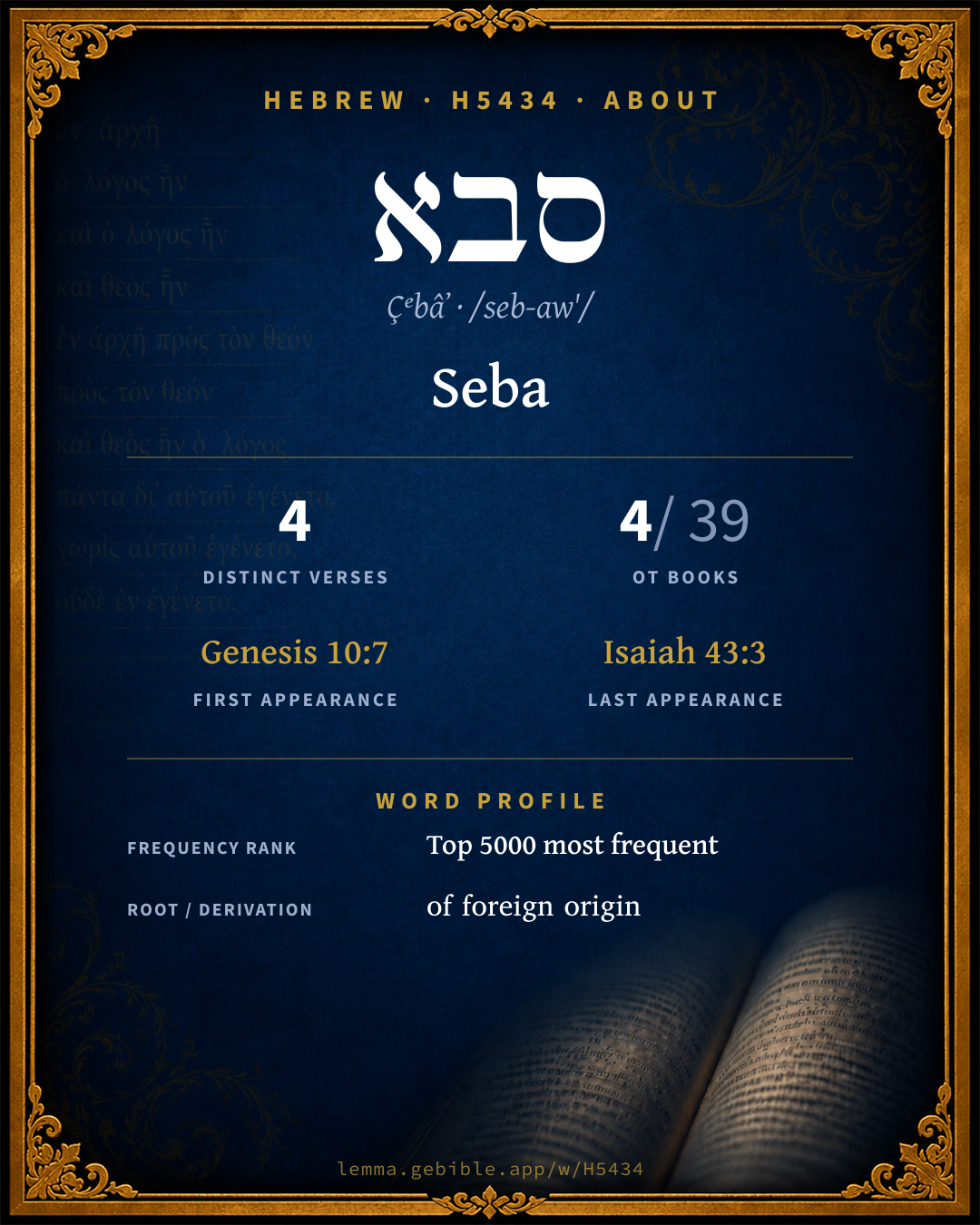
סְבָא
Seba
BDB lists 3 entries for ‘Seba’ fuller range ↓
Full lexicon entry — Brown-Driver-Briggs (BDB)
From Brown-Driver-Briggs (BDB)
Where this word appears
Grammar key — what these labels mean
Part of speech
- Noun
- A naming word — a person, place, thing, or idea.
Noun type
- Proper
- A name of a specific person, place, or people (e.g. Abraham, Zion, Israel).
Every verse where H5434 appears in the Book of Genesis — 1 distinct verse. Click any verse to open its interlinear word-by-word view. Verse text shown in the World English Bible for context — . Each verse’s Hebrew form is shown with its reference; the English is not keyword-highlighted, since the data carries no word-level English alignment. Use “Compare translations” on any verse to read it across multiple English versions. This concordance covers the Hebrew Bible; Septuagint (Greek Old Testament) occurrences are not indexed here.
Genesis
About this entry
At a glance — auto-summarized from this page’s data, not written by a person. Every figure links to its source below. This summary describes the numbers; it doesn’t interpret them.
סבא (Çᵉbâʼ) is a Hebrew name most often rendered “Seba.” The Hebrew Bible uses it only 4 verses. Genesis dominates its distribution — 1 of 4 verses. It first appears in Genesis 10:7. The sections below give every occurrence and version rendering.
Gloss history
Strong's 1890 vs modern scholarship
About this word
Strong's H5434 catalogs a Hebrew word from the Hebrew Old Testament.
These counts are not copied from any lexicon or concordance. They are computed here, from the morphology-tagged Hebrew Old Testament. What Lemma adds →
- 4
- distinct verses
- The word appears in 4 distinct verses.
- 4 / 39
- OT books
- The word appears in 4 of 39 Old Testament books.
- #3,696
- by frequency
- Top 5000 most frequent Hebrew words (rank 3,696 of 8,640 Hebrew words by occurrence).
View all 4 occurrences in the concordance →
Most concentrated in
- Genesis 1 verse 25%
- 1 Chronicles 1 verse 25%
- Psalms 1 verse 25%
By section of the Old Testament
By traditional corpus
Conventional, traditional groupings — biblical authorship is debated, so this is a traditional corpus grouping, not an authorship claim. Each share is this word’s portion of its verses in that division of the Hebrew canon. Each figure is a share of the word’s 4 distinct verses.
- Writings (Ketuvim) 2 verses · 50%
- Torah (Pentateuch) 1 verse · 25%
- Prophets (Nevi'im) 1 verse · 25%
How translations render this word
Counts come from each version’s own published word-to-Strong’s tagging or interlinear alignment — an approximate guide to how each version renders this word, not a word-level alignment the data otherwise carries. Because each total is that version’s own tagged count, the per-version totals vary from one another and need not match the appearance or distinct-verse counts above. These counts may also differ from a printed concordance because Lemma counts each distinctly tagged rendering and does not collapse phrase taggings into a single head-word total. This is a fixed set of word-tagged versions (KJV, ASV, BSB, ULT) and does not change with the reading translation you choose elsewhere. Each version’s license is shown beside its name below (and on Sources).
- King James Version: Seba 4×
- American Standard Version: Seba 3×
- Berean Standard Bible: Seba 4×
- unfoldingWord Literal Text: Seba 4×
King James Version Public Domain
Renders H5434 across 4 tagged occurrences — most commonly:
American Standard Version Public Domain
Renders H5434 across 4 tagged occurrences — most commonly:
Plus 1 rendering that appears only once — usually multi-word phrases or single function words the recovered tagging swept in, not distinct renderings.
Berean Standard Bible Public Domain
Renders H5434 across 4 tagged occurrences — most commonly:
unfoldingWord Literal Text CC BY-SA 4.0
Renders H5434 across 4 tagged occurrences — most commonly:
Senses in BDB
The 3 senses BDB distinguishes for this word, in lexicon order (not ranked by frequency or importance). The full entry — with sub-senses — is in the Lexicon Entry tab.
- Seba = "drink thou"
- a son of Cush (noun proper masculine)
- a nation south of Palestine, perhaps Ethiopia (noun proper locative)
Word origin
n.pr.m. 1st son of Cush, poet. and late;—Gn 10:7 (P) (𝔊 Σαβα, as שְׁבָא) = 1 Ch 1:9 (𝔊 id., but B Σαβατ); = nation (or territory) ψ 72:10 (𝔊 Σαβα; + שְׁבָא, 𝔊 Αραβων), so (+ כּוּשׁ, ‖ מִצְרַיִם) Is 43:3 (𝔊 Σοηνη); clearly situated in south; most prob. = λιμὴν Σαβά, and Σαβαὶ πόλις εὐμεγέθης, in Adulic gulf on W. coast of Red Sea; v. Straboxvi. 4.8.10 Ptol iv. 7, 7 f. DiGn Bae ψ DuIs; > Meroë JosAnt. ii, 10, 2 al.
— Brown-Driver-Briggs (Oxford 1906, public domain), digitized via Sefaria, supplemented by the OpenScriptures HebrewLexicon (CC BY 4.0). See Sources.
Origin: of foreign origin
Jastrow Dictionary
A second Hebrew/Aramaic lexicon for comparison, covering Aramaic and post-biblical (Talmudic, Targumic, Midrashic) usage that the biblical-Hebrew BDB does not. Matched by lemma rather than by Strong’s number, so a lemma may carry more than one Jastrow headword (shown separately below), and the entries cover usage well beyond the Bible.
סָבָא II
- 1. pr. n. m. Saba. Y. Yeb. IX, beg. 10ᵃ ניחא בר ס׳; Y. Kil. IX, beg. 31ᵈ סָבָה.
- 2. כְּפַר ס׳ pr. n. pl. K’far Saba, in Samaria. Y. Dem. II, 22ᶜ bot. (ed. Krot. כפרסבא, one word). Nidd. 61ᵃ; Tosef. ib. VIII, 5 (v. Hildesh. Beitr., p. 10).
סָבָא III
- to drink freely.—Part. pass. סָבוּא, pl. סְבוּאִים, סְבוּאִין soaked, satiated. Nidd. 24ᵇ עצמותיו ס׳ Ar. (ed. סכויין) his bones are found satiated with moisture, i.e. porous, contrad. to משוחין oily, smooth.
סְבָא
- Part. סָבֵי. Targ. O. Deut. XXI, 20.—[Targ. I Sam. XXX, 20 וסבא some ed., read ושְׁבָא.].
- to retail wine in the shop or tavern. B. Bath. 98ᵃ אדעתא לסַבּוּיֵיה with the intention to retail it.
- to satiate, soak; trnsf. (cmp. סָפַג) to lash. Keth. 10ᵃ אַסְבּוּהוּ כופרי make him absorb (strike him with) palm switches. Ib. ומַסְבִּינָן ליה וכ׳ and we lash him nevertheless.
A Dictionary of the Targumim, the Talmud Babli and Yerushalmi, and the Midrashic Literature (Marcus Jastrow; London, Luzac, 1903) — Public Domain. Digitized via Sefaria. Digitized via Sefaria. Full attribution on Sources.
Forms in the corpus
The 3 distinct written forms H5434 takes in the Hebrew Bible, most frequent first — each parse links to that state’s occurrences in the concordance. Hebrew forms include their vowel points and cantillation, so a single lemma takes many written forms.
| Form | Parsing | Example | Uses |
|---|---|---|---|
| סְבָא֙ | Noun, Proper | Genesis 10:7 | 2 |
| וּ/סְבָ֖א | Noun, Proper | Isaiah 43:3 | 1 |
| וּ֝/סְבָ֗א | Noun, Proper | Psalms 72:10 | 1 |
Same root — word family
Other BDB entries built from the same root as H5434, grouped by Strong’s listed origin. These share a root / origin per the lexicon — not necessarily a shared meaning. Each links to that word’s own entry.
Proper names from this root
People and places named from this root — a name, not an additional meaning of the word.
Compare all same-root words → 1 of the same-root words is a proper name (a person or place). They share a root, not necessarily a meaning.
Bible dictionary
Public-domain dictionary articles matched to this entry by name (Seba). A biblical name can be shared by more than one person or place, so an article may treat several.
Easton's Bible Dictionary · M. G. Easton, 1897
(1.) One of the sons of Cush (Gen. 10:7).
(2.) The name of a country and nation (Isa. 43:3; 45:14) mentioned along with Egypt and Ethiopia, and therefore probably in north-eastern Africa. The ancient name of Meroe. The kings of Sheba and Seba are mentioned together in Ps. 72:10.
Smith's Bible Dictionary · William Smith, 1863
(pl. Sebaim ; in Authorized Version incorrectly rendered Sabeans) heads the list of the sons of Cush. Besides the mention of Seba in the lists of the pens of Cush, (Genesis 10:7; 1 Chronicles 1:9) there are but three notices of the nation-- (Psalms 72:10; Isaiah 43:3; 45:14) These passages seem to show that Seba was a nation of Africa bordering on or included in Cush, and in Solomon's time independent and of political importance. It may perhaps be identified with the island of Meroe. Josephus says that Saba was the ancient name of the Ethiopian island and city of Meroe, but he writes Seba, in the notice of the Noachian settlements, Sabas. The island of Meroe lay between the Astaboras, the Atbara, the most northern tributary of the Nile, and the Astapus, the Bahr el-Azrak, "Blue River," the eastern of its two great confluents.
Hitchcock's Bible Names Dictionary · Roswell D. Hitchcock, 1869
a drunkard; that turns
Classic public-domain reference works; full attribution on Sources.
Septuagint verse parallels
This word appears in 4 verses that also exist in the Greek Old Testament (Septuagint), out of the 4 Hebrew verses it occurs in. You can read those verses in Greek by switching the Old Testament edition to the Septuagint.
Read these verses in the Septuagint
This is a verse-level parallel only — the same verses exist in both the Hebrew and Greek Old Testaments. No word-level Hebrew↔Greek correspondence is claimed: the data carries no such alignment, so no Greek word is shown as this Hebrew word’s translation. Coverage is not total — the Septuagint omits the deuterocanon and renumbers the Psalms, so some Hebrew verses have no direct Greek parallel.