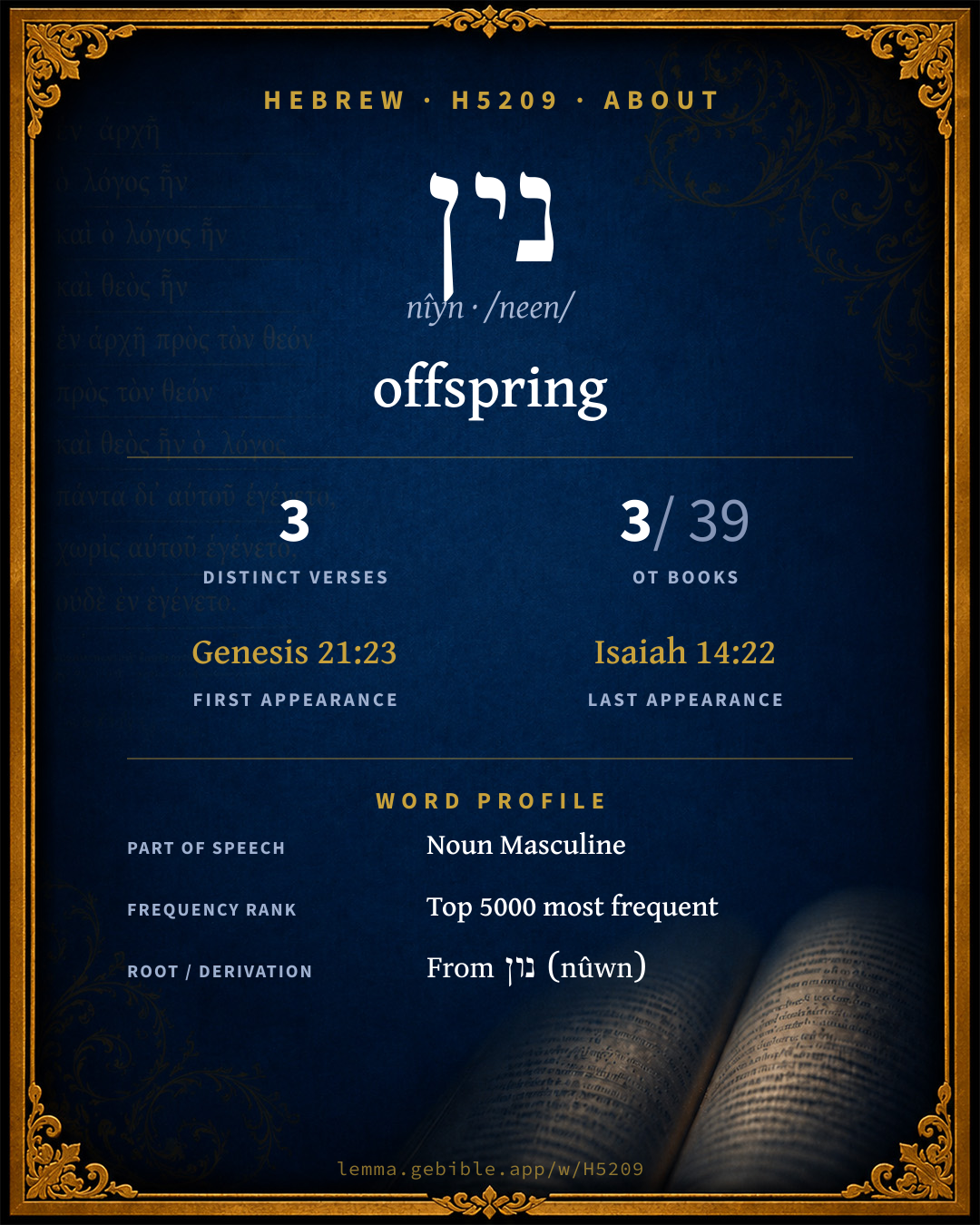
נִין
offspring
Full lexicon entry — Brown-Driver-Briggs (BDB)
From Brown-Driver-Briggs (BDB)
Where this word appears
See every Absolute-state word in the Hebrew Bible →
Grammar key — what these labels mean
Part of speech
- Noun
- A naming word — a person, place, thing, or idea.
Noun type
- Common
- A common noun — a general class of person, place, or thing (“king,” “city,” “water”), not a specific name.
State
- Absolute
- The independent form of a noun, not bound to a following word.
- Construct
- A noun bound to a following noun in a possessive / “of” relationship (the construct chain).
Gender
- Masculine
- Grammatically masculine.
Number
- Singular
- One.
2 distinct verses where H5209 appears in the Absolute state, across 2 books. Filtered view — show all forms. Click any verse to open its interlinear word-by-word view. Verse text shown in the World English Bible for context — . Each verse’s Hebrew form is shown with its reference; the English is not keyword-highlighted, since the data carries no word-level English alignment. Use “Compare translations” on any verse to read it across multiple English versions. This concordance covers the Hebrew Bible; Septuagint (Greek Old Testament) occurrences are not indexed here.
Job 1 verse
Isaiah 1 verse
About this entry
At a glance — auto-summarized from this page’s data, not written by a person. Every figure links to its source below. This summary describes the numbers; it doesn’t interpret them.
נין (nîyn) is a Hebrew noun most often rendered “offspring.” It occurs a mere 3 verses across Scripture. It concentrates in Genesis, which alone accounts for 33% of its uses. Debuting at Genesis 21:23, it then recurs through the corpus. From the same root come נון, מנון and נון. The sections below give every sense, occurrence, and version rendering.
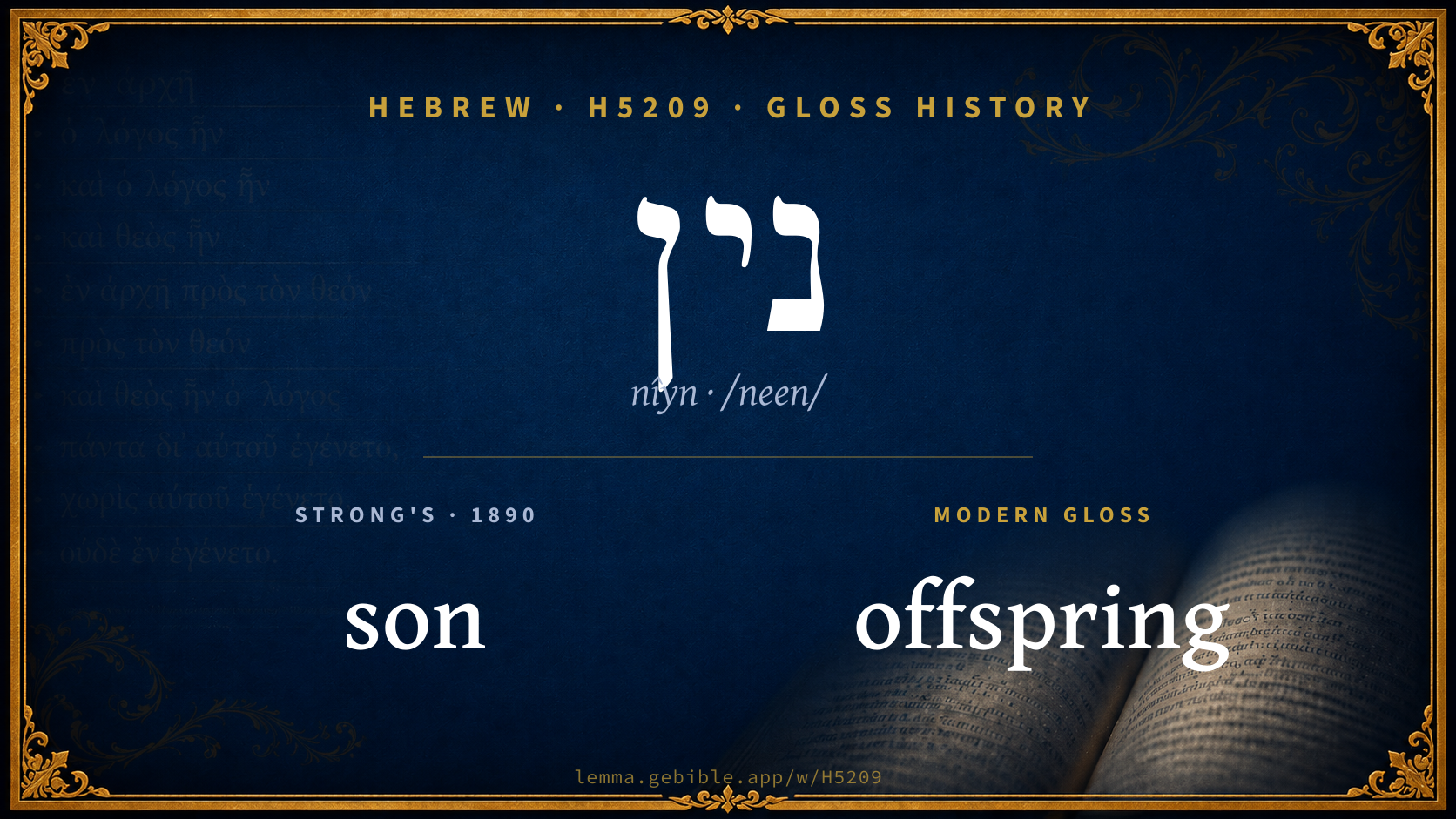
Gloss history
Strong's 1890 vs modern scholarship
About this word
Strong's H5209 catalogs a Hebrew word from the Hebrew Old Testament.
These counts are not copied from any lexicon or concordance. They are computed here, from the morphology-tagged Hebrew Old Testament. What Lemma adds →
- 3
- distinct verses
- The word appears in 3 distinct verses.
- 3 / 39
- OT books
- The word appears in 3 of 39 Old Testament books.
- #4,179
- by frequency
- Top 5000 most frequent Hebrew words (rank 4,179 of 8,640 Hebrew words by occurrence).
View all 3 occurrences in the concordance →
By section of the Old Testament
By traditional corpus
Conventional, traditional groupings — biblical authorship is debated, so this is a traditional corpus grouping, not an authorship claim. Each share is this word’s portion of its verses in that division of the Hebrew canon. Each figure is a share of the word’s 3 distinct verses.
- Torah (Pentateuch) 1 verse · 33%
- Prophets (Nevi'im) 1 verse · 33%
- Writings (Ketuvim) 1 verse · 33%
How translations render this word
Counts come from each version’s own published word-to-Strong’s tagging or interlinear alignment — an approximate guide to how each version renders this word, not a word-level alignment the data otherwise carries. Because each total is that version’s own tagged count, the per-version totals vary from one another and need not match the appearance or distinct-verse counts above. These counts may also differ from a printed concordance because Lemma counts each distinctly tagged rendering and does not collapse phrase taggings into a single head-word total. This is a fixed set of word-tagged versions (KJV, ASV, BSB, ULT) and does not change with the reading translation you choose elsewhere. Each version’s license is shown beside its name below (and on Sources).
BDB lists this Strong’s number as 2 distinct words (homographs). Each count above pools all of them and is not split by sense — see the Senses section below. A low-frequency rendering may belong to a different one of those words, not the primary meaning.
- King James Version†: Son 2×
- American Standard Version†: He shall have neither son 1×, Me 1×, Son 1×
- Berean Standard Bible†: Offspring 2×
- unfoldingWord Literal Text†: Offspring 1×, Or with my children 1×, Son 1×
King James Version Public Domain
Renders H5209 across 3† tagged occurrences — most commonly:
Plus 1 rendering that appears only once — usually multi-word phrases or single function words the recovered tagging swept in, not distinct renderings.
American Standard Version Public Domain
Renders H5209 across 3† tagged occurrences — most commonly:
Berean Standard Bible Public Domain
Renders H5209 across 3† tagged occurrences — most commonly:
Plus 1 rendering that appears only once — usually multi-word phrases or single function words the recovered tagging swept in, not distinct renderings.
unfoldingWord Literal Text CC BY-SA 4.0
Renders H5209 across 3† tagged occurrences — most commonly:
Senses in the full BDB
Hebrew verbs can shift meaning by stem (binyan): Qal is the basic action, Niphal is often passive or reflexive, Piel often intensifies or makes it factitive, and Hiphil is typically causative. The senses below are grouped under the stem BDB assigns to each.
What do BDB’s symbols mean?
BDB uses these scholarly abbreviations:
| Symbol | Meaning |
|---|---|
| 𝔊 | the Septuagint (the ancient Greek translation, LXX) |
| 𝔙 | the Vulgate (the Latin translation) |
| 𝔖 | the Syriac version (the Peshitta) |
| 𝔗 | the Targum (the Aramaic translation) |
| ψ | the Psalms |
| √ | root (the underlying root or stem) |
| ‖ | parallel passage (a synonymous or contrasted parallel) |
| † | the dagger: every passage where the word occurs is cited |
The 2 senses and sub-senses the full Brown-Driver-Briggs lexicon distinguishes for this word, in lexicon order (not ranked by frequency), with BDB’s own verbatim wording and sub-sense lettering. Shown in Hebrew script with BDB’s own scholarly abbreviations. The condensed entry is in the Lexicon Entry tab. See also the Forms in the corpus table below.
נין I opagate, increase (si vera l.) (> denom. from נין Hup-Now SS
Qal
- (or Hiph.?) Impf. ינין Kt; >
Niphal
- ינּוֹן Qr ψ 72:17 let his name have increase (or, if Niph., be propagated, spread); but dub., Vrss perhaps יִכּוֹן be established, endure. e.g. Psalms 72:17
נין II [m.] offspring, posterity
Senses from the full Brown-Driver-Briggs lexicon (Brown, Driver, Briggs; Oxford 1906 — public domain), digitized via Sefaria, supplemented by the OpenScriptures HebrewLexicon (CC BY 4.0). Full attribution on Sources.
Word origin
I. vb. propagate, increase (si vera l.) (> denom. from נין Hup-Now SS;—NH נוּן = fish, so Aramaic נוּנָא, ܢܽܘܢܳܐ, Assyrian nûnu);—
I. n.[m.] offspring, posterity;—abs. Jb 18:19 Is 14:22; sf. נִינִי Gn 21:23 (all ‖ נֶכֶד).
— Brown-Driver-Briggs (Oxford 1906, public domain), digitized via Sefaria, supplemented by the OpenScriptures HebrewLexicon (CC BY 4.0). See Sources.
Derived from נון (nûwn) (H5125) — to increase.
Jastrow Dictionary
A second Hebrew/Aramaic lexicon for comparison, covering Aramaic and post-biblical (Talmudic, Targumic, Midrashic) usage that the biblical-Hebrew BDB does not. Matched by lemma rather than by Strong’s number, so a lemma may carry more than one Jastrow headword (shown separately below), and the entries cover usage well beyond the Bible.
אֲחַשְׁדַּרְפְּנַיָּא
- … m. pl.(h. satraps, Persian governors. Dan. III, 2; a. e.—Cant. R. to VII, 9. e.g. Daniel 3:2
אַשְׁקְלוֹן
- (b. h.) Ashkelon, a Philistian town. Y. Shebi. VI, 36ᶜ; Sifré Deut. 51, v. גִּינְּתָא; a. e.—Deriv. אַשְׁקְלוֹנִי m. Ashkelonian. Y. Peah I, 15ᶜ top.—Pl. אַשְׁקְלוֹנִים, נִין … Kel. XIII, 7 Ashk. levers; a. e.
גַּוָּון
- (גּוּן, constr. גּוֹן) m. (גּוּן) surface, color; resemblance. Erub. 53ᵇ (as specimen of elegant language) מאי גַּוַּון טליתך of what color is thy cloak?—Midr. Till. to Ps. XC, end מפני מה [בחר] תכלת מכל ג׳ why has the blue been preferred to any other color?—Pl. גַּוָּונִים, נִין … Ber. 6ᵇ. Nidd. 24ᵇ ג׳ תנן the Mishnah (III, 2 גנינים) speaks of variegated colors. Num. R. s. 12 מינין הרבה וג׳ הרבה many qualities and many colors; a. fr.—Trnsf. כְּגוֹן (cmp. כְּעֵין s. v. עַיִן) like, similar to; for example. כגון ש־ (Chald. כגון ד׳) for instance if, when. Pes. 119ᵇ כג׳ תמרים וכ׳ such things as dates, roasted ears &c. Ib. כג׳ אורדילאי לי e.g. mushrooms for me. B. Mets. 101ᵃ כג׳ דא צריכא רבה something like this was very necessary to be said. Ḥull. 84ᵃ כג׳אנו people like ourselves (in our condition). Y. Ber. I, 3ᵇ top כג׳ אנו שעוסקין וכ׳ people like ourselves who are engaged &c. Shebi. VIII, 1; 3. Tosef. ib. IV, 8. Orl. II, 7. B. Kam. 108ᵃ כ׳ שטען וכ׳ e.g. if he claims &c. B. Mets. 69ᵃ כ׳ דאית וכ׳ if he has &c.; a. v. fr.—Denom. גִּוֵּון to color. Sabb. 140ᵃ top the egg is put in לגַוֵּון (Ar. לגַוָּאן, Ms. M. לגיאן, O. ליגרון) only for coloring.
מְתוּרְגְּמָן
- (תִּרְגֵּם) interpreter. Lam. R. to I, 13 (ref. to Esth. VII, 5) ויאמר … למ׳ ויאמר המ׳ וכ׳ King Ahasver spoke to the interpreter, and the interpreter to Esther; Yalk. Esth. 1058; (Meg. 16ᵃ תורגמן).—Esp. a) translator (into Chaldaic or Greek) of the Biblical portion read at services. Meg. IV, 4 לא יקרא למ׳ וכ׳ one must not read for the translator more than one verse at a time. Ib. עד כדי שלא יפסוק המ׳ occupying no more time (in rolling the scroll) than the translator requires for interpreting the verse last read; a. e.—b) = אֲמוֹרָא q. v. Ḥull. 142ᵃ ר׳ חוצפית המ׳. Ex. R. s. 3, end; a. e.—Pl. מְתוּרְגְּמָנִים, נִין … Koh. R. to VII, 5. Ib. to IX, 17. Pes. 50ᵇ; a. e. e.g. Esther 7:5
נִין
- [tender,] child, offspring. Mekh. B’shall., Amalek, s. 2 אם אניח נ׳ ונכד וכ׳ I will not leave over a son or son’s son of Amalek; Yalk. Ex. 266).
A Dictionary of the Targumim, the Talmud Babli and Yerushalmi, and the Midrashic Literature (Marcus Jastrow; London, Luzac, 1903) — Public Domain. Digitized via Sefaria. Digitized via Sefaria. Full attribution on Sources.
Forms in the corpus
The 3 distinct written forms H5209 takes in the Hebrew Bible, most frequent first — each parse links to that state’s occurrences in the concordance. Hebrew forms include their vowel points and cantillation, so a single lemma takes many written forms.
| Form | Parsing | Example | Uses |
|---|---|---|---|
| וְ/נִ֥ין | Noun, Common, Masculine, Singular, Absolute | Isaiah 14:22 | 1 |
| וּ/לְ/נִינִ֖/י | Noun, Common, Masculine, Singular, Construct | Genesis 21:23 | 1 |
| נִ֤ין | Noun, Common, Masculine, Singular, Absolute | Job 18:19 | 1 |
Same root — word family
Other BDB entries built from the same root as H5209, grouped by Strong’s listed origin. These share a root / origin per the lexicon — not necessarily a shared meaning. Each links to that word’s own entry.
Derives from
Shares the same root
Proper names from this root
People and places named from this root — a name, not an additional meaning of the word.
Compare all same-root words → 1 of the same-root words is a proper name (a person or place). They share a root, not necessarily a meaning.
Septuagint verse parallels
This word appears in 3 verses that also exist in the Greek Old Testament (Septuagint), out of the 3 Hebrew verses it occurs in. You can read those verses in Greek by switching the Old Testament edition to the Septuagint.
Read these verses in the Septuagint
This is a verse-level parallel only — the same verses exist in both the Hebrew and Greek Old Testaments. No word-level Hebrew↔Greek correspondence is claimed: the data carries no such alignment, so no Greek word is shown as this Hebrew word’s translation. Coverage is not total — the Septuagint omits the deuterocanon and renumbers the Psalms, so some Hebrew verses have no direct Greek parallel.