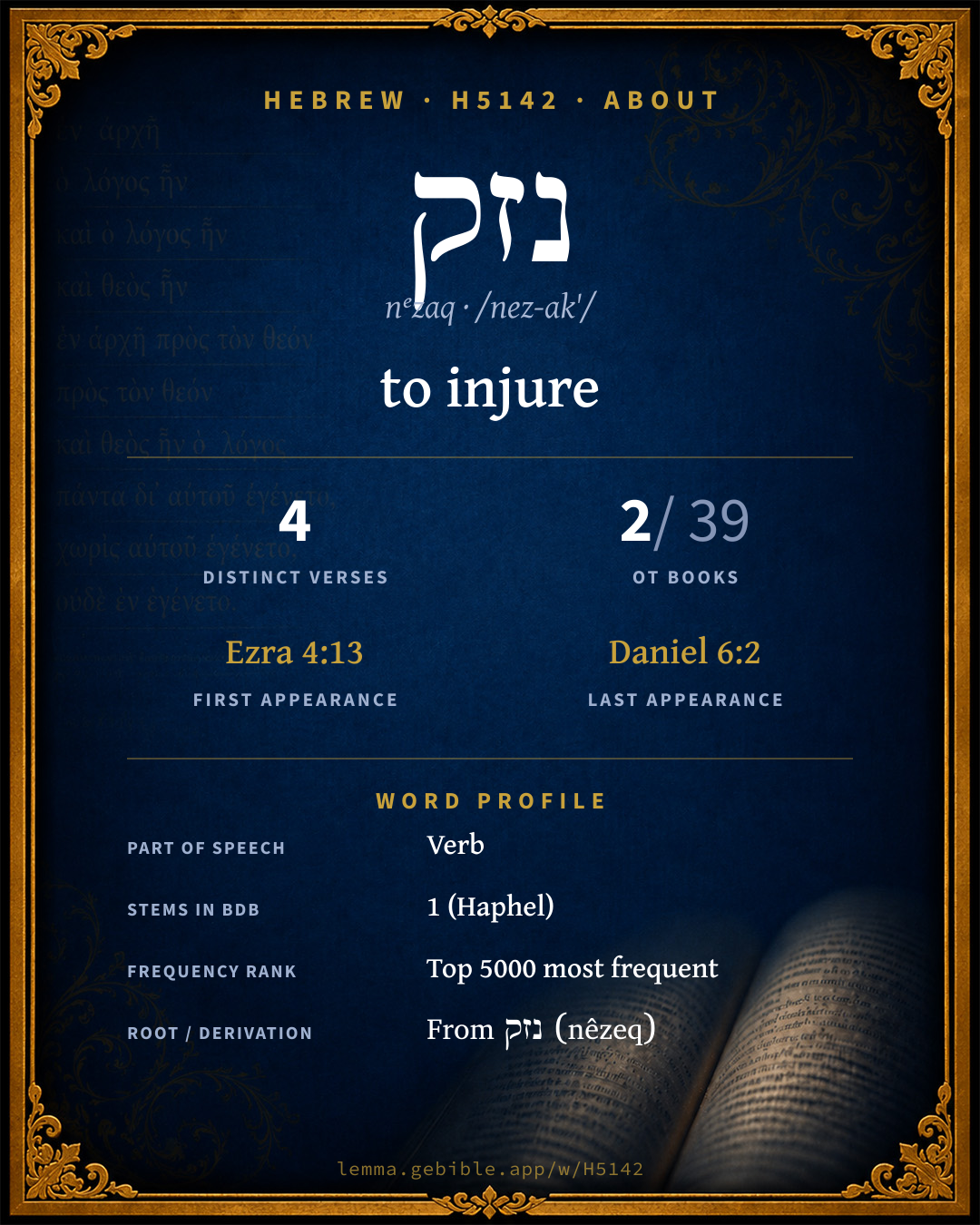
נְזַק
to injure
‘to injure’ is one of 3 main senses fuller range ↓
Full lexicon entry — Brown-Driver-Briggs (BDB)
From Brown-Driver-Briggs (BDB)
Where this word appears
See every Hiphil verb in the Hebrew Bible →
Grammar key — what these labels mean
Part of speech
- Verb
- An action or state-of-being word.
Noun type
- Common
- A common noun — a general class of person, place, or thing (“king,” “city,” “water”), not a specific name.
Stem
- Hiphil
- The causative active stem (“he caused / brought about”).
- Qal
- The basic, simple active stem — the plain form of the verb (“he wrote”).
Form
- Participle Active
- A verbal adjective expressing ongoing or characteristic action (“writing / one who writes”).
- Imperfect
- An incomplete, ongoing, or future action (“he will / would write”).
State
- Construct
- A noun bound to a following noun in a possessive / “of” relationship (the construct chain).
- Absolute
- The independent form of a noun, not bound to a following word.
Person
- 3rd Person
- The one spoken about (“he / she / it / they”).
Gender
- Feminine
- Grammatically feminine.
- Masculine
- Grammatically masculine.
Number
- Singular
- One.
1 distinct verse where H5142 appears in the Qal stem, across 1 book. Filtered view — show all forms. Click any verse to open its interlinear word-by-word view. Verse text shown in the World English Bible for context — . Each verse’s Hebrew form is shown with its reference; the English is not keyword-highlighted, since the data carries no word-level English alignment. Use “Compare translations” on any verse to read it across multiple English versions. This concordance covers the Hebrew Bible; Septuagint (Greek Old Testament) occurrences are not indexed here.
Daniel 1 verse
About this entry
At a glance — auto-summarized from this page’s data, not written by a person. Every figure links to its source below. This summary describes the numbers; it doesn’t interpret them.
At its core, נזק (nᵉzaq) means “to injure.” A scarce word — 4 verses in all of the Hebrew Bible. The word gravitates to Ezra (75%), then Daniel. Scripture first uses it in Ezra 4:13. Carrying more than one sense, it rewards its full sense range. Each statement above links to its evidence; the full detail follows below.
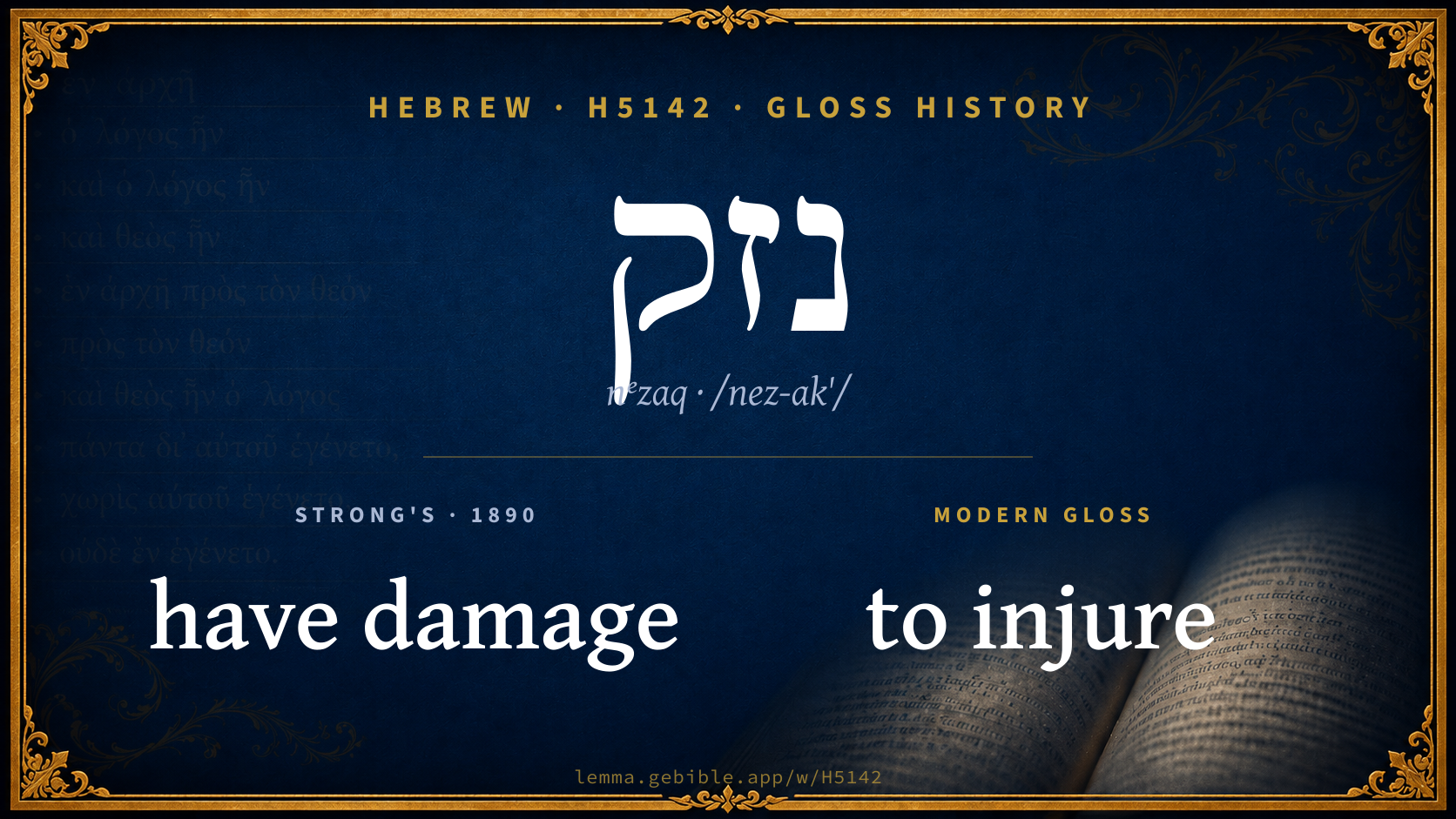
Gloss history
Strong's 1890 vs modern scholarship
About this word
Strong's H5142 catalogs a Hebrew word from the Hebrew Old Testament.
These counts are not copied from any lexicon or concordance. They are computed here, from the morphology-tagged Hebrew Old Testament. What Lemma adds →
- 4
- distinct verses
- The word appears in 4 distinct verses.
- 2 / 39
- OT books
- The word appears in 2 of 39 Old Testament books.
- #3,696
- by frequency
- Top 5000 most frequent Hebrew words (rank 3,696 of 8,640 Hebrew words by occurrence).
View all 4 occurrences in the concordance →
By traditional corpus
Conventional, traditional groupings — biblical authorship is debated, so this is a traditional corpus grouping, not an authorship claim. Each share is this word’s portion of its verses in that division of the Hebrew canon. Each figure is a share of the word’s 4 distinct verses.
- Writings (Ketuvim) 4 verses · 100%
How translations render this word
Counts come from each version’s own published word-to-Strong’s tagging or interlinear alignment — an approximate guide to how each version renders this word, not a word-level alignment the data otherwise carries. Because each total is that version’s own tagged count, the per-version totals vary from one another and need not match the appearance or distinct-verse counts above. These counts may also differ from a printed concordance because Lemma counts each distinctly tagged rendering and does not collapse phrase taggings into a single head-word total. This is a fixed set of word-tagged versions (KJV, ASV, BSB, ULT) and does not change with the reading translation you choose elsewhere. Each version’s license is shown beside its name below (and on Sources).
- King James Version: Damage 1×, Hurt 1×, Hurtful 1×
- American Standard Version: Damage 1×, End it will be hurtful 1×, Hurt 1×
- Berean Standard Bible: Harmful 1×, Interests to suffer 1×, Suffer loss 1×
- unfoldingWord Literal Text: Harm of 1×, Loss 1×, One that has caused harm to 1×
King James Version Public Domain
Renders H5142 across 4 tagged occurrences — most commonly:
American Standard Version Public Domain
Renders H5142 across 4 tagged occurrences — most commonly:
Berean Standard Bible Public Domain
Renders H5142 across 4 tagged occurrences — most commonly:
unfoldingWord Literal Text CC BY-SA 4.0
Renders H5142 across 5 tagged occurrences — most commonly:
Senses in the full BDB
What do BDB’s symbols mean?
BDB uses these scholarly abbreviations:
| Symbol | Meaning |
|---|---|
| 𝔊 | the Septuagint (the ancient Greek translation, LXX) |
| 𝔙 | the Vulgate (the Latin translation) |
| 𝔖 | the Syriac version (the Peshitta) |
| 𝔗 | the Targum (the Aramaic translation) |
| ψ | the Psalms |
| √ | root (the underlying root or stem) |
| ‖ | parallel passage (a synonymous or contrasted parallel) |
| † | the dagger: every passage where the word occurs is cited |
The 1 sense the full Brown-Driver-Briggs lexicon distinguishes for this word, in lexicon order (not ranked by frequency), with BDB’s own verbatim wording and sub-sense lettering. Shown in Hebrew script with BDB’s own scholarly abbreviations. The condensed entry is in the Lexicon Entry tab. See also the Forms in the corpus table below.
Haphel
- . injure
Senses from the full Brown-Driver-Briggs lexicon (Brown, Driver, Briggs; Oxford 1906 — public domain), digitized via Sefaria, supplemented by the OpenScriptures HebrewLexicon (CC BY 4.0). Full attribution on Sources.
Word origin
[ נְזַק ] vb. suffer injury
— Brown-Driver-Briggs (Oxford 1906, public domain), digitized via Sefaria, supplemented by the OpenScriptures HebrewLexicon (CC BY 4.0). See Sources.
Derived from נזק (nêzeq) (H5143) — injury.
Jastrow Dictionary
A second Hebrew/Aramaic lexicon for comparison, covering Aramaic and post-biblical (Talmudic, Targumic, Midrashic) usage that the biblical-Hebrew BDB does not. Matched by lemma rather than by Strong’s number, so a lemma may carry more than one Jastrow headword (shown separately below), and the entries cover usage well beyond the Bible.
נָזַק
- Hif. הִזִּיק (denom. of נֵזֶק) to hurt, injure, damage. Ex. R. s. 20, beg. דלג … ולא הִזִּיקוֹ stepped over the child and did not injure it. B. Kam. I, 1 לילך ולהַזִּיק to do injury in moving (be an active agency of damage); ib. וכשה׳ חב וכ׳ and when one of them caused damage, the offender (מַזִּיק) is responsible. Ib. III, 6 והִזִּיקוּ זה וכ׳ and hurt one another (by collision); a. fr.—V. מַזִּיק.
- to be hurt, injured, damaged. Ib. III, 1, sq. Ib. 31ᵇ שהוּזְּקוּ כלים בכלים vessels (belonging to one person) were damaged by collision with (another person’s) vessels; a. fr.
- same. Ex. R. l. c. end שלא יִנָּזְקוּ that they be not hurt (by the wolves). Deut. R. s. 7 ולא תִנָּזֵק צפורנו של אחד מהם rather than a nail of one of them be injured; a. e.—Usu. part. נִיזּוֹק, נִזּוֹק; pl. נִיזּוֹקִים, נִיזּוֹקִין. Ber. 9ᵇ אינו נ׳ כל וכ׳ has no evil to fear for the entire day. Ib. 40ᵃ ואי אתה נ׳ and thou shalt not get sick; a. fr.—Ḥull. 142ᵃ; Pes. 8ᵇ, a. e. שלוחי מצוה אינן נ׳ those going on a religious mission will not meet with evil; a. e.—V. נִיזָּק.
נְזַק
- Targ. Ps. XCI, 7 יקרבון למִנְזָק (h. text יגש); a. e.
- same. Targ. Jer. XII, 14 (h. text נגע); a. e.
- (הַנְזֵק), אַזֵּיק same. Targ. O. Gen. XXVI, 11. Targ. Ex. XI, 7 לא יַנְזֵק … בלישניה ed. Berl. (ed. Vien. לישניה, corr. acc.; Y. יְהַנְ׳); a. e.—B. Kam. 27ᵇ הוא דא׳ אנפשיה it is he who hurt himself (through his own action); ib. 28ᵃ א׳ נפשיה. Ib. 13ᵇ אַזְּקֵיה תורא דמשאיל וכ׳ the ox of the lender injured that of the borrower. Ib. אזקי ed. (read with Ms. M. אזקיה). B. Mets. 117ᵃ אזלי ומַזְּקֵי וכ׳ the water came down and damaged the property of those living below; a. fr.—Gitt. 53ᵃ לאוזוקי קא מכוין (read: לאַזּוּקֵיה or לאַנְזוּקֵיה, Rashi לצעריה) he has the intention to harm him.
- , Ittaf. אִיתַּזַּק; Ithpe. אִיתְנְזִיק, אִינְּזִיק to be hurt, to meet with an accident. Targ. II Chr. XXXII, 31. Targ. Job V, 24.—B. Kam. 13ᵇ אילו איתזק מעלמא if he had been hurt through any other cause. Ber. 9ᵇ ואִיתַּזְּקִי and I met with evil; במאי אִיתַּזְּקַת what was the evil thou didst meet with?—Lev. R. s. 24 ולית אתון מִתְנַזְּקִין and you have never been injured. Kidd. 29ᵇ הוו מִיתַּזְּקֵי they used to be hurt (by a demon, v. מַזִּיק); a. fr.
נֵזֶק
- [junction, touch; cmp. נגע, רע &c.,] accident, evil, injury, damage; תַּשְׁלוּמֵי נ׳ indemnity. Ab. Zar. I, 7 וכל דבר שיש בו נ׳ לרבים or anything through which the public may be injured. B. Kam. I, 1 חב … לשלם תשלומי נ׳ וכ׳ the offender is bound to pay indemnity with the best of the land (out of his best lands, v. עִידִית). Ib. 2 הכשרתי במקצת נִזְקוֹ I have been partly instrumental in injuring him, v. הֶכְשֵׁר. Ib. II, 5, a. fr. חצי נ׳ indemnity up to half the damage, opp. נ׳ שלם full indemnity. Ib. VIII, 1 בנ׳ בצער וכ׳ (has to pay) damages (for the maimed limb), an indemnity for the pain inflicted &c.; a. fr.—Pl. נְזָקִים, נְזָקִין; constr. נִזְקֵי. Ib. 84ᵃ דנין נ׳ מנ׳ וכ׳ we may draw an analogy between different cases of mayhem, but not between mayhem and homicide. Ib. נ׳ שור בשור damages for an ox injured by an ox; a. fr.—נְזָקִין, נְזִיקִין (fr. נָזִיק) cases of damages, laws concerning injuries; damages. Ib. I, 1, v. אָב II. Mekh. Mishp. s. 14; a. fr., v. נִיזָּקִין.—Esp. N’ziḳin, (Seder N’ziḳin) name of the fourth Order of the Mishnah, Tosefta and Talmud, also of a section of M’khilta Mishpaṭim. Sabb. 31ᵃ. Lev. R. s. 19 נ׳ ל׳ פרקים N. which contains thirty chapters; a. e.—B. Kam. 102ᵃ כולה נ׳ חדא וכ׳ the entire N’ziḳin (Baba Ḳamma, M’tsiʿa and Bathra) is one treatise.
נֶזֶק
- Targ. O. Ex. XXIV, 11. Targ. Y. ib. XXX, 12 ני׳ דמותא (h. text נגף). Ib. XXI, 19; a. e.—B. Kam. 84ᵃ לבר מנזקא Ms. M. (ed. מנזק) except indemnity for loss of limb. Ib. שומו ליה נִיזְקֵיה assess the damages due him for the loss of his hand; a. fr.
A Dictionary of the Targumim, the Talmud Babli and Yerushalmi, and the Midrashic Literature (Marcus Jastrow; London, Luzac, 1903) — Public Domain. Digitized via Sefaria. Digitized via Sefaria. Full attribution on Sources.
Forms in the corpus
The 4 distinct written forms H5142 takes in the Hebrew Bible, most frequent first — each parse links to that stem’s occurrences in the concordance. Hebrew forms include their vowel points and cantillation, so a single lemma takes many written forms.
| Form | Parsing | Example | Uses |
|---|---|---|---|
| וּֽ/מְהַנְזְקַ֤ת | Verb, Hiphil, Participle Active, Feminine, Singular, Construct | Ezra 4:15 | 1 |
| לְ/הַנְזָקַ֖ת | Noun, Common, Feminine, Singular, Construct | Ezra 4:22 | 1 |
| נָזִֽק | Verb, Qal, Participle Active, Masculine, Singular, Absolute | Daniel 6:2 | 1 |
| תְּהַנְזִֽק | Verb, Hiphil, Imperfect, 3rd Person, Masculine, Singular | Ezra 4:13 | 1 |
Septuagint verse parallels
This word appears in 4 verses that also exist in the Greek Old Testament (Septuagint), out of the 4 Hebrew verses it occurs in. You can read those verses in Greek by switching the Old Testament edition to the Septuagint.
Read these verses in the Septuagint
This is a verse-level parallel only — the same verses exist in both the Hebrew and Greek Old Testaments. No word-level Hebrew↔Greek correspondence is claimed: the data carries no such alignment, so no Greek word is shown as this Hebrew word’s translation. Coverage is not total — the Septuagint omits the deuterocanon and renumbers the Psalms, so some Hebrew verses have no direct Greek parallel.