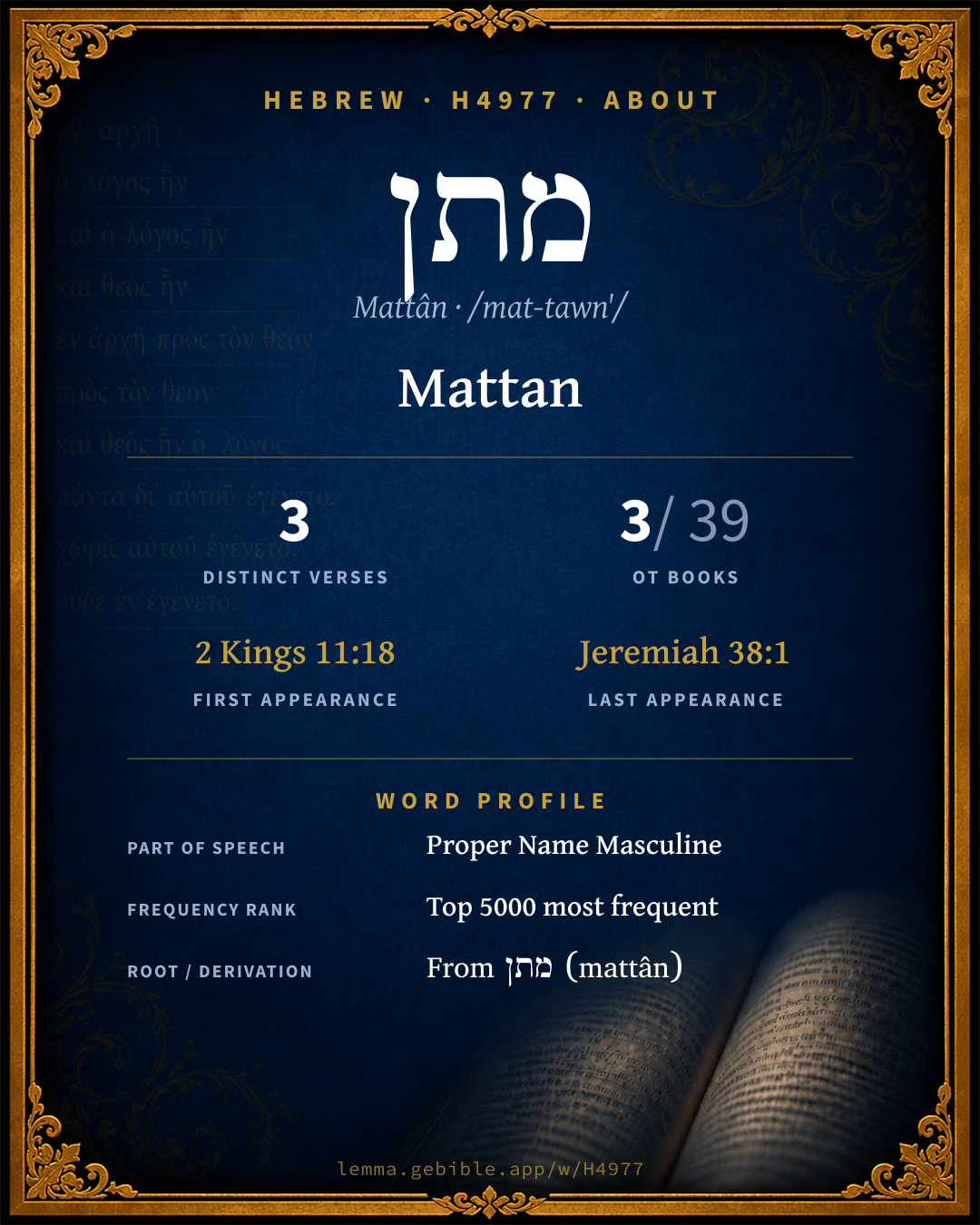
מַתָּן
Mattan
BDB lists 3 entries for ‘Mattan’ fuller range ↓
Full lexicon entry — Brown-Driver-Briggs (BDB)
From Brown-Driver-Briggs (BDB)
Where this word appears
Grammar key — what these labels mean
Part of speech
- Noun
- A naming word — a person, place, thing, or idea.
Noun type
- Proper
- A name of a specific person, place, or people (e.g. Abraham, Zion, Israel).
Every verse where H4977 appears in the Book of Jeremiah — 1 distinct verse. Click any verse to open its interlinear word-by-word view. Verse text shown in the World English Bible for context — . Each verse’s Hebrew form is shown with its reference; the English is not keyword-highlighted, since the data carries no word-level English alignment. Use “Compare translations” on any verse to read it across multiple English versions. This concordance covers the Hebrew Bible; Septuagint (Greek Old Testament) occurrences are not indexed here.
Jeremiah
About this entry
At a glance — auto-summarized from this page’s data, not written by a person. Every figure links to its source below. This summary describes the numbers; it doesn’t interpret them.
“Mattan” is the headline sense of the Hebrew name מתן (Mattân). A scarce word — 3 verses in all of the Hebrew Bible. It concentrates in 2 Kings, which alone accounts for 33% of its uses. First canonically at 2 Kings 11:18, it enters the text early. See 3-verse concordance and the renderings breakdown below.
Gloss history
Strong's 1890 vs modern scholarship
About this word
Strong's H4977 catalogs a Hebrew word from the Hebrew Old Testament.
These counts are not copied from any lexicon or concordance. They are computed here, from the morphology-tagged Hebrew Old Testament. What Lemma adds →
- 3
- distinct verses
- The word appears in 3 distinct verses.
- 3 / 39
- OT books
- The word appears in 3 of 39 Old Testament books.
- #4,179
- by frequency
- Top 5000 most frequent Hebrew words (rank 4,179 of 8,640 Hebrew words by occurrence).
View all 3 occurrences in the concordance →
Most concentrated in
- 2 Kings 1 verse 33%
- 2 Chronicles 1 verse 33%
- Jeremiah 1 verse 33%
By section of the Old Testament
By traditional corpus
Conventional, traditional groupings — biblical authorship is debated, so this is a traditional corpus grouping, not an authorship claim. Each share is this word’s portion of its verses in that division of the Hebrew canon. Each figure is a share of the word’s 3 distinct verses.
- Prophets (Nevi'im) 2 verses · 67%
- Writings (Ketuvim) 1 verse · 33%
How translations render this word
Counts come from each version’s own published word-to-Strong’s tagging or interlinear alignment — an approximate guide to how each version renders this word, not a word-level alignment the data otherwise carries. Because each total is that version’s own tagged count, the per-version totals vary from one another and need not match the appearance or distinct-verse counts above. These counts may also differ from a printed concordance because Lemma counts each distinctly tagged rendering and does not collapse phrase taggings into a single head-word total. This is a fixed set of word-tagged versions (KJV, ASV, BSB, ULT) and does not change with the reading translation you choose elsewhere. Each version’s license is shown beside its name below (and on Sources).
BDB lists this Strong’s number as 3 distinct words (homographs). Each count above pools all of them and is not split by sense — see the Senses section below. A low-frequency rendering may belong to a different one of those words, not the primary meaning.
- King James Version†: Mattan 3×
- American Standard Version†: Mattan 3×
- Berean Standard Bible†: Mattan 3×
- unfoldingWord Literal Text†: Mattan 2×
King James Version Public Domain
Renders H4977 across 3† tagged occurrences — most commonly:
American Standard Version Public Domain
Renders H4977 across 3† tagged occurrences — most commonly:
Berean Standard Bible Public Domain
Renders H4977 across 3† tagged occurrences — most commonly:
unfoldingWord Literal Text CC BY-SA 4.0
Renders H4977 across 3† tagged occurrences — most commonly:
Plus 1 rendering that appears only once — usually multi-word phrases or single function words the recovered tagging swept in, not distinct renderings.
Senses in the full BDB
What do BDB’s symbols mean?
BDB uses these scholarly abbreviations:
| Symbol | Meaning |
|---|---|
| 𝔊 | the Septuagint (the ancient Greek translation, LXX) |
| 𝔙 | the Vulgate (the Latin translation) |
| 𝔖 | the Syriac version (the Peshitta) |
| 𝔗 | the Targum (the Aramaic translation) |
| ψ | the Psalms |
| √ | root (the underlying root or stem) |
| ‖ | parallel passage (a synonymous or contrasted parallel) |
| † | the dagger: every passage where the word occurs is cited |
The 2 senses and sub-senses the full Brown-Driver-Briggs lexicon distinguishes for this word, in lexicon order (not ranked by frequency), with BDB’s own verbatim wording and sub-sense lettering. Shown in Hebrew script with BDB’s own scholarly abbreviations. The condensed entry is in the Lexicon Entry tab. See also the Forms in the corpus table below.
מתן I i, ii. מַתָּנָה, מַתְּנַי, מַתַּנְיָה(וּ) v. נתן.
מתן II
- 1. priest of Baal at Jerusalem 2 K 11:18 = 2 Ch 23:17; 𝔊 Μαγθαν, Ματθαν, 𝔊L Ματθαν. e.g. 2 Kings 11:18
- 2. father of Shephatiah, in Judah Je 38:1; 𝔊 Ναθαν, Μαθθᾱ. e.g. Jeremiah 38:1
Senses from the full Brown-Driver-Briggs lexicon (Brown, Driver, Briggs; Oxford 1906 — public domain), digitized via Sefaria, supplemented by the OpenScriptures HebrewLexicon (CC BY 4.0). Full attribution on Sources.
Word origin
n.m. Pr 18:16 coll. gift(s);—abs. מ׳ Gn 34:12 + 2 times; cstr. id. Pr 18:16 (v. Baer ad loc. Ges§ 92 g Köii 1, 98); sf. מַתָּנָם Nu 18:11;—marriage-gifts Gn 34:12 (J; + מֹהַר); offerings Nu 18:11 (P; תְּרוּמַת מ׳); elsewhere gen., gifts, presents, Pr 18:16; 21:14 (‖ שֹׁחַד); אִישׁ מַתָּן 19:6 = a giver of gifts.
— Brown-Driver-Briggs (Oxford 1906, public domain), digitized via Sefaria, supplemented by the OpenScriptures HebrewLexicon (CC BY 4.0). See Sources.
Derived from מתן (mattân) (H4976) — gifts.
Jastrow Dictionary
A second Hebrew/Aramaic lexicon for comparison, covering Aramaic and post-biblical (Talmudic, Targumic, Midrashic) usage that the biblical-Hebrew BDB does not. Matched by lemma rather than by Strong’s number, so a lemma may carry more than one Jastrow headword (shown separately below), and the entries cover usage well beyond the Bible.
מָתַן
- [to stretch,] (cmp. ארך) to be long, slow; to wait; esp. (of fruits taken off the tree) to lie over for complete ripening. Toh. IX, 5 שיִמְתּוֹנוּ שיהו וכ׳ that they (the olives) may lie over so that they be easy to crush; ib. שימתונו שימלחם that they may lie over until they be ripe for salting; Tosef. ib. X, 10 שיַמְתִּינֵם ושימלחם (Hif.) to let them lie over &c.
- 1. (neut. verb) (neut. verb) to last, remain fresh, keep. Makhsh. VI, 2 בשביל שיַמְתִּינוּ (Maim. in comment. ed. Dehr. שימתונו) that they may remain fresh (Maim.). Sabb. XXIII, 5 (of a corpse) בשביל שיַמְתִּין (Ar. שיִמָּתֵן, Nif.) that it may be preserved.
- 2. to keep, to let (fruits) lie over. Tosef. Makhsh. l. c., v. supra.
- 3. to wait, tarry, postpone. Ḥull. II, 4. Ib. 47ᵇ הַמְתִּינִי לו עד וכ׳ postpone his circumcision until &c. Y. Pes. X, 37ᵈ אילו נַמְתִּין וכ׳ (not ממתין) if we were to wait (with the recital of the exodus) until &c. Gen. R. s. 18 (play on יתבששו, Gen. II, 25) לא הִמְתִּינוּ בשלותן וכ׳ they did not remain in their happiness for six hours; a. fr. e.g. Genesis 2:25
- 4. to be slow, patient. Ab. d’R. N. ch. I שיהא אדם מַמְתִּין בדבריו ואל יהא מקפיד על דבריו that man should be slow and patient in giving his opinion, and not angrily insist on his words.
מְתַן
- , to cause delay, to let wait. Targ. Job XXXII, 4 (h. text חִכָּה).—Part. pass. מְתִין waiting, detained, fr. which מְתִין, מְתֵין to wait for, hope; to be slow. Targ. Lam. II, 16. Targ. Esth. II, 12. Targ. Ps. LVI, 7. Ib. CXXX, 5 מְתֵינִית Ms. (ed. אַמְתִּינֵית Af.); a. e.—Yeb. 63ᵃ מְתוֹן נסיב וכ׳ be slow in taking a wife, opp. קפוץ.—V. מְתִין.
- to tarry, remain; to wait. Targ. Y. I Gen. II, 25 (v. Gen. R. s. 18, quot. in preced.). Ib. XXXI, 28 לא אַמְתַּנְתַּנִי thou didst not wait for me (give me an opportunity, h. text נטשתני). Targ. I Chr. IV, 18; a. fr.—Yeb. 91ᵇ איבעי לה לאַמְתּוּנֵי she ought to have waited.
מָתַן ²
- = מָאתָן, v. מְאָה. Targ. O. Num. XVI, 2; 17 ed. Berl.
מַתָּן
- giving, gift.—מַתּן תורה giving of the Law, revelation at Mount Sinai. Ber. 58ᵃ bot. Gen. R. s. 34; a. fr.—מ׳ שכר reward. Ab. II, 16; a. fr.—מ׳ דמים sprinkling or smearing the blood (on the altar &c.). R. Hash. 28ᵇ; a. fr.—Zeb. VIII, 10 מַתַּן ארבע במ׳ ארבע blood requiring four applications mixed with &c.; R. Hash. l. c.; Y. Erub. X, end, 26ᵈ; Bab. Erub. 100ᵃ. Ib. מ׳ ארבע במ׳ אחת (Zeb. l. c. במתנה) blood requiring four applications mixed with blood requiring one application; a. fr.—מַשָּׂא ומַ׳, v. מַשָּׂא.
A Dictionary of the Targumim, the Talmud Babli and Yerushalmi, and the Midrashic Literature (Marcus Jastrow; London, Luzac, 1903) — Public Domain. Digitized via Sefaria. Digitized via Sefaria. Full attribution on Sources.
Forms in the corpus
The 2 distinct written forms H4977 takes in the Hebrew Bible, most frequent first — each parse links to that state’s occurrences in the concordance. Hebrew forms include their vowel points and cantillation, so a single lemma takes many written forms.
| Form | Parsing | Example | Uses |
|---|---|---|---|
| מַתָּן֙ | Noun, Proper | 2 Chronicles 23:17 | 2 |
| מַתָּ֗ן | Noun, Proper | Jeremiah 38:1 | 1 |
Same root — word family
Other BDB entries built from the same root as H4977, grouped by Strong’s listed origin. These share a root / origin per the lexicon — not necessarily a shared meaning. Each links to that word’s own entry.
Derives from
Shares the same root
Proper names from this root
People and places named from this root — a name, not an additional meaning of the word.
Compare all same-root words → Showing 4 of 7 — not the complete family. 3 of the same-root words are proper names (people or places). They share a root, not necessarily a meaning.
Bible dictionary
Public-domain dictionary articles matched to this entry by name (Mattan). A biblical name can be shared by more than one person or place, so an article may treat several.
Easton's Bible Dictionary · M. G. Easton, 1897
Gift. (1.) A priest of Baal, slain before his altar during the reformation under Jehoiada (2 Kings 11:18).
(2.) The son of Eleazar, and father of Jacob, who was the father of Joseph, the husband of the Virgin Mary (Matt. 1:15).
(3.) The father of Shephatiah (Jer. 38:1).
Smith's Bible Dictionary · William Smith, 1863
(a gift).
+ The priest of Baal slain before his altars in the idol temple at Jerusalem. (2 Kings 11:18; 2 Chronicles 23:17) He probably accompanied Athalia from Samaria. + The father of Shephatiah. (Jeremiah 38:1)
Hitchcock's Bible Names Dictionary · Roswell D. Hitchcock, 1869
Mattana, Mattenai, gifts; rains
Classic public-domain reference works; full attribution on Sources.
Septuagint verse parallels
This word appears in 3 verses that also exist in the Greek Old Testament (Septuagint), out of the 3 Hebrew verses it occurs in. You can read those verses in Greek by switching the Old Testament edition to the Septuagint.
Read these verses in the Septuagint
This is a verse-level parallel only — the same verses exist in both the Hebrew and Greek Old Testaments. No word-level Hebrew↔Greek correspondence is claimed: the data carries no such alignment, so no Greek word is shown as this Hebrew word’s translation. Coverage is not total — the Septuagint omits the deuterocanon and renumbers the Psalms, so some Hebrew verses have no direct Greek parallel.