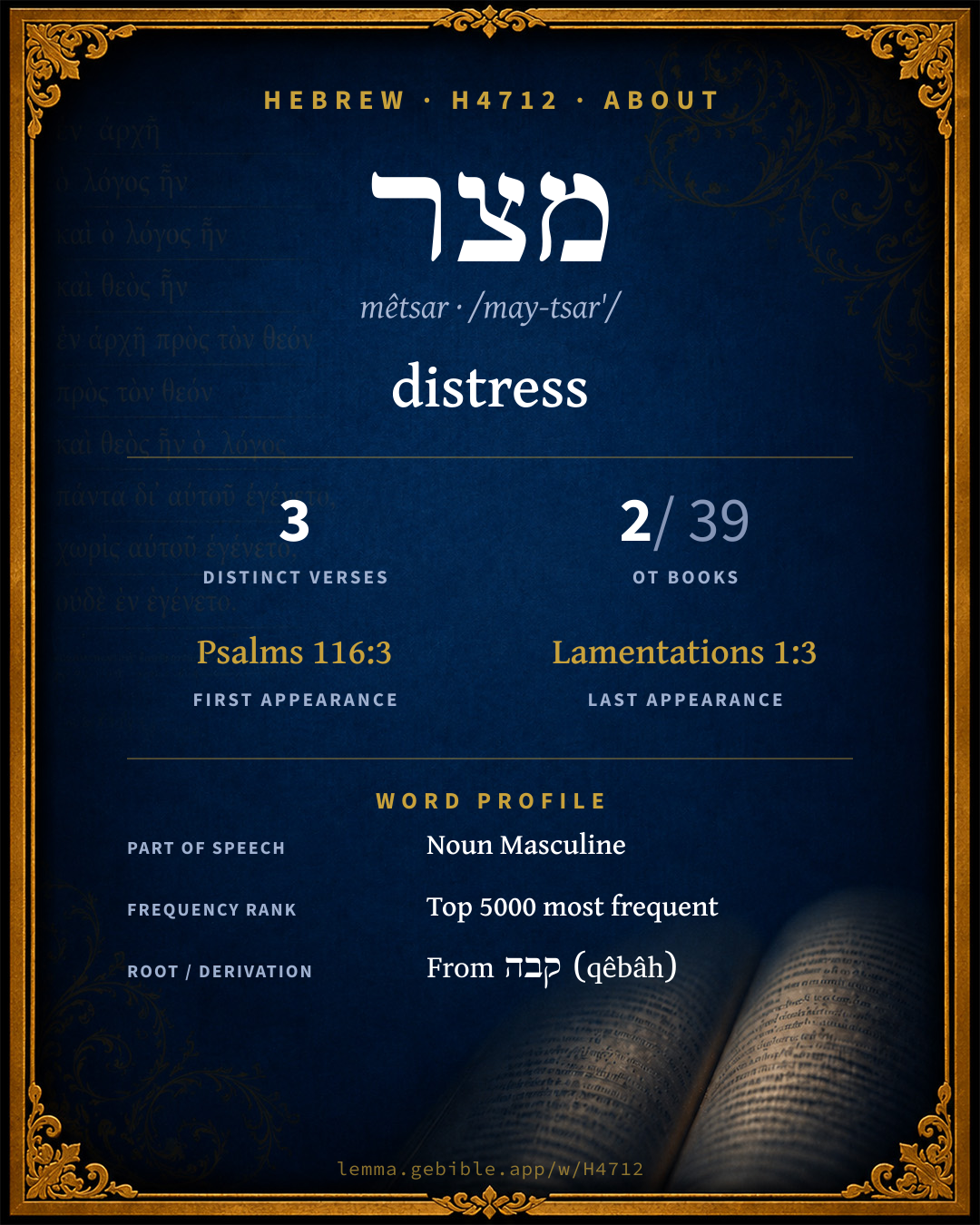
מֵצַר
distress
Full lexicon entry — Brown-Driver-Briggs (BDB)
From Brown-Driver-Briggs (BDB)
Where this word appears
See every Absolute-state word in the Hebrew Bible →
Grammar key — what these labels mean
Noun type
- Common
- A common noun — a general class of person, place, or thing (“king,” “city,” “water”), not a specific name.
State
- Construct
- A noun bound to a following noun in a possessive / “of” relationship (the construct chain).
- Absolute
- The independent form of a noun, not bound to a following word.
Gender
- Masculine
- Grammatically masculine.
Number
- Plural
- More than one (in Hebrew, generally three or more).
- Singular
- One.
Every verse where H4712 appears in the Book of Psalms — 2 distinct verses. Click any verse to open its interlinear word-by-word view. Verse text shown in the World English Bible for context — . Each verse’s Hebrew form is shown with its reference; the English is not keyword-highlighted, since the data carries no word-level English alignment. Use “Compare translations” on any verse to read it across multiple English versions. This concordance covers the Hebrew Bible; Septuagint (Greek Old Testament) occurrences are not indexed here.
Psalms
About this entry
At a glance — auto-summarized from this page’s data, not written by a person. Every figure links to its source below. This summary describes the numbers; it doesn’t interpret them.
The Hebrew noun מצר centers on the idea of “distress.” The Hebrew Bible uses it only 3 verses. The word gravitates to Psalms (67%), then Lamentations. Its earliest occurrence is Psalms 116:3. Dig into 3-verse concordance and the renderings breakdown below.
Gloss history
Strong's 1890 vs modern scholarship
About this word
Strong's H4712 catalogs a Hebrew word from the Hebrew Old Testament.
These counts are not copied from any lexicon or concordance. They are computed here, from the morphology-tagged Hebrew Old Testament. What Lemma adds →
- 3
- distinct verses
- The word appears in 3 distinct verses.
- 2 / 39
- OT books
- The word appears in 2 of 39 Old Testament books.
- #4,179
- by frequency
- Top 5000 most frequent Hebrew words (rank 4,179 of 8,640 Hebrew words by occurrence).
View all 3 occurrences in the concordance →
Most concentrated in
- Psalms 2 verses 67%
- Lamentations 1 verse 33%
By section of the Old Testament
By traditional corpus
Conventional, traditional groupings — biblical authorship is debated, so this is a traditional corpus grouping, not an authorship claim. Each share is this word’s portion of its verses in that division of the Hebrew canon. Each figure is a share of the word’s 3 distinct verses.
- Writings (Ketuvim) 3 verses · 100%
How translations render this word
Counts come from each version’s own published word-to-Strong’s tagging or interlinear alignment — an approximate guide to how each version renders this word, not a word-level alignment the data otherwise carries. Because each total is that version’s own tagged count, the per-version totals vary from one another and need not match the appearance or distinct-verse counts above. These counts may also differ from a printed concordance because Lemma counts each distinctly tagged rendering and does not collapse phrase taggings into a single head-word total. This is a fixed set of word-tagged versions (KJV, ASV, BSB, ULT) and does not change with the reading translation you choose elsewhere. Each version’s license is shown beside its name below (and on Sources).
- King James Version: Between the straits 1×, Distress 1×, Pains 1×
- American Standard Version: Distress 1×, Me 1×, Within the straits 1×
- Berean Standard Bible: Distress 2×
- unfoldingWord Literal Text: Constriction 1×, Constrictions 1×, Narrow passes 1×
King James Version Public Domain
Renders H4712 across 3 tagged occurrences — most commonly:
American Standard Version Public Domain
Renders H4712 across 3 tagged occurrences — most commonly:
Berean Standard Bible Public Domain
Renders H4712 across 3 tagged occurrences — most commonly:
Plus 1 rendering that appears only once — usually multi-word phrases or single function words the recovered tagging swept in, not distinct renderings.
unfoldingWord Literal Text CC BY-SA 4.0
Renders H4712 across 3 tagged occurrences — most commonly:
Senses in BDB
The 1 sense BDB distinguishes for this word, in lexicon order (not ranked by frequency or importance). The full entry — with sub-senses — is in the Lexicon Entry tab.
- straits, distress
Word origin
מֵצַר n.[m.] straits, distress;—abs.
— Brown-Driver-Briggs (Oxford 1906, public domain), digitized via Sefaria, supplemented by the OpenScriptures HebrewLexicon (CC BY 4.0). See Sources.
Derived from קבה (qêbâh) (H6896) — belly.
Jastrow Dictionary
A second Hebrew/Aramaic lexicon for comparison, covering Aramaic and post-biblical (Talmudic, Targumic, Midrashic) usage that the biblical-Hebrew BDB does not. Matched by lemma rather than by Strong’s number, so a lemma may carry more than one Jastrow headword (shown separately below), and the entries cover usage well beyond the Bible.
מָצַּר I
- (sec. r. of צרר) to twist, make a rope. Y. Sot. VI, beg. 20ᵈ מוֹצְרו֗, v. מָזַר.
מְצַר
- Y. Sot. VI, beg. 20ᵈ מַצְרַן, v. מָזַר
מָצַר II
- (denom. of מֵצַר) to define the boundaries, to bound. B. Bath. 61ᵇ, sq., v. מֵצַר h.
מְצַר ²
- B. Bath. 61ᵇ top אע"ג דמ׳ ליה מצרי וכ׳ although he mentioned in the agreement the outer boundaries of the land. Ib. הוה ליה למִימְצַר ליה ולא מ׳ he ought to have defined (the parts of the house which he sold), but did not do so. Ab. Zar. 70ᵇ מימר אמר אַמִּצְרֵי דגג קמְצַרְנָא Ms. M. (v. Rashi a. l.) he may say (I stretched my hand over to the neighbor’s roof, because) I wanted to measure the boundary lines on the roof; v. infra.
- to stretch one’s self. Ib. ed. אִימְּצוּרֵי קא מִמְּצַּרְנָא (not ממצרא; v. Rashi a. l., a. Koh. Ar. Compl. s. v. מצר; Rashi Var. אומצודי קא ממצדנא, corr. acc.) I stretched myself, v. מוּג ch.—[B. Bath. 6ᵇ מִמְּצוּרֵי קא מִמְּצִירְנָא, a gloss borrowed fr. Ab. Zar. l. c.; v. Rabb. D. S. a. l. note 300.]
מֵצַר
- 1. narrow, pass. Ḥull. 50ᵇ (expl. כרס הפנימי) מן המי׳ ולמטה from where the stomach begins to narrow and downward (the animal being suspended with its head down).
- 2. distress. Midr. Till. to CXVIII, 5 מן המ׳ מדבר במצרים ‘out of distress’ (ib.) alludes to Egypt; Yalk. ib. 875.
- 3. a narrow path marking the boundary between fields, balk, ridge; in gen. boundary. B. Bath. 55ᵃ, v. חֲצָב II. Y. ib. III, beg. 13ᵈ; Y. Kidd. I, 60ᵈ top אפי׳ מי׳ בנתיים even the (common) balk between them; Y. Peah II, beg. 16ᵈ. B. Mets. 107ᵃ אילן העומד על המ׳ a tree standing on the balk. Ib. בממלא כל המ׳ כולו when it covers the entire width of the balk. B. Bath. 53ᵇ מי אמרינן האי מ׳ דהאי ארעא ודהאי ארעא הוא Ms. M. (ed. מ׳ דארעא חד הוא) do we say, this balk belongs to both fields (and taking possession of it means possession of both)? Ib. מ׳ אפסרא דארעא וכ׳ (Ms. O. מוֹסֵרָא; differ. in Ms. M.), v. אַפְסָרָא. Ib. 62ᵃ מ׳ ראובן וכ׳ the field which I sell thee is contiguous to Reuben’s on the east and on the west side; a. fr.—Pl. מְצָרִים boundary lines, bounds. Ib. 61ᵇ אע"פ שמָצַר לו מ׳ החיצונים although he defined (in the agreement) the outermost lines (of the group of buildings or fields), מ׳ הרחיב לו he intended only to give an amplified description of the situation (not to sell him the entire group). Ib. VII, 3 בסימניו ובמְצָרָיו (if he says, I sell thee a Beth Kor of land) giving its description and boundaries (and it turns out to be less than a Beth Kor); a. fr.—Sabb. 118ᵃ נחלה בלא מ׳ a boundless possession.
מֵצַר ²
- B. Bath. 5ᵃ זבין ארעא אמ׳ וכ׳ bought a field contiguous to the estate of R.—Ib., a. fr. דינא דבר מ׳ the prerogative of the neighbor, the right of preemption. B. Mets. 108ᵇ, a. fr. לית בה דינא דבר מ׳ the law of preemption does not apply in this case. B. Bath. 62ᵇ, v. פַּלְגָּא; a. fr.—Pl. מִצְרֵי, מִי׳. Ib. 61ᵇ, v. מְצַר II.
מֵצַר ³
- (מְצַר I, v. מִצְרִי I) rope of rushes &c.;
- 1. a contemptuous name for slave (cmp. אַרְוִיסָא). B. Bath. 127ᵇ דקארי ליה עבדא מ׳ מאה when he had been in the habit of calling him (whom he now claims to be his son) promiscuously ‘slave’, ‘metsar (rope)’, ‘one hundred’); מאי מ׳ מאה מ׳ עבדא מאה [דשוה] מאה זוזי (v. Rabb. D. S. a. l. note 70) what is metsar meah? M. means slave; meah, that he is worth one hundred Zuz; [differ. interpret. in comment.—Alf. דאמרי אינשי מ׳ עבדא מאה זוזי for people say, ‘the rope of a slave (is worth) one hundred Zuz’].
- 2. a cable stretched across a river and holding a board suspended, rope-bridge. M. Kat. 6ᵇ bot. Kidd. 81ᵃ. Bets. 7ᵇ. B. Bath. 167ᵃ אנחי ידאי אמ׳ I would put my hand on a rope-bridge (and write to imitate the writing of a trembling hand).
צֹר
- , v. צוֹר
צַר I
- to be narrow, v. צָרַר.
צַר II
- preced.)
- 1. (adj.) narrow. Par. XII, 2 צלוחית שפיה צר a flask with a narrow neck; a. e.—צַר עַיִן, pl. צָרֵי עין narrow-minded, selfish, envious. Y. Taan. III, 66ᵈ (ref. to Job XXXVI, 19) אם סדרתה תפלה לא יהו לך צ׳ ע׳ מלמעלה if thou orderest thy prayer well, thou shalt have no envious adversaries in heaven above; a. e.; v. עַיִן.—Fem. צָרָה. Esth. R. to I, 5, a. e., v. עַיִן; a. fr.—Pl. צָרוֹת. Y. Sot. IX, 24ᵃ bot. רחבות מלמעלן וצ׳ וכ׳ wide above, and narrow below; a. fr. e.g. Job 36:19
- 2. anguish, trouble. Erub. 65ᵃ בַּצַּר אל יורה, v. יָרָה.
- 3. oppressor, adversary. Gen. R. s. 61, end, v. צוֹר.—[Yalk. Gen. 62 שונא וצר, v. עָר.]—Pl. צָרִים. Ex. R. s. 21 (ref. to Job l. c.) ערוך שועך … צ׳ מלמעלן order thy prayer before thy Maker, that thou have no adversaries (accusers) in heaven above; Snh. 44ᵇ כל המאמץ … אין לו צ׳ וכ׳ he who strengthens himself (makes a strong effort) for prayer, has no adversaries &c. Ib. ואל יהיו צ׳ וכ׳ and that he may have no adversaries &c. Ex. R. s. 27 צָרֵיהֶם של ישראל Israel’s allied adversaries; a. fr.
A Dictionary of the Targumim, the Talmud Babli and Yerushalmi, and the Midrashic Literature (Marcus Jastrow; London, Luzac, 1903) — Public Domain. Digitized via Sefaria. Digitized via Sefaria. Full attribution on Sources.
Forms in the corpus
The 3 distinct written forms H4712 takes in the Hebrew Bible, most frequent first — each parse links to that state’s occurrences in the concordance. Hebrew forms include their vowel points and cantillation, so a single lemma takes many written forms.
| Form | Parsing | Example | Uses |
|---|---|---|---|
| הַ/מְּצָרִֽים | Noun, Common, Masculine, Plural, Absolute | Lamentations 1:3 | 1 |
| הַ֭/מֵּצַ֥ר | Noun, Common, Masculine, Singular, Absolute | Psalms 118:5 | 1 |
| וּ/מְצָרֵ֣י | Noun, Common, Masculine, Plural, Construct | Psalms 116:3 | 1 |
Septuagint verse parallels
This word appears in 2 verses that also exist in the Greek Old Testament (Septuagint), out of the 3 Hebrew verses it occurs in. You can read those verses in Greek by switching the Old Testament edition to the Septuagint.
Read these verses in the Septuagint
This is a verse-level parallel only — the same verses exist in both the Hebrew and Greek Old Testaments. No word-level Hebrew↔Greek correspondence is claimed: the data carries no such alignment, so no Greek word is shown as this Hebrew word’s translation. Coverage is not total — the Septuagint omits the deuterocanon and renumbers the Psalms, so some Hebrew verses have no direct Greek parallel.