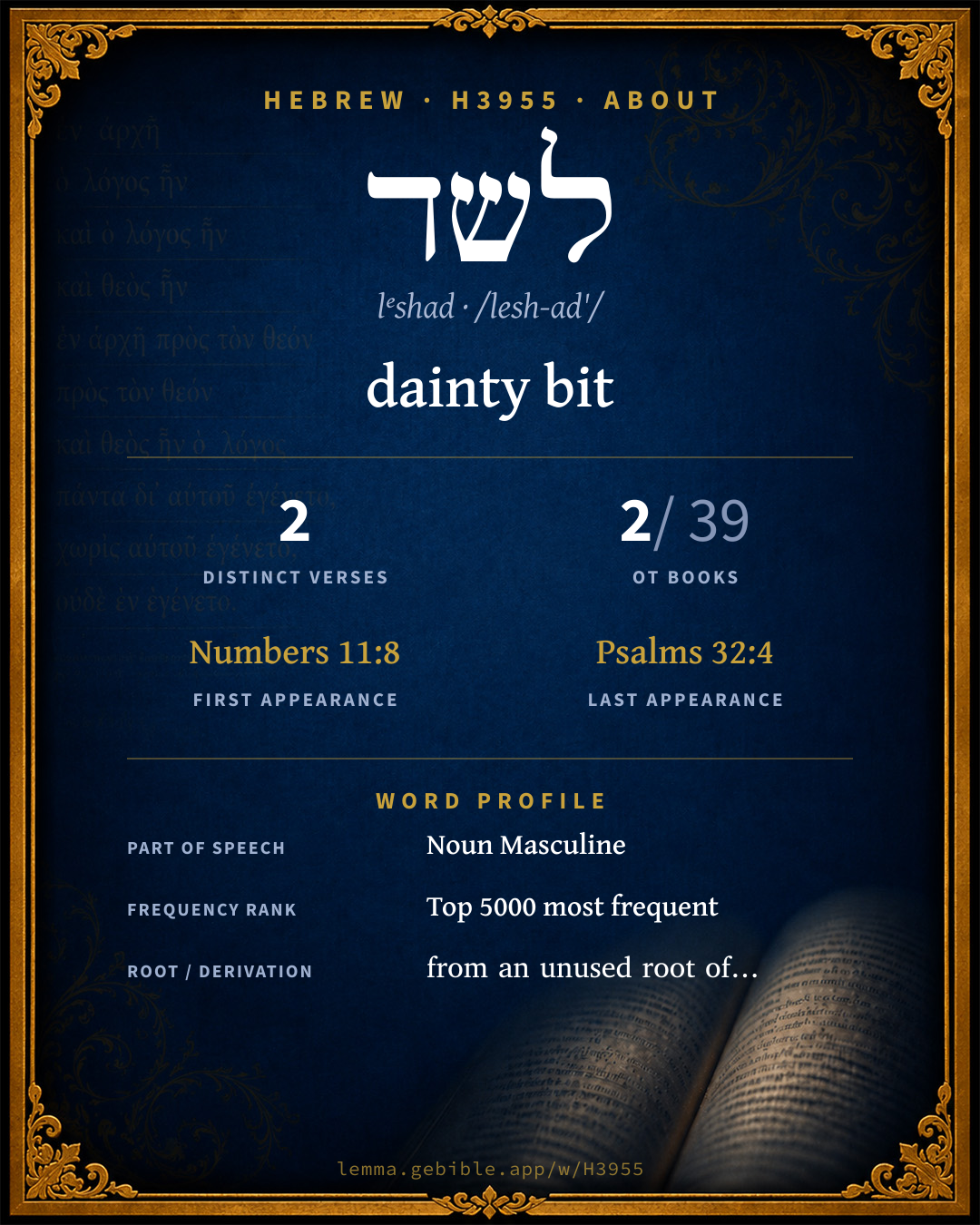
לָשָׁד
dainty bit
Full lexicon entry — Brown-Driver-Briggs (BDB)
From Brown-Driver-Briggs (BDB)
Where this word appears
Grammar key — what these labels mean
Part of speech
- Noun
- A naming word — a person, place, thing, or idea.
Noun type
- Common
- A common noun — a general class of person, place, or thing (“king,” “city,” “water”), not a specific name.
State
- Construct
- A noun bound to a following noun in a possessive / “of” relationship (the construct chain).
Gender
- Masculine
- Grammatically masculine.
Number
- Singular
- One.
Every verse where H3955 appears in the Book of Numbers — 1 distinct verse. Click any verse to open its interlinear word-by-word view. Verse text shown in the World English Bible for context — . Each verse’s Hebrew form is shown with its reference; the English is not keyword-highlighted, since the data carries no word-level English alignment. Use “Compare translations” on any verse to read it across multiple English versions. This concordance covers the Hebrew Bible; Septuagint (Greek Old Testament) occurrences are not indexed here.
Numbers
About this entry
At a glance — auto-summarized from this page’s data, not written by a person. Every figure links to its source below. This summary describes the numbers; it doesn’t interpret them.
At its core, לשד (lᵉshad) means “dainty bit.” It occurs a mere 2 verses across Scripture. Its uses cluster heavily in Numbers (50% of all occurrences). Its earliest occurrence is Numbers 11:8. For the data behind this summary, explore the sense tree and the renderings breakdown below.
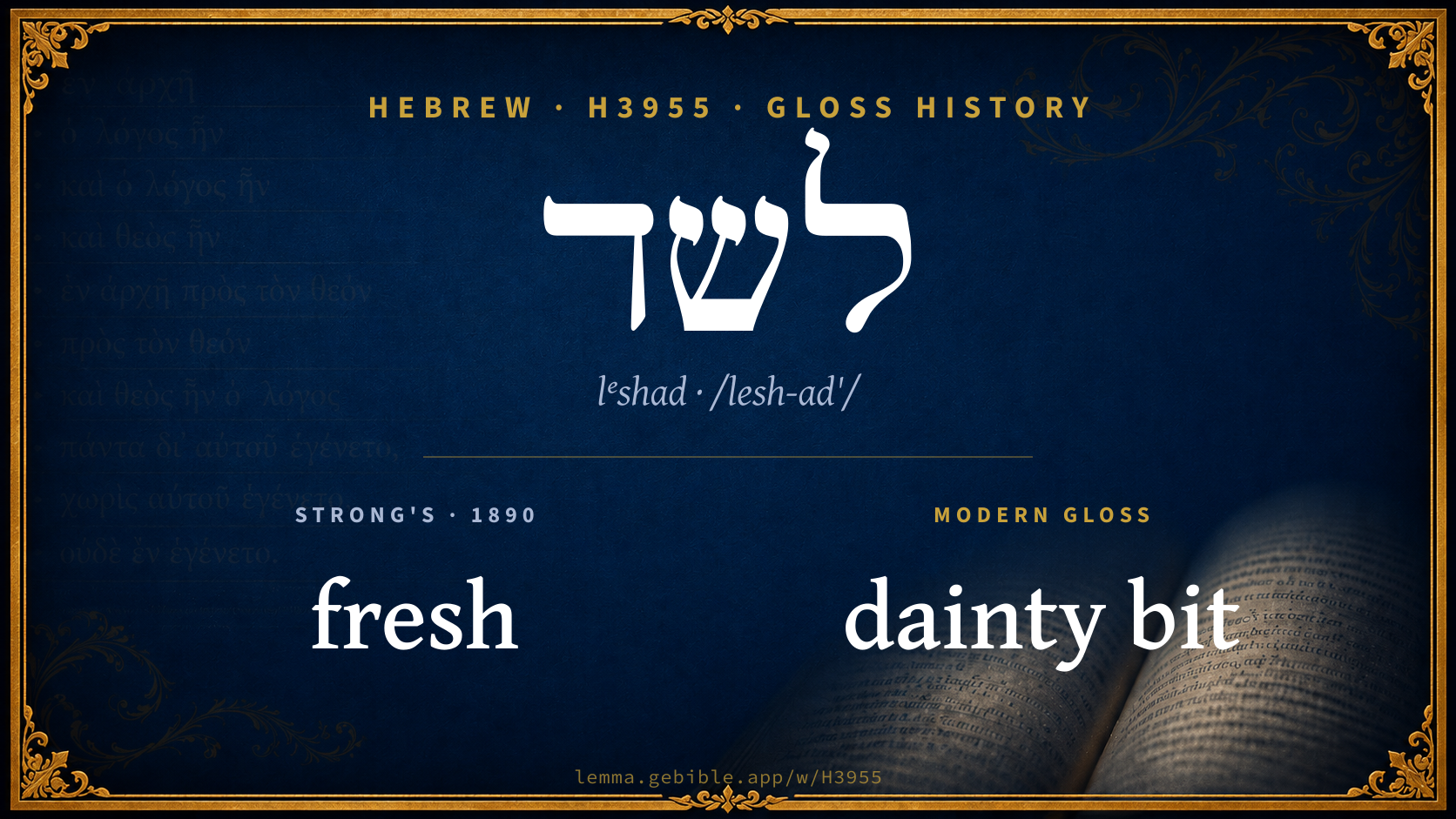
Gloss history
Strong's 1890 vs modern scholarship
About this word
Strong's H3955 catalogs a Hebrew word from the Hebrew Old Testament.
These counts are not copied from any lexicon or concordance. They are computed here, from the morphology-tagged Hebrew Old Testament. What Lemma adds →
- 2
- distinct verses
- The word appears in 2 distinct verses.
- 2 / 39
- OT books
- The word appears in 2 of 39 Old Testament books.
- #4,807
- by frequency
- Top 5000 most frequent Hebrew words (rank 4,807 of 8,640 Hebrew words by occurrence).
View all 2 occurrences in the concordance →
By traditional corpus
Conventional, traditional groupings — biblical authorship is debated, so this is a traditional corpus grouping, not an authorship claim. Each share is this word’s portion of its verses in that division of the Hebrew canon. Each figure is a share of the word’s 2 distinct verses.
- Torah (Pentateuch) 1 verse · 50%
- Writings (Ketuvim) 1 verse · 50%
How translations render this word
Counts come from each version’s own published word-to-Strong’s tagging or interlinear alignment — an approximate guide to how each version renders this word, not a word-level alignment the data otherwise carries. Because each total is that version’s own tagged count, the per-version totals vary from one another and need not match the appearance or distinct-verse counts above. These counts may also differ from a printed concordance because Lemma counts each distinctly tagged rendering and does not collapse phrase taggings into a single head-word total. This is a fixed set of word-tagged versions (KJV, ASV, BSB, ULT) and does not change with the reading translation you choose elsewhere. Each version’s license is shown beside its name below (and on Sources).
- King James Version: Fresh 1×, Moisture 1×
- American Standard Version: Fresh 1×, Me 1×
- Berean Standard Bible: Like pastry 1×, Strength 1×
- unfoldingWord Literal Text: Freshness of 1×, Vitality 1×
King James Version Public Domain
Renders H3955 across 2 tagged occurrences — most commonly:
American Standard Version Public Domain
Renders H3955 across 2 tagged occurrences — most commonly:
Berean Standard Bible Public Domain
Renders H3955 across 2 tagged occurrences — most commonly:
unfoldingWord Literal Text CC BY-SA 4.0
Renders H3955 across 2 tagged occurrences — most commonly:
Senses in BDB
The 1 sense BDB distinguishes for this word, in lexicon order (not ranked by frequency or importance). The full entry — with sub-senses — is in the Lexicon Entry tab.
- juice, juicy bit, dainty bit
Word origin
n.m. juice, juicy or dainty bit, dainty;—cstr. כְּטַעַם לְשַׁד הַשָּׁ֑מֶן Nu 11:8 (J) sim. of taste of manna (𝔊 ἐγκρίς, 𝔙 panis oleatus), i.e. a dainty prepared with oil (cf. Di); נֶהְפַּךְ לְשַׁדִּי בְּחַרְבֹנֵי קַיִץ ψ 32:4 my juice (sap, life-moisture) is transformed, etc.
— Brown-Driver-Briggs (Oxford 1906, public domain), digitized via Sefaria, supplemented by the OpenScriptures HebrewLexicon (CC BY 4.0). See Sources.
Origin: from an unused root of uncertain meaning
Jastrow Dictionary
A second Hebrew/Aramaic lexicon for comparison, covering Aramaic and post-biblical (Talmudic, Targumic, Midrashic) usage that the biblical-Hebrew BDB does not. Matched by lemma rather than by Strong’s number, so a lemma may carry more than one Jastrow headword (shown separately below), and the entries cover usage well beyond the Bible.
שַׂד
- (שָׂדַד) furrow.—Pl. שִׂדִּים, שִׂידִּ׳. Gen. R. s. 42 (expl. עמק השדים, Gen. XIV, 10) שהוא עשוי ש׳ ש׳ תלמים דבר אחר וכ׳ (the valley was called Siddim,) because it was made up into siddim, (which means) furrows; another explanation (as if שָׁדַיִם), because it fed its children like breasts; Yalk. ib. 72 (corr. acc.). e.g. Genesis 14:10
שַׁד
- , v. Ges. Thes. s. v.) female breast. Tosef. Sot. IV, 3 (ref. to לשד, Num. XI, 8) מה שד זה עיקר וכ׳ ed. Zuck. (Var. דד) as the breast is essential for the child and everything else is of secondary import, so was the manna &c.; מה שד זה אם יונק וכ׳ as the breast does not harm the child, even if it suck it an entire day &c.; Yoma 75ᵃ מה שד זה תינוק וכ׳ as the child finds in the breast all tastes &c.—Du. שָׁדַיִם; pl. constr. שְׁדֵי. Gen. R. s. 42; Yalk. ib. 72, v. preced. Tanḥ. Sh’moth 25 והיונקים כחלב משרי אמם and the sucklings found in the manna a taste like that of the milk from their mothers’ breast (ref. to Num. l. c.). Ber. 3ᵃ. Sot. 30ᵇ; a. fr. e.g. Numbers 11:8
שֵׁד
- (b. h.) demon. Yoma 75ᵃ (play on לשד, Num. XI, 8) מה שד זה מתהפך וכ׳ as the demon changes into many colors (appearances), so did the manna change into many tastes. Snh. 67ᵇ דקפיד אמנא שד, v. קְפַד. Ib. (ref. to Ex. VIII, 15) מיכן שאין השד וכ׳ from here we learn that the conjured demon cannot create anything smaller than a barley corn; a. fr.—Pl. שֵׁדִים, שֵׁדִין, שֵׁי׳. Lev. R. s. 22 (ref. to Lev. XVII, 7) ואין … אלא ש׳ this s’‘irim means demons; ואין ש׳ … שעירים and this shedim (Deut. XXXII, 17) means s’‘irim (ref. to Is. XIII, 21). Snh. l. c., v. לְהָטִים; a. fr.—Fem. שֵׁדָה, שֵׁי׳; pl. שֵׁדוֹת, שֵׁי׳. Pesik. R. s. 15 (expl. שרה ושדות, Koh. II, 8) שדים וש׳ male and female demons; Pesik. Haḥod., p. 45ᵇ before Solomon sinned, היה רודה בשידה וש׳ he ruled over all sorts of demonesses. e.g. Numbers 11:8
A Dictionary of the Targumim, the Talmud Babli and Yerushalmi, and the Midrashic Literature (Marcus Jastrow; London, Luzac, 1903) — Public Domain. Digitized via Sefaria. Digitized via Sefaria. Full attribution on Sources.
Forms in the corpus
The 2 distinct written forms H3955 takes in the Hebrew Bible, most frequent first — each parse links to that state’s occurrences in the concordance. Hebrew forms include their vowel points and cantillation, so a single lemma takes many written forms.
| Form | Parsing | Example | Uses |
|---|---|---|---|
| לְשַׁ֥ד | Noun, Common, Masculine, Singular, Construct | Numbers 11:8 | 1 |
| לְשַׁדִּ֑/י | Noun, Common, Masculine, Singular, Construct | Psalms 32:4 | 1 |
Septuagint verse parallels
This word appears in 2 verses that also exist in the Greek Old Testament (Septuagint), out of the 2 Hebrew verses it occurs in. You can read those verses in Greek by switching the Old Testament edition to the Septuagint.
Read these verses in the Septuagint
This is a verse-level parallel only — the same verses exist in both the Hebrew and Greek Old Testaments. No word-level Hebrew↔Greek correspondence is claimed: the data carries no such alignment, so no Greek word is shown as this Hebrew word’s translation. Coverage is not total — the Septuagint omits the deuterocanon and renumbers the Psalms, so some Hebrew verses have no direct Greek parallel.