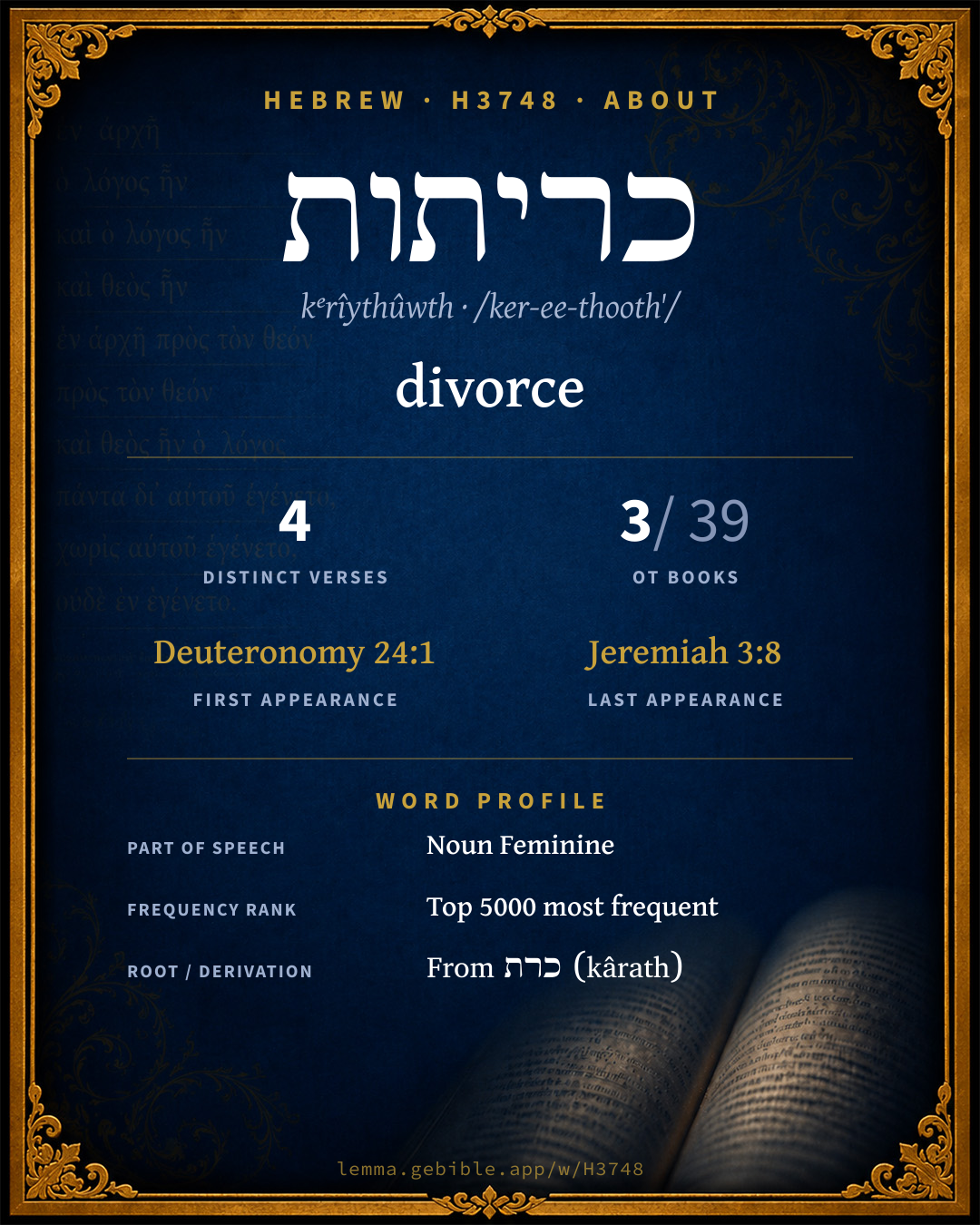
כְּרִיתוּת
divorce
Full lexicon entry — Brown-Driver-Briggs (BDB)
From Brown-Driver-Briggs (BDB)
Where this word appears
Grammar key — what these labels mean
Part of speech
- Noun
- A naming word — a person, place, thing, or idea.
Noun type
- Common
- A common noun — a general class of person, place, or thing (“king,” “city,” “water”), not a specific name.
State
- Absolute
- The independent form of a noun, not bound to a following word.
- Construct
- A noun bound to a following noun in a possessive / “of” relationship (the construct chain).
Gender
- Feminine
- Grammatically feminine.
Number
- Singular
- One.
- Plural
- More than one (in Hebrew, generally three or more).
Every verse where H3748 appears in the Book of Jeremiah — 1 distinct verse. Click any verse to open its interlinear word-by-word view. Verse text shown in the World English Bible for context — . Each verse’s Hebrew form is shown with its reference; the English is not keyword-highlighted, since the data carries no word-level English alignment. Use “Compare translations” on any verse to read it across multiple English versions. This concordance covers the Hebrew Bible; Septuagint (Greek Old Testament) occurrences are not indexed here.
Jeremiah
About this entry
At a glance — auto-summarized from this page’s data, not written by a person. Every figure links to its source below. This summary describes the numbers; it doesn’t interpret them.
כריתות — transliterated kᵉrîythûwth — is a Hebrew noun carrying the sense “divorce.” It is rare — just 4 verses in the entire Hebrew Bible. More than half of its appearances fall in Deuteronomy. Its earliest occurrence is Deuteronomy 24:1. It shares a root with כרת, כרתה and כרית. See the sense tree, 4-verse concordance, and the renderings breakdown below.
Gloss history
Strong's 1890 vs modern scholarship
About this word
Strong's H3748 catalogs a Hebrew word from the Hebrew Old Testament.
These counts are not copied from any lexicon or concordance. They are computed here, from the morphology-tagged Hebrew Old Testament. What Lemma adds →
- 4
- distinct verses
- The word appears in 4 distinct verses.
- 3 / 39
- OT books
- The word appears in 3 of 39 Old Testament books.
- #3,696
- by frequency
- Top 5000 most frequent Hebrew words (rank 3,696 of 8,640 Hebrew words by occurrence).
View all 4 occurrences in the concordance →
Most concentrated in
- Deuteronomy 2 verses 50%
- Isaiah 1 verse 25%
- Jeremiah 1 verse 25%
By section of the Old Testament
By traditional corpus
Conventional, traditional groupings — biblical authorship is debated, so this is a traditional corpus grouping, not an authorship claim. Each share is this word’s portion of its verses in that division of the Hebrew canon. Each figure is a share of the word’s 4 distinct verses.
- Torah (Pentateuch) 2 verses · 50%
- Prophets (Nevi'im) 2 verses · 50%
How translations render this word
Counts come from each version’s own published word-to-Strong’s tagging or interlinear alignment — an approximate guide to how each version renders this word, not a word-level alignment the data otherwise carries. Because each total is that version’s own tagged count, the per-version totals vary from one another and need not match the appearance or distinct-verse counts above. These counts may also differ from a printed concordance because Lemma counts each distinctly tagged rendering and does not collapse phrase taggings into a single head-word total. This is a fixed set of word-tagged versions (KJV, ASV, BSB, ULT) and does not change with the reading translation you choose elsewhere. Each version’s license is shown beside its name below (and on Sources).
- King James Version: Divorcement 3×
- American Standard Version: Divorcement 3×
- Berean Standard Bible: Divorce 4×
- unfoldingWord Literal Text: Divorce 3×
King James Version Public Domain
Renders H3748 across 4 tagged occurrences — most commonly:
Plus 1 rendering that appears only once — usually multi-word phrases or single function words the recovered tagging swept in, not distinct renderings.
American Standard Version Public Domain
Renders H3748 across 4 tagged occurrences — most commonly:
Plus 1 rendering that appears only once — usually multi-word phrases or single function words the recovered tagging swept in, not distinct renderings.
Berean Standard Bible Public Domain
Renders H3748 across 4 tagged occurrences — most commonly:
unfoldingWord Literal Text CC BY-SA 4.0
Renders H3748 across 4 tagged occurrences — most commonly:
Plus 1 rendering that appears only once — usually multi-word phrases or single function words the recovered tagging swept in, not distinct renderings.
Senses in BDB
The 1 sense BDB distinguishes for this word, in lexicon order (not ranked by frequency or importance). The full entry — with sub-senses — is in the Lexicon Entry tab.
- divorce, dismissal, divorcement
Word origin
n.f. divorcement;—כ׳ Is 50:1; כְּרִיתֻת Dt 24:1, 3; pl. sf. כְּרִיתֻתֶיהָ Je 3:8; סֵפֶר כ׳ writing (i.e. deed) of divorcement, Dt 24:1, 3; Is 50:1; Je 3:8.
— Brown-Driver-Briggs (Oxford 1906, public domain), digitized via Sefaria, supplemented by the OpenScriptures HebrewLexicon (CC BY 4.0). See Sources.
Derived from כרת (kârath) (H3772) — to cut.
Jastrow Dictionary
A second Hebrew/Aramaic lexicon for comparison, covering Aramaic and post-biblical (Talmudic, Targumic, Midrashic) usage that the biblical-Hebrew BDB does not. Matched by lemma rather than by Strong’s number, so a lemma may carry more than one Jastrow headword (shown separately below), and the entries cover usage well beyond the Bible.
כְּרִיתוּת
- final divorce. Sifré Deut. 269 (ref. to Deut. XXIV, 1) שיהא כורת מכאן … אין זה כ׳ he must make the thing final, from this we derive that if a man says, this is thy letter of divorce under the condition that thou wilt never go …, this is no final (valid) divorce; Gitt. 83ᵇ. Tosef. ib. IX (VII), 1; a. fr.—Gitt. l. c.; ib. 21ᵇ; Succ. 24ᵇ, a. e. כרת כ׳ the legal deduction from the use of the word כריתות (Deut. l. c.) where the word כָּרֵת might have been used. e.g. Deuteronomy 24:1
כָּרֵת
- (= הִכָּרֵת, v. כָּרַתNif.) excommunication, extermination; (in Talm. law) divine punishment through premature or sudden death, opp. to מיתה בידי אדם capital punishment. Snh. 60ᵇ זובח … כ׳ הוא is not slaughtering consecrated animals outside of the Temple punishable with extinction?, opp. קטלא death by execution. M. Kat. 28ᵃ מת בחמשים שנה זו היא מיתת כ׳ if one dies at the age of fifty, that is death of divine visitation; Y. Bicc. II, beg. 64ᶜ בהִיכָּרֵת; Treat. S’maḥ. III, 8 בהִכָּרֵת. Ib. 10 וכי מה מודיענו שמיתתם בהכרת what is there to indicate that they died by divine visitation?; Y. l. c. 64ᵈ top שהוא בהיכרת.—M. Kat. l. c. נפקי לי מכ׳ I have escaped the punishment of kareth (being sixty years old). Ib. כ׳ דשני the kareth of years, premature death; כ׳ דיומי the k. of days, sudden death. Ḥull. 31ᵃ עון כ׳ a transgression punishable with k., opp. איסור מיתה. Macc. III, 15 (23ᵃ) נפטרו מידי כְּרֵיתָן Ms. M. (ed. ידי כְּרִיתָתָם) are released from k. (which would otherwise await them). Ib. 13ᵇ ולמה יצאת כ׳ באחותו why is the punishment of k. specifically mentioned with reference to incest with a sister (Lev. XX, 17, being included in Lev. XVIII, 29)?—Gen. R. s. 28 (ref. to כְּרֵתִים, Zeph. II, 5, v. Targ. a. l.) גוי שהוא ראוי כ׳ a nation deserving extermination; (Yalk. Zeph. 567 ראוי לִיכָּרֵת); a. v. fr.—Pl. כְּרִיתוֹת (fr. כְּרִיתָה). Ker. I, 1 שלשים ושש כ׳ בתורה there are thirty six transgressions mentioned in the Torah as (eventually) punishable with kareth. Macc. III, 15, a. fr. חייבי כ׳ those on whose transgressions the penalty of k. is pronounced; a. fr.—K’rithoth, a treatise of the Mishnah, Tosefta, and Talmud Babli, of the Order of Kodashim. e.g. Leviticus 20:17
A Dictionary of the Targumim, the Talmud Babli and Yerushalmi, and the Midrashic Literature (Marcus Jastrow; London, Luzac, 1903) — Public Domain. Digitized via Sefaria. Digitized via Sefaria. Full attribution on Sources.
Forms in the corpus
The 3 distinct written forms H3748 takes in the Hebrew Bible, most frequent first — each parse links to that state’s occurrences in the concordance. Hebrew forms include their vowel points and cantillation, so a single lemma takes many written forms.
| Form | Parsing | Example | Uses |
|---|---|---|---|
| כְּרִיתֻת֙ | Noun, Common, Feminine, Singular, Absolute | Deuteronomy 24:1 | 2 |
| כְּרִית֤וּת | Noun, Common, Feminine, Singular, Construct | Isaiah 50:1 | 1 |
| כְּרִיתֻתֶ֖י/הָ | Noun, Common, Feminine, Plural, Construct | Jeremiah 3:8 | 1 |
Same root — word family
Other BDB entries built from the same root as H3748, grouped by Strong’s listed origin. These share a root / origin per the lexicon — not necessarily a shared meaning. Each links to that word’s own entry.
Derives from
Shares the same root
Proper names from this root
People and places named from this root — a name, not an additional meaning of the word.
Compare all same-root words → Showing 4 of 5 — not the complete family. 2 of the same-root words are proper names (people or places). They share a root, not necessarily a meaning.
Septuagint verse parallels
This word appears in 4 verses that also exist in the Greek Old Testament (Septuagint), out of the 4 Hebrew verses it occurs in. You can read those verses in Greek by switching the Old Testament edition to the Septuagint.
Read these verses in the Septuagint
This is a verse-level parallel only — the same verses exist in both the Hebrew and Greek Old Testaments. No word-level Hebrew↔Greek correspondence is claimed: the data carries no such alignment, so no Greek word is shown as this Hebrew word’s translation. Coverage is not total — the Septuagint omits the deuterocanon and renumbers the Psalms, so some Hebrew verses have no direct Greek parallel.