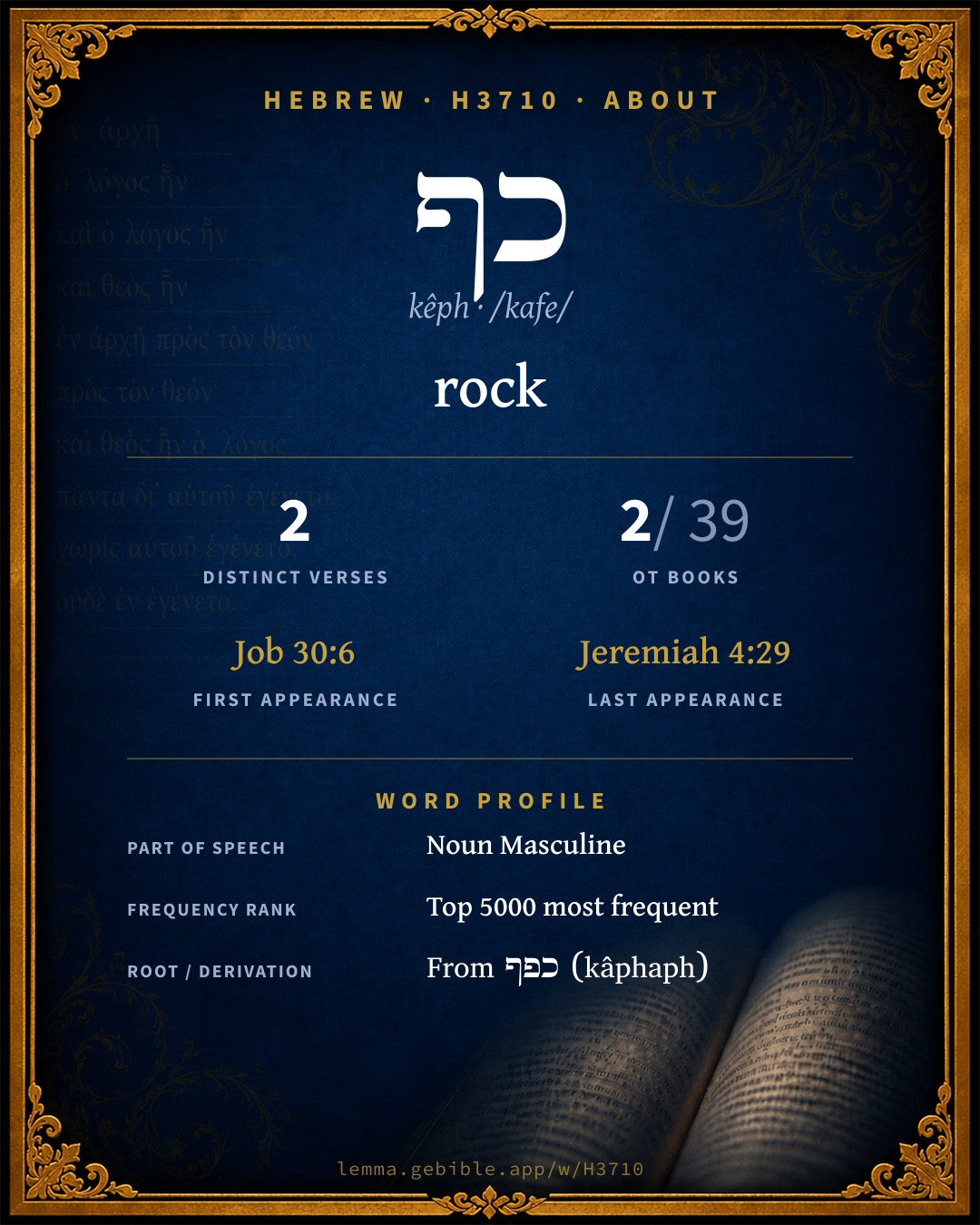
כֵּף
rock
Full lexicon entry — Brown-Driver-Briggs (BDB)
From Brown-Driver-Briggs (BDB)
Where this word appears
Grammar key — what these labels mean
Noun type
- Common
- A common noun — a general class of person, place, or thing (“king,” “city,” “water”), not a specific name.
State
- Absolute
- The independent form of a noun, not bound to a following word.
Gender
- Masculine
- Grammatically masculine.
Number
- Plural
- More than one (in Hebrew, generally three or more).
Every verse where H3710 appears in the Book of Jeremiah — 1 distinct verse. Click any verse to open its interlinear word-by-word view. Verse text shown in the World English Bible for context — . Each verse’s Hebrew form is shown with its reference; the English is not keyword-highlighted, since the data carries no word-level English alignment. Use “Compare translations” on any verse to read it across multiple English versions. This concordance covers the Hebrew Bible; Septuagint (Greek Old Testament) occurrences are not indexed here.
Jeremiah
About this entry
At a glance — auto-summarized from this page’s data, not written by a person. Every figure links to its source below. This summary describes the numbers; it doesn’t interpret them.
כף (kêph) is a Hebrew noun most often rendered “rock.” The Hebrew Bible uses it only 2 verses. It clusters heavily in Job, which alone accounts for 50% of its uses. It first appears in Job 30:6. From the same root come כפף and כף. For the data behind this summary, explore the sense tree and the renderings breakdown below.
Gloss history
Strong's 1890 vs modern scholarship
About this word
Strong's H3710 catalogs a Hebrew word from the Hebrew Old Testament.
These counts are not copied from any lexicon or concordance. They are computed here, from the morphology-tagged Hebrew Old Testament. What Lemma adds →
- 2
- distinct verses
- The word appears in 2 distinct verses.
- 2 / 39
- OT books
- The word appears in 2 of 39 Old Testament books.
- #4,807
- by frequency
- Top 5000 most frequent Hebrew words (rank 4,807 of 8,640 Hebrew words by occurrence).
View all 2 occurrences in the concordance →
By traditional corpus
Conventional, traditional groupings — biblical authorship is debated, so this is a traditional corpus grouping, not an authorship claim. Each share is this word’s portion of its verses in that division of the Hebrew canon. Each figure is a share of the word’s 2 distinct verses.
- Prophets (Nevi'im) 1 verse · 50%
- Writings (Ketuvim) 1 verse · 50%
How translations render this word
Counts come from each version’s own published word-to-Strong’s tagging or interlinear alignment — an approximate guide to how each version renders this word, not a word-level alignment the data otherwise carries. Because each total is that version’s own tagged count, the per-version totals vary from one another and need not match the appearance or distinct-verse counts above. These counts may also differ from a printed concordance because Lemma counts each distinctly tagged rendering and does not collapse phrase taggings into a single head-word total. This is a fixed set of word-tagged versions (KJV, ASV, BSB, ULT) and does not change with the reading translation you choose elsewhere. Each version’s license is shown beside its name below (and on Sources).
- King James Version: Rocks 2×
- American Standard Version: Rocks 2×
- Berean Standard Bible: Among the rocks 2×
- unfoldingWord Literal Text: Among the rocks 1×, And 1×, Rocks 1×
King James Version Public Domain
Renders H3710 across 2 tagged occurrences — most commonly:
American Standard Version Public Domain
Renders H3710 across 2 tagged occurrences — most commonly:
Berean Standard Bible Public Domain
Renders H3710 across 2 tagged occurrences — most commonly:
unfoldingWord Literal Text CC BY-SA 4.0
Renders H3710 across 3 tagged occurrences — most commonly:
Senses in BDB
The 1 sense BDB distinguishes for this word, in lexicon order (not ranked by frequency or importance). The full entry — with sub-senses — is in the Lexicon Entry tab.
- rock, hollow of a rock
Word origin
Derived from כפף (kâphaph) (H3721) — to bow down.
Jastrow Dictionary
A second Hebrew/Aramaic lexicon for comparison, covering Aramaic and post-biblical (Talmudic, Targumic, Midrashic) usage that the biblical-Hebrew BDB does not. Matched by lemma rather than by Strong’s number, so a lemma may carry more than one Jastrow headword (shown separately below), and the entries cover usage well beyond the Bible.
כָּף
- , v. כָּפַף, כְּפַף.
כֵּף
- , v. כֵּיף
כַּף
- c. (b. h.; [something arched, hollow,]
- 1. palm of the hand, hand.—Du. כַּפַּיִם. Y. Ber. I, 3ᶜ bot., v. חָטַף. Naz. 46ᵇ, v. כָּנָף; a. fr.—נשא כ׳ to raise the hands, to pronounce the priestly benediction. Ber. V, 4 לא ישא את כַּפָּיו must not pronounce &c.; a. fr.
- 2. sole of the foot. Du. as ab. Ḥull. 70ᵇ מהלכי כ׳ animals walking on soles (having no split hoofs, Lev. XI, 27).—Trnsf. glove; sole of the shoe. Kel. XXVI, 3 כף לוקטי(ם) קוצים (R. S. כפלוקטי) the thorn-pickers’ glove. Tosef. Kel. B. Bath. IV, 5 רוב כף אחת, the larger portion of one sole; כל כף אחת the whole of &c. e.g. Leviticus 11:27
- 3. the crest (fleshy elevation) over the genitals. Tosef. Nidd. VI, 4, sq. עד שתפשט את הכף (Var. משתתפשט) when the crest (of the girl) begins to flatten; Y. Yeb. I, 2ᵈ bot. עד שתתפשט הכף; Y. Snh. VIII, beg. 26ᵃ משתתפשט הכ׳ (of a male); Nidd. 47ᵃ, sq. נתמעך הכ׳ the crest grows lower. Ib. 52ᵇ אחת על הכ׳ one hair on the crest; a. e.
- 4. pan, censer. Tam. V, 4 (containing the בָּזָךְ). Ib. VII, 2 כף וכסויה the censer and its lid; a. fr.—Pl. כַּפּוֹת. Num. R. s. 14; a. e.
- 5. spoon, mason’s trowel &c. Kel. XIII, 2; 4; a. fr. Sabb. VIII, 5 כ׳ סיד, expl. ib. 80ᵇ כ׳ של סיידין the plasterers’ trowel.—Pl. כַּפִּים, כַּפִּין. Midd. III, 4 כפין של ברזל Ar. (ed. כפיס, Var. כפים) iron trowels.
- 6. (with, or without מאזנים) scale of the balance. Ab. II, 8. Pesik. Aḥăré, p. 167ᵃ כ׳ עוונות וכ׳ the scale of sins on the one side, and that of merits on the other; והקב"ה מטה לכ׳ זכות and the Lord bends (the balance) towards the scale of merits. Ab. I, 6, v. זְכוּת; a. fr.—Du. כַּפַּיִים, כַּפַּיִין. Tosef. Kel. B. Mets. II, 5 (ed. Zuck. כיפין, read: כפיין).
- 7. shore, banks (v. כֵּיפָא). Num. R. s. 13, v. חָף.—Pl. כַּפִּים, constr. כַּפֵּי. Lam. R. introd. (R. Ḥăn. 3) (transl. גיא המלח, II Chr. XXV, 11) כ׳ המלח the salt shores. e.g. 2 Chronicles 25:11
כַּף ²
- 1. palm, hand. Targ. Y. Gen. III, 19.—Pl. כַּפַּיָּא. Targ. Ps. XCVIII, 8 (v., however, Num. R. s. 13, s. v. חָף).
- 2. border, shore, v. כֵּיפָא.
- 3. bundle, sheaf. Snh. 26ᵇ bot. חד גנב כ׳ Ar. (v. Rabb. D. S. a. l. note 6, Var. in Ar. הזמת כ׳, v. הזמת; ed. קבא דשערי) one stole a sheaf.—Pl. (כֵּיפֵי) כַּפִּין. Y. Sabb. III, 5ᵈ bot. מיתן תלתא כ׳ וכ׳ to bring three bunches (of twigs) and put dishes upon them. Gitt. 86ᵇ דביני כיפי, v. דִּידְבָא. Pes. 40ᵃ, v. הֲפַךְ. Ned. 48ᵇ top כי׳ דכיתנא flax bunches, v. שְׁמַט; a. e.—Ib. bot. דשדיא בכיפי, v. כְּפֵילָא.
- 4. top branch of palm trees (v. כִּיפָּה).—Pl. כַּפֵּי. Succ. 32ᵃ ואימא תרתי כ׳ דתמרי perhaps kappoth (Lev. XXIII, 40) means two tops of palm trees? e.g. Leviticus 23:40
- 5. pan, spoon &c. Pes. 28ᵃ, v. חֲטַט I. Sabb. 142ᵇ מנח כ׳ אכיפי (Ms. M. כיפא) placed a ladle on a pile of sheaves. Ḥull. 54ᵃ מאי כ׳ what kappa do yon mean?—כ׳ דידא pan of the fore foot (shoulder), כ׳ דמוחא scull
- 6. shoulder(also of human beings). B. Bath. 96ᵇ top אכ׳ Ms. M. a. Ar. (ed. אכתפא); Sot. 34ᵃ bot. בכ׳ Ar. (ed. לכתפיה); Taan. 23ᵇ אחד כַּפֵּיה Ar. (ed. כתפיה), v. כַּתְּפָא.—Sot. 6ᵇ … אטו בכַפָּהּ תלי לה Ar. (ed. בכיפה) do the young priests (that guard the woman) suspend her by her shoulder (Rashi: by her cap), i.e. can they watch all her movements?
A Dictionary of the Targumim, the Talmud Babli and Yerushalmi, and the Midrashic Literature (Marcus Jastrow; London, Luzac, 1903) — Public Domain. Digitized via Sefaria. Digitized via Sefaria. Full attribution on Sources.
Forms in the corpus
The 2 distinct written forms H3710 takes in the Hebrew Bible, most frequent first — each parse links to that state’s occurrences in the concordance. Hebrew forms include their vowel points and cantillation, so a single lemma takes many written forms.
| Form | Parsing | Example | Uses |
|---|---|---|---|
| וְ/כֵפִֽים | Noun, Common, Masculine, Plural, Absolute | Job 30:6 | 1 |
| וּ/בַ/כֵּפִ֖ים | Noun, Common, Masculine, Plural, Absolute | Jeremiah 4:29 | 1 |
Same root — word family
Other BDB entries built from the same root as H3710, grouped by Strong’s listed origin. These share a root / origin per the lexicon — not necessarily a shared meaning. Each links to that word’s own entry.
Derives from
Shares the same root
Compare all same-root words → They share a root, not necessarily a meaning.
Septuagint verse parallels
This word appears in 2 verses that also exist in the Greek Old Testament (Septuagint), out of the 2 Hebrew verses it occurs in. You can read those verses in Greek by switching the Old Testament edition to the Septuagint.
Read these verses in the Septuagint
This is a verse-level parallel only — the same verses exist in both the Hebrew and Greek Old Testaments. No word-level Hebrew↔Greek correspondence is claimed: the data carries no such alignment, so no Greek word is shown as this Hebrew word’s translation. Coverage is not total — the Septuagint omits the deuterocanon and renumbers the Psalms, so some Hebrew verses have no direct Greek parallel.