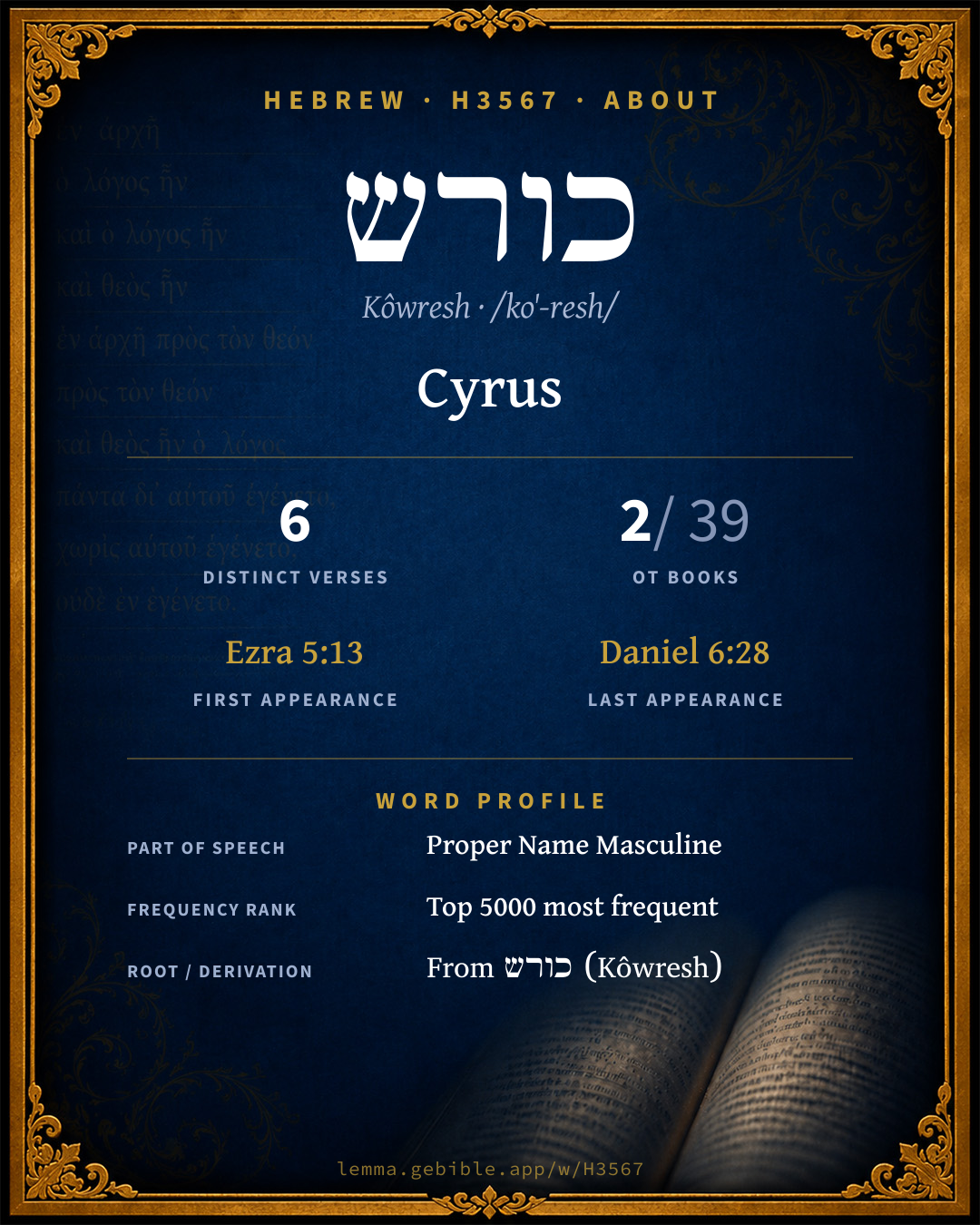
כּ֫וֹרֶשׁ
Cyrus
BDB lists 2 entries for ‘Cyrus’ fuller range ↓
Full lexicon entry — Brown-Driver-Briggs (BDB)
From Brown-Driver-Briggs (BDB)
Where this word appears
Grammar key — what these labels mean
Part of speech
- Noun
- A naming word — a person, place, thing, or idea.
Noun type
- Proper
- A name of a specific person, place, or people (e.g. Abraham, Zion, Israel).
Every verse where H3567 appears in the Book of Ezra — 5 distinct verses. Click any verse to open its interlinear word-by-word view. Verse text shown in the World English Bible for context — . Each verse’s Hebrew form is shown with its reference; the English is not keyword-highlighted, since the data carries no word-level English alignment. Use “Compare translations” on any verse to read it across multiple English versions. This concordance covers the Hebrew Bible; Septuagint (Greek Old Testament) occurrences are not indexed here.
Ezra
- Ezra 5:13 לְ/כ֥וֹרֶשׁ כּ֤וֹרֶשׁ prep + n Proper n Proper But in the first year of Cyrus king of Babylon, Cyrus the king made a decree to build this house of God.
- Ezra 5:14 כּ֣וֹרֶשׁ n Proper The gold and silver vessels also of the house of God, which Nebuchadnezzar took out of the temple that was in Jerusalem, and brought into the temple of Babylon, those did Cyrus the king take out of the temple of Babylon, and they were delivered to one whose name was Sheshbazzar, whom he had made governor;
- Ezra 5:17 כּ֤וֹרֶשׁ n Proper Now therefore, if it seem good to the king, let there be search made in the king's treasure-house, which is there at Babylon, whether it be so, that a decree was made of Cyrus the king to build this house of God at Jerusalem; and let the king send his pleasure to us concerning this matter.
- Ezra 6:3 לְ/כ֣וֹרֶשׁ כּ֣וֹרֶשׁ prep + n Proper n Proper In the first year of Cyrus the king, Cyrus the king made a decree: Concerning the house of God at Jerusalem, let the house be built, the place where they offer sacrifices, and let the foundations of it be strongly laid; the height of it sixty cubits, and the breadth of it sixty cubits;
- Ezra 6:14 כּ֣וֹרֶשׁ n Proper The elders of the Jews built and prospered, through the prophesying of Haggai the prophet and Zechariah the son of Iddo. They built and finished it, according to the commandment of the God of Israel, and according to the decree of Cyrus, and Darius, and Artaxerxes king of Persia.
About this entry
At a glance — auto-summarized from this page’s data, not written by a person. Every figure links to its source below. This summary describes the numbers; it doesn’t interpret them.
כורש — transliterated Kôwresh — is a Hebrew name carrying the sense “Cyrus.” Its uses cluster heavily in Ezra (83% of all occurrences). With 6 verses in 2 books, it is an uncommon word in the Hebrew Bible. Debuting at Ezra 5:13, it then recurs through the corpus. See 6-verse concordance and the renderings breakdown below.
Gloss history
Strong's 1890 vs modern scholarship
About this word
Strong's H3567 catalogs a Hebrew word from the Hebrew Old Testament.
These counts are not copied from any lexicon or concordance. They are computed here, from the morphology-tagged Hebrew Old Testament. What Lemma adds →
- 6
- distinct verses
- The word appears in 6 distinct verses.
- 2 / 39
- OT books
- The word appears in 2 of 39 Old Testament books.
- #2,625
- by frequency
- Top 5000 most frequent Hebrew words (rank 2,625 of 8,640 Hebrew words by occurrence).
View all 6 occurrences in the concordance →
By traditional corpus
Conventional, traditional groupings — biblical authorship is debated, so this is a traditional corpus grouping, not an authorship claim. Each share is this word’s portion of its verses in that division of the Hebrew canon. Each figure is a share of the word’s 6 distinct verses.
- Writings (Ketuvim) 6 verses · 100%
How translations render this word
Counts come from each version’s own published word-to-Strong’s tagging or interlinear alignment — an approximate guide to how each version renders this word, not a word-level alignment the data otherwise carries. Because each total is that version’s own tagged count, the per-version totals vary from one another and need not match the appearance or distinct-verse counts above. These counts may also differ from a printed concordance because Lemma counts each distinctly tagged rendering and does not collapse phrase taggings into a single head-word total. This is a fixed set of word-tagged versions (KJV, ASV, BSB, ULT) and does not change with the reading translation you choose elsewhere. Each version’s license is shown beside its name below (and on Sources).
- King James Version: Cyrus 6×
- American Standard Version: Cyrus 7×
- Berean Standard Bible: Cyrus 6×
- unfoldingWord Literal Text: Cyrus 8×
King James Version Public Domain
Renders H3567 across 8 tagged occurrences — most commonly:
Plus 2 renderings that appear only once — usually multi-word phrases or single function words the recovered tagging swept in, not distinct renderings.
American Standard Version Public Domain
Renders H3567 across 8 tagged occurrences — most commonly:
Plus 1 rendering that appears only once — usually multi-word phrases or single function words the recovered tagging swept in, not distinct renderings.
Berean Standard Bible Public Domain
Renders H3567 across 7 tagged occurrences — most commonly:
Plus 1 rendering that appears only once — usually multi-word phrases or single function words the recovered tagging swept in, not distinct renderings. Not rendered by a distinct English word in 1 further occurrence.
unfoldingWord Literal Text CC BY-SA 4.0
Renders H3567 across 8 tagged occurrences — most commonly:
Senses in BDB
The 2 senses BDB distinguishes for this word, in lexicon order (not ranked by frequency or importance). The full entry — with sub-senses — is in the Lexicon Entry tab.
- Cyrus = "posses thou the furnace"
- the king of Persia and conqueror of Babylon…
Word origin
כּ֫וֹרֶשׁ 9 n.pr.m. Cyrus (BH id.)
— Brown-Driver-Briggs (Oxford 1906, public domain), digitized via Sefaria, supplemented by the OpenScriptures HebrewLexicon (CC BY 4.0). See Sources.
Derived from כורש (Kôwresh) (H3566) — Cyrus.
Forms in the corpus
The 5 distinct written forms H3567 takes in the Hebrew Bible, most frequent first — each parse links to that state’s occurrences in the concordance. Hebrew forms include their vowel points and cantillation, so a single lemma takes many written forms.
| Form | Parsing | Example | Uses |
|---|---|---|---|
| כּ֣וֹרֶשׁ | Noun, Proper | Ezra 5:14 | 3 |
| כּ֤וֹרֶשׁ | Noun, Proper | Ezra 5:13 | 2 |
| כּ֥וֹרֶשׁ | Noun, Proper | Daniel 6:28 | 1 |
| לְ/כ֣וֹרֶשׁ | Noun, Proper | Ezra 6:3 | 1 |
| לְ/כ֥וֹרֶשׁ | Noun, Proper | Ezra 5:13 | 1 |
Bible dictionary
Public-domain dictionary articles matched to this entry by name (Cyrus). A biblical name can be shared by more than one person or place, so an article may treat several.
Easton's Bible Dictionary · M. G. Easton, 1897
(Heb. Ko'resh), the celebrated "King of Persia" (Elam) who was conqueror of Babylon, and issued the decree of liberation to the Jews (Ezra 1:1, 2). He was the son of Cambyses, the prince of Persia, and was born about B.C. 599. In the year B.C. 559 he became king of Persia, the kingdom of Media being added to it partly by conquest. Cyrus was a great military leader, bent on universal conquest. Babylon fell before his army (B.C. 538) on the night of Belshazzar's feast (Dan. 5:30), and then the ancient dominion of Assyria was also added to his empire (cf., "Go up, O Elam", Isa. 21:2).
Hitherto the great kings of the earth had only oppressed the Jews. Cyrus was to them as a "shepherd" (Isa. 44:28; 45:1). God employed him in doing service to his ancient people. He may posibly have gained, through contact with the Jews, some knowledge of their religion.
The "first year of Cyrus" (Ezra 1:1) is not the year of his elevation to power over the Medes, nor over the Persians, nor the year of the fall of Babylon, but the year succeeding the two years during which "Darius the Mede" was viceroy in Babylon after its fall. At this time only (B.C. 536) Cyrus became actual king over Palestine, which became a part of his Babylonian empire. The edict of Cyrus for the rebuilding of Jerusalem marked a great epoch in the history of the Jewish people (2 Chr. 36:22, 23; Ezra 1:1-4; 4:3; 5:13-17; 6:3-5).
This decree was discovered "at Achmetha [R.V. marg., "Ecbatana"], in the palace that is in the province of the Medes" (Ezra 6:2). A chronicle drawn up just after the conquest of Babylonia by Cyrus, gives the history of the reign of Nabonidus (Nabunahid), the last king of Babylon, and of the fall of the Babylonian empire. In B.C. 538 there was a revolt in Southern Babylonia, while the army of Cyrus entered the country from the north. In June the Babylonian army was completely defeated at Opis, and immediately afterwards Sippara opened its gates to the conqueror. Gobryas (Ugbaru), the governor of Kurdistan, was then sent to Babylon, which surrendered "without fighting," and the daily services in the temples continued without a break. In October, Cyrus himself arrived, and proclaimed a general amnesty, which was communicated by Gobryas to "all the province of Babylon," of which he had been made governor. Meanwhile, Nabonidus, who had concealed himself, was captured, but treated honourably; and when his wife died, Cambyses, the son of Cyrus, conducted the funeral. Cyrus now assumed the title of "king of Babylon," claimed to be the descendant of the ancient kings, and made rich offerings to the temples. At the same time he allowed the foreign populations who had been deported to Babylonia to return to their old homes, carrying with them the images of their gods. Among these populations were the Jews, who, as they had no images, took with them the sacred vessels of the temple.
Smith's Bible Dictionary · William Smith, 1863
(the sun), the founder of the Persian empire--see (2 Chronicles 36:22,23; Daniel 6:28; 10:1,13)--was, according to the common legend, the son of Cambyses, a Persian of the royal family of the Achaemenidae. When he grew up to manhood his courage and genius placed him at the head of the Persians. His conquests were numerous and brilliant. He defeated and captured the Median king B.C. 559. In B.C. 546 (?) he defeated Croesus, and the kingdom of lydia was the prize of his success. Babylon fell before his army, and the ancient dominions of Assyria were added to his empire B.C. 538. The prophet Daniel's home for a time was at his court. (Daniel 6:28) The edict of Cyrus for the rebuilding of the temple, (2 Chronicles 36:22,23; Ezra 1:1-4; 3:7; 4:3; 5:13,17; 6:3) was in fact the beginning of Judaism; and the great changes by which the nation was transformed into a church are clearly marked. His tomb is still shown at Pasargadae, the scene of his first decisive victory.
Hitchcock's Bible Names Dictionary · Roswell D. Hitchcock, 1869
as miserable; as heir
Classic public-domain reference works; full attribution on Sources.
Septuagint verse parallels
This word appears in 6 verses that also exist in the Greek Old Testament (Septuagint), out of the 6 Hebrew verses it occurs in. You can read those verses in Greek by switching the Old Testament edition to the Septuagint.
Read these verses in the Septuagint
This is a verse-level parallel only — the same verses exist in both the Hebrew and Greek Old Testaments. No word-level Hebrew↔Greek correspondence is claimed: the data carries no such alignment, so no Greek word is shown as this Hebrew word’s translation. Coverage is not total — the Septuagint omits the deuterocanon and renumbers the Psalms, so some Hebrew verses have no direct Greek parallel.