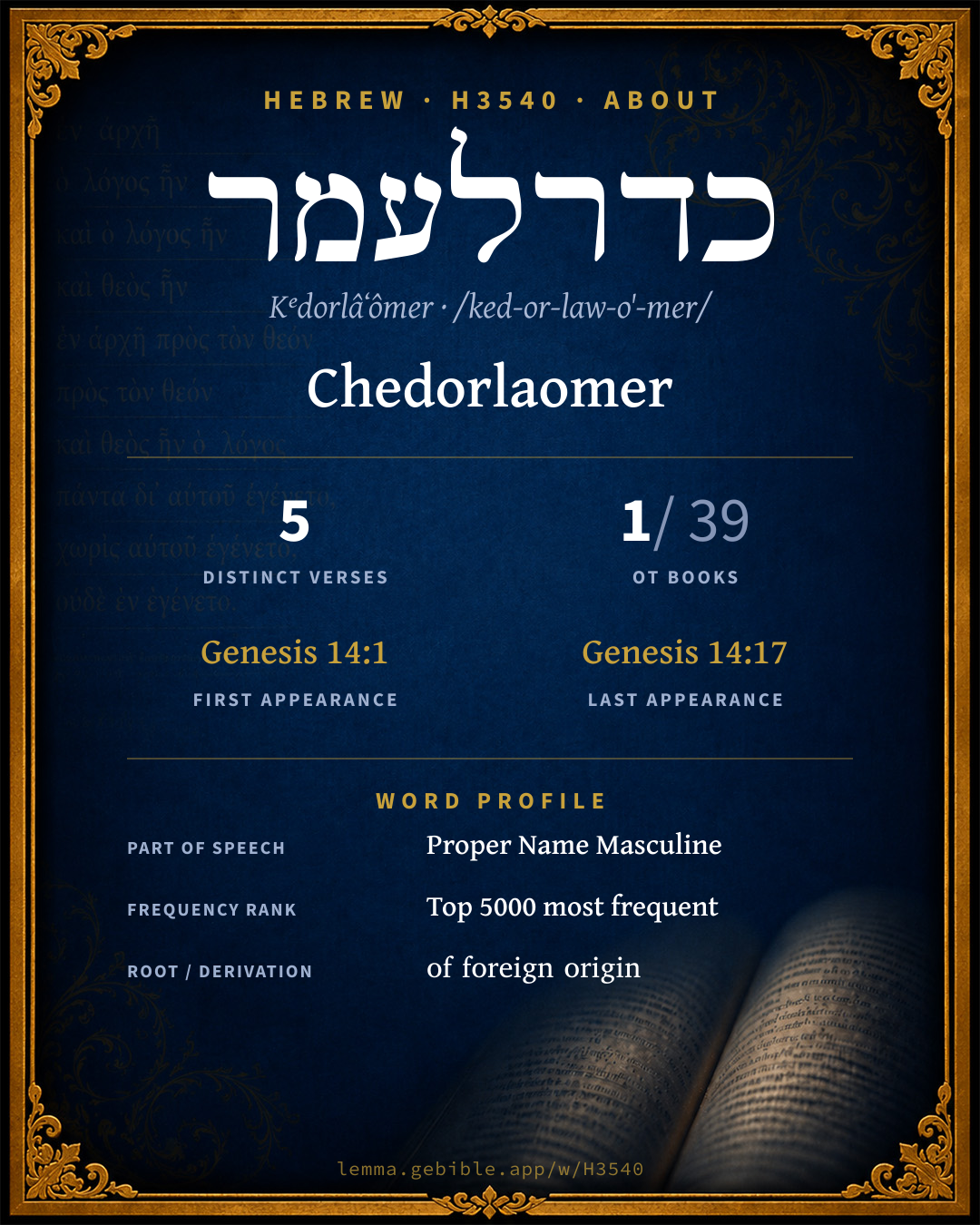
כְּדׇרְלָעֹמֶר
Chedorlaomer
BDB lists 2 entries for ‘Chedorlaomer’ fuller range ↓
Full lexicon entry — Brown-Driver-Briggs (BDB)
From Brown-Driver-Briggs (BDB)
Where this word appears
Grammar key — what these labels mean
Part of speech
- Noun
- A naming word — a person, place, thing, or idea.
Noun type
- Proper
- A name of a specific person, place, or people (e.g. Abraham, Zion, Israel).
Every verse where H3540 appears — 5 distinct verses across 1 book. Click any verse to open its interlinear word-by-word view. Verse text shown in the World English Bible for context — . Each verse’s Hebrew form is shown with its reference; the English is not keyword-highlighted, since the data carries no word-level English alignment. Use “Compare translations” on any verse to read it across multiple English versions. This concordance covers the Hebrew Bible; Septuagint (Greek Old Testament) occurrences are not indexed here.
Genesis 5 verses
- Genesis 14:1 כְּדָרְלָעֹ֨מֶר֙ n Proper It happened in the days of Amraphel, king of Shinar, Arioch, king of Ellasar, Chedorlaomer, king of Elam, and Tidal, king of Goiim,
- Genesis 14:4 כְּדָרְלָעֹ֑מֶר n Proper Twelve years they served Chedorlaomer, and in the thirteenth year, they rebelled.
- Genesis 14:5 כְדָרְלָעֹ֗מֶר n Proper In the fourteenth year Chedorlaomer came, and the kings who were with him, and struck the Rephaim in Ashteroth Karnaim, and the Zuzim in Ham, and the Emim in Shaveh-kiriathaim,
- Genesis 14:9 כְּדָרְלָעֹ֜מֶר n Proper against Chedorlaomer king of Elam, and Tidal king of Goiim, and Amraphel king of Shinar, and Arioch king of Ellasar; four kings against the five.
- Genesis 14:17 כְּדָרלָעֹ֔מֶר n Proper The king of Sodom went out to meet him, after his return from the slaughter of Chedorlaomer and the kings who were with him, at the valley of Shaveh (the same is the King's Valley).
About this entry
At a glance — auto-summarized from this page’s data, not written by a person. Every figure links to its source below. This summary describes the numbers; it doesn’t interpret them.
“Chedorlaomer” is the headline sense of the Hebrew name כדרלעמר (Kᵉdorlâʻômer). A scarce word — 5 verses in all of the Hebrew Bible. More than three-quarters of its appearances fall in Genesis. Scripture first uses it in Genesis 14:1. See 5-verse concordance and the renderings breakdown below.
Gloss history
Strong's 1890 vs modern scholarship
About this word
Strong's H3540 catalogs a Hebrew word from the Hebrew Old Testament.
These counts are not copied from any lexicon or concordance. They are computed here, from the morphology-tagged Hebrew Old Testament. What Lemma adds →
- 5
- distinct verses
- The word appears in 5 distinct verses.
- 1 / 39
- OT books
- The word appears in 1 of 39 Old Testament books.
- #3,337
- by frequency
- Top 5000 most frequent Hebrew words (rank 3,337 of 8,640 Hebrew words by occurrence).
View all 5 occurrences in the concordance →
Most concentrated in
- Genesis 5 verses 100%
By section of the Old Testament
By traditional corpus
Conventional, traditional groupings — biblical authorship is debated, so this is a traditional corpus grouping, not an authorship claim. Each share is this word’s portion of its verses in that division of the Hebrew canon. Each figure is a share of the word’s 5 distinct verses.
- Torah (Pentateuch) 5 verses · 100%
How translations render this word
Counts come from each version’s own published word-to-Strong’s tagging or interlinear alignment — an approximate guide to how each version renders this word, not a word-level alignment the data otherwise carries. Because each total is that version’s own tagged count, the per-version totals vary from one another and need not match the appearance or distinct-verse counts above. These counts may also differ from a printed concordance because Lemma counts each distinctly tagged rendering and does not collapse phrase taggings into a single head-word total. This is a fixed set of word-tagged versions (KJV, ASV, BSB, ULT) and does not change with the reading translation you choose elsewhere. Each version’s license is shown beside its name below (and on Sources).
- King James Version: Chedorlaomer 5×
- American Standard Version: Chedorlaomer 4×
- Berean Standard Bible: Chedorlaomer 5×
- unfoldingWord Literal Text: Chedorlaomer 5×
King James Version Public Domain
Renders H3540 across 5 tagged occurrences — most commonly:
American Standard Version Public Domain
Renders H3540 across 5 tagged occurrences — most commonly:
Plus 1 rendering that appears only once — usually multi-word phrases or single function words the recovered tagging swept in, not distinct renderings.
Berean Standard Bible Public Domain
Renders H3540 across 5 tagged occurrences — most commonly:
unfoldingWord Literal Text CC BY-SA 4.0
Renders H3540 across 5 tagged occurrences — most commonly:
Senses in BDB
The 2 senses BDB distinguishes for this word, in lexicon order (not ranked by frequency or importance). The full entry — with sub-senses — is in the Lexicon Entry tab.
- Chedorlaomer = "handful of sheaves"
- the king of Elam defeated by Abraham
Word origin
n.pr.m. king of Elam ( = Babylon. Kudar-Laga[mar] (Lagamaru = n.pr. div.), v. PinchesVict. Inst. Jan. 20, 1896 SayPSBA, June 1896, 176 ScheilRev. Bibl. 1896, 600 f., cf. SchrCOT)—Gn 14:1, 4, 5, 9, 17.
— Brown-Driver-Briggs (Oxford 1906, public domain), digitized via Sefaria, supplemented by the OpenScriptures HebrewLexicon (CC BY 4.0). See Sources.
Origin: of foreign origin
Forms in the corpus
The 5 distinct written forms H3540 takes in the Hebrew Bible, most frequent first — each parse links to that state’s occurrences in the concordance. Hebrew forms include their vowel points and cantillation, so a single lemma takes many written forms.
| Form | Parsing | Example | Uses |
|---|---|---|---|
| כְדָרְלָעֹ֗מֶר | Noun, Proper | Genesis 14:5 | 1 |
| כְּדָרְלָעֹ֑מֶר | Noun, Proper | Genesis 14:4 | 1 |
| כְּדָרְלָעֹ֜מֶר | Noun, Proper | Genesis 14:9 | 1 |
| כְּדָרְלָעֹ֨מֶר֙ | Noun, Proper | Genesis 14:1 | 1 |
| כְּדָרלָעֹ֔מֶר | Noun, Proper | Genesis 14:17 | 1 |
Bible dictionary
Public-domain dictionary articles matched to this entry by name (Chedorlaomer). A biblical name can be shared by more than one person or place, so an article may treat several.
Easton's Bible Dictionary · M. G. Easton, 1897
(= Khudur-Lagamar of the inscriptions), king of Elam. Many centuries before the age of Abraham, Canaan and even the Sinaitic peninsula had been conquered by Babylonian kings, and in the time of Abraham himself Babylonia was ruled by a dynasty which claimed sovereignity over Syria and Palestine. The kings of the dynasty bore names which were not Babylonian, but at once South Arabic and Hebrew. The most famous king of the dynasty was Khammu-rabi, who united Babylonia under one rule, and made Babylon its capital. When he ascended the throne, the country was under the suzerainty of the Elamites, and was divided into two kingdoms, that of Babylon (the Biblical Shinar) and that of Larsa (the Biblical Ellasar). The king of Larsa was Eri-Aku ("the servant of the moon-god"), the son of an Elamite prince, Kudur-Mabug, who is entitled "the father of the land of the Amorites." A recently discovered tablet enumerates among the enemies of Khammu-rabi, Kudur-Lagamar ("the servant of the goddess Lagamar") or Chedorlaomer, Eri-Aku or Arioch, and Tudkhula or Tidal. Khammu-rabi, whose name is also read Ammi-rapaltu or Amraphel by some scholars, succeeded in overcoming Eri-Aku and driving the Elamites out of Babylonia. Assur-bani-pal, the last of the Assyrian conquerors, mentions in two inscriptions that he took Susa 1635 years after Kedor-nakhunta, king of Elam, had conquered Babylonia. It was in the year B.C. 660 that Assur-bani-pal took Susa.
Hitchcock's Bible Names Dictionary · Roswell D. Hitchcock, 1869
roundness of a sheaf
Classic public-domain reference works; full attribution on Sources.
Septuagint verse parallels
This word appears in 5 verses that also exist in the Greek Old Testament (Septuagint), out of the 5 Hebrew verses it occurs in. You can read those verses in Greek by switching the Old Testament edition to the Septuagint.
Read these verses in the Septuagint
This is a verse-level parallel only — the same verses exist in both the Hebrew and Greek Old Testaments. No word-level Hebrew↔Greek correspondence is claimed: the data carries no such alignment, so no Greek word is shown as this Hebrew word’s translation. Coverage is not total — the Septuagint omits the deuterocanon and renumbers the Psalms, so some Hebrew verses have no direct Greek parallel.