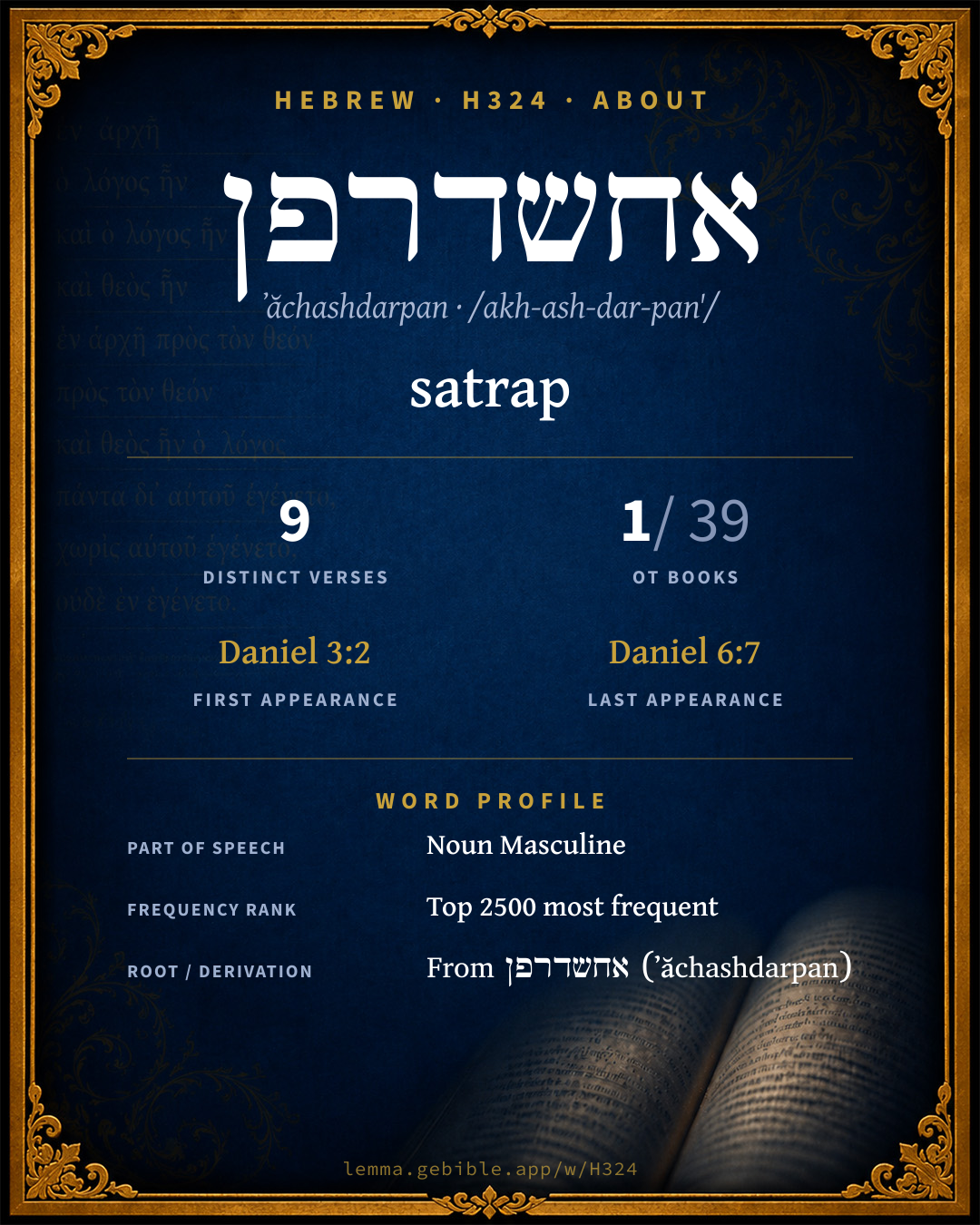
אֲחַשְׁדַּרְפְּנִין
satrap
Full lexicon entry — Brown-Driver-Briggs (BDB)
From Brown-Driver-Briggs (BDB)
Where this word appears
Every verse where H324 appears — 9 distinct verses across 1 book. Click any verse to open its interlinear word-by-word view. Verse text shown in the World English Bible for context — . Each verse’s Hebrew form is shown with its reference; the English is not keyword-highlighted, since the data carries no word-level English alignment. Use “Compare translations” on any verse to read it across multiple English versions. This concordance covers the Hebrew Bible; Septuagint (Greek Old Testament) occurrences are not indexed here.
Daniel 9 verses
- Daniel 3:2 לַֽ/אֲחַשְׁדַּרְפְּנַיָּ֡/א ptcl do + n c mp det + ptcl def.art Then Nebuchadnezzar the king sent to gather together the satraps, the deputies, and the governors, the judges, the treasurers, the counselors, the sheriffs, and all the rulers of the provinces, to come to the dedication of the image which Nebuchadnezzar the king had set up.
- Daniel 3:3 אֲחַשְׁדַּרְפְּנַיָּ֡/א n c mp det + ptcl def.art Then the satraps, the deputies, and the governors, the judges, the treasurers, the counselors, the sheriffs, and all the rulers of the provinces, were gathered together to the dedication of the image that Nebuchadnezzar the king had set up; and they stood before the image that Nebuchadnezzar had set up.
- Daniel 3:27 אֲחַשְׁדַּרְפְּנַיָּ֞/א n c mp det + ptcl def.art The satraps, the deputies, and the governors, and the king's counselors, being gathered together, saw these men, that the fire had no power on their bodies, nor was the hair of their head singed, neither were their pants changed, nor had the smell of fire passed on them.
- Daniel 6:1 לַ/אֲחַשְׁדַּרְפְּנַיָּ֖/א ptcl do + n c mp det + ptcl def.art It pleased Darius to set over the kingdom one hundred twenty satraps, who should be throughout the whole kingdom;
- Daniel 6:2 אֲחַשְׁדַּרְפְּנַיָּ֣/א n c mp det + ptcl def.art and over them three presidents, of whom Daniel was one; that these satraps might give account to them, and that the king should have no damage.
- Daniel 6:3 וַ/אֲחַשְׁדַּרְפְּנַיָּ֑/א conj + n c ms det + ptcl def.art Then this Daniel was distinguished above the presidents and the satraps, because an excellent spirit was in him; and the king thought to set him over the whole realm.
- Daniel 6:4 וַ/אֲחַשְׁדַּרְפְּנַיָּ֗/א conj + n c mp det + ptcl def.art Then the presidents and the satraps sought to find occasion against Daniel as touching the kingdom; but they could find no occasion nor fault, because he was faithful, neither was there any error or fault found in him.
- Daniel 6:6 וַ/אֲחַשְׁדַּרְפְּנַיָּ/א֙ conj + n c mp det + ptcl def.art Then these presidents and satraps assembled together to the king, and said thus to him, King Darius, live forever.
- Daniel 6:7 וַֽ/אֲחַשְׁדַּרְפְּנַיָּ/א֙ conj + n c mp det + ptcl def.art All the presidents of the kingdom, the deputies and the satraps, the counselors and the governors, have consulted together to establish a royal statute, and to make a strong interdict, that whoever shall ask a petition of any god or man for thirty days, save of you, O king, he shall be cast into the den of lions.
About this entry
At a glance — auto-summarized from this page’s data, not written by a person. Every figure links to its source below. This summary describes the numbers; it doesn’t interpret them.
The Hebrew noun אחשדרפן centers on the idea of “satrap.” The word gravitates to Daniel (100%). It appears 9 verses across 1 book of the Hebrew Bible, among its uncommon vocabulary. Debuting at Daniel 3:2, it then recurs through the corpus. Where the King James Version says “princes,” newer translations reach for “satraps” (Berean Standard Bible); the renderings breakdown has the detail. For the data behind this summary, explore the sense tree and the renderings breakdown below.
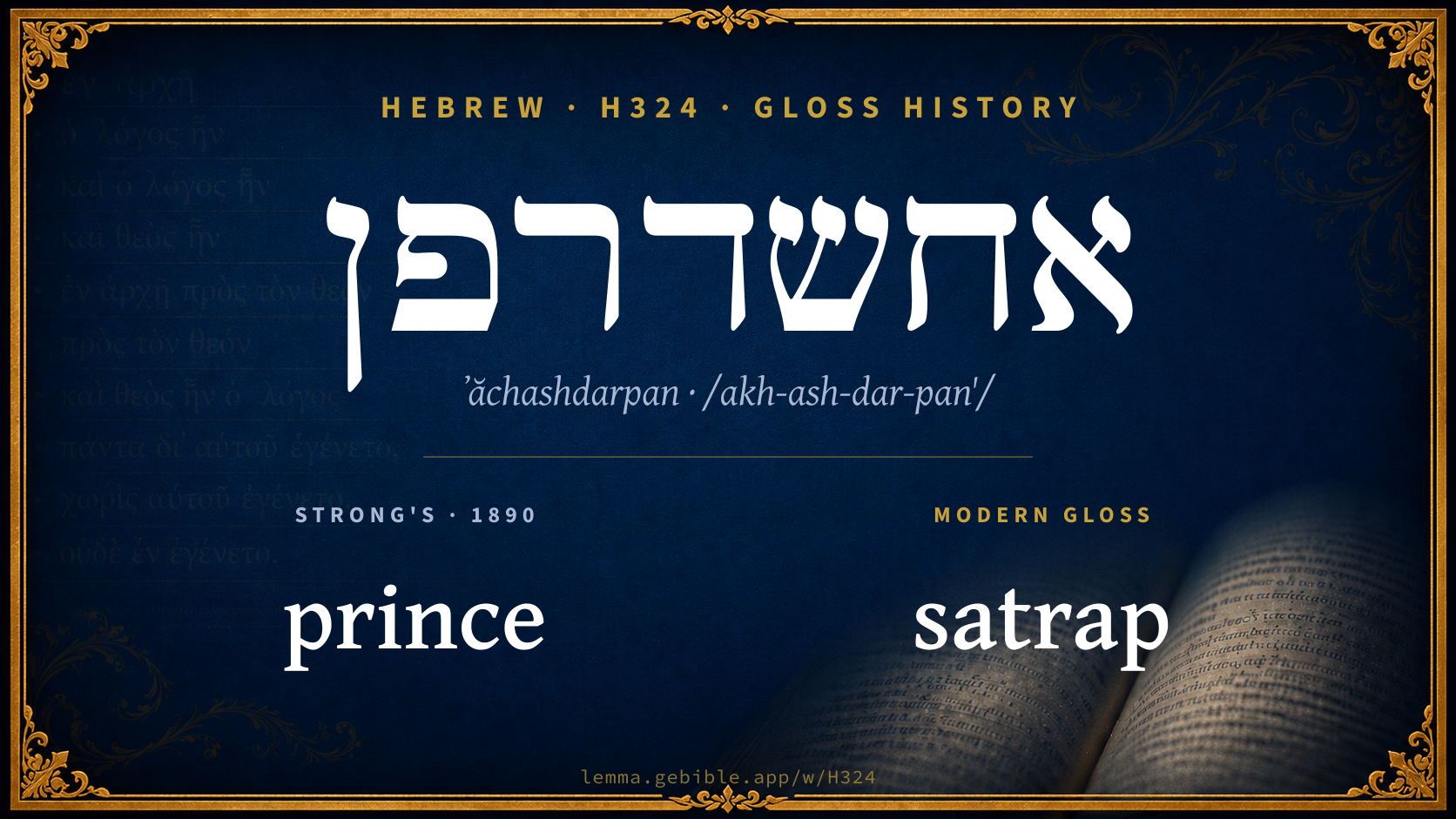
Gloss history
Strong's 1890 vs modern scholarship
About this word
Strong's H324 catalogs a Hebrew word from the Hebrew Old Testament.
These counts are not copied from any lexicon or concordance. They are computed here, from the morphology-tagged Hebrew Old Testament. What Lemma adds →
- 9
- distinct verses
- The word appears in 9 distinct verses.
- 1 / 39
- OT books
- The word appears in 1 of 39 Old Testament books.
- #2,481
- by frequency
- Top 2500 most frequent Hebrew words (rank 2,481 of 8,640 Hebrew words by occurrence).
View all 9 occurrences in the concordance →
Most concentrated in
- Daniel 9 verses 100%
By section of the Old Testament
By traditional corpus
Conventional, traditional groupings — biblical authorship is debated, so this is a traditional corpus grouping, not an authorship claim. Each share is this word’s portion of its verses in that division of the Hebrew canon. Each figure is a share of the word’s 9 distinct verses.
- Writings (Ketuvim) 9 verses · 100%
How translations render this word
Counts come from each version’s own published word-to-Strong’s tagging or interlinear alignment — an approximate guide to how each version renders this word, not a word-level alignment the data otherwise carries. Because each total is that version’s own tagged count, the per-version totals vary from one another and need not match the appearance or distinct-verse counts above. These counts may also differ from a printed concordance because Lemma counts each distinctly tagged rendering and does not collapse phrase taggings into a single head-word total. This is a fixed set of word-tagged versions (KJV, ASV, BSB, ULT) and does not change with the reading translation you choose elsewhere. Each version’s license is shown beside its name below (and on Sources).
- King James Version: Princes 9×
- American Standard Version: Satraps 9×
- Berean Standard Bible: Satraps 9×
- unfoldingWord Literal Text: Satraps 9×
King James Version Public Domain
Renders H324 across 9 tagged occurrences — most commonly:
American Standard Version Public Domain
Renders H324 across 9 tagged occurrences — most commonly:
Berean Standard Bible Public Domain
Renders H324 across 9 tagged occurrences — most commonly:
unfoldingWord Literal Text CC BY-SA 4.0
Renders H324 across 9 tagged occurrences — most commonly:
Senses in BDB
The 1 sense BDB distinguishes for this word, in lexicon order (not ranked by frequency or importance). The full entry — with sub-senses — is in the Lexicon Entry tab.
- satrap, a governor of a Persian province
Word origin
Derived from אחשדרפן (ʼăchashdarpan) (H323) — satrap.
Forms in the corpus
The 9 distinct written forms H324 takes in the Hebrew Bible, most frequent first — each parse links to that state’s occurrences in the concordance. Hebrew forms include their vowel points and cantillation, so a single lemma takes many written forms.
| Form | Parsing | Example | Uses |
|---|---|---|---|
| אֲחַשְׁדַּרְפְּנַיָּ֞/א | Particle, Definite Article | Daniel 3:27 | 1 |
| אֲחַשְׁדַּרְפְּנַיָּ֡/א | Particle, Definite Article | Daniel 3:3 | 1 |
| אֲחַשְׁדַּרְפְּנַיָּ֣/א | Particle, Definite Article | Daniel 6:2 | 1 |
| וַ/אֲחַשְׁדַּרְפְּנַיָּ/א֙ | Particle, Definite Article | Daniel 6:6 | 1 |
| וַ/אֲחַשְׁדַּרְפְּנַיָּ֑/א | Particle, Definite Article | Daniel 6:3 | 1 |
| וַ/אֲחַשְׁדַּרְפְּנַיָּ֗/א | Particle, Definite Article | Daniel 6:4 | 1 |
| וַֽ/אֲחַשְׁדַּרְפְּנַיָּ/א֙ | Particle, Definite Article | Daniel 6:7 | 1 |
| לַ/אֲחַשְׁדַּרְפְּנַיָּ֖/א | Particle, Definite Article | Daniel 6:1 | 1 |
| לַֽ/אֲחַשְׁדַּרְפְּנַיָּ֡/א | Particle, Definite Article | Daniel 3:2 | 1 |
Septuagint verse parallels
This word appears in 9 verses that also exist in the Greek Old Testament (Septuagint), out of the 9 Hebrew verses it occurs in. You can read those verses in Greek by switching the Old Testament edition to the Septuagint.
Read these verses in the Septuagint
This is a verse-level parallel only — the same verses exist in both the Hebrew and Greek Old Testaments. No word-level Hebrew↔Greek correspondence is claimed: the data carries no such alignment, so no Greek word is shown as this Hebrew word’s translation. Coverage is not total — the Septuagint omits the deuterocanon and renumbers the Psalms, so some Hebrew verses have no direct Greek parallel.