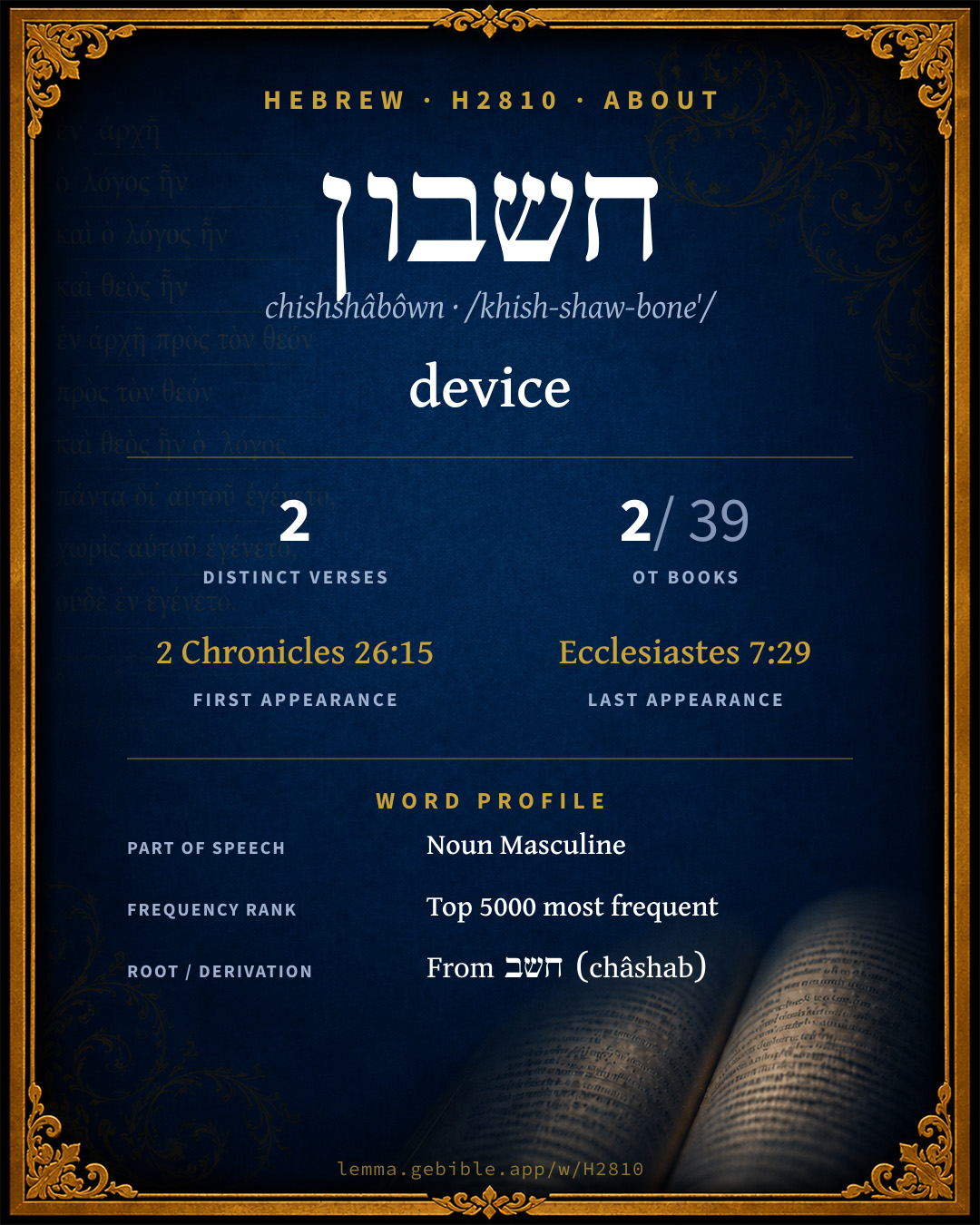
חִשָּׁבוֹן
device
Full lexicon entry — Brown-Driver-Briggs (BDB)
From Brown-Driver-Briggs (BDB)
Where this word appears
Grammar key — what these labels mean
Part of speech
- Noun
- A naming word — a person, place, thing, or idea.
Noun type
- Common
- A common noun — a general class of person, place, or thing (“king,” “city,” “water”), not a specific name.
State
- Absolute
- The independent form of a noun, not bound to a following word.
Gender
- Masculine
- Grammatically masculine.
Number
- Plural
- More than one (in Hebrew, generally three or more).
Every verse where H2810 appears in the Book of 2 Chronicles — 1 distinct verse. Click any verse to open its interlinear word-by-word view. Verse text shown in the World English Bible for context — . Each verse’s Hebrew form is shown with its reference; the English is not keyword-highlighted, since the data carries no word-level English alignment. Use “Compare translations” on any verse to read it across multiple English versions. This concordance covers the Hebrew Bible; Septuagint (Greek Old Testament) occurrences are not indexed here.
2 Chronicles
About this entry
At a glance — auto-summarized from this page’s data, not written by a person. Every figure links to its source below. This summary describes the numbers; it doesn’t interpret them.
The Hebrew noun חשבון centers on the idea of “device.” It is rare — just 2 verses in the entire Hebrew Bible. 2 Chronicles dominates its distribution — 1 of 2 verses. Debuting at 2 Chronicles 26:15, it then recurs through the corpus. Sharing its root, it stands alongside חשב, חשב and חשב. Dig into 2-verse concordance and the renderings breakdown below.
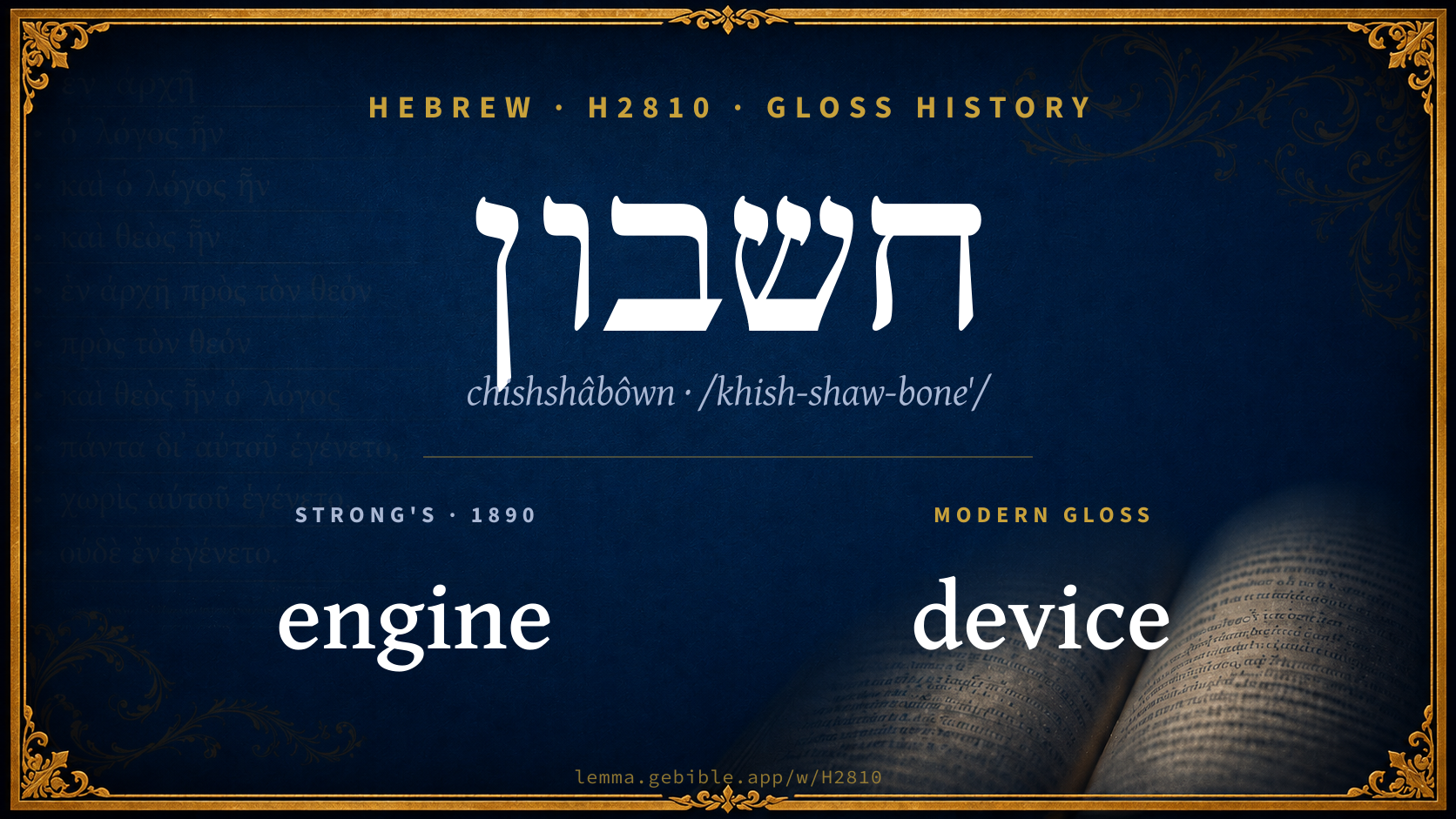
Gloss history
Strong's 1890 vs modern scholarship
About this word
Strong's H2810 catalogs a Hebrew word from the Hebrew Old Testament.
These counts are not copied from any lexicon or concordance. They are computed here, from the morphology-tagged Hebrew Old Testament. What Lemma adds →
- 2
- distinct verses
- The word appears in 2 distinct verses.
- 2 / 39
- OT books
- The word appears in 2 of 39 Old Testament books.
- #4,807
- by frequency
- Top 5000 most frequent Hebrew words (rank 4,807 of 8,640 Hebrew words by occurrence).
View all 2 occurrences in the concordance →
Most concentrated in
- 2 Chronicles 1 verse 50%
- Ecclesiastes 1 verse 50%
By section of the Old Testament
By traditional corpus
Conventional, traditional groupings — biblical authorship is debated, so this is a traditional corpus grouping, not an authorship claim. Each share is this word’s portion of its verses in that division of the Hebrew canon. Each figure is a share of the word’s 2 distinct verses.
- Writings (Ketuvim) 2 verses · 100%
How translations render this word
Counts come from each version’s own published word-to-Strong’s tagging or interlinear alignment — an approximate guide to how each version renders this word, not a word-level alignment the data otherwise carries. Because each total is that version’s own tagged count, the per-version totals vary from one another and need not match the appearance or distinct-verse counts above. These counts may also differ from a printed concordance because Lemma counts each distinctly tagged rendering and does not collapse phrase taggings into a single head-word total. This is a fixed set of word-tagged versions (KJV, ASV, BSB, ULT) and does not change with the reading translation you choose elsewhere. Each version’s license is shown beside its name below (and on Sources).
- King James Version: Engines 1×, Inventions 1×
- American Standard Version: Engines 1×, Inventions 1×
- Berean Standard Bible: Devices 1×, Schemes 1×
- unfoldingWord Literal Text: Schemes 1×, War machines 1×
King James Version Public Domain
Renders H2810 across 2 tagged occurrences — most commonly:
American Standard Version Public Domain
Renders H2810 across 2 tagged occurrences — most commonly:
Berean Standard Bible Public Domain
Renders H2810 across 2 tagged occurrences — most commonly:
unfoldingWord Literal Text CC BY-SA 4.0
Renders H2810 across 2 tagged occurrences — most commonly:
Senses in BDB
The 1 sense BDB distinguishes for this word, in lexicon order (not ranked by frequency or importance). The full entry — with sub-senses — is in the Lexicon Entry tab.
- device, invention
Word origin
[ חִשָּׁבוֹן ] n.m. device, invention
— Brown-Driver-Briggs (Oxford 1906, public domain), digitized via Sefaria, supplemented by the OpenScriptures HebrewLexicon (CC BY 4.0). See Sources.
Derived from חשב (châshab) (H2803) — to think.
Jastrow Dictionary
A second Hebrew/Aramaic lexicon for comparison, covering Aramaic and post-biblical (Talmudic, Targumic, Midrashic) usage that the biblical-Hebrew BDB does not. Matched by lemma rather than by Strong’s number, so a lemma may carry more than one Jastrow headword (shown separately below), and the entries cover usage well beyond the Bible.
חֶשְׁבּוֹן
- preced. wds.)
- 1. account, sum; accountability; punishment and reward. B. Bath. 9ᵇ ח׳ גדול sum total. Ib. 78ᵇ (play on Ḥeshbon, Num. XXI, 27; 30) באו ונחשב חֶשְׁבּוֹנוֹ וכ׳ come and let us examine the account of the world (human affairs), the loss etc. Ib. אבד ח׳ וכ׳ the accountability of the world is gone (there is no reward or punishment). Ex. R. s. 51, beg., a. fr. ליתן ח׳ to render an account. Tosef. B. Kam. X, 21 מה ח׳ עשה וכ׳ how our father settled with yon; Y. ib. X, 7ᵇ bot.—Y. Ab. Zar. II, 42ᵃ top ח׳ מים וכ׳ he understands the calculation of the action of the water. Ib. ח׳ גדול הוא this is a great thing to calculate; a. fr. e.g. Numbers 21:27
- 2. promptness in business. Deut. R. s. 4 איני מכיר חֶשְׁבּוֹנְךָ I do not know your way of settling (whether you are prompt); ib. עשית לי ח׳ טוב you paid me promptly. [Yalk. Deut. 808 הח׳ read בעל הח׳ market commissioner.]—Pl. חֶשְׁבּוֹנוֹת. Sabb. 150ᵃ, sq., v. חָשַׁב. Bekh. 5ᵃ בקי בח׳ a good arithmetician.
A Dictionary of the Targumim, the Talmud Babli and Yerushalmi, and the Midrashic Literature (Marcus Jastrow; London, Luzac, 1903) — Public Domain. Digitized via Sefaria. Digitized via Sefaria. Full attribution on Sources.
Forms in the corpus
The 2 distinct written forms H2810 takes in the Hebrew Bible, most frequent first — each parse links to that state’s occurrences in the concordance. Hebrew forms include their vowel points and cantillation, so a single lemma takes many written forms.
| Form | Parsing | Example | Uses |
|---|---|---|---|
| חִשְּׁבֹנ֜וֹת | Noun, Common, Masculine, Plural, Absolute | 2 Chronicles 26:15 | 1 |
| חִשְּׁבֹנ֥וֹת | Noun, Common, Masculine, Plural, Absolute | Ecclesiastes 7:29 | 1 |
Same root — word family
Other BDB entries built from the same root as H2810, grouped by Strong’s listed origin. These share a root / origin per the lexicon — not necessarily a shared meaning. Each links to that word’s own entry.
Derives from
Shares the same root
- חשב chăshab H2804 to think
- חשב chêsheb H2805 girdle
- חשבון cheshbôwn H2808 reckoning
- מחשבה machăshâbâh H4284 thought
Proper names from this root
People and places named from this root — a name, not an additional meaning of the word.
- חשבדנה Chashbaddânâh H2806 Hashbadana
- חשבה Chăshubâh H2807 Hashubah
- חשביה Chăshabyâh H2811 Hashabiah
- חשוב Chashshûwb H2815 Hashub
Compare all same-root words → Showing 4 of 10 — not the complete family. 4 of the same-root words are proper names (people or places). They share a root, not necessarily a meaning.
Septuagint verse parallels
This word appears in 2 verses that also exist in the Greek Old Testament (Septuagint), out of the 2 Hebrew verses it occurs in. You can read those verses in Greek by switching the Old Testament edition to the Septuagint.
Read these verses in the Septuagint
This is a verse-level parallel only — the same verses exist in both the Hebrew and Greek Old Testaments. No word-level Hebrew↔Greek correspondence is claimed: the data carries no such alignment, so no Greek word is shown as this Hebrew word’s translation. Coverage is not total — the Septuagint omits the deuterocanon and renumbers the Psalms, so some Hebrew verses have no direct Greek parallel.