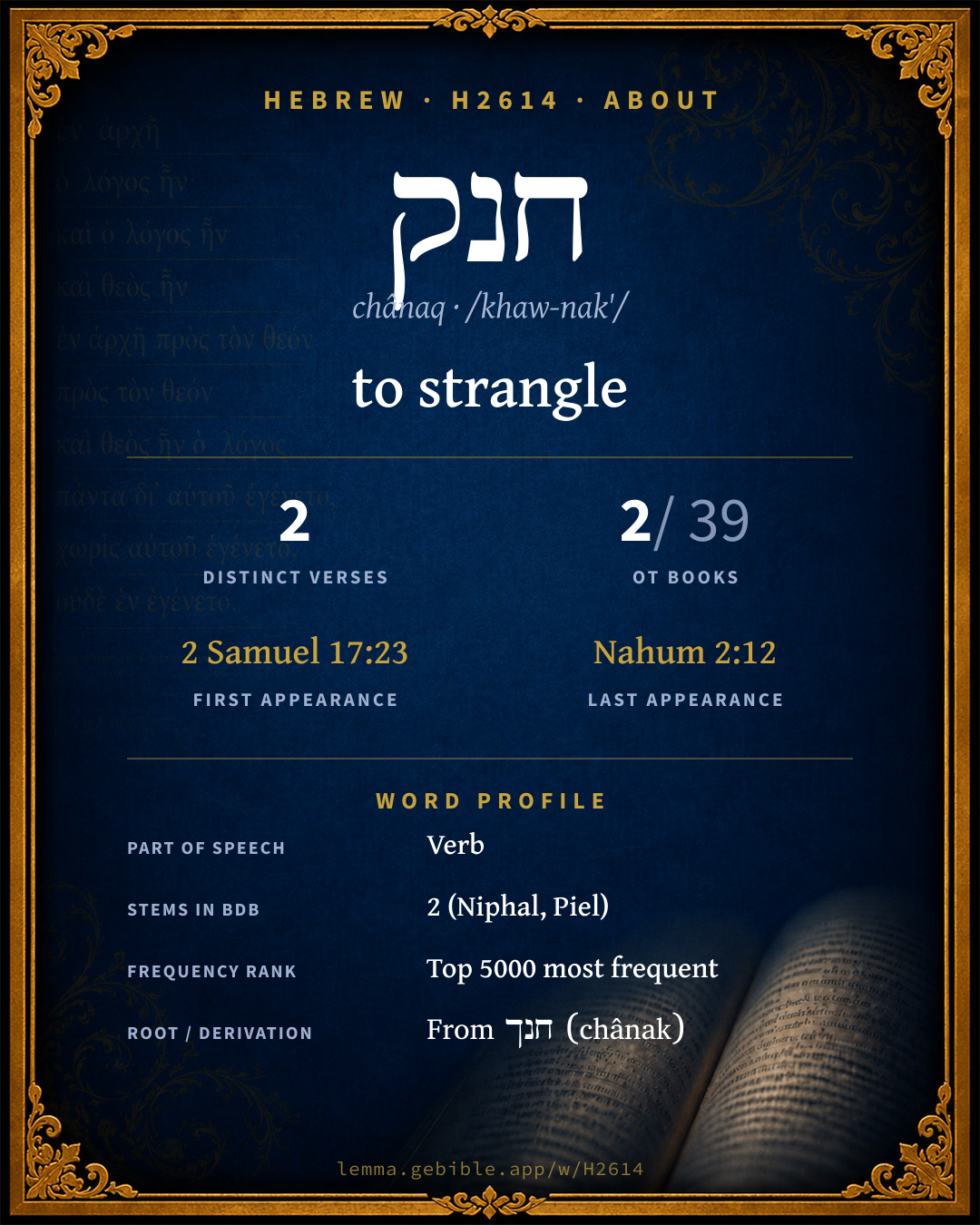
חָנַק
to strangle
‘to strangle’ is one of 3 main senses fuller range ↓
Full lexicon entry — Brown-Driver-Briggs (BDB)
From Brown-Driver-Briggs (BDB)
Where this word appears
See every Niphal verb in the Hebrew Bible →
Grammar key — what these labels mean
Stem
- Niphal
- Usually the simple passive or reflexive of the Qal (“he was written”).
- Piel
- An intensive or resultative active stem.
Form
- Sequential Imperfect
- An imperfect with prefixed waw — the standard past-narrative form (waw-consecutive imperfect).
- Participle Active
- A verbal adjective expressing ongoing or characteristic action (“writing / one who writes”).
State
- Absolute
- The independent form of a noun, not bound to a following word.
Person
- 3rd Person
- The one spoken about (“he / she / it / they”).
Gender
- Masculine
- Grammatically masculine.
Number
- Singular
- One.
1 distinct verse where H2614 appears in the Niphal stem, across 1 book. Filtered view — show all forms. Click any verse to open its interlinear word-by-word view. Verse text shown in the World English Bible for context — . Each verse’s Hebrew form is shown with its reference; the English is not keyword-highlighted, since the data carries no word-level English alignment. Use “Compare translations” on any verse to read it across multiple English versions. This concordance covers the Hebrew Bible; Septuagint (Greek Old Testament) occurrences are not indexed here.
2 Samuel 1 verse
About this entry
At a glance — auto-summarized from this page’s data, not written by a person. Every figure links to its source below. This summary describes the numbers; it doesn’t interpret them.
חנק — transliterated chânaq — is a Hebrew verb carrying the sense “to strangle.” With only 2 verses it sits in the long tail of Hebrew Bible vocabulary. More than half of its appearances fall in 2 Samuel. Debuting at 2 Samuel 17:23, it then recurs through the corpus. Across 2 stems, its meaning turns on the binyan (Niphal, Piel). See the sense tree, 2-verse concordance, and the renderings breakdown below.
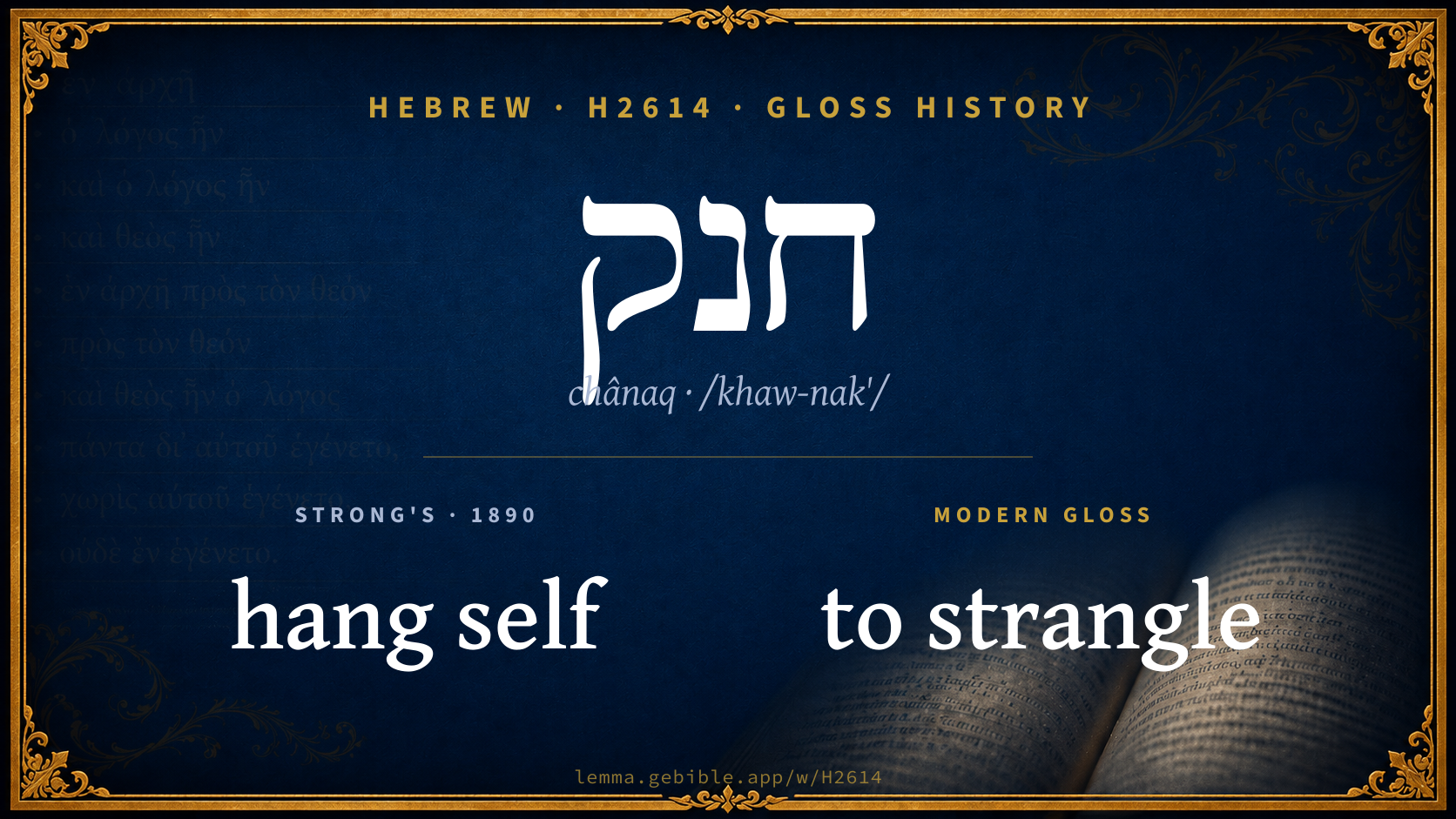
Gloss history
Strong's 1890 vs modern scholarship
About this word
Strong's H2614 catalogs a Hebrew word from the Hebrew Old Testament.
These counts are not copied from any lexicon or concordance. They are computed here, from the morphology-tagged Hebrew Old Testament. What Lemma adds →
- 2
- distinct verses
- The word appears in 2 distinct verses.
- 2 / 39
- OT books
- The word appears in 2 of 39 Old Testament books.
- #4,807
- by frequency
- Top 5000 most frequent Hebrew words (rank 4,807 of 8,640 Hebrew words by occurrence).
View all 2 occurrences in the concordance →
By traditional corpus
Conventional, traditional groupings — biblical authorship is debated, so this is a traditional corpus grouping, not an authorship claim. Each share is this word’s portion of its verses in that division of the Hebrew canon. Each figure is a share of the word’s 2 distinct verses.
- Prophets (Nevi'im) 2 verses · 100%
How translations render this word
Counts come from each version’s own published word-to-Strong’s tagging or interlinear alignment — an approximate guide to how each version renders this word, not a word-level alignment the data otherwise carries. Because each total is that version’s own tagged count, the per-version totals vary from one another and need not match the appearance or distinct-verse counts above. These counts may also differ from a printed concordance because Lemma counts each distinctly tagged rendering and does not collapse phrase taggings into a single head-word total. This is a fixed set of word-tagged versions (KJV, ASV, BSB, ULT) and does not change with the reading translation you choose elsewhere. Each version’s license is shown beside its name below (and on Sources).
- King James Version: Hanged 1×, Strangled 1×
- American Standard Version: Hanged 1×, Strangled 1×
- Berean Standard Bible: Hanged himself 1×, Strangled prey 1×
- unfoldingWord Literal Text: He hanged himself 1×, Strangling 1×
King James Version Public Domain
Renders H2614 across 2 tagged occurrences — most commonly:
American Standard Version Public Domain
Renders H2614 across 2 tagged occurrences — most commonly:
Berean Standard Bible Public Domain
Renders H2614 across 2 tagged occurrences — most commonly:
unfoldingWord Literal Text CC BY-SA 4.0
Renders H2614 across 2 tagged occurrences — most commonly:
Senses in the full BDB
Hebrew verbs can shift meaning by stem (binyan): Qal is the basic action, Niphal is often passive or reflexive, Piel often intensifies or makes it factitive, and Hiphil is typically causative. The senses below are grouped under the stem BDB assigns to each.
What do BDB’s symbols mean?
BDB uses these scholarly abbreviations:
| Symbol | Meaning |
|---|---|
| 𝔊 | the Septuagint (the ancient Greek translation, LXX) |
| 𝔙 | the Vulgate (the Latin translation) |
| 𝔖 | the Syriac version (the Peshitta) |
| 𝔗 | the Targum (the Aramaic translation) |
| ψ | the Psalms |
| √ | root (the underlying root or stem) |
| ‖ | parallel passage (a synonymous or contrasted parallel) |
| † | the dagger: every passage where the word occurs is cited |
The 2 senses and sub-senses the full Brown-Driver-Briggs lexicon distinguishes for this word, in lexicon order (not ranked by frequency), with BDB’s own verbatim wording and sub-sense lettering. Shown in Hebrew script with BDB’s own scholarly abbreviations. The condensed entry is in the Lexicon Entry tab. See also the Forms in the corpus table below.
Niphal
- . strangled himself
Piel
- . strangle, of lion strangling prey, fig. of Ninevitish king
Senses from the full Brown-Driver-Briggs lexicon (Brown, Driver, Briggs; Oxford 1906 — public domain), digitized via Sefaria, supplemented by the OpenScriptures HebrewLexicon (CC BY 4.0). Full attribution on Sources.
Word origin
Derived from חנך (chânak) (H2596) — to dedicate.
Jastrow Dictionary
A second Hebrew/Aramaic lexicon for comparison, covering Aramaic and post-biblical (Talmudic, Targumic, Midrashic) usage that the biblical-Hebrew BDB does not. Matched by lemma rather than by Strong’s number, so a lemma may carry more than one Jastrow headword (shown separately below), and the entries cover usage well beyond the Bible.
חָנַק
- [to press,] to seize by the throat, to choke. Tosef. Sabb. III (IV), 6 ואין חוֹנְקִין בשבת you must not press (the jugular veins, to relieve from belly-ache) on the Sabbath; v. infra Pi.—B. Bath. X, 8 (175ᵇ) הרי החוֹנֵק את וכ׳ if one seizes a debtor by the throat (threatening violence). Ib. 176ᵃ בחָנוּק in the case of one being threatened (and another pledging himself for him). Sabb. 57ᵃ אין אשה חוֹנֶקֶת וכ׳ a woman will not choke herself (will not tie a band around her neck so closely that no water could get under it when bathing); ib.ᵇ אשה ח׳ וכ׳ a woman does tie a chain closely in order to appear fleshy. Gen. R. s. 34 (ref. to דם האדם באדם, Gen. IX, 6) אף החוֹנְקוֹ (the gentile is guilty of bloodshed) even if he only chokes a man (‘shedding the blood of man in man’); Y. Kidd. I, 58ᶜ top בחונקו מפני עצמו (read: ממונו) when he merely chokes him to take his money; a. e.—Esp. to strangle to death. B. Kam. 47ᵇ ח׳ את עצמו (the ox) strangled himself (by being caught in a rope). Y. Sot. IX, 23ᶜ נמצא חָנוּק if he was found strangled; a. e.—Trnsf. to produce anguish, agony. Ḥull. I, 2 מפני שהן חוֹנְקִין because they (a saw &c.) cause agony as if by choking (instead of cutting).—[Kidd. 62ᵃ (ref. to Num. V, 19—20) according to R. Meïr (who says that a condition is not valid unless both the negative and the positive alternatives are stated) חִנְקִי מיבעי ליה it ought to have been added (to vers 20) ‘die in agony’. א"ר תנחום הנקי כתיב said R. T. it says (verse 19) hnki (which may be read hinnaki for the one alternative and hinki for ḥinki for the other); Ar. reads הנקי, v. נָקִי.] e.g. Genesis 9:6
- 1. to be strangled. Snh. XI, 1 (84ᵇ) הנֶחְנָקִין those sentenced to death by strangulation. Pes. 112ᵃ לֵיחָנֵק, v. אִילָּן.
- 2. to feel like choking, to be sorry (cmp. אָנַק). Cant. R. to IV, 12 התחיל … רואה ונ׳ the seller sees it and grieves (over his loss); Yalk. Ex. 225 Mekh. B’shall. s. 1 לֵיחָנֵק.—[Sabb. 66ᵇ, v. infra.]
- 1. to squeeze in, immure. Pirké d’R. El. ch. XLVIII; Yalk. Ex. 169 (היו) מְחַנְּקִין את ישראל וכ׳ pressed Israelites between the walls (having mingled their bodies with the clay).
- 2. to strangle. Tosef. M. Kat. I, 5 מְחַנְּקִין וכ׳ (M. Kat. 6ᵇ חונקין) the aunts choke each other to death.
- 3. to press the throat, to squeeze the jugular veins (an operation applied in cases of abdominal affection, Ar. s. v. חנק; to reset a laryngal muscle or ring, Rashi; oth. defin., v. Ar. s. v.). Sabb. 66ᵇ לְחַנֵּק to perform the operation (Rashi a. Ar. ed. Koh. לֵיחָנֵק to have the operation performed).
חֲנַק
- to strangle. Targ. II Esth. I, 3.—Keth. 60ᵇ וחֲנַקְתֵּיה she choked her child to death; דלא … דחַנְקַן בנייהו for women (of sound mind) will not choke their children (in order to be allowed to marry again before the lapse of a certain time). Y. Taan. IV, 69ᵇ top … הוה והוה ח׳ ליה air burst forth out of the bottle and choked him. Y. Ab. Zar. II, 40ᵈ חַנְקַת גרמה she hanged herself. Y. Ber. II, 5ᵃ top בעייא … מִיחְנְקוּנֵיה I would rather choke him; a. e.—Gitt. 67ᵇ דחַנְקָא, v. דִּיסְתָּנָא I.
- to hang one’s self. Targ. II Sam. XVII, 23.—Y. Snh. X, 29ᵃ bot. כדון דוד מִתְחַנֵּק now David will die in despair (cmp. preced. Nif.). Ib. יהא סופיה מִתְחַנְּקָא will end his life by suicide.
חֶנֶק
- (preced. wds.) execution by strangulation. Snh. VII, 1; a. fr.
A Dictionary of the Targumim, the Talmud Babli and Yerushalmi, and the Midrashic Literature (Marcus Jastrow; London, Luzac, 1903) — Public Domain. Digitized via Sefaria. Digitized via Sefaria. Full attribution on Sources.
Forms in the corpus
The 2 distinct written forms H2614 takes in the Hebrew Bible, most frequent first — each parse links to that stem’s occurrences in the concordance. Hebrew forms include their vowel points and cantillation, so a single lemma takes many written forms.
| Form | Parsing | Example | Uses |
|---|---|---|---|
| וַ/יֵּחָנַ֑ק | Verb, Niphal, Sequential Imperfect, 3rd Person, Masculine, Singular | 2 Samuel 17:23 | 1 |
| וּ/מְחַנֵּ֖ק | Verb, Piel, Participle Active, Masculine, Singular, Absolute | Nahum 2:12 | 1 |
Same root — word family
Other BDB entries built from the same root as H2614, grouped by Strong’s listed origin. These share a root / origin per the lexicon — not necessarily a shared meaning. Each links to that word’s own entry.
Derives from
Shares the same root
Derived from this word
Proper names from this root
People and places named from this root — a name, not an additional meaning of the word.
Compare all same-root words → Showing 4 of 7 — not the complete family. 1 of the same-root words is a proper name (a person or place). They share a root, not necessarily a meaning.
Septuagint verse parallels
This word appears in 2 verses that also exist in the Greek Old Testament (Septuagint), out of the 2 Hebrew verses it occurs in. You can read those verses in Greek by switching the Old Testament edition to the Septuagint.
Read these verses in the Septuagint
This is a verse-level parallel only — the same verses exist in both the Hebrew and Greek Old Testaments. No word-level Hebrew↔Greek correspondence is claimed: the data carries no such alignment, so no Greek word is shown as this Hebrew word’s translation. Coverage is not total — the Septuagint omits the deuterocanon and renumbers the Psalms, so some Hebrew verses have no direct Greek parallel.