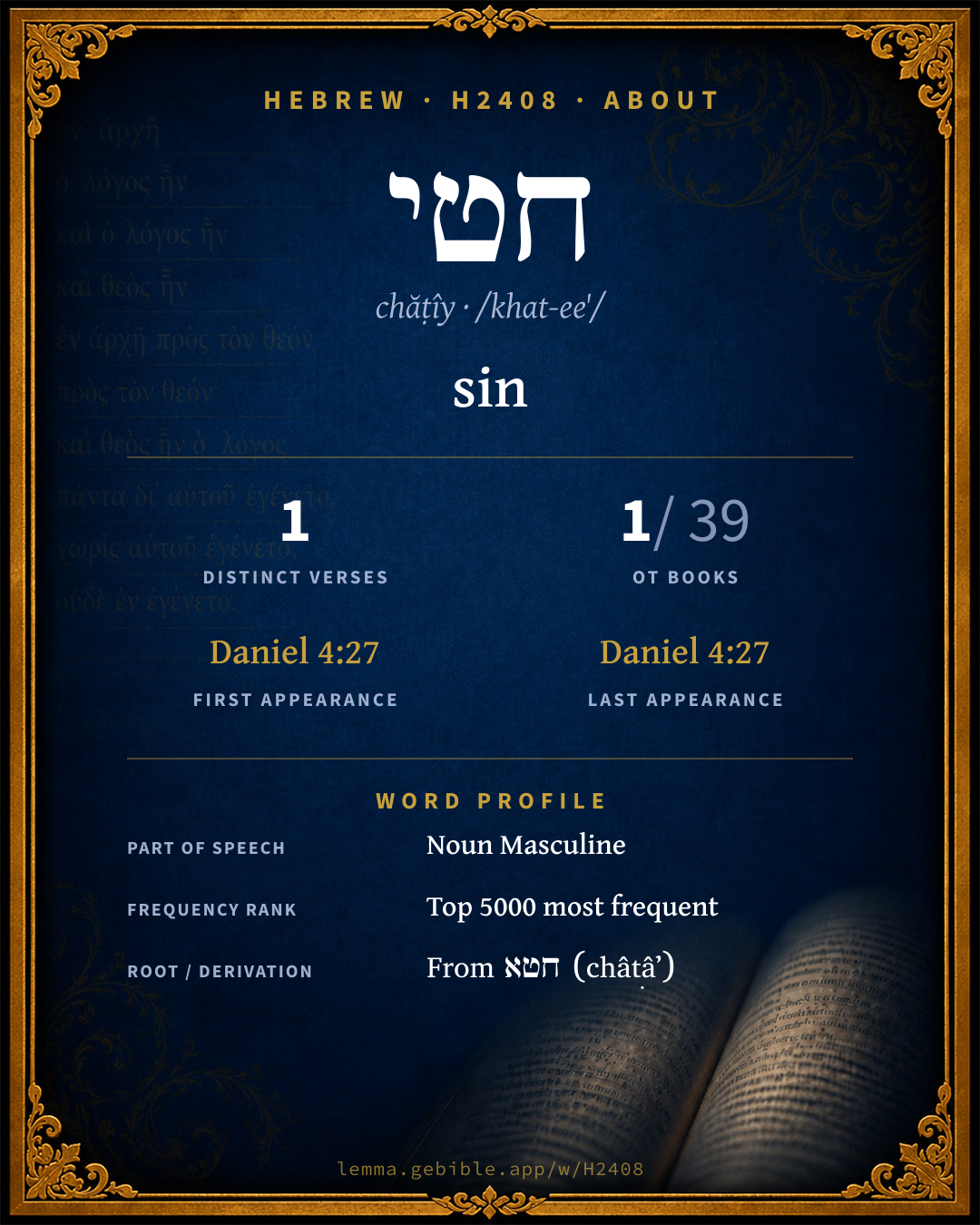
חֲטָי
sin
Full lexicon entry — Brown-Driver-Briggs (BDB)
From Brown-Driver-Briggs (BDB)
Where this word appears
Grammar key — what these labels mean
Noun type
- Common
- A common noun — a general class of person, place, or thing (“king,” “city,” “water”), not a specific name.
State
- Construct
- A noun bound to a following noun in a possessive / “of” relationship (the construct chain).
Gender
- Masculine
- Grammatically masculine.
Number
- Singular
- One.
Every verse where H2408 appears — 1 distinct verse across 1 book. Click any verse to open its interlinear word-by-word view. Verse text shown in the World English Bible for context — . Each verse’s Hebrew form is shown with its reference; the English is not keyword-highlighted, since the data carries no word-level English alignment. Use “Compare translations” on any verse to read it across multiple English versions. This concordance covers the Hebrew Bible; Septuagint (Greek Old Testament) occurrences are not indexed here.
Daniel 1 verse
About this entry
At a glance — auto-summarized from this page’s data, not written by a person. Every figure links to its source below. This summary describes the numbers; it doesn’t interpret them.
חטי (chăṭîy) is a Hebrew noun most often rendered “sin.” A scarce word — 1 verse in all of the Hebrew Bible. Daniel dominates its distribution — 1 of 1 verses. Its lone occurrence is Daniel 4:27. Sharing its root, it stands alongside חטא, חטא and חטא. The sections below give every sense, occurrence, and version rendering.
Gloss history
Strong's 1890 vs modern scholarship
About this word
Strong's H2408 catalogs a Hebrew word from the Hebrew Old Testament.
These counts are not copied from any lexicon or concordance. They are computed here, from the morphology-tagged Hebrew Old Testament. What Lemma adds →
- 1
- distinct verses
- The word appears in 1 distinct verse.
- 1 / 39
- OT books
- The word appears in 1 of 39 Old Testament books.
- #4,807
- by frequency
- Top 5000 most frequent Hebrew words (rank 4,807 of 8,640 Hebrew words by occurrence).
View all 1 occurrence in the concordance →
Most concentrated in
- Daniel 1 verse 100%
By section of the Old Testament
By traditional corpus
Conventional, traditional groupings — biblical authorship is debated, so this is a traditional corpus grouping, not an authorship claim. Each share is this word’s portion of its verses in that division of the Hebrew canon. Each figure is a share of the word’s 1 distinct verse.
- Writings (Ketuvim) 1 verse · 100%
How translations render this word
Counts come from each version’s own published word-to-Strong’s tagging or interlinear alignment — an approximate guide to how each version renders this word, not a word-level alignment the data otherwise carries. Because each total is that version’s own tagged count, the per-version totals vary from one another and need not match the appearance or distinct-verse counts above. These counts may also differ from a printed concordance because Lemma counts each distinctly tagged rendering and does not collapse phrase taggings into a single head-word total. This is a fixed set of word-tagged versions (KJV, ASV, BSB, ULT) and does not change with the reading translation you choose elsewhere. Each version’s license is shown beside its name below (and on Sources).
- King James Version: Sins 1×
- American Standard Version: Sins 1×
- Berean Standard Bible: Sins 1×
- unfoldingWord Literal Text: Sins 1×
King James Version Public Domain
Renders H2408 across 1 tagged occurrence — most commonly:
American Standard Version Public Domain
Renders H2408 across 1 tagged occurrence — most commonly:
Berean Standard Bible Public Domain
Renders H2408 across 1 tagged occurrence — most commonly:
unfoldingWord Literal Text CC BY-SA 4.0
Renders H2408 across 1 tagged occurrence — most commonly:
Senses in BDB
The 1 sense BDB distinguishes for this word, in lexicon order (not ranked by frequency or importance). The full entry — with sub-senses — is in the Lexicon Entry tab.
- sin
Word origin
[ חֲטָי ] n.[m.] sin;—sf. Dn 4:24
— Brown-Driver-Briggs (Oxford 1906, public domain), digitized via Sefaria, supplemented by the OpenScriptures HebrewLexicon (CC BY 4.0). See Sources.
Derived from חטא (châṭâʼ) (H2398) — to sin.
Jastrow Dictionary
A second Hebrew/Aramaic lexicon for comparison, covering Aramaic and post-biblical (Talmudic, Targumic, Midrashic) usage that the biblical-Hebrew BDB does not. Matched by lemma rather than by Strong’s number, so a lemma may carry more than one Jastrow headword (shown separately below), and the entries cover usage well beyond the Bible.
חִטָּא I
- (חטט), line drawn with a stylus.—Pl. חִטֵּי. Keth. 69ᵃ top ביני ח׳ between the lines, v. תְּלֵי.
חטי
- [to stroll idly, saunter (v. Fl. to Levy Targ. Dict. I, 4242),] to live in luxury, to be like a nobleman, to be well-dressed, clean &c. (cmp. פנק, פרנק).
- to make look well, polish, dress, cleanse, prepare. Ḥull. 27ᵃ (play on וש̇ח̇ט̇, Lev. I, 5) ממקום שש̇ח̇ חַטֵֹּהוּ from the place where the animal bends (its head, the front of the neck), cleanse it (let its blood run out). Ib. ממאי דהאי חטהו לישנא דדכויי הוא how can you prove that this ḥattehu has the meaning of cleansing?—Ib. ממקום שס̇ח̇ ח̇ט̇הו from where it utters sound, cleanse it. [Cant. R. to VII, 2, v. infra.] e.g. Leviticus 1:5
- 1. to enjoy, to be gratified. Cant. R. to VII, 2 [read:] כל חִיטּוּיִין … שישראל מִתְחַטִּין וכ׳ all luxuries and enjoyments which Israel indulge in and enjoy. Men. 66ᵇ (play on נ̇ת̇ע̇ל̇ס̇ה̇, Prov. VII, 18) נ̇שא ונת̇ן ונע̇לה ונ̇שמח ונִתְחַטֵּא באהבים let us have a conversation, then let us go up and rejoice and delight ourselves with dalliances; Sifra Vayikra, N’dabah, ch. XIV, Par. 13. Men. l. c. (play on נ̇ע̇ל̇ס̇ה̇ Job XXXIX, 13) נ̇וש̇א עול̇ה ונתח̇טא; Sifra l. c. נושא ועולה ומִתְחַטֵּא he (the bird) raises (his wings) and rises and enjoys himself (differ. interpret. in Rashi). e.g. Proverbs 7:18
- 2. to show one’s self a nobleman, to be generous, proud. Cant. R. to VII, 7 שהיה מתחטא על וכ׳ he was generous towards &c. (ref. to Gen. XIV, 23, Dan. V, 17). e.g. Genesis 14:23
- 3. to be imperious, to lord it, to ask petulantly. Taan. III, 8 אתה מתח׳ לפני thou comest petulantly before the Lord כבן שהוא מתח׳ על וכ׳ like a son that lords it over his father &c. Cant. R. to V, 6 (explain. חמק, ib.) נתח׳ וכ׳ he became petulant, he got angry with me.
חֲטִי
- ; part. חַטְיָא used to comfort, tender, delicate. Targ. Y. Gen. XXXIII, 13 טליא חַטְיָין (h. text רכים).
- to cause to be generous, to persuade to leniency. Koh. R. to IX, 18 אנא אזלא ומְחַטָּא ליה I will go to appeal to his generosity (Midr. Sam. ch. XXXII ומפייסה).
- to be raised in luxury. Part. pass. מִחְטֵי, fem. מֶחְטָיָא, מֶחְטַיְיתָא delicate. Targ. Y. I Deut. XXVIII, 54, Targ. Y. II, Deut. XXVIII, 54; 56.
חטי ²
- (b. h.) [to miss,] to fail, err, sin. Yoma IV, 2, sq. Ber. 17ᵃ; a. fr. R. Hash. 26ᵃ חוֹטֵא בל יקריב he that sinned (with gold by making the golden calf) shall not bring nigh (the gold, enter with gold garments); ח׳ בל יתגאה he that sinned (with gold) shall not parade himself (with it).—Keth. 11ᵃ שלא יהא חוטא נשכר that the sinner may not profit by his sin; Yeb. 92ᵇ; a. e.
- to expiate (cleanse from sin, v. חָטָא I). Yoma V, 5 (58ᵇ) מְחַטֵּא ויורד he expiates (sprinkles) and goes down (sprinkling downward; Rashi: moves his arm downward). Ib. במקומו היה עומד ומח׳ he remained in his place and sprinkled. Zeb. 53ᵃ
- to cause to sin. Midr. Till. to Ps. IV, 5; Pesik. Shubah, p. 158ᵃ. Ab. V, 18; a. fr.
חֲטִי ²
- Targ. Y. Gen. XLIX, 3. Targ. Josh. VII, 11; a. fr.—Sabb. 56ᵃ מֶהְטָא נמי לא חטאו but at all events they did not sin; ib. 56ᵇ ומיחטא וכ׳.—Pes. 113ᵇ; Macc. 11ᵃ, v. זִיגּוֹד; a. fr.
- to cause to sin. Targ. Y. Num. XXVII, 3; a. e.
- same. Targ. Y. II, Num. XXIV, 14 חַטֵּי יתהון (ed. Ven. חָטֵי) seduce them (to immorality).
- to be tempted. Y. Taan. I, 64ᵇ bot. תִיחְטְיִי that thou be not tempted to sin (through thy husband’s absence).
חֳטִי
- = חֵטא, esp. unexpiated sin, consequence of sin. Y. Taan. IV, 68ᶜ top חֶטְיוֹ של וכ׳, v. אוּנְקְיָא. V. חֶטְיָיה.
חֲטָי
- Dan. IV, 24.—Pl. with suffix חֲטוֹי. Targ. Prov. XXVIII, 13 (Ms. חַטּוֹי, some ed. חֶטֹּוי). e.g. Daniel 4:24
A Dictionary of the Targumim, the Talmud Babli and Yerushalmi, and the Midrashic Literature (Marcus Jastrow; London, Luzac, 1903) — Public Domain. Digitized via Sefaria. Digitized via Sefaria. Full attribution on Sources.
Forms in the corpus
The 2 distinct written forms H2408 takes in the Hebrew Bible, most frequent first — each parse links to that state’s occurrences in the concordance. Hebrew forms include their vowel points and cantillation, so a single lemma takes many written forms.
| Form | Parsing | Example | Uses |
|---|---|---|---|
| ו/חטי/ך | Noun, Common, Masculine, Singular, Construct | Daniel 4:27 | 1 |
| וַ/חֲטָאָ/ךְ֙ | Noun, Common, Masculine, Singular, Construct | Daniel 4:27 | 1 |
Same root — word family
Other BDB entries built from the same root as H2408, grouped by Strong’s listed origin. These share a root / origin per the lexicon — not necessarily a shared meaning. Each links to that word’s own entry.
Derives from
Shares the same root
Derived from this word
Compare all same-root words → Showing 4 of 6 — not the complete family. They share a root, not necessarily a meaning.
Septuagint verse parallels
This word appears in 1 verse that also exists in the Greek Old Testament (Septuagint), out of the 1 Hebrew verse it occurs in. You can read those verses in Greek by switching the Old Testament edition to the Septuagint.
Read these verses in the Septuagint
This is a verse-level parallel only — the same verses exist in both the Hebrew and Greek Old Testaments. No word-level Hebrew↔Greek correspondence is claimed: the data carries no such alignment, so no Greek word is shown as this Hebrew word’s translation. Coverage is not total — the Septuagint omits the deuterocanon and renumbers the Psalms, so some Hebrew verses have no direct Greek parallel.