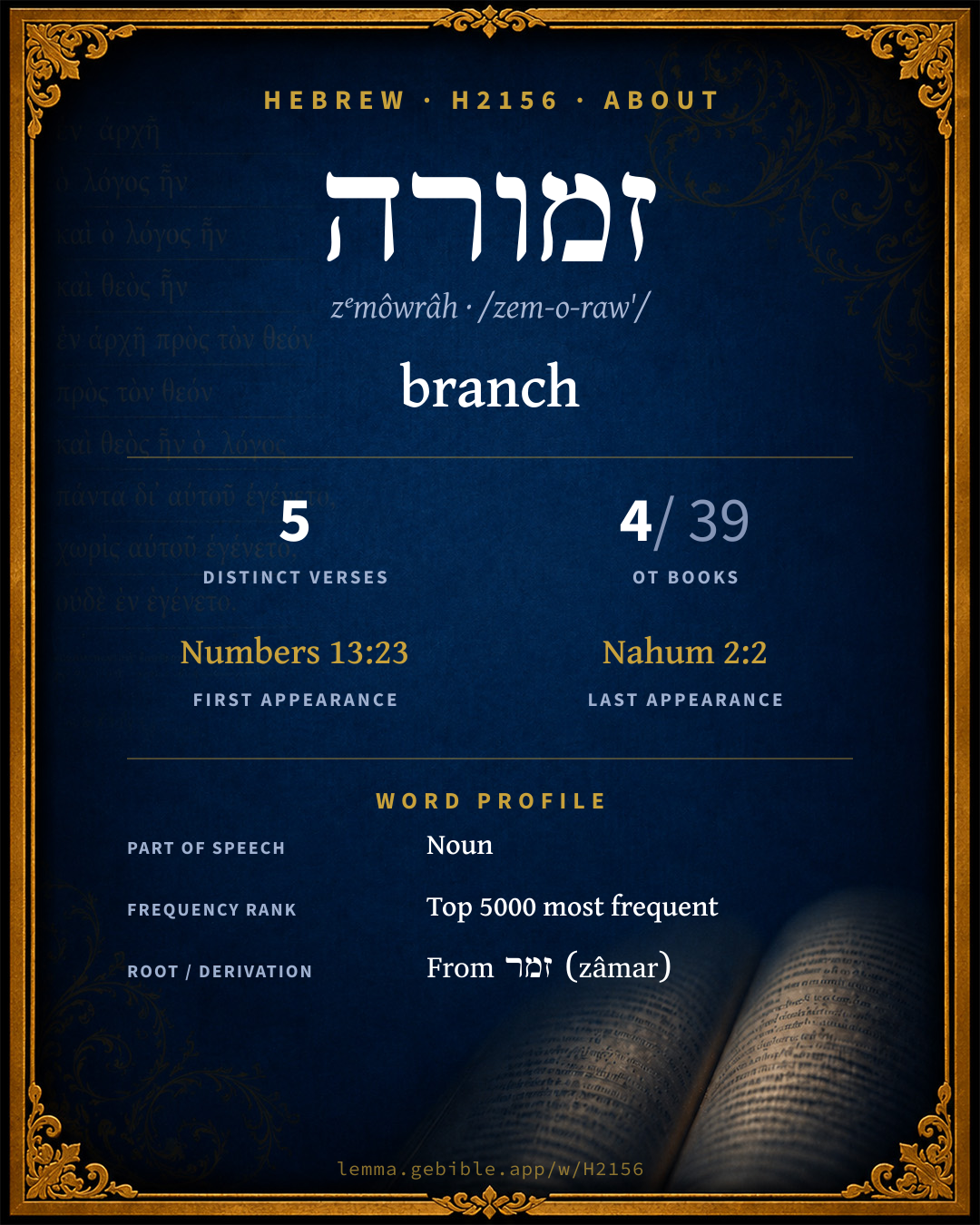
זְמוֹרָה
branch
Full lexicon entry — Brown-Driver-Briggs (BDB)
From Brown-Driver-Briggs (BDB)
Where this word appears
See every Absolute-state word in the Hebrew Bible →
Grammar key — what these labels mean
Part of speech
- Noun
- A naming word — a person, place, thing, or idea.
Noun type
- Common
- A common noun — a general class of person, place, or thing (“king,” “city,” “water”), not a specific name.
State
- Absolute
- The independent form of a noun, not bound to a following word.
- Construct
- A noun bound to a following noun in a possessive / “of” relationship (the construct chain).
Gender
- Feminine
- Grammatically feminine.
Number
- Singular
- One.
- Plural
- More than one (in Hebrew, generally three or more).
3 distinct verses where H2156 appears in the Absolute state, across 2 books. Filtered view — show all forms. Click any verse to open its interlinear word-by-word view. Verse text shown in the World English Bible for context — . Each verse’s Hebrew form is shown with its reference; the English is not keyword-highlighted, since the data carries no word-level English alignment. Use “Compare translations” on any verse to read it across multiple English versions. This concordance covers the Hebrew Bible; Septuagint (Greek Old Testament) occurrences are not indexed here.
Numbers 1 verse
Ezekiel 2 verses
- Ezekiel 8:17 הַ/זְּמוֹרָ֖ה ptcl def.art + n c fs Then he said to me, Have you seen [this], son of man? Is it a light thing to the house of Judah that they commit the abominations which they commit here? for they have filled the land with violence, and have turned again to provoke me to anger: and, behold, they put the branch to their nose.
- Ezekiel 15:2 הַ/זְּמוֹרָ֕ה ptcl def.art + n c fs Son of man, what is the vine tree more than any tree, the vine-branch which is among the trees of the forest?
About this entry
At a glance — auto-summarized from this page’s data, not written by a person. Every figure links to its source below. This summary describes the numbers; it doesn’t interpret them.
זמורה (zᵉmôwrâh) is a Hebrew noun most often rendered “branch.” It is rare — just 5 verses in the entire Hebrew Bible. Ezekiel dominates its distribution — 2 of 5 verses. It first appears in Numbers 13:23. Sharing its root, it stands alongside זמר, זמיר and זמר. The sections below give every sense, occurrence, and version rendering.
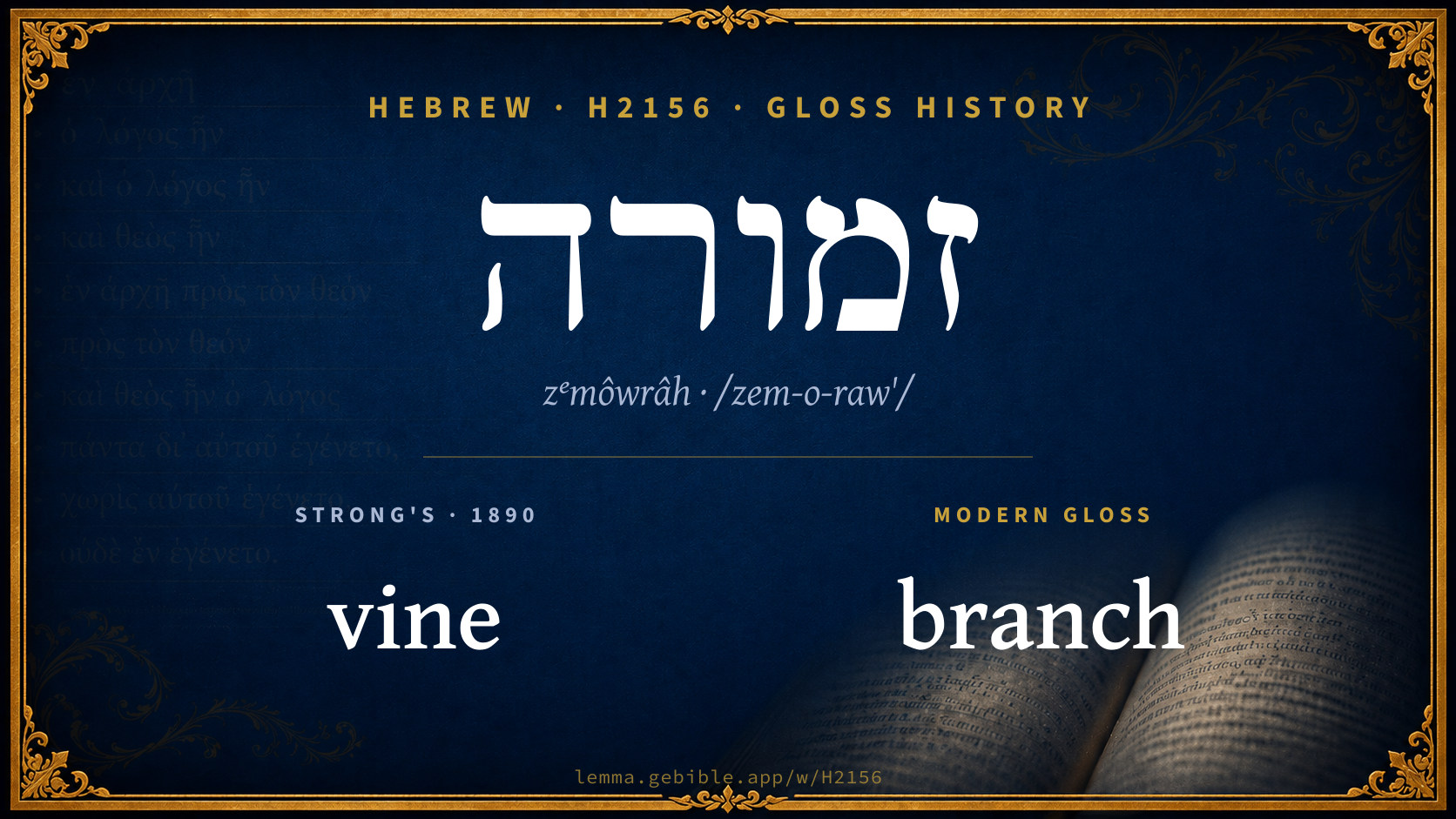
Gloss history
Strong's 1890 vs modern scholarship
About this word
Strong's H2156 catalogs a Hebrew word from the Hebrew Old Testament.
These counts are not copied from any lexicon or concordance. They are computed here, from the morphology-tagged Hebrew Old Testament. What Lemma adds →
- 5
- distinct verses
- The word appears in 5 distinct verses.
- 4 / 39
- OT books
- The word appears in 4 of 39 Old Testament books.
- #3,337
- by frequency
- Top 5000 most frequent Hebrew words (rank 3,337 of 8,640 Hebrew words by occurrence).
View all 5 occurrences in the concordance →
By section of the Old Testament
By traditional corpus
Conventional, traditional groupings — biblical authorship is debated, so this is a traditional corpus grouping, not an authorship claim. Each share is this word’s portion of its verses in that division of the Hebrew canon. Each figure is a share of the word’s 5 distinct verses.
- Prophets (Nevi'im) 4 verses · 80%
- Torah (Pentateuch) 1 verse · 20%
How translations render this word
Counts come from each version’s own published word-to-Strong’s tagging or interlinear alignment — an approximate guide to how each version renders this word, not a word-level alignment the data otherwise carries. Because each total is that version’s own tagged count, the per-version totals vary from one another and need not match the appearance or distinct-verse counts above. These counts may also differ from a printed concordance because Lemma counts each distinctly tagged rendering and does not collapse phrase taggings into a single head-word total. This is a fixed set of word-tagged versions (KJV, ASV, BSB, ULT) and does not change with the reading translation you choose elsewhere. Each version’s license is shown beside its name below (and on Sources).
- King James Version: Branch 1×, Or than a branch 1×, Slips 1×
- American Standard Version: Lo they put the branch 1×, Slips 1×, Thence a branch 1×
- Berean Standard Bible: Branch 3×
- unfoldingWord Literal Text: And 2×, Branch 2×
King James Version Public Domain
Renders H2156 across 5 tagged occurrences — most commonly:
American Standard Version Public Domain
Renders H2156 across 5 tagged occurrences — most commonly:
Berean Standard Bible Public Domain
Renders H2156 across 5 tagged occurrences — most commonly:
Plus 2 renderings that appear only once — usually multi-word phrases or single function words the recovered tagging swept in, not distinct renderings.
unfoldingWord Literal Text CC BY-SA 4.0
Renders H2156 across 8 tagged occurrences — most commonly:
Plus 4 renderings that appear only once — usually multi-word phrases or single function words the recovered tagging swept in, not distinct renderings.
Senses in BDB
The 1 sense BDB distinguishes for this word, in lexicon order (not ranked by frequency or importance). The full entry — with sub-senses — is in the Lexicon Entry tab.
- branch, twig, shoot
Word origin
n.[f.] branch, twig, shoot—abs. ז׳ Nu 13:23, הַוּ׳ Ez 8:17; 15:2; cstr. זְמֹרַת Is 17:10; sf. זְמֹרֵיהֶם Na 2:3;—branch of grape-vine Nu 13:23 (JE), Eze 15:2; branch, twig (Co Reissigbündel) used in idolatrous worship הַוּ׳ אֶל־אַפָּם Ez 8:17 (v. Sm and most), but custom obscure (v. Da), and text dub.; זְמֹרַת זָר (cf. Ew§ 287 b) Is 17:10 twigs of a strange one (i.e. of a strange god) fig. of idolatrous cults adopted by Isr.; ז׳ pl. in fig. of Israelites Na 2:3.
— Brown-Driver-Briggs (Oxford 1906, public domain), digitized via Sefaria, supplemented by the OpenScriptures HebrewLexicon (CC BY 4.0). See Sources.
Derived from זמר (zâmar) (H2168) — to prune.
Jastrow Dictionary
A second Hebrew/Aramaic lexicon for comparison, covering Aramaic and post-biblical (Talmudic, Targumic, Midrashic) usage that the biblical-Hebrew BDB does not. Matched by lemma rather than by Strong’s number, so a lemma may carry more than one Jastrow headword (shown separately below), and the entries cover usage well beyond the Bible.
זְמוֹרָה
- 1. vine-shoot, vine-rod. Sabb. XVII, 6 ז׳ שהיא וכ׳ a rod which is tied to a pitcher (to let it down into the well); a. e.—Esp. the rod as an officer’s badge and punishing instrument. Num. R. s. 18 וליתן לו ז׳ and to give him the rod (appoint him an officer).—בעל הז׳ carrier of the rod (among the Romans Centurio, v. Sm. Ant. s. v.). Sabb. 145ᵇ ובעלי ז׳ Ms. M. (ed. ובעל) and Centuriones, v. הֶגְמוֹן. Y. Sot. IX, 24ᵇ top (rank of officers) בעל האגמון בעל הז׳ וכ׳ cane-bearer, rod-bearer, strap-bearer; Tosef. ib. XV, 7 (variously corrupted, v. Var. in ed. Zuck.). Midr. Till. to Ps. LXXIII, end; Yalk. ib. 808. Ex. R. s. 21, end; a. fr.—Pl. זְמוֹרוֹת. Gen. R. s. 31, end ז׳ לפילים vine-rods as food for elephants; ז׳ לנטיעות shoots for future plantation.
- 2. membrum virile, phallus. Tanḥ. Ki Thetsé 10 the Israelites did not know מה טיבה של ז׳ the idolatrous function of the phallus (with ref. to Ez. VIII, 17). Ib. חיכך … את הז׳ Esau giggled and produced the phallus; Pesik. Zakhor, p. 27ᵇ. Num. R. s. 13. Pesik. R. s. 7 בחירופיו … ובז׳ with his (Amalek’s) blasphemies and by throwing up the phallus (taken from the mutilated Israelitish bodies). Ib. זְמוֹרָתָם של וכ׳ the membra of Israelites; Num. R. s. 13 (זַכְרוּתָן). e.g. Ezekiel 8:17
A Dictionary of the Targumim, the Talmud Babli and Yerushalmi, and the Midrashic Literature (Marcus Jastrow; London, Luzac, 1903) — Public Domain. Digitized via Sefaria. Digitized via Sefaria. Full attribution on Sources.
Forms in the corpus
The 5 distinct written forms H2156 takes in the Hebrew Bible, most frequent first — each parse links to that state’s occurrences in the concordance. Hebrew forms include their vowel points and cantillation, so a single lemma takes many written forms.
| Form | Parsing | Example | Uses |
|---|---|---|---|
| הַ/זְּמוֹרָ֕ה | Noun, Common, Feminine, Singular, Absolute | Ezekiel 15:2 | 1 |
| הַ/זְּמוֹרָ֖ה | Noun, Common, Feminine, Singular, Absolute | Ezekiel 8:17 | 1 |
| וּ/זְמֹ֥רַת | Noun, Common, Feminine, Singular, Construct | Isaiah 17:10 | 1 |
| וּ/זְמֹרֵי/הֶ֖ם | Noun, Common, Feminine, Plural, Construct | Nahum 2:2 | 1 |
| זְמוֹרָה֙ | Noun, Common, Feminine, Singular, Absolute | Numbers 13:23 | 1 |
Same root — word family
Other BDB entries built from the same root as H2156, grouped by Strong’s listed origin. These share a root / origin per the lexicon — not necessarily a shared meaning. Each links to that word’s own entry.
Derives from
Shares the same root
- זמיר zâmîyr H2159 pruning
- זמר zâmar H2167 to sing
- זמרה zimrâh H2173 choice fruits
- מזמרה mazmêrâh H4211 pruning knife
- מזמרה mᵉzammᵉrâh H4212 snuffers
Compare all same-root words → Showing 4 of 7 — not the complete family. They share a root, not necessarily a meaning.
Septuagint verse parallels
This word appears in 5 verses that also exist in the Greek Old Testament (Septuagint), out of the 5 Hebrew verses it occurs in. You can read those verses in Greek by switching the Old Testament edition to the Septuagint.
Read these verses in the Septuagint
This is a verse-level parallel only — the same verses exist in both the Hebrew and Greek Old Testaments. No word-level Hebrew↔Greek correspondence is claimed: the data carries no such alignment, so no Greek word is shown as this Hebrew word’s translation. Coverage is not total — the Septuagint omits the deuterocanon and renumbers the Psalms, so some Hebrew verses have no direct Greek parallel.