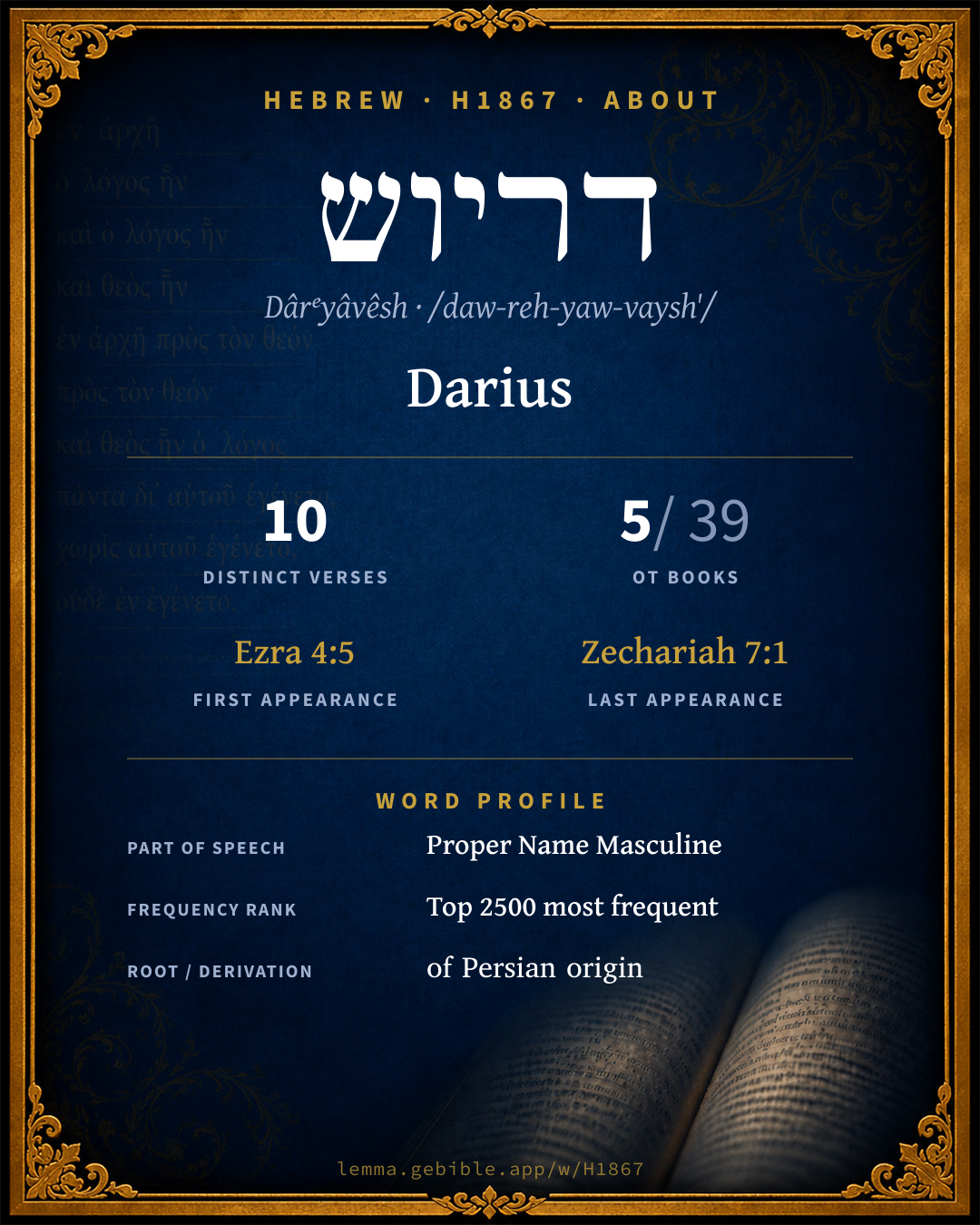
דָּֽרְיָ֫וֶשׁ
Darius
BDB lists 4 entries for ‘Darius’ fuller range ↓
Full lexicon entry — Brown-Driver-Briggs (BDB)
From Brown-Driver-Briggs (BDB)
Where this word appears
Grammar key — what these labels mean
Part of speech
- Noun
- A naming word — a person, place, thing, or idea.
Noun type
- Proper
- A name of a specific person, place, or people (e.g. Abraham, Zion, Israel).
Every verse where H1867 appears in the Book of Nehemiah — 1 distinct verse. Click any verse to open its interlinear word-by-word view. Verse text shown in the World English Bible for context — . Each verse’s Hebrew form is shown with its reference; the English is not keyword-highlighted, since the data carries no word-level English alignment. Use “Compare translations” on any verse to read it across multiple English versions. This concordance covers the Hebrew Bible; Septuagint (Greek Old Testament) occurrences are not indexed here.
Nehemiah
About this entry
At a glance — auto-summarized from this page’s data, not written by a person. Every figure links to its source below. This summary describes the numbers; it doesn’t interpret them.
דריוש — transliterated Dârᵉyâvêsh — is a Hebrew name carrying the sense “Darius.” Its earliest occurrence is Ezra 4:5. It appears 10 verses across 5 books of the Hebrew Bible, among its uncommon vocabulary. More than a quarter of its appearances fall in Haggai. Each statement above links to its evidence; the full detail follows below.
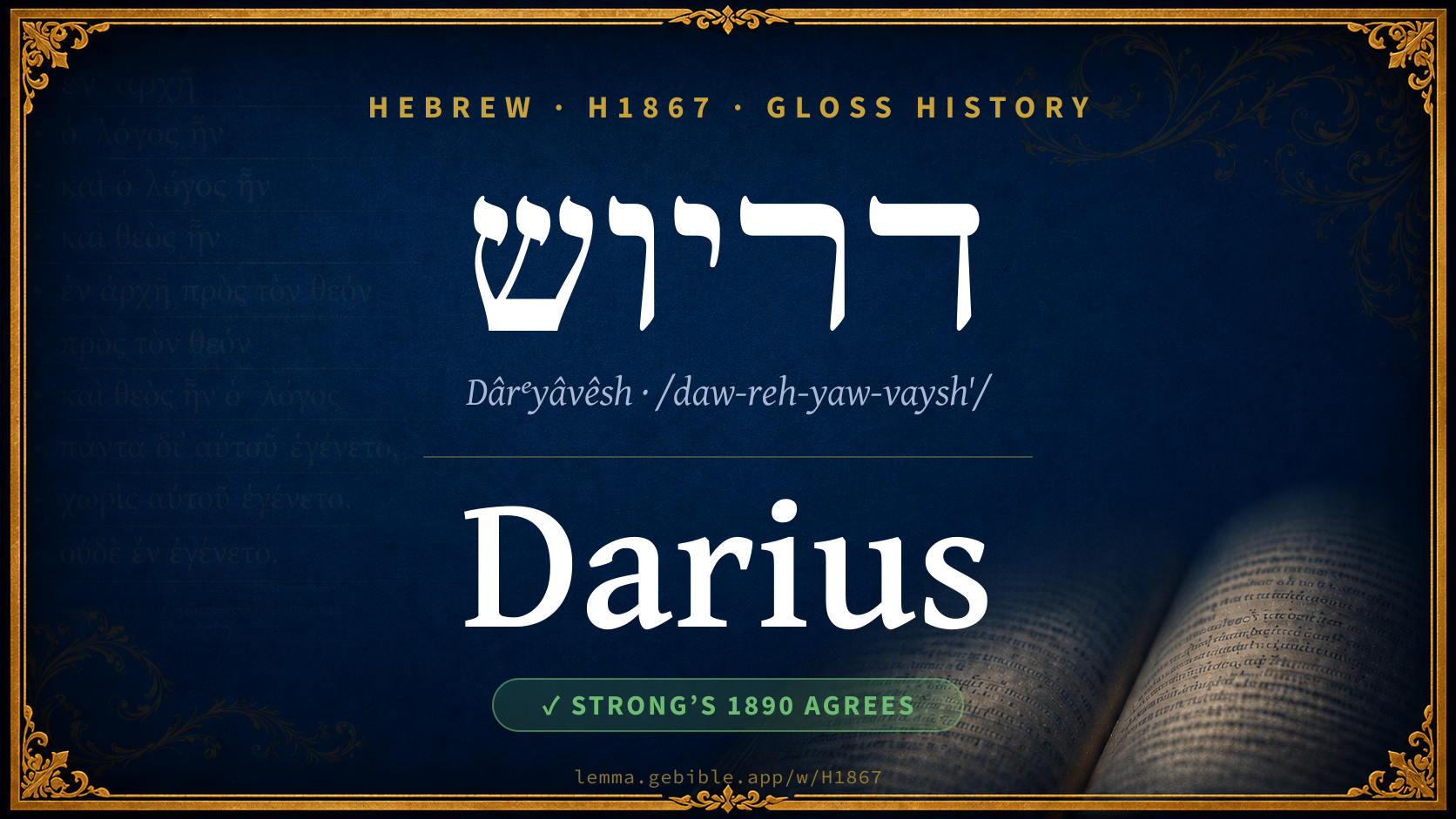
Gloss history
Strong's 1890 vs modern scholarship
About this word
Strong's H1867 catalogs a Hebrew word from the Hebrew Old Testament.
These counts are not copied from any lexicon or concordance. They are computed here, from the morphology-tagged Hebrew Old Testament. What Lemma adds →
- 10
- distinct verses
- The word appears in 10 distinct verses.
- 5 / 39
- OT books
- The word appears in 5 of 39 Old Testament books.
- #2,342
- by frequency
- Top 2500 most frequent Hebrew words (rank 2,342 of 8,640 Hebrew words by occurrence).
View all 10 occurrences in the concordance →
By section of the Old Testament
By traditional corpus
Conventional, traditional groupings — biblical authorship is debated, so this is a traditional corpus grouping, not an authorship claim. Each share is this word’s portion of its verses in that division of the Hebrew canon. Each figure is a share of the word’s 10 distinct verses.
- Prophets (Nevi'im) 6 verses · 60%
- Writings (Ketuvim) 4 verses · 40%
How translations render this word
Counts come from each version’s own published word-to-Strong’s tagging or interlinear alignment — an approximate guide to how each version renders this word, not a word-level alignment the data otherwise carries. Because each total is that version’s own tagged count, the per-version totals vary from one another and need not match the appearance or distinct-verse counts above. These counts may also differ from a printed concordance because Lemma counts each distinctly tagged rendering and does not collapse phrase taggings into a single head-word total. This is a fixed set of word-tagged versions (KJV, ASV, BSB, ULT) and does not change with the reading translation you choose elsewhere. Each version’s license is shown beside its name below (and on Sources).
- King James Version: Darius 10×
- American Standard Version: Darius 10×
- Berean Standard Bible: Darius 10×
- unfoldingWord Literal Text: Darius 10×
King James Version Public Domain
Renders H1867 across 10 tagged occurrences — most commonly:
American Standard Version Public Domain
Renders H1867 across 10 tagged occurrences — most commonly:
Berean Standard Bible Public Domain
Renders H1867 across 10 tagged occurrences — most commonly:
unfoldingWord Literal Text CC BY-SA 4.0
Renders H1867 across 10 tagged occurrences — most commonly:
Senses in the full BDB
What do BDB’s symbols mean?
BDB uses these scholarly abbreviations:
| Symbol | Meaning |
|---|---|
| 𝔊 | the Septuagint (the ancient Greek translation, LXX) |
| 𝔙 | the Vulgate (the Latin translation) |
| 𝔖 | the Syriac version (the Peshitta) |
| 𝔗 | the Targum (the Aramaic translation) |
| ψ | the Psalms |
| √ | root (the underlying root or stem) |
| ‖ | parallel passage (a synonymous or contrasted parallel) |
| † | the dagger: every passage where the word occurs is cited |
The 3 senses and sub-senses the full Brown-Driver-Briggs lexicon distinguishes for this word, in lexicon order (not ranked by frequency), with BDB’s own verbatim wording and sub-sense lettering. Shown in Hebrew script with BDB’s own scholarly abbreviations. The condensed entry is in the Lexicon Entry tab. See also the Forms in the corpus table below.
- 1. Darius Hystaspis, 522–485 Ezr 4:5 Hg 1:1, 15; 2:10 Zc 1:1, 7; 7:1. e.g. Ezra 4:5
- 2. Darius Codomannus, 336–332 Ne 12:22. e.g. Nehemiah 12:22
- 3. ‘Darius the Mede,’ Dn 9:1; 11:1, cf. Bev Dan. p. 19. e.g. Daniel 9:1
Senses from the full Brown-Driver-Briggs lexicon (Brown, Driver, Briggs; Oxford 1906 — public domain), digitized via Sefaria, supplemented by the OpenScriptures HebrewLexicon (CC BY 4.0). Full attribution on Sources.
Word origin
n.pr.m. Darius (Old Pers. Dârayavaʾush cf. SpiegAPK 81)—
— Brown-Driver-Briggs (Oxford 1906, public domain), digitized via Sefaria, supplemented by the OpenScriptures HebrewLexicon (CC BY 4.0). See Sources.
Origin: of Persian origin
Jastrow Dictionary
A second Hebrew/Aramaic lexicon for comparison, covering Aramaic and post-biblical (Talmudic, Targumic, Midrashic) usage that the biblical-Hebrew BDB does not. Matched by lemma rather than by Strong’s number, so a lemma may carry more than one Jastrow headword (shown separately below), and the entries cover usage well beyond the Bible.
דָּרְיָוֶשׁ
- (b. h.) pr. n. m. Darius, King of Persia. Lev. R. s. 13; Esth. R. to IV, 4 ד׳ האחרון וכ׳ Darius the Second was the son of Esther.
A Dictionary of the Targumim, the Talmud Babli and Yerushalmi, and the Midrashic Literature (Marcus Jastrow; London, Luzac, 1903) — Public Domain. Digitized via Sefaria. Digitized via Sefaria. Full attribution on Sources.
Forms in the corpus
The 6 distinct written forms H1867 takes in the Hebrew Bible, most frequent first — each parse links to that state’s occurrences in the concordance. Hebrew forms include their vowel points and cantillation, so a single lemma takes many written forms.
| Form | Parsing | Example | Uses |
|---|---|---|---|
| לְ/דָרְיָ֑וֶשׁ | Noun, Proper | Haggai 2:10 | 3 |
| דָּרְיָ֥וֶשׁ | Noun, Proper | Ezra 4:5 | 2 |
| לְ/דָרְיָ֖וֶשׁ | Noun, Proper | Daniel 11:1 | 2 |
| לְ/דָרְיָ֛וֶשׁ | Noun, Proper | Daniel 9:1 | 1 |
| לְ/דָרְיָ֣וֶשׁ | Noun, Proper | Haggai 1:1 | 1 |
| לְ/דָרְיָ֥וֶשׁ | Noun, Proper | Haggai 1:15 | 1 |
Same root — word family
Other BDB entries built from the same root as H1867, grouped by Strong’s listed origin. These share a root / origin per the lexicon — not necessarily a shared meaning. Each links to that word’s own entry.
Proper names from this root
People and places named from this root — a name, not an additional meaning of the word.
Compare all same-root words → 1 of the same-root words is a proper name (a person or place). They share a root, not necessarily a meaning.
Bible dictionary
Public-domain dictionary articles matched to this entry by name (Darius). A biblical name can be shared by more than one person or place, so an article may treat several.
Easton's Bible Dictionary · M. G. Easton, 1897
The holder or supporter, the name of several Persian kings. (1.) Darius the Mede (Dan. 11:1), "the son of Ahasuerus, of the seed of the Medes" (9:1). On the death of Belshazzar the Chaldean he "received the kingdom" of Babylon as viceroy from Cyrus. During his brief reign (B.C. 538-536) Daniel was promoted to the highest dignity (Dan. 6:1, 2); but on account of the malice of his enemies he was cast into the den of lions. After his miraculous escape, a decree was issued by Darius enjoining "reverence for the God of Daniel" (6:26). This king was probably the "Astyages" of the Greek historians. Nothing can, however, be with certainty affirmed regarding him. Some are of opinion that the name "Darius" is simply a name of office, equivalent to "governor," and that the "Gobryas" of the inscriptions was the person intended by the name.
(2.) Darius, king of Persia, was the son of Hystaspes, of the royal family of the Achaemenidae. He did not immediately succeed Cyrus on the throne. There were two intermediate kings, viz., Cambyses (the Ahasuerus of Ezra), the son of Cyrus, who reigned from B.C. 529-522, and was succeeded by a usurper named Smerdis, who occupied the throne only ten months, and was succeeded by this Darius (B.C. 521-486). Smerdis was a Margian, and therefore had no sympathy with Cyrus and Cambyses in the manner in which they had treated the Jews. He issued a decree prohibiting the restoration of the temple and of Jerusalem (Ezra 4:17-22). But soon after his death and the accession of Darius, the Jews resumed their work, thinking that the edict of Smerdis would be now null and void, as Darius was in known harmony with the religious policy of Cyrus. The enemies of the Jews lost no time in bringing the matter under the notice of Darius, who caused search to be made for the decree of Cyrus (q.v.). It was not found at Babylon, but at Achmetha (Ezra 6:2); and Darius forthwith issued a new decree, giving the Jews full liberty to prosecute their work, at the same time requiring the Syrian satrap and his subordinates to give them all needed help. It was with the army of this king that the Greeks fought the famous battle of Marathon (B.C. 490). During his reign the Jews enjoyed much peace and prosperity. He was succeeded by Ahasuerus, known to the Greeks as Xerxes, who reigned for twenty-one years.
(3.) Darius the Persian (Neh. 12:22) was probably the Darius II. (Ochus or Nothus) of profane history, the son of Artaxerxes Longimanus, who was the son and successor of Ahasuerus (Xerxes). There are some, however, who think that the king here meant was Darius III. (Codomannus), the antagonist of Alexander the Great (B.C. 336-331).
Smith's Bible Dictionary · William Smith, 1863
(lord), the name of several kings of Media and Persia.
+ DARIUS THE MEDE, (Daniel 6:1; 11:1) "the son of Ahasuerus," (Daniel 9:1) who succeeded to the Babylonian kingdom ont he death of Belshazzar, being then sixty-two years old. (Daniel 5:31; 9:1) (B.C. 538.) Only one year of his reign is mentioned, (Daniel 9:1; 11:1) but that was of great importance for the Jews. Daniel was advanced by the king to the highest dignity, (Daniel 6:1) ff., and in his reign was cast into the lions' den. Dan. 6. This Darius is probably the same as "Astyages," the last king of the Medes. + DARIUS, the son of Hystaspes the founder of the Perso-Arian dynasty. Upon the usurpation of the magian Smerdis, he conspired with six other Persian chiefs to overthrow the impostor and on the success of the plot was placed upon the throne, B.C. 521. With regard to the Jews, Darius Hystaspes pursued the same policy as Cyrus, and restored to them the privileges which they had lost. (Ezra 5:1) etc.; Ezra 6:1 etc. + DARIUS THE PERSIAN, (Nehemiah 12:22) may be identified with Darius II. Nothus (Ochus), king of Persia B.C. 424-3 to 405-4; but it is not improbable that it points to Darius III. Codomannus, the antagonist of Alexander and the last king of Persia, B.C. 336-330.
Hitchcock's Bible Names Dictionary · Roswell D. Hitchcock, 1869
he that informs himself
Classic public-domain reference works; full attribution on Sources.
Septuagint verse parallels
This word appears in 9 verses that also exist in the Greek Old Testament (Septuagint), out of the 10 Hebrew verses it occurs in. You can read those verses in Greek by switching the Old Testament edition to the Septuagint.
Read these verses in the Septuagint
This is a verse-level parallel only — the same verses exist in both the Hebrew and Greek Old Testaments. No word-level Hebrew↔Greek correspondence is claimed: the data carries no such alignment, so no Greek word is shown as this Hebrew word’s translation. Coverage is not total — the Septuagint omits the deuterocanon and renumbers the Psalms, so some Hebrew verses have no direct Greek parallel.