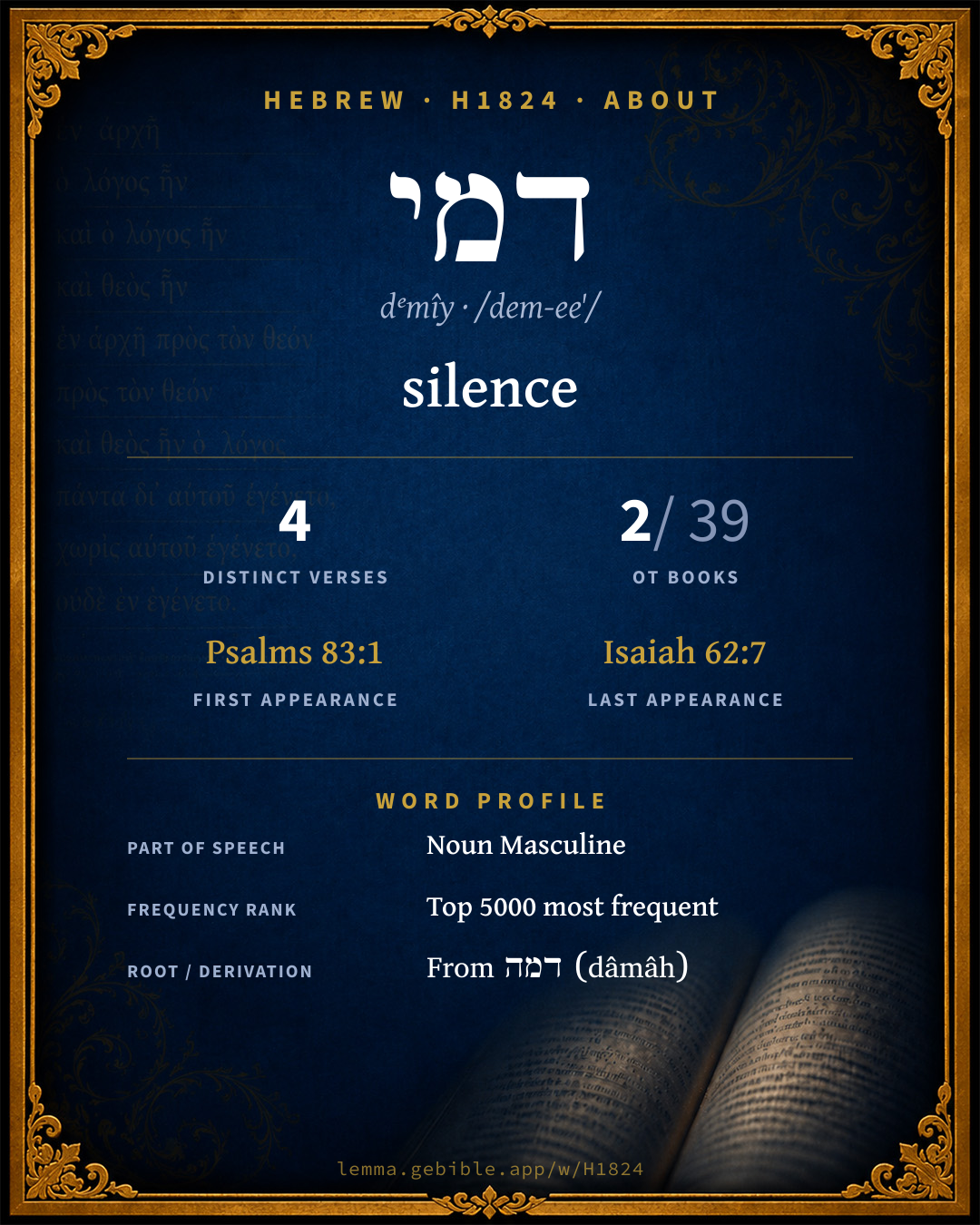
דֳּמִי
silence
Full lexicon entry — Brown-Driver-Briggs (BDB)
From Brown-Driver-Briggs (BDB)
Where this word appears
See every Absolute-state word in the Hebrew Bible →
Grammar key — what these labels mean
Part of speech
- Noun
- A naming word — a person, place, thing, or idea.
Noun type
- Common
- A common noun — a general class of person, place, or thing (“king,” “city,” “water”), not a specific name.
State
- Absolute
- The independent form of a noun, not bound to a following word.
- Construct
- A noun bound to a following noun in a possessive / “of” relationship (the construct chain).
Gender
- Masculine
- Grammatically masculine.
Number
- Singular
- One.
Grammatical forms
- Noun, Common, Masculine, Singular, Absolute 3 times (75%)
- Noun, Common, Masculine, Singular, Construct 1 time (25%)
Parsed forms decoded from the imported morphology (morphhb / Westminster Leningrad Codex — WLC text public domain, morphhb tagging CC BY 4.0), counted across 4 parsed occurrences — not distinct verses.
Every verse where H1824 appears — 4 distinct verses across 2 books. Click any verse to open its interlinear word-by-word view. Verse text shown in the World English Bible for context — . Each verse’s Hebrew form is shown with its reference; the English is not keyword-highlighted, since the data carries no word-level English alignment. Use “Compare translations” on any verse to read it across multiple English versions. This concordance covers the Hebrew Bible; Septuagint (Greek Old Testament) occurrences are not indexed here.
Psalms 1 verse
Isaiah 3 verses
- Isaiah 38:10 בִּ/דְמִ֥י prep + n c ms cs I said, In the noontide of my days I shall go into the gates of Sheol: I am deprived of the residue of my years.
- Isaiah 62:6 דֳּמִ֖י n c ms I have set watchmen on your walls, Jerusalem; they shall never hold their peace day nor night: you who call on Yahweh, take no rest,
- Isaiah 62:7 דֳמִ֖י n c ms and give him no rest, until he establish, and until he make Jerusalem a praise in the earth.
About this entry
At a glance — auto-summarized from this page’s data, not written by a person. Every figure links to its source below. This summary describes the numbers; it doesn’t interpret them.
At its core, דמי (dᵉmîy) means “silence.” With only 4 verses it sits in the long tail of Hebrew Bible vocabulary. The word gravitates to Isaiah (75%), then Psalms. Scripture first uses it in Psalms 83:1. It clusters with דמה, דומה and דומיה under a shared root. See the sense tree, 4-verse concordance, and the renderings breakdown below.
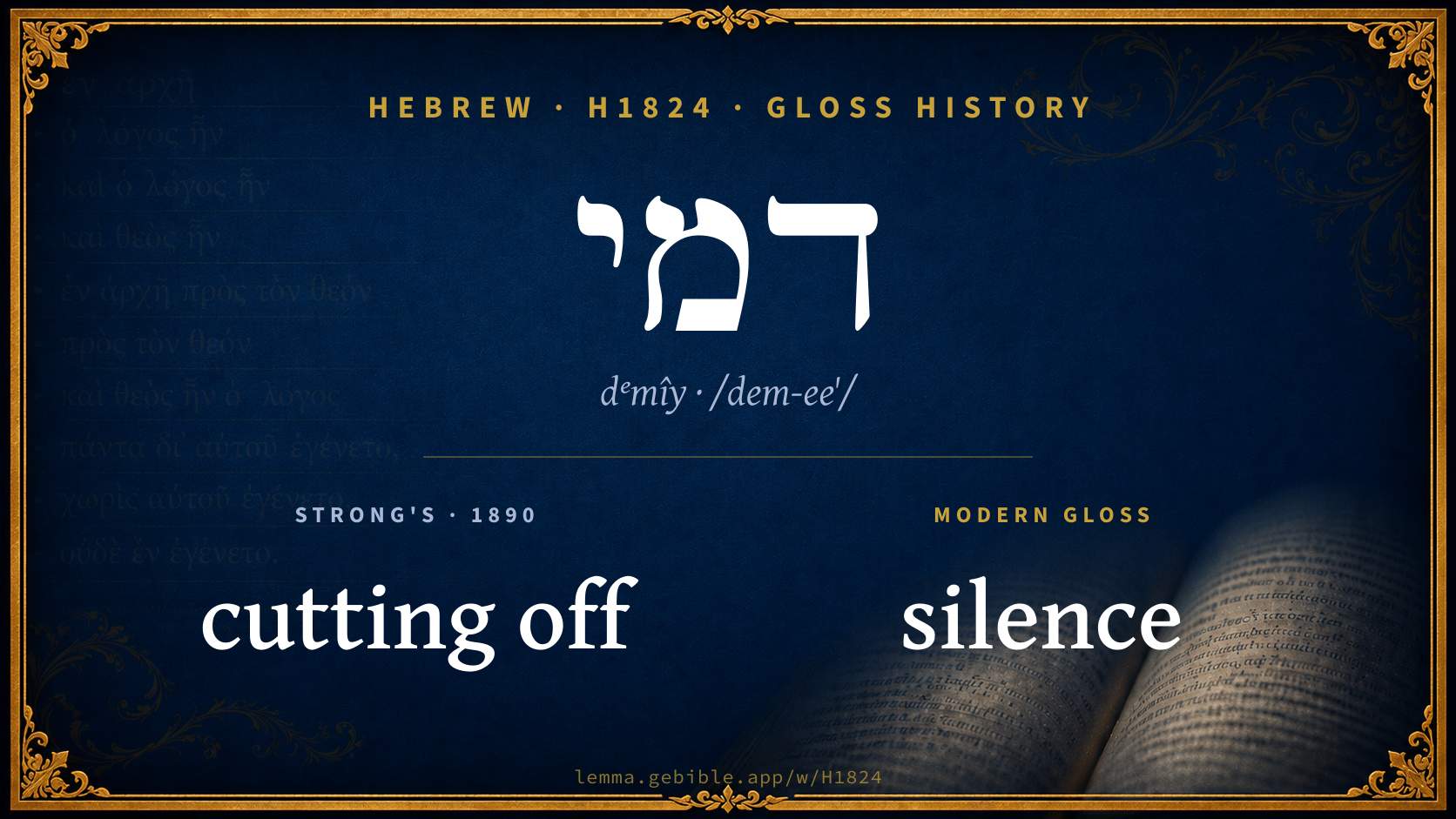
Gloss history
Strong's 1890 vs modern scholarship
About this word
Strong's H1824 catalogs a Hebrew word from the Hebrew Old Testament.
These counts are not copied from any lexicon or concordance. They are computed here, from the morphology-tagged Hebrew Old Testament. What Lemma adds →
- 4
- distinct verses
- The word appears in 4 distinct verses.
- 2 / 39
- OT books
- The word appears in 2 of 39 Old Testament books.
- #3,696
- by frequency
- Top 5000 most frequent Hebrew words (rank 3,696 of 8,640 Hebrew words by occurrence).
View all 4 occurrences in the concordance →
By traditional corpus
Conventional, traditional groupings — biblical authorship is debated, so this is a traditional corpus grouping, not an authorship claim. Each share is this word’s portion of its verses in that division of the Hebrew canon. Each figure is a share of the word’s 4 distinct verses.
- Prophets (Nevi'im) 3 verses · 75%
- Writings (Ketuvim) 1 verse · 25%
How translations render this word
Counts come from each version’s own published word-to-Strong’s tagging or interlinear alignment — an approximate guide to how each version renders this word, not a word-level alignment the data otherwise carries. Because each total is that version’s own tagged count, the per-version totals vary from one another and need not match the appearance or distinct-verse counts above. These counts may also differ from a printed concordance because Lemma counts each distinctly tagged rendering and does not collapse phrase taggings into a single head-word total. This is a fixed set of word-tagged versions (KJV, ASV, BSB, ULT) and does not change with the reading translation you choose elsewhere. Each version’s license is shown beside its name below (and on Sources).
- King James Version: Cutting off 1×, Keep not silence 1×, Keep not thou silence 1×
- American Standard Version: Noontide 1×, Rest 1×, Take ye no rest 1×
- Berean Standard Bible: Any rest 1×, Prime 1×, Rest 1×
- unfoldingWord Literal Text: Be quiet 1×, May silence 1×, May there 1×
King James Version Public Domain
Renders H1824 across 4 tagged occurrences — most commonly:
American Standard Version Public Domain
Renders H1824 across 3 tagged occurrences — most commonly:
Berean Standard Bible Public Domain
Renders H1824 across 4 tagged occurrences — most commonly:
unfoldingWord Literal Text CC BY-SA 4.0
Renders H1824 across 5 tagged occurrences — most commonly:
Senses in the full BDB
What do BDB’s symbols mean?
BDB uses these scholarly abbreviations:
| Symbol | Meaning |
|---|---|
| 𝔊 | the Septuagint (the ancient Greek translation, LXX) |
| 𝔙 | the Vulgate (the Latin translation) |
| 𝔖 | the Syriac version (the Peshitta) |
| 𝔗 | the Targum (the Aramaic translation) |
| ψ | the Psalms |
| √ | root (the underlying root or stem) |
| ‖ | parallel passage (a synonymous or contrasted parallel) |
| † | the dagger: every passage where the word occurs is cited |
The 2 senses and sub-senses the full Brown-Driver-Briggs lexicon distinguishes for this word, in lexicon order (not ranked by frequency), with BDB’s own verbatim wording and sub-sense lettering. Shown in Hebrew script with BDB’s own scholarly abbreviations. The condensed entry is in the Lexicon Entry tab. See also the Forms in the corpus table below.
- 1. quiet, in phr. אַל־ד׳ לָכֶם Is 62:6 keep not quiet (let there be no quiet to you); in prayer to God אַל־ד׳ לָךְ ψ 83:2 keep not quiet (inactive; ‖ חרשׂ, שׁקט); cf. וְאַל־תִּתְּנוּ ד׳ לוֹ Is 62:7 and give no rest to him (י׳). e.g. Isaiah 62:6
- 2. in phr. בִּדְמִי יָמַי, Is 38:10 appar. quiet, peacefulness, even tenour, of my days (so De Or SS); others, as Hi Ew Che Di, pause, resting-time, i.e. noon-day (cf. 𝔖 𝔙, & height 𝔊), fig. of middle life, but usage dub.; KloSK 1884, 157 cessation, pause, of natural end of life, Hezekiah’s natural expectation, in contrast with the speedy death implied in v b; but parallelism of v 11a is ag. this; Brd emends בְּרֻם after 𝔊; Klol.c. suggests בְּתֹם or כְּתֹם but preferably in the half, i.e. the midst of my days from דָּמָה aequavit (Dathe). e.g. Isaiah 38:10
Senses from the full Brown-Driver-Briggs lexicon (Brown, Driver, Briggs; Oxford 1906 — public domain), digitized via Sefaria, supplemented by the OpenScriptures HebrewLexicon (CC BY 4.0). Full attribution on Sources.
Word origin
n.[m.] cessation, pause, quiet, rest; ד׳ Is 62:6 + 2 times; cstr. דְּמִי Is 38:10 (but v. infr.);—
— Brown-Driver-Briggs (Oxford 1906, public domain), digitized via Sefaria, supplemented by the OpenScriptures HebrewLexicon (CC BY 4.0). See Sources.
Derived from דמה (dâmâh) (H1820) — to cease.
Jastrow Dictionary
A second Hebrew/Aramaic lexicon for comparison, covering Aramaic and post-biblical (Talmudic, Targumic, Midrashic) usage that the biblical-Hebrew BDB does not. Matched by lemma rather than by Strong’s number, so a lemma may carry more than one Jastrow headword (shown separately below), and the entries cover usage well beyond the Bible.
דְּמֵי I
- 1. to be dumb. Targ. Hab. II, 19 דַּמְיָא (some ed. incorr. ר׳). e.g. Habakkuk 2:19
- 2. to imagine, suspect, consider, Targ. I Kings VIII, 27 דָּמֵי (incorr. חמי).—Part. act. a. pass. דָּמֵי suspected, considered; resembling, like.—Yeb. 114ᵇ אמרה בדְדָמֵי she speaks of what was to be suspected (under the circumstances, though she has not seen it).—שפיר דמי it is considered as right, it is right. Ab. Zar. 38ᵇ ש׳ ד׳ it is all right (is permitted). Ber. 13ᵇ הא מיגנא ש׳ ד׳ but to lie (on the back) is permitted; a. v. fr.—Ber. 25ᵇ כוליה ביתא … ד׳ the entire house is to be considered (for legal purposes) as four cubits. Ib. 4ᵇ כתפלה אריכתא דַמְיָא is to be considered as one continued prayer, v. אֲרִיכָא; a. fr.—היכי דמי (abbrev. ה"ד) what is it like? in what case? Yeb. 63ᵇ ה"ד אשה רעה what do you call ‘a bad wife’? Sabb. 4ᵃ ה"ר אילימא וכ׳ what case do you mean? Do you mean the case of an involuntary transgressor &c.?; a. v. fr.—Targ. Y. I Deut. XXXII, 32, v. Pa.—Erub. 54ᵃ כהלולא ד׳ is like a wedding feast (soon passing away). B. Kam. 85ᵃ דַּמְיַת עלי כאריא וכ׳, v. אֲרַב. Taan. 21ᵇ דַּמְיָין מעייהו ל־ their entrails look like those of human beings; a. fr.—Pes. 14ᵇ, a. fr. מי דָמֵי is this like (the other)?, i.e. there is no analogy between them.
- 1. to compare. Targ. Is. XL, 25; a. fr.—Ḥull. 55ᵇ, a. e. טרפות קא מְדַמְּיַת להדדי you compare cases of T’refoth to one another (form an analogy)? (v. preced. Pi.). Snh. 47ᵃ מי קא מדמית וכ׳ can you compare &c.?—Part. pass. מְדַמֵּי, f. מְדַמְיָא, pl. מְדַמְיָין. Targ. Y. II, Deut. XXXII, 32 sq. (Y. I דמי׳).
- 2. to imagine, speculate. Targ. Jud. XI, 23. Targ. Is. XLV, 9; a. e.
- , אִדְּ׳
- 1. to be like, to take an example. Targ. Prov. VI, 6 אִתְדְּמֵא וכ׳ imitate the ant (ed. Vien. אִתְרְמֵי, read אתד׳). Targ. Ps. CII, 7; a. e.—Y. Shek. IV, 48ᵈ top; Y. Dem. I, 21ᵈ bot. לא אִידְּמִינָן we cannot compare ourselves. Gitt. 57ᵇ אייתו דמי ולא אִידְּמוּ they brought blood of animals but it did not look like (the blood of the prophet); a. fr.
- 2. to appear in the disguise of. Kidd. 81ᵃ … אי׳ ליה שטן כ Satan appeared to him as a woman &c. Ib. 29ᵇ אי׳ ליה וכ׳ (a demon) appeared to him as a monster &c. Snh. 95ᵃ אד׳; a. fr.
דָּם ²
- 1. blood; life. Targ. O. Gen. IV, 10. Targ. ib. IX, 6; a. fr.—B. Bath. 58ᵇ בריש כל מרעין אנא ד׳ וכ׳ at the head of all diseases (chief cause of physical disorders) am I, the blood. Yoma 82ᵇ, a. e. מאי חזית דד׳ דידך וכ׳ what right hast thou to assume that thy blood is redder than thy neighbor’s (you have no right to commit murder even under compulsion). Kidd. 81ᵃ נשויתיה (שויתי) לָדָמָךְ וכ׳ I should have valued thy life two M’ah, i.e. I should not have spared thee; Pes. 112ᵇ Ms. M. (ed. סכנתיך, v. Rabb. D. S. a. l. note 200, a. note 3). Keth. 60ᵇ bot. על דמא דחמרא Ar. s. v. גרדן (ed. רמא) on the blood of an ass.—Pl. דְּמֶי. Targ. Gen. IV, 11; a. fr.—Gitt. 57ᵇ, v. דְּמֵי I.
- 2. congestion. Ab. Zar. 28ᵇ; Bets. 22ᵃ ד׳ דמעתא וכ׳ congestion of the eye, tears &c. Gitt. 68ᵇ לד׳ דרישא for congestion of the head (head-ache). [דְּמֵי equivalent, v. דָּמִין.] V. אִדְמָא.
דְּמַאי
- (דמי) suspicion, talk, whence (cmp. דּוּמָה, שְׁתוֹקִי) D’mai, fruits about which there is a suspicion as to the tithes therefrom being properly taken, opp. וַדַּאי. Y. Maas. Sh. V, end, 56ᵈ [read:] דמאי דְּמַי תיקן דְּמַי לא תיקן D’mai means, There is a talk that he has given the tithes, there is a talk that he has not; Y. Sot. IX, 24ᵇ top ומי לא תיקן (read דְּמַי). Y. Dem. II, 22ᵃ top; Y. Shek. V, 48ᵈ top ארימתון דְּמַיָּין have you set apart what is due of them (the barley) according to the law of D’mai?—Dem. I, 1. Ib. 3 פטור מן הד׳ is exempt from the law of D’mai (no tithes required of them on account of doubt); a. fr.—D’mai, name of a treatise of Mishnah, Tosefta a. Y’rushalmi of the Order of Z’raïm. [Not to be confounded with דְּמַאי = ד־מאי of what.]
דמי
- v. דמם,
- 1. to mumble, think (cmp. דבב); to be silent. Denom. (דִּימָה,) דָּמוּת.
- 2. to imagine, compare. Denom. דְּמוּת.
- 3. (denom. of דְּמוּת) to resemble, be like, to imitate. Sabb. 133ᵇ הוי דוֹמֶה לו imitate Him. Ber. 29ᵇ שתפלתו דוֹמָה עליו וכ׳ to whom his prayer appears like a burden. Taan. 22ᵇ אין דורו דומה יפה (v. Rabb. D. S. a. l. note 20) his generation was not considered worthy. B. Kam. 92ᵇ; Yalk. Jud. 67 ובן אדם לדו׳ לו (not ובני) and man associates with his equal. Sifra Sh’mini Par. 10, ch. XII; Ḥull. 76ᵇ הַדֹּומֶה that which resembles the animal specified in the Bible (species); הד׳ לַדֹּומֶה what resembles the animal classified with the animal specified in the Bible (genus); a. fr.—אֵינוֹ דוֹמֶה there is no resemblance, you cannot compare. Yeb. 64ᵃ א׳ ד׳ תפלת … לתפלת וכ׳ you cannot compare the prayer of … to the prayer of &c. Sabb. 119ᵇ; a. fr.—Ḥull. 48ᵇ זו דוֹמָה לזו these are analogous cases, v. Pi.—(משל) למה הדבר דומה (abbrev. מלה"ד, לה"ד) (a simile:) to what can this be compared?, a phrase introducing a simile. Taan. 25ᵇ. Yoma 86ᵇ; a. v. fr.
- [
- 1. (b. h.) to be silenced, undone].].
- 2. to be compared, to be imagined; to appear in the disguise of; to seem. Kidd. 32ᵇ כמה"ש נִדְמוּ לו that they appeared to him as ministering angels; נדמו לו לערביים they appeared to him as if they were Arabs. Succ. 52ᵃ צדיקים נ׳ להם כהר וכ׳ to the righteous sin will appear like a high mount; a. fr.—נִדְמֶה an animal suspected to be a hybrid or looking like one (cmp. דְּמַאי), esp. a lamb looking like a kid, and vice versa. Bekh. 12ᵃ ‘a ewe which gave birth to what looked like a kid’. Ḥull. 38ᵇ; a. fr.
- 1. to compare, judge from analogy. Lev. R. s. 32 דִּמִּיתִיךָ להם I made thee like them (beasts). B. Bath. 130ᵇ ובלבד שלא יְדַמֶּה וכ׳ but one must not decide ritual cases by analogy; v. Ḥull. 48ᵇ
- 2. to have an opinion without authority to refer to. Gitt. 19ᵃ; 37ᵃ מפני שאנו מְדַמִּין because we have such an opinion.—Part. pass. מְדוּמֶּה, pl. מְדוּמִּין; כמ׳ אני it seems to me, כמ׳ אנו it seems to us &c. Men. 18ᵃ. Taan. 23ᵃ; a. fr.—Y. Ber. II, 5ᵇ bot. כמ׳ הייתי I thought.
דְּמֵי II
- 1. pl. of דְּמָא.
- 2. value, v. דָּמִין.
דְּמַי
- , v. דְּמַאי
דָּמִין
- , constr. דְּמֵי ch. same. Targ. Lam. V, 4 (h. text מְחִיר); a. fr.—B. Mets. 5ᵇ he thinks (as a mental reservation) דמי קא יהבנא ליה I am willing to compensate him. Ib. לא תחמוד לאינשי בלא ד׳ משמע להו common people understand the law, ‘thou shalt not covet’ (Ex. XX, 16) to mean coveting to get our neighbor’s property without compensation. B. Kam. 46ᵃ אי דְּמֵי רדיא וכ׳ if he paid the market price of a ploughing ox, he surely bought him for ploughing; a. fr. e.g. Exodus 20:16
A Dictionary of the Targumim, the Talmud Babli and Yerushalmi, and the Midrashic Literature (Marcus Jastrow; London, Luzac, 1903) — Public Domain. Digitized via Sefaria. Digitized via Sefaria. Full attribution on Sources.
Forms in the corpus
The 4 distinct written forms H1824 takes in the Hebrew Bible, most frequent first — each parse links to that state’s occurrences in the concordance. Hebrew forms include their vowel points and cantillation, so a single lemma takes many written forms.
| Form | Parsing | Example | Uses |
|---|---|---|---|
| בִּ/דְמִ֥י | Noun, Common, Masculine, Singular, Construct | Isaiah 38:10 | 1 |
| דֳמִ֖י | Noun, Common, Masculine, Singular, Absolute | Isaiah 62:7 | 1 |
| דֳּמִ֖י | Noun, Common, Masculine, Singular, Absolute | Isaiah 62:6 | 1 |
| דֳּמִי | Noun, Common, Masculine, Singular, Absolute | Psalms 83:1 | 1 |
Same root — word family
Other BDB entries built from the same root as H1824, grouped by Strong’s listed origin. These share a root / origin per the lexicon — not necessarily a shared meaning. Each links to that word’s own entry.
Derives from
Shares the same root
Compare all same-root words → Showing 4 of 5 — not the complete family. They share a root, not necessarily a meaning.
Septuagint verse parallels
This word appears in 4 verses that also exist in the Greek Old Testament (Septuagint), out of the 4 Hebrew verses it occurs in. You can read those verses in Greek by switching the Old Testament edition to the Septuagint.
Read these verses in the Septuagint
This is a verse-level parallel only — the same verses exist in both the Hebrew and Greek Old Testaments. No word-level Hebrew↔Greek correspondence is claimed: the data carries no such alignment, so no Greek word is shown as this Hebrew word’s translation. Coverage is not total — the Septuagint omits the deuterocanon and renumbers the Psalms, so some Hebrew verses have no direct Greek parallel.