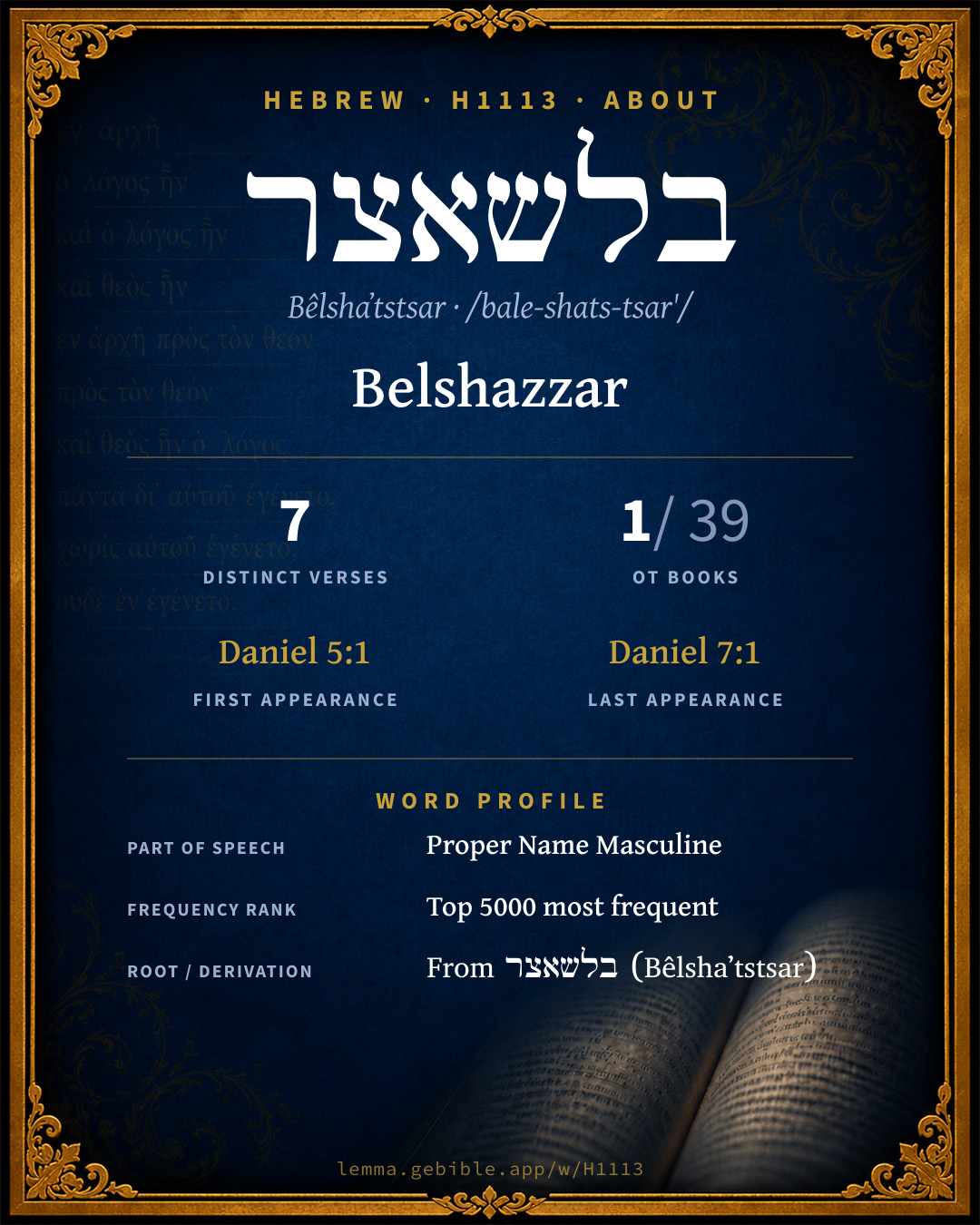
בֵּלְשַׁאצַּר
Belshazzar
BDB lists 2 entries for ‘Belshazzar’ fuller range ↓
Full lexicon entry — Brown-Driver-Briggs (BDB)
From Brown-Driver-Briggs (BDB)
Where this word appears
Grammar key — what these labels mean
Part of speech
- Noun
- A naming word — a person, place, thing, or idea.
Noun type
- Proper
- A name of a specific person, place, or people (e.g. Abraham, Zion, Israel).
Every verse where H1113 appears — 7 distinct verses across 1 book. Click any verse to open its interlinear word-by-word view. Verse text shown in the World English Bible for context — . Each verse’s Hebrew form is shown with its reference; the English is not keyword-highlighted, since the data carries no word-level English alignment. Use “Compare translations” on any verse to read it across multiple English versions. This concordance covers the Hebrew Bible; Septuagint (Greek Old Testament) occurrences are not indexed here.
Daniel 7 verses
- Daniel 5:1 בֵּלְשַׁאצַּ֣ר n Proper Belshazzar the king made a great feast to a thousand of his lords, and drank wine before the thousand.
- Daniel 5:2 בֵּלְשַׁאצַּ֞ר n Proper Belshazzar, while he tasted the wine, commanded to bring the golden and silver vessels which Nebuchadnezzar his father had taken out of the temple which was in Jerusalem; that the king and his lords, his wives and his concubines, might drink from it.
- Daniel 5:9 בֵלְשַׁאצַּר֙ n Proper Then was king Belshazzar greatly troubled, and his face was changed in him, and his lords were perplexed.
- Daniel 5:22 בֵּלְשַׁאצַּ֔ר n Proper You his son, Belshazzar, have not humbled your heart, though you knew all this,
- Daniel 5:29 בֵּלְשַׁאצַּ֗ר n Proper Then commanded Belshazzar, and they clothed Daniel with purple, and put a chain of gold about his neck, and made proclamation concerning him, that he should be the third ruler in the kingdom.
- Daniel 5:30 בֵּלְאשַׁצַּ֖ר n Proper In that night Belshazzar the Chaldean King was slain.
- Daniel 7:1 לְ/בֵלְאשַׁצַּר֙ prep + n Proper In the first year of Belshazzar king of Babylon Daniel had a dream and visions of his head on his bed: then he wrote the dream and told the sum of the matters.
About this entry
At a glance — auto-summarized from this page’s data, not written by a person. Every figure links to its source below. This summary describes the numbers; it doesn’t interpret them.
“Belshazzar” is the headline sense of the Hebrew name בלשאצר (Bêlshaʼtstsar). It clusters heavily in Daniel, which alone accounts for 100% of its uses. With 7 verses in 1 book, it is an uncommon word in the Hebrew Bible. Debuting at Daniel 5:1, it then recurs through the corpus. Each statement above links to its evidence; the full detail follows below.
Gloss history
Strong's 1890 vs modern scholarship
About this word
Strong's H1113 catalogs a Hebrew word from the Hebrew Old Testament.
These counts are not copied from any lexicon or concordance. They are computed here, from the morphology-tagged Hebrew Old Testament. What Lemma adds →
- 7
- distinct verses
- The word appears in 7 distinct verses.
- 1 / 39
- OT books
- The word appears in 1 of 39 Old Testament books.
- #2,835
- by frequency
- Top 5000 most frequent Hebrew words (rank 2,835 of 8,640 Hebrew words by occurrence).
View all 7 occurrences in the concordance →
Most concentrated in
- Daniel 7 verses 100%
By section of the Old Testament
By traditional corpus
Conventional, traditional groupings — biblical authorship is debated, so this is a traditional corpus grouping, not an authorship claim. Each share is this word’s portion of its verses in that division of the Hebrew canon. Each figure is a share of the word’s 7 distinct verses.
- Writings (Ketuvim) 7 verses · 100%
How translations render this word
Counts come from each version’s own published word-to-Strong’s tagging or interlinear alignment — an approximate guide to how each version renders this word, not a word-level alignment the data otherwise carries. Because each total is that version’s own tagged count, the per-version totals vary from one another and need not match the appearance or distinct-verse counts above. These counts may also differ from a printed concordance because Lemma counts each distinctly tagged rendering and does not collapse phrase taggings into a single head-word total. This is a fixed set of word-tagged versions (KJV, ASV, BSB, ULT) and does not change with the reading translation you choose elsewhere. Each version’s license is shown beside its name below (and on Sources).
BDB lists this Strong’s number as 3 distinct words (homographs). Each count above pools all of them and is not split by sense — see the Senses section below. A low-frequency rendering may belong to a different one of those words, not the primary meaning.
- King James Version†: Belshazzar 6×
- American Standard Version†: Belshazzar 7×
- Berean Standard Bible†: Belshazzar 6×
- unfoldingWord Literal Text†: Belshazzar 7×
King James Version Public Domain
Renders H1113 across 7† tagged occurrences — most commonly:
Plus 1 rendering that appears only once — usually multi-word phrases or single function words the recovered tagging swept in, not distinct renderings.
American Standard Version Public Domain
Renders H1113 across 7† tagged occurrences — most commonly:
Berean Standard Bible Public Domain
Renders H1113 across 7† tagged occurrences — most commonly:
Plus 1 rendering that appears only once — usually multi-word phrases or single function words the recovered tagging swept in, not distinct renderings.
unfoldingWord Literal Text CC BY-SA 4.0
Renders H1113 across 7† tagged occurrences — most commonly:
Senses in BDB
The 2 senses BDB distinguishes for this word, in lexicon order (not ranked by frequency or importance). The full entry — with sub-senses — is in the Lexicon Entry tab.
- Belshazzar = "Bel protect the king"
- king of Babylon at the time of its fall; he to whom Daniel interpreted the writing on the wall
Word origin
n.pr.m. (Bêl-šar-uṣur, Bel, protect the king COT Dn 5:1) Dn 8:1; represented as king of Babylon, successor, and appar. son of Nebucharezzar (5:1, 2, 11 etc.); in cuneif. inscr. known only as prince, son of Nabonidus (last Shemitic king of Babylon), v. COT l.c.
— Brown-Driver-Briggs (Oxford 1906, public domain), digitized via Sefaria, supplemented by the OpenScriptures HebrewLexicon (CC BY 4.0). See Sources.
Derived from בלשאצר (Bêlshaʼtstsar) (H1112) — Belshazzar.
Forms in the corpus
The 7 distinct written forms H1113 takes in the Hebrew Bible, most frequent first — each parse links to that state’s occurrences in the concordance. Hebrew forms include their vowel points and cantillation, so a single lemma takes many written forms.
| Form | Parsing | Example | Uses |
|---|---|---|---|
| בֵלְשַׁאצַּר֙ | Noun, Proper | Daniel 5:9 | 1 |
| בֵּלְאשַׁצַּ֖ר | Noun, Proper | Daniel 5:30 | 1 |
| בֵּלְשַׁאצַּ֔ר | Noun, Proper | Daniel 5:22 | 1 |
| בֵּלְשַׁאצַּ֗ר | Noun, Proper | Daniel 5:29 | 1 |
| בֵּלְשַׁאצַּ֞ר | Noun, Proper | Daniel 5:2 | 1 |
| בֵּלְשַׁאצַּ֣ר | Noun, Proper | Daniel 5:1 | 1 |
| לְ/בֵלְאשַׁצַּר֙ | Noun, Proper | Daniel 7:1 | 1 |
Bible dictionary
Public-domain dictionary articles matched to this entry by name (Belshazzar). A biblical name can be shared by more than one person or place, so an article may treat several.
Easton's Bible Dictionary · M. G. Easton, 1897
Bel protect the king!, the last of the kings of Babylon (Dan. 5:1). He was the son of Nabonidus by Nitocris, who was the daughter of Nebuchadnezzar and the widow of Nergal-sharezer. When still young he made a great feast to a thousand of his lords, and when heated with wine sent for the sacred vessels his "father" (Dan. 5:2), or grandfather, Nebuchadnezzar had carried away from the temple in Jerusalem, and he and his princes drank out of them. In the midst of their mad revelry a hand was seen by the king tracing on the wall the announcement of God's judgment, which that night fell upon him. At the instance of the queen (i.e., his mother) Daniel was brought in, and he interpreted the writing. That night the kingdom of the Chaldeans came to an end, and the king was slain (Dan. 5:30). (See NERGAL-SHAREZER.)
The absence of the name of Belshazzar on the monuments was long regarded as an argument against the genuineness of the Book of Daniel. In 1854 Sir Henry Rawlinson found an inscription of Nabonidus which referred to his eldest son. Quite recently, however, the side of a ravine undermined by heavy rains fell at Hillah, a suburb of Babylon. A number of huge, coarse earthenware vases were laid bare. These were filled with tablets, the receipts and contracts of a firm of Babylonian bankers, which showed that Belshazzar had a household, with secretaries and stewards. One was dated in the third year of the king Marduk-sar-uzur. As Marduk-sar-uzar was another name for Baal, this Marduk-sar-uzur was found to be the Belshazzar of Scripture. In one of these contract tablets, dated in the July after the defeat of the army of Nabonidus, we find him paying tithes for his sister to the temple of the sun-god at Sippara.
Smith's Bible Dictionary · William Smith, 1863
(prince of Bel), the last king of Babylon. In (Daniel 5:2) Nebuchadnezzar is called the father of Belshazzar. This, of course, need only mean grandfather or ancestor. According to the well-known narrative Belshazzar gave a splendid feast in his palace during the siege of Babylon (B.C. 538), using the sacred vessels of the temple, which Nebuchadnezzer had brought from Jerusalem. The miraculous appearance of the handwriting on the wall, the calling in of Daniel to interpret its meaning the prophecy of the overthrow of the kingdom, and Belshazsar's death, accorded in Dan. 5.
Hitchcock's Bible Names Dictionary · Roswell D. Hitchcock, 1869
master of the treasure
Classic public-domain reference works; full attribution on Sources.
Septuagint verse parallels
This word appears in 4 verses that also exist in the Greek Old Testament (Septuagint), out of the 7 Hebrew verses it occurs in. You can read those verses in Greek by switching the Old Testament edition to the Septuagint.
Read these verses in the Septuagint
This is a verse-level parallel only — the same verses exist in both the Hebrew and Greek Old Testaments. No word-level Hebrew↔Greek correspondence is claimed: the data carries no such alignment, so no Greek word is shown as this Hebrew word’s translation. Coverage is not total — the Septuagint omits the deuterocanon and renumbers the Psalms, so some Hebrew verses have no direct Greek parallel.