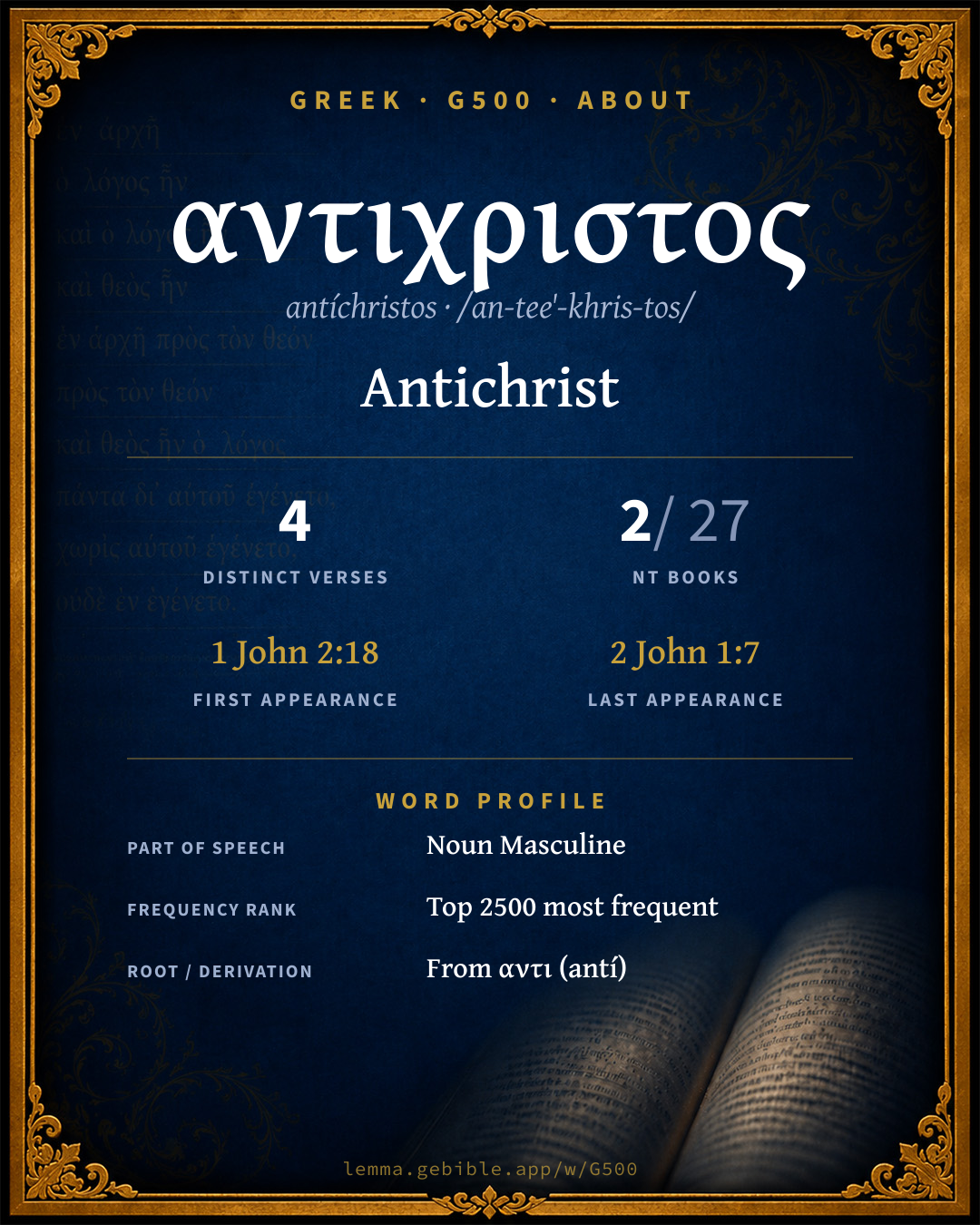
ἀντίχριστος
Antichrist
Full lexicon entry — Thayer's Greek Lexicon
From Thayer's Greek Lexicon
Where this word appears
Grammar key — what these labels mean
Part of speech
- Noun
- A naming word — a person, place, thing, or idea.
Case
- Nominative
- The case of the subject (and the predicate nominative).
- Genitive
- The case of source, possession, or “of” — answers “whose / from what.”
Gender
- Masculine
- Grammatically masculine.
Number
- Singular
- One.
- Plural
- More than one.
Every verse where G500 appears in the Book of 2 John — 1 distinct verse. Click any verse to open its interlinear word-by-word view. Verse text shown in the World English Bible for context — . Each verse’s Greek form is shown with its reference; the English is not keyword-highlighted, since the data carries no word-level English alignment. Use “Compare translations” on any verse to read it across multiple English versions. This concordance covers the Greek New Testament; Septuagint (Greek Old Testament) occurrences of this word are not indexed here.
2 John
About this entry
At a glance — auto-summarized from this page’s data, not written by a person. Every figure links to its source below. This summary describes the numbers; it doesn’t interpret them.
“Antichrist” is the headline sense of the Greek name αντιχριστος (antíchristos). It occurs a mere 4 verses across Scripture. It clusters heavily in 1 John, which alone accounts for 75% of its uses. First canonically at 1 John 2:18, it enters the text early. See 4-verse concordance and the renderings breakdown below.
Gloss history
Strong's 1890 vs modern scholarship
About this word
Strong's G500 catalogs a Greek word from the Greek New Testament.
These counts are not copied from any lexicon or concordance. They are computed here, from the morphology-tagged Greek New Testament. What Lemma adds →
- 4
- distinct verses
- The word appears in 4 distinct verses.
- 2 / 27
- NT books
- The word appears in 2 of 27 New Testament books.
- #1,648
- by frequency
- Top 2500 most frequent Greek words (rank 1,648 of 5,347 Greek words by occurrence).
View all 4 occurrences in the concordance →
By traditional corpus
Conventional, traditional groupings — biblical authorship is debated, so this is a traditional corpus grouping, not an authorship claim. Some books belong to more than one corpus (Luke is in both the Gospels and the Lukan corpus, and so on), so these shares overlap and need not total 100%. Each figure is a share of the word’s 4 distinct verses.
- Johannine 4 verses · 100%
- General (Catholic) Epistles 4 verses · 100%
How translations render this word
Counts come from each version’s own published word-to-Strong’s tagging or interlinear alignment — an approximate guide to how each version renders this word, not a word-level alignment the data otherwise carries. Because each total is that version’s own tagged count, the per-version totals vary from one another and need not match the appearance or distinct-verse counts above. These counts may also differ from a printed concordance because Lemma counts each distinctly tagged rendering and does not collapse phrase taggings into a single head-word total. This is a fixed set of word-tagged versions (KJV, ASV, BSB, ULT) and does not change with the reading translation you choose elsewhere. Each version’s license is shown beside its name below (and on Sources).
- King James Version: Antichrist 3×
- American Standard Version: Antichrist 3×
- Berean Standard Bible: Antichrist 4×
- unfoldingWord Literal Text: Antichrist 4×
King James Version Public Domain
Renders G500 across 5 tagged occurrences — most commonly:
Plus 2 renderings that appear only once — usually multi-word phrases or single function words the recovered tagging swept in, not distinct renderings.
American Standard Version Public Domain
Renders G500 across 5 tagged occurrences — most commonly:
Plus 2 renderings that appear only once — usually multi-word phrases or single function words the recovered tagging swept in, not distinct renderings.
Berean Standard Bible Public Domain
Renders G500 across 5 tagged occurrences — most commonly:
Plus 1 rendering that appears only once — usually multi-word phrases or single function words the recovered tagging swept in, not distinct renderings.
unfoldingWord Literal Text CC BY-SA 4.0
Renders G500 across 5 tagged occurrences — most commonly:
Plus 1 rendering that appears only once — usually multi-word phrases or single function words the recovered tagging swept in, not distinct renderings.
Senses in Thayer's
The 1 sense Thayer's distinguishes for this word, in lexicon order (not ranked by frequency or importance). The full entry — with sub-senses — is in the Lexicon Entry tab.
- the adversary of the Messiah
Word origin
Derived from αντι (antí) (G473) — against.
Forms in the corpus
The 3 distinct written forms G500 takes in the Greek New Testament, most frequent first — each parse links to that case’s occurrences in the concordance.
| Form | Parsing | Example | Uses |
|---|---|---|---|
| ἀντίχριστος antíchristos | Noun, Nominative, Singular, Masculine | 1 John 2:18 | 3 |
| ἀντίχριστοι antíchristoi | Noun, Nominative, Plural, Masculine | 1 John 2:18 | 1 |
| ἀντιχρίστου antichrístou | Noun, Genitive, Singular, Masculine | 1 John 4:3 | 1 |
Same root — word family
Other Thayer's entries built from the same root as G500, grouped by Strong’s listed origin. These share a root / origin per the lexicon — not necessarily a shared meaning. Each links to that word’s own entry.
Derives from
Shares the same root
- ανθιστημι anthístēmi G436 to resist
- ανθομολογεομαι anthomologéomai G437 to acknowledge
- ανθυπατος anthýpatos G446 proconsul
- ανταγωνιζομαι antagōnízomai G464 to struggle
- ανταλλαγμα antállagma G465 exchange
- ανταναπληροω antanaplēróō G466 to fill up
- ανταποδιδωμι antapodídōmi G467 to repay
- ανταποκρινομαι antapokrínomai G470 to contradict
- αντεπω antépō G471 to speak against
- αντεχομαι antéchomai G472 to withstand
- αντιβαλλω antibállō G474 to throw back
- αντιδιατιθεμαι antidiatíthemai G475 to oppose
- αντιδικος antídikos G476 opponent
- αντιθεσις antíthesis G477 opposition
- αντικαθιστημι antikathístēmi G478 to place opposite
- αντικαλεω antikaléō G479 to invite in turn
- αντικειμαι antíkeimai G480 to oppose
- αντικρυ antikrý G481 opposite
- αντιλαμβανομαι antilambánomai G482 to take hold
- αντιλεγω antilégō G483 to contradict
- αντιλοιδορεω antiloidoréō G486 to revile back
- αντιλυτρον antílytron G487 ransom
- αντιμετρεω antimetréō G488 to repay
- αντιμισθια antimisthía G489 reward
+8 more words share this root (not shown).
Proper names from this root
People and places named from this root — a name, not an additional meaning of the word.
Compare all same-root words → Showing 4 of 35 — not the complete family. 1 of the same-root words is a proper name (a person or place). They share a root, not necessarily a meaning.
Bible dictionary
Public-domain dictionary articles matched to this entry by name (Antichrist). A biblical name can be shared by more than one person or place, so an article may treat several.
Easton's Bible Dictionary · M. G. Easton, 1897
Against Christ, or an opposition Christ, a rival Christ. The word is used only by the apostle John. Referring to false teachers, he says (1 John 2:18, 22; 4:3; 2 John 1:7), "Even now are there many antichrists."
(1.) This name has been applied to the "little horn" of the "king of fierce countenance" (Dan. 7:24, 25; 8:23-25).
(2.) It has been applied also to the "false Christs" spoken of by our Lord (Matt. 24:5, 23, 24).
(3.) To the "man of sin" described by Paul (2 Thess. 2:3, 4, 8-10).
(4.) And to the "beast from the sea" (Rev. 13:1; 17:1-18).
Smith's Bible Dictionary · William Smith, 1863
This term is employed by the apostle John alone, and is defined by him in a manner which leaves no doubt as to its intrinsic meaning. With regard to its application there is less certainty. In the first passage-- (1 John 2:18)--in which it occurs, the apostle makes direct reference to the false Christs whose coming, it had been fore-told, should mark the last days. In v. 22 we find, "he is antichrist, that denieth the Father and the Son;" and still more positively, "every spirit that confesseth not that Jesus Christ is come in the flesh is of antichrist." Comp. (2 John 1:7) From these emphatic and repeated definitions it has been supposed that the object of the apostle in his first epistle was to combat the errors of Cerinthus, the Docetae and the Gnostics on the subject of the Incarnation. (They denied the union of the divine and human in Christ.) The coming of Antichrist was (believed to be foretold in the "vile person" of Daniel's prophecy, (Daniel 11:21) which received its first accomplishment in Antiochus Epiphanes but of which the complete fulfillment was reserved for the last times. He is identified with "the man of sin, the son of perdition." 2 Thessalonians 2:3) This interpretation brings Antichrist into close connection with the gigantic power of evil, symbolized by the "beast," (Revelation 13:1) ... who received his power from the dragon (i.e. the devil, the serpent of Genesis), continued for forty and two months, and was invested with the kingdom of the ten kings who destroyed the harlot Babylon, (Revelation 17:12,17) the city of seven hills. The destruction of Babylon is to be followed by the rule of Antichrist for a short period, (Revelation 17:10) to be in his turn overthrown in "the battle of that great day of God Almighty," (Revelation 16:14) with the false prophet and all his followers. Rev. 19. The personality of Antichrist is to be inferred as well from the personality of his historical precursor as from that of him to whom he stands opposed. Such an interpretation is to be preferred to that which regards Antichrist as the embodiment and personification of all powers and agencies inimical to Christ, or of the Antichristian might of the world.
Hitchcock's Bible Names Dictionary · Roswell D. Hitchcock, 1869
an adversary to Christ
Classic public-domain reference works; full attribution on Sources.