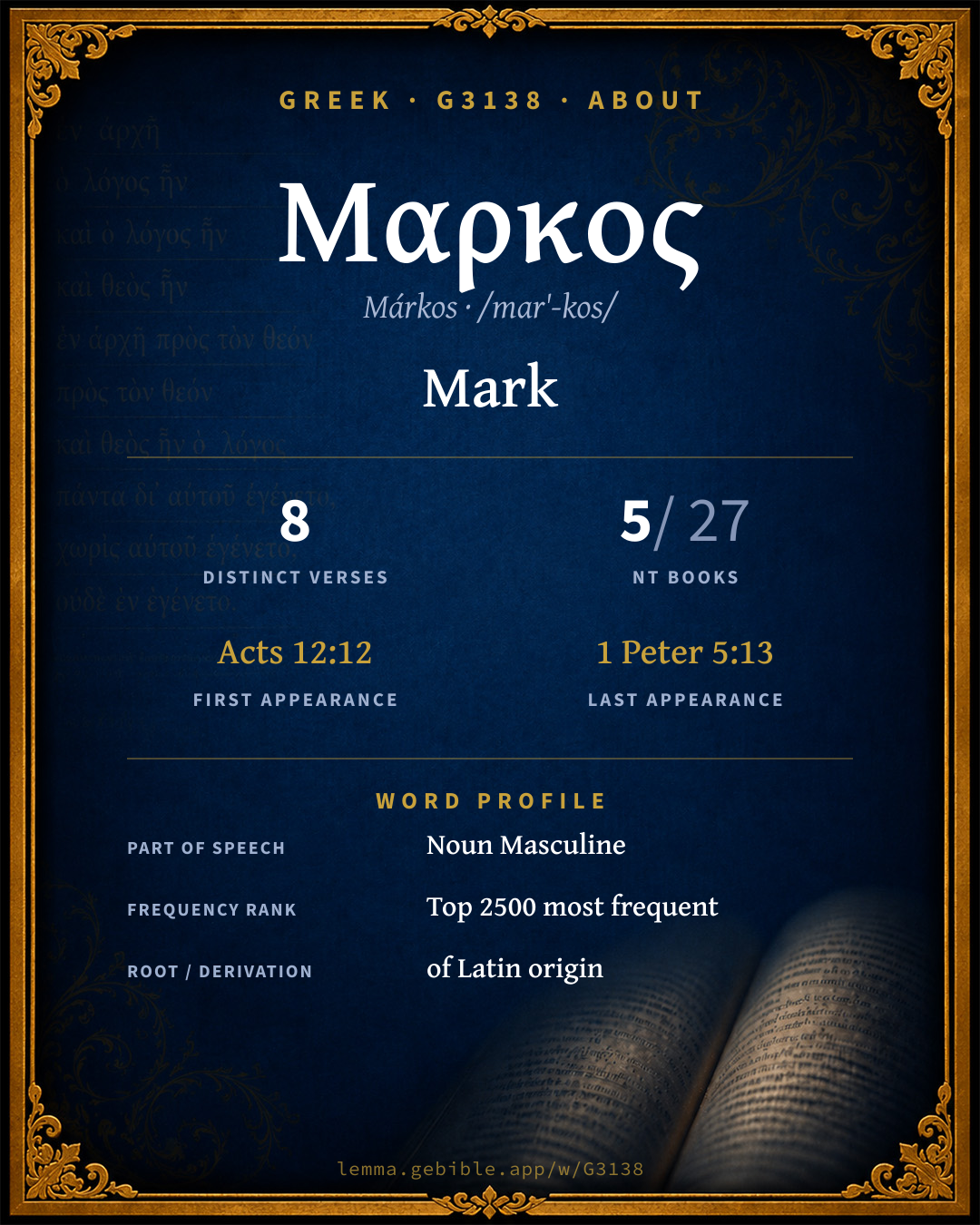
Μάρκος
Mark
Thayer's lists 2 entries for ‘Mark’ fuller range ↓
Full lexicon entry — Thayer's Greek Lexicon
From Thayer's Greek Lexicon
Where this word appears
See every Accusative-case word in the Greek New Testament →
Grammar key — what these labels mean
Part of speech
- Noun
- A naming word — a person, place, thing, or idea.
Case
- Accusative
- The case of the direct object and of extent.
- Nominative
- The case of the subject (and the predicate nominative).
- Genitive
- The case of source, possession, or “of” — answers “whose / from what.”
Gender
- Masculine
- Grammatically masculine.
Number
- Singular
- One.
1 distinct verse where G3138 appears in the Genitive case, across 1 book. Filtered view — show all forms. Click any verse to open its interlinear word-by-word view. Verse text shown in the World English Bible for context — . Each verse’s Greek form is shown with its reference; the English is not keyword-highlighted, since the data carries no word-level English alignment. Use “Compare translations” on any verse to read it across multiple English versions. This concordance covers the Greek New Testament; Septuagint (Greek Old Testament) occurrences of this word are not indexed here.
Acts 1 verse
About this entry
At a glance — auto-summarized from this page’s data, not written by a person. Every figure links to its source below. This summary describes the numbers; it doesn’t interpret them.
Μαρκος — transliterated Márkos — is a Greek name carrying the sense “Mark.” More than half of its appearances fall in Acts. It appears 8 verses across 5 books of the Greek New Testament, among its uncommon vocabulary. Debuting at Acts 12:12, it then recurs through the corpus. See 8-verse concordance and the renderings breakdown below.
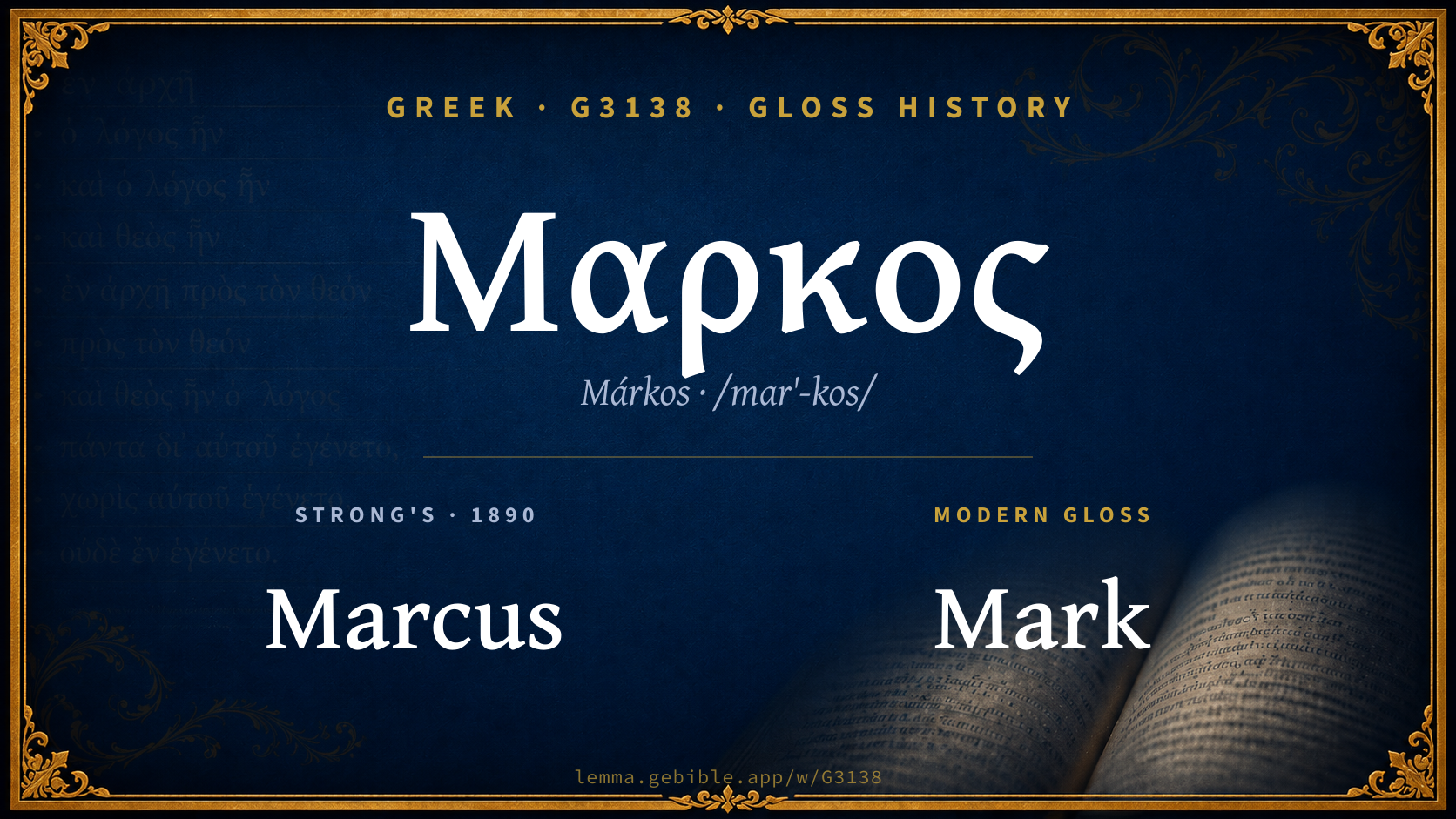
Gloss history
Strong's 1890 vs modern scholarship
About this word
Strong's G3138 catalogs a Greek word from the Greek New Testament.
These counts are not copied from any lexicon or concordance. They are computed here, from the morphology-tagged Greek New Testament. What Lemma adds →
- 8
- distinct verses
- The word appears in 8 distinct verses.
- 5 / 27
- NT books
- The word appears in 5 of 27 New Testament books.
- #1,240
- by frequency
- Top 2500 most frequent Greek words (rank 1,240 of 5,347 Greek words by occurrence).
View all 8 occurrences in the concordance →
Most concentrated in
- Acts 4 verses 50%
- Colossians 1 verse 13%
- 2 Timothy 1 verse 13%
By section of the New Testament
By traditional corpus
Conventional, traditional groupings — biblical authorship is debated, so this is a traditional corpus grouping, not an authorship claim. Some books belong to more than one corpus (Luke is in both the Gospels and the Lukan corpus, and so on), so these shares overlap and need not total 100%. Each figure is a share of the word’s 8 distinct verses.
- Lukan (Luke–Acts) 4 verses · 50%
- Pauline corpus 3 verses · 38%
- General (Catholic) Epistles 1 verse · 13%
How translations render this word
Counts come from each version’s own published word-to-Strong’s tagging or interlinear alignment — an approximate guide to how each version renders this word, not a word-level alignment the data otherwise carries. Because each total is that version’s own tagged count, the per-version totals vary from one another and need not match the appearance or distinct-verse counts above. These counts may also differ from a printed concordance because Lemma counts each distinctly tagged rendering and does not collapse phrase taggings into a single head-word total. This is a fixed set of word-tagged versions (KJV, ASV, BSB, ULT) and does not change with the reading translation you choose elsewhere. Each version’s license is shown beside its name below (and on Sources).
- King James Version: Mark 5×, Marcus 2×
- American Standard Version: Mark 5×
- Berean Standard Bible: Mark 8×
- unfoldingWord Literal Text: Mark 8×
King James Version Public Domain
Renders G3138 across 8 tagged occurrences — most commonly:
Plus 1 rendering that appears only once — usually multi-word phrases or single function words the recovered tagging swept in, not distinct renderings.
American Standard Version Public Domain
Renders G3138 across 7 tagged occurrences — most commonly:
Plus 2 renderings that appear only once — usually multi-word phrases or single function words the recovered tagging swept in, not distinct renderings.
Berean Standard Bible Public Domain
Renders G3138 across 8 tagged occurrences — most commonly:
unfoldingWord Literal Text CC BY-SA 4.0
Renders G3138 across 8 tagged occurrences — most commonly:
Senses in Thayer's
The 2 senses Thayer's distinguishes for this word, in lexicon order (not ranked by frequency or importance). The full entry — with sub-senses — is in the Lexicon Entry tab.
- Mark = "a defense"
- an evangelist…
Word origin
Origin: of Latin origin
Of Latin origin; Marcus a Christian : - Marcus Mark.
— Strong’s Exhaustive Concordance (1890), public domain.
Forms in the corpus
The 4 distinct written forms G3138 takes in the Greek New Testament, most frequent first — each parse links to that case’s occurrences in the concordance.
| Form | Parsing | Example | Uses |
|---|---|---|---|
| Μᾶρκον Mârkon | Noun, Accusative, Singular, Masculine | Acts 12:25 | 4 |
| Μᾶρκος Mârkos | Noun, Nominative, Singular, Masculine | Colossians 4:10 | 2 |
| Μάρκος Márkos | Noun, Nominative, Singular, Masculine | Philemon 1:24 | 1 |
| Μάρκου Márkou | Noun, Genitive, Singular, Masculine | Acts 12:12 | 1 |
Bible dictionary
Public-domain dictionary articles matched to this entry by name (Mark). A biblical name can be shared by more than one person or place, so an article may treat several.
Easton's Bible Dictionary · M. G. Easton, 1897
The evangelist; "John whose surname was Mark" (Acts 12:12, 25). Mark (Marcus, Col. 4:10, etc.) was his Roman name, which gradually came to supersede his Jewish name John. He is called John in Acts 13:5, 13, and Mark in 15:39, 2 Tim. 4:11, etc.
He was the son of Mary, a woman apparently of some means and influence, and was probably born in Jerusalem, where his mother resided (Acts 12:12). Of his father we know nothing. He was cousin of Barnabas (Col. 4:10). It was in his mother's house that Peter found "many gathered together praying" when he was released from prison; and it is probable that it was here that he was converted by Peter, who calls him his "son" (1 Pet. 5:13). It is probable that the "young man" spoken of in Mark 14:51, 52 was Mark himself. He is first mentioned in Acts 12:25. He went with Paul and Barnabas on their first journey (about A.D. 47) as their "minister," but from some cause turned back when they reached Perga in Pamphylia (Acts 12:25; 13:13). Three years afterwards a "sharp contention" arose between Paul and Barnabas (15:36-40), because Paul would not take Mark with him. He, however, was evidently at length reconciled to the apostle, for he was with him in his first imprisonment at Rome (Col. 4:10; Philemon 1:24). At a later period he was with Peter in Babylon (1 Pet. 5:13), then, and for some centuries afterwards, one of the chief seats of Jewish learning; and he was with Timothy in Ephesus when Paul wrote him during his second imprisonment (2 Tim. 4:11). He then disappears from view.
Smith's Bible Dictionary · William Smith, 1863
one of the evangelists, and probable author of the Gospel bearing his name. (Marcus was his Latin surname. His Jewish name was John, which is the same as Johanan (the grace of God). We can almost trace the steps whereby the former became his prevalent name in the Church. "John, whose surname was Mark" in (Acts 12:12,25; 15:37) becomes "John" alone in (Acts 13:5,13) "Mark" in (Acts 15:39) and thenceforward there is no change. (Colossians 4:10); Phlm 1:24; 2Tim 4:11 The evangelist was the son of a certain Mary, a Jewish matron of some position who dwelt in Jerusalem, (Acts 12:12) and was probably born of a Hellenistic family in that city. Of his father we know nothing; but we do know that the future evangelist was cousin of Barnabas of Cyprus, the great friend of St. Paul. His mother would seem to have been intimately acquainted with St. Peter, and it was to her house, as to a familiar home, that the apostle repaired, A.D. 44, after his deliverance from prison (Acts 12:12) This fact accounts for St. Mark's intimate acquaintance with that apostle, to whom also he probably owed his conversion, for St. Peter calls him his son. (1 Peter 5:13) We hear Of him for the first time in Acts 15:25 where we find him accompanying and Barnabas on their return from Jerusalem to Antioch, A.D. 45. He next comes before us on the occasion of the earliest missionary journey of the same apostles, A.D. 48, when he joined them as their "minister." (Acts 13:8) With them he visited Cyprus; but at Perga in Pamphylia, (Acts 13:13) when they were about to enter upon the more arduous part of their mission, he left them, and, for some unexplained reason, returned to Jerusalem to his mother and his home. Notwithstanding this, we find him at Paul's side during that apostle's first imprisonment at Rome, A.D. 61-63, and he Is acknowledged by him as one of his few fellow laborers who had been a "comfort" to him during the weary hours of his imprisonment. (Colossians 4:10,11); Phle 1:24 We next have traces of him in (1 Peter 5:13) "The church that is in Babylon ... saluteth you, and so doth Marcus my son." From this we infer that he joined his spiritual father, the great friend of his mother, at Babylon, then and for same hundred years afterward one of the chief seats of Jewish culture. From Babylon he would seem to have returned to Asia Minor; for during his second imprisonment A.D. 68 St. Paul, writing to Timothy charges him to bring Mark with him to me, on the ground that he was "profitable to him For the ministry." (2 Timothy 4:11) From this point we gain no further information from the New Testament respecting the evangelist. It is most probable, however that he did join the apostle at Rome whither also St. Peter would seem to have proceeded, and suffered martyrdom with St. Paul. After the death of these two great pillars of the Church; ecclesiastical tradition affirms that St. Mark visited Egypt, founded the church of Alexandria, and died by martyrdom.--Condensed from Cambridge Bible for Schools.--ED.)
Hitchcock's Bible Names Dictionary · Roswell D. Hitchcock, 1869
same as Marcus
Classic public-domain reference works; full attribution on Sources.