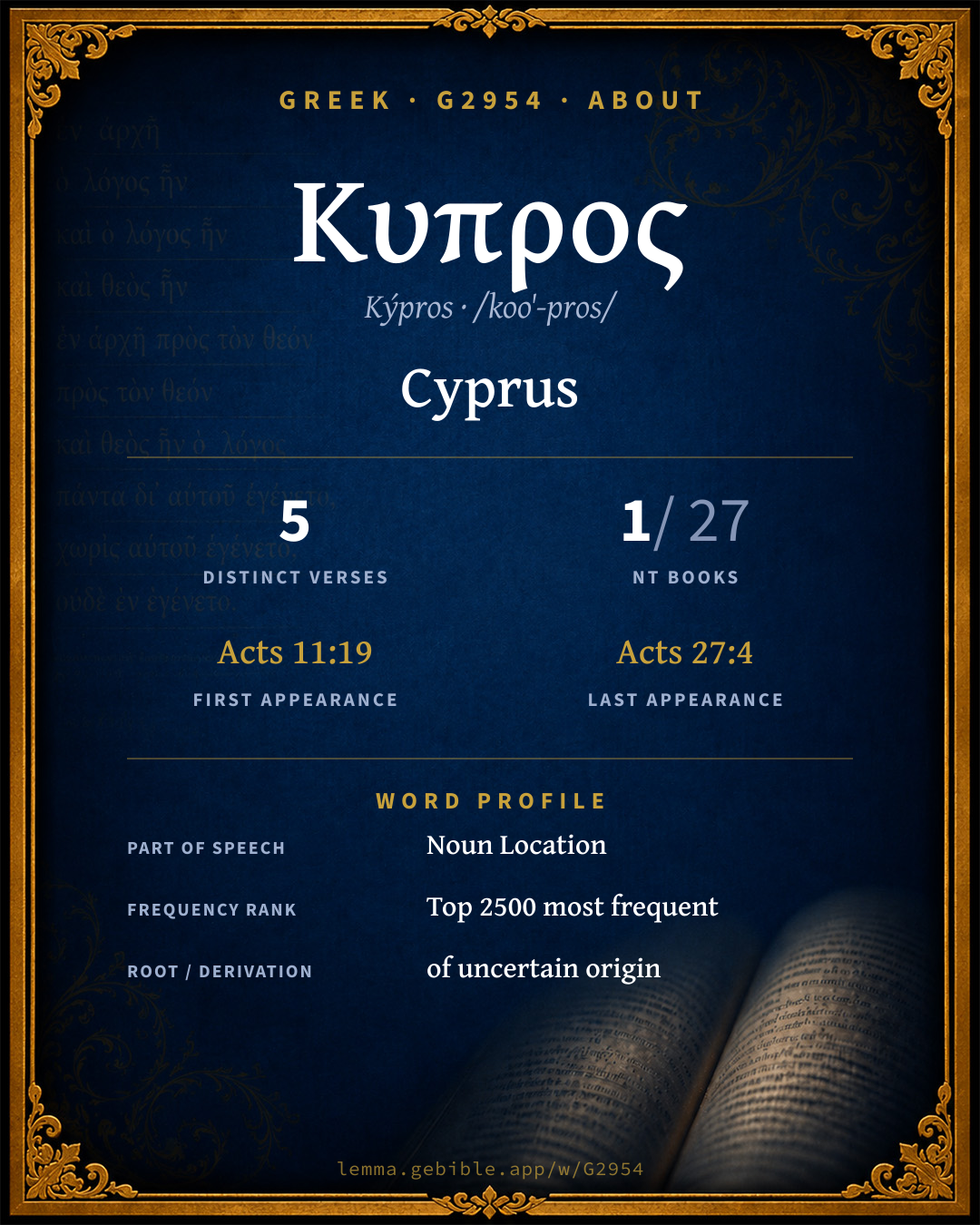
Κύπρος
Cyprus
Thayer's lists 2 entries for ‘Cyprus’ fuller range ↓
Full lexicon entry — Thayer's Greek Lexicon
From Thayer's Greek Lexicon
Where this word appears
See every Accusative-case word in the Greek New Testament →
Grammar key — what these labels mean
Part of speech
- Noun
- A naming word — a person, place, thing, or idea.
Case
- Accusative
- The case of the direct object and of extent.
- Genitive
- The case of source, possession, or “of” — answers “whose / from what.”
Gender
- Feminine
- Grammatically feminine.
Number
- Singular
- One.
Grammatical forms
- Noun, Accusative, Singular, Feminine 4 times (80%)
- Noun, Genitive, Singular, Feminine 1 time (20%)
Parsed forms decoded from the imported morphology (Robinson–Tischendorf, public domain), counted across 5 parsed occurrences — not distinct verses.
Every verse where G2954 appears — 5 distinct verses across 1 book. Click any verse to open its interlinear word-by-word view. Verse text shown in the World English Bible for context — . Each verse’s Greek form is shown with its reference; the English is not keyword-highlighted, since the data carries no word-level English alignment. Use “Compare translations” on any verse to read it across multiple English versions. This concordance covers the Greek New Testament; Septuagint (Greek Old Testament) occurrences of this word are not indexed here.
Acts 5 verses
- Acts 11:19 Κύπρου n gen sg fem They therefore who were scattered abroad by the oppression that arose about Stephen traveled as far as Phoenicia, Cyprus, and Antioch, speaking the word to no one except to Jews only.
- Acts 13:4 Κύπρον n acc sg fem So, being sent out by the Holy Spirit, they went down to Seleucia. From there they sailed to Cyprus.
- Acts 15:39 Κύπρον n acc sg fem Then the contention grew so sharp that they separated from each other. Barnabas took Mark with him, and sailed away to Cyprus,
- Acts 21:3 Κύπρον n acc sg fem When we had come in sight of Cyprus, leaving it on the left hand, we sailed to Syria, and landed at Tyre, for there the ship was to unload her cargo.
- Acts 27:4 Κύπρον n acc sg fem Putting to sea from there, we sailed under the lee of Cyprus, because the winds were contrary.
About this entry
At a glance — auto-summarized from this page’s data, not written by a person. Every figure links to its source below. This summary describes the numbers; it doesn’t interpret them.
Κυπρος — transliterated Kýpros — is a Greek name carrying the sense “Cyprus.” The Greek New Testament uses it only 5 verses. More than three-quarters of its appearances fall in Acts. Debuting at Acts 11:19, it then recurs through the corpus. See 5-verse concordance and the renderings breakdown below.
Gloss history
Strong's 1890 vs modern scholarship
About this word
Strong's G2954 catalogs a Greek word from the Greek New Testament.
These counts are not copied from any lexicon or concordance. They are computed here, from the morphology-tagged Greek New Testament. What Lemma adds →
- 5
- distinct verses
- The word appears in 5 distinct verses.
- 1 / 27
- NT books
- The word appears in 1 of 27 New Testament books.
- #1,648
- by frequency
- Top 2500 most frequent Greek words (rank 1,648 of 5,347 Greek words by occurrence).
View all 5 occurrences in the concordance →
Most concentrated in
- Acts 5 verses 100%
By section of the New Testament
By traditional corpus
Conventional, traditional groupings — biblical authorship is debated, so this is a traditional corpus grouping, not an authorship claim. Some books belong to more than one corpus (Luke is in both the Gospels and the Lukan corpus, and so on), so these shares overlap and need not total 100%. Each figure is a share of the word’s 5 distinct verses.
- Lukan (Luke–Acts) 5 verses · 100%
How translations render this word
Counts come from each version’s own published word-to-Strong’s tagging or interlinear alignment — an approximate guide to how each version renders this word, not a word-level alignment the data otherwise carries. Because each total is that version’s own tagged count, the per-version totals vary from one another and need not match the appearance or distinct-verse counts above. These counts may also differ from a printed concordance because Lemma counts each distinctly tagged rendering and does not collapse phrase taggings into a single head-word total. This is a fixed set of word-tagged versions (KJV, ASV, BSB, ULT) and does not change with the reading translation you choose elsewhere. Each version’s license is shown beside its name below (and on Sources).
- King James Version: Cyprus 5×
- American Standard Version: Cyprus 4×
- Berean Standard Bible: Cyprus 5×
- unfoldingWord Literal Text: Cyprus 5×
King James Version Public Domain
Renders G2954 across 5 tagged occurrences — most commonly:
American Standard Version Public Domain
Renders G2954 across 5 tagged occurrences — most commonly:
Plus 1 rendering that appears only once — usually multi-word phrases or single function words the recovered tagging swept in, not distinct renderings.
Berean Standard Bible Public Domain
Renders G2954 across 5 tagged occurrences — most commonly:
unfoldingWord Literal Text CC BY-SA 4.0
Renders G2954 across 5 tagged occurrences — most commonly:
Senses in Thayer's
The 2 senses Thayer's distinguishes for this word, in lexicon order (not ranked by frequency or importance). The full entry — with sub-senses — is in the Lexicon Entry tab.
- Cyprus = "love: a blossom"
- a very fertile and delightful island of the Mediterranean, lying between Cilicia and Syria
Word origin
Origin: of uncertain origin
Of uncertain origin; Cyprus an island in the mediterranean : - Cyprus.
— Strong’s Exhaustive Concordance (1890), public domain.
Forms in the corpus
The 2 distinct written forms G2954 takes in the Greek New Testament, most frequent first — each parse links to that case’s occurrences in the concordance.
| Form | Parsing | Example | Uses |
|---|---|---|---|
| Κύπρον Kýpron | Noun, Accusative, Singular, Feminine | Acts 13:4 | 4 |
| Κύπρου Kýprou | Noun, Genitive, Singular, Feminine | Acts 11:19 | 1 |
Same root — word family
Other Thayer's entries built from the same root as G2954, grouped by Strong’s listed origin. These share a root / origin per the lexicon — not necessarily a shared meaning. Each links to that word’s own entry.
Proper names from this root
People and places named from this root — a name, not an additional meaning of the word.
Compare all same-root words → 1 of the same-root words is a proper name (a person or place). They share a root, not necessarily a meaning.
Bible dictionary
Public-domain dictionary articles matched to this entry by name (Cyprus). A biblical name can be shared by more than one person or place, so an article may treat several.
Easton's Bible Dictionary · M. G. Easton, 1897
One of the largest islands of the Mediterranean, about 148 miles long and 40 broad. It is distant about 60 miles from the Syrian coast. It was the "Chittim" of the Old Testament (Num. 24:24). The Greek colonists gave it the name of Kypros, from the cyprus, i.e., the henna (see CAMPHIRE), which grew on this island. It was originally inhabited by Phoenicians. In B.C. 477 it fell under the dominion of the Greeks; and became a Roman province B.C. 58. In ancient times it was a centre of great commercial activity. Corn and wine and oil were produced here in the greatest perfection. It was rich also in timber and in mineral wealth.
It is first mentioned in the New Testament (Acts 4:36) as the native place of Barnabas. It was the scene of Paul's first missionary labours (13:4-13), when he and Barnabas and John Mark were sent forth by the church of Antioch. It was afterwards visited by Barnabas and Mark alone (15:39). Mnason, an "old disciple," probaly one of the converts of the day of Pentecost belonging to this island, is mentioned (21:16). It is also mentioned in connection with the voyages of Paul (Acts 21:3; 27:4). After being under the Turks for three hundred years, it was given up to the British Government in 1878.
Smith's Bible Dictionary · William Smith, 1863
an island of Asia in the Mediterranean. It is about 140 miles long and 50 miles wide at the widest part. Its two chief cities were Salamis, at the east end of the island, and Paphos, at the west end. "Cyprus occupies a distinguished place in both sacred and profane history. It early belonged to the Phoenicians of the neighboring coast; was afterwards colonized by Greeks' passed successively under the power of the Pharaohs, Persians, Ptolemies and Romans, excepting a short period of independence in the fourth century B.C. It was one of the chief seats of the worship of Venus, hence called Cypria. Recently the discoveries in Cyprus by Cesnola have excited new interest.--Appleton's Am. Encyc. It was the native place of Barnabas, (Acts 4:36) and was visited by Paul. (Acts 13:4-13; 15:39; 21:3) See also (Acts 27:4)
Hitchcock's Bible Names Dictionary · Roswell D. Hitchcock, 1869
fair; fairness
Classic public-domain reference works; full attribution on Sources.
Septuagint usage
The same Greek word Κυπρος appears 2 times in the Greek Old Testament (Septuagint), across 2 verses in 1 book.
- 2
- LXX occurrences
- Tagged occurrences of this Greek word in the Septuagint.
- 2
- verses
- Distinct Septuagint verses containing this word.
- 1 / 39
- OT books
- The word appears in 1 of the 39 Old Testament books.
Sample Septuagint occurrences
- Song of Solomon 1:14 κύπρος
Septuagint occurrences (same lexeme)
Every verse where the same Strong’s number (G2954) appears in the Greek Septuagint. Verse text shown in the World English Bible for context; the Greek form is the matched word — the English is not keyword-highlighted.
- Song of Solomon 1:14 κύπρος My beloved is to me a cluster of henna blossoms From the vineyards of En Gedi. Lover
- Song of Solomon 4:13 κύπρος Your shoots are an orchard of pomegranates, with precious fruits: Henna with spikenard plants,
These are occurrences of the same Greek lexeme (G2954) in the Septuagint — not a translation of any one Hebrew word. The store carries no word-level Hebrew↔Greek alignment, so no Hebrew original is asserted here. Counts come from the recovered LXX Strong's tagging — high-frequency vocabulary is well covered, while rare or late forms may be untagged — so they reflect tagged occurrences and may slightly undercount.