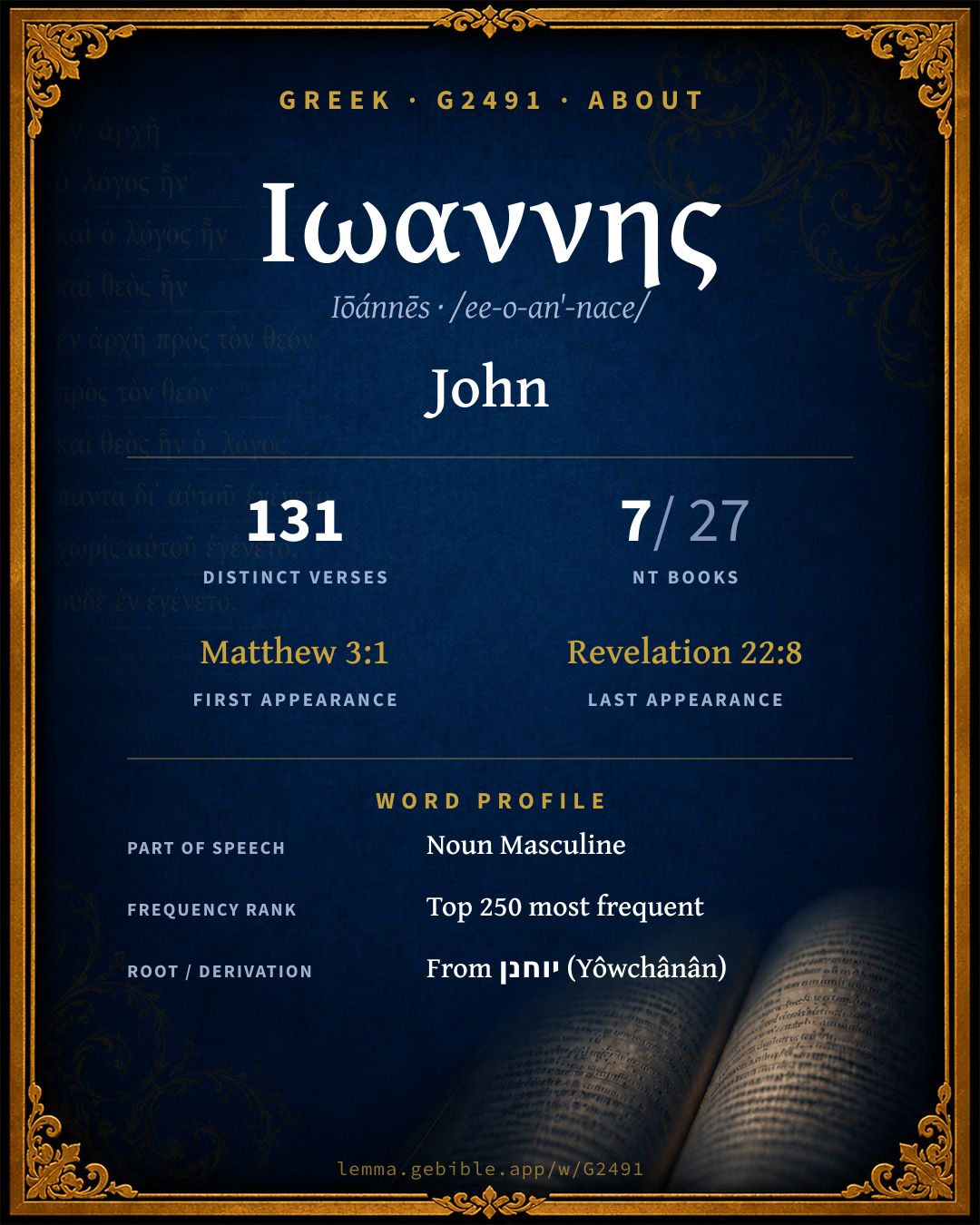
Ἰωάννης
John
Thayer's lists 5 entries for ‘John’ fuller range ↓
Full lexicon entry — Thayer's Greek Lexicon
From Thayer's Greek Lexicon
Where this word appears
See every Nominative-case word in the Greek New Testament →
Grammar key — what these labels mean
Part of speech
- Noun
- A naming word — a person, place, thing, or idea.
Case
- Nominative
- The case of the subject (and the predicate nominative).
- Genitive
- The case of source, possession, or “of” — answers “whose / from what.”
- Accusative
- The case of the direct object and of extent.
- Dative
- The case of the indirect object, means, or location — “to / for / with / in.”
Gender
- Masculine
- Grammatically masculine.
Number
- Singular
- One.
3 verses where G2491 appears in the Nominative case in the Book of Revelation. Filtered view — show all forms. Click any verse to open its interlinear word-by-word view. Verse text shown in the World English Bible for context — . Each verse’s Greek form is shown with its reference; the English is not keyword-highlighted, since the data carries no word-level English alignment. Use “Compare translations” on any verse to read it across multiple English versions. This concordance covers the Greek New Testament; Septuagint (Greek Old Testament) occurrences of this word are not indexed here.
Revelation
- Revelation 1:4 Ἰωάννης n nom sg masc John, to the seven assemblies that are in Asia: Grace to you and peace, from God, who is and who was and who is to come; and from the seven Spirits who are before his throne;
- Revelation 1:9 Ἰωάννης n nom sg masc I John, your brother and partner with you in oppression, Kingdom, and perseverance in Christ Jesus, was on the isle that is called Patmos because of God's Word and the testimony of Jesus Christ.
- Revelation 22:8 Ἰωάννης n nom sg masc Now I, John, am the one who heard and saw these things. When I heard and saw, I fell down to worship before the feet of the angel who had shown me these things.
About this entry
At a glance — auto-summarized from this page’s data, not written by a person. Every figure links to its source below. This summary describes the numbers; it doesn’t interpret them.
Ιωαννης — transliterated Iōánnēs — is a Greek name carrying the sense “John.” Debuting at Matthew 3:1, it then recurs through the corpus. The Greek New Testament uses it across 131 verses — common. Each statement above links to its evidence; the full detail follows below.
Gloss history
Strong's 1890 vs modern scholarship
About this word
Strong's G2491 catalogs a Greek word from the Greek New Testament.
These counts are not copied from any lexicon or concordance. They are computed here, from the morphology-tagged Greek New Testament. What Lemma adds →
- 131
- distinct verses
- The word appears in 131 distinct verses.
- 7 / 27
- NT books
- The word appears in 7 of 27 New Testament books.
- #125
- by frequency
- Top 250 most frequent Greek words (rank 125 of 5,347 Greek words by occurrence).
View all 131 occurrences in the concordance →
By section of the New Testament
By traditional corpus
Conventional, traditional groupings — biblical authorship is debated, so this is a traditional corpus grouping, not an authorship claim. Some books belong to more than one corpus (Luke is in both the Gospels and the Lukan corpus, and so on), so these shares overlap and need not total 100%. Each figure is a share of the word’s 131 distinct verses.
- Gospels 102 verses · 78%
- Lukan (Luke–Acts) 54 verses · 41%
- Johannine 26 verses · 20%
- Revelation 4 verses · 3%
- Pauline corpus 1 verse · 1%
How translations render this word
Counts come from each version’s own published word-to-Strong’s tagging or interlinear alignment — an approximate guide to how each version renders this word, not a word-level alignment the data otherwise carries. Because each total is that version’s own tagged count, the per-version totals vary from one another and need not match the appearance or distinct-verse counts above. These counts may also differ from a printed concordance because Lemma counts each distinctly tagged rendering and does not collapse phrase taggings into a single head-word total. This is a fixed set of word-tagged versions (KJV, ASV, BSB, ULT) and does not change with the reading translation you choose elsewhere. Each version’s license is shown beside its name below (and on Sources).
- King James Version: John 129×, John's 2×
- American Standard Version: John 121×
- Berean Standard Bible: John 115×, John’s 13×, Than john 2×
- unfoldingWord Literal Text: John 131×, Son of john 3×
King James Version Public Domain
Renders G2491 across 133 tagged occurrences — most commonly:
Plus 2 renderings that appear only once — usually multi-word phrases or single function words the recovered tagging swept in, not distinct renderings.
American Standard Version Public Domain
Renders G2491 across 130 tagged occurrences — most commonly:
Plus 9 renderings that appear only once — usually multi-word phrases or single function words the recovered tagging swept in, not distinct renderings.
Berean Standard Bible Public Domain
Renders G2491 across 131 tagged occurrences — most commonly:
Plus 1 rendering that appears only once — usually multi-word phrases or single function words the recovered tagging swept in, not distinct renderings. Not rendered by a distinct English word in 4 further occurrences.
unfoldingWord Literal Text CC BY-SA 4.0
Renders G2491 across 136 tagged occurrences — most commonly:
Plus 2 renderings that appear only once — usually multi-word phrases or single function words the recovered tagging swept in, not distinct renderings.
Senses in Thayer's
The 5 senses Thayer's distinguishes for this word, in lexicon order (not ranked by frequency or importance). The full entry — with sub-senses — is in the Lexicon Entry tab.
- John = "Jehovah is a gracious giver"
- John the Baptist was the son of Zacharias and Elisabeth…
- John the apostle…
- John surnamed Mark, the companion of Barnabas and Paul. Acts 12:12
- John a certain man, a member of the Sanhedrin Acts 5:6
Word origin
Derived from יוחנן (Yôwchânân) (H3110) — Johanan.
Of hebrew origin [ H3110 ]; Joannes (that is Jochanan ) the name of four Israelites : - John.
— Strong’s Exhaustive Concordance (1890), public domain.
Forms in the corpus
The 5 distinct written forms G2491 takes in the Greek New Testament, most frequent first — each parse links to that case’s occurrences in the concordance.
| Form | Parsing | Example | Uses |
|---|---|---|---|
| Ἰωάννης Iōánnēs | Noun, Nominative, Singular, Masculine | Matthew 3:1 | 53 |
| Ἰωάννου Iōánnou | Noun, Genitive, Singular, Masculine | Matthew 9:14 | 39 |
| Ἰωάννην Iōánnēn | Noun, Accusative, Singular, Masculine | Matthew 3:13 | 37 |
| Ἰωάννῃ Iōánnē | Noun, Dative, Singular, Masculine | Matthew 11:4 | 3 |
| Ἰωάννει Iōánnei | Noun, Dative, Singular, Masculine | Luke 7:18 | 2 |
Same root — word family
Other Thayer's entries built from the same root as G2491, grouped by Strong’s listed origin. These share a root / origin per the lexicon — not necessarily a shared meaning. Each links to that word’s own entry.
Derives from
Proper names from this root
People and places named from this root — a name, not an additional meaning of the word.
Compare all same-root words → Showing 4 of 5 — not the complete family. 4 of the same-root words are proper names (people or places). They share a root, not necessarily a meaning.
Bible dictionary
Public-domain dictionary articles matched to this entry by name (John). A biblical name can be shared by more than one person or place, so an article may treat several.
Easton's Bible Dictionary · M. G. Easton, 1897
(1.) One who, with Annas and Caiaphas, sat in judgment on the apostles Peter and John (Acts 4:6). He was of the kindred of the high priest; otherwise unknown.
(2.) The Hebrew name of Mark (q.v.). He is designated by this name in the acts of the Apostles (12:12, 25; 13:5, 13; 15:37).
(3.) THE APOSTLE, brother of James the "Greater" (Matt. 4:21; 10:2; Mark 1:19; 3:17; 10:35). He was one, probably the younger, of the sons of Zebedee (Matt. 4:21) and Salome (Matt. 27:56; comp. Mark 15:40), and was born at Bethsaida. His father was apparently a man of some wealth (comp. Mark 1:20; Luke 5:3; John 19:27). He was doubtless trained in all that constituted the ordinary education of Jewish youth. When he grew up he followed the occupation of a fisherman on the Lake of Galilee. When John the Baptist began his ministry in the wilderness of Judea, John, with many others, gathered round him, and was deeply influenced by his teaching. There he heard the announcement, "Behold the Lamb of God," and forthwith, on the invitation of Jesus, became a disciple and ranked among his followers (John 1:36, 37) for a time. He and his brother then returned to their former avocation, for how long is uncertain. Jesus again called them (Matt. 4: 21; Luke 5:1-11), and now they left all and permanently attached themselves to the company of his disciples. He became one of the innermost circle (Mark 5:37; Matt. 17:1; 26:37; Mark 13:3). He was the disciple whom Jesus loved. In zeal and intensity of character he was a "Boanerges" (Mark 3:17). This spirit once and again broke out (Matt. 20:20-24; Mark 10:35-41; Luke 9:49, 54). At the betrayal he and Peter follow Christ afar off, while the others betake themselves to hasty flight (John 18:15). At the trial he follows Christ into the council chamber, and thence to the praetorium (18:16, 19, 28) and to the place of crucifixion (19:26, 27). To him and Peter, Mary first conveys tidings of the resurrection (20:2), and they are the first to go and see what her strange words mean. After the resurrection he and Peter again return to the Sea of Galilee, where the Lord reveals himself to them (21:1, 7). We find Peter and John frequently after this together (Acts 3:1; 4:13). John remained apparently in Jerusalem as the leader of the church there (Acts 15:6; Gal. 2:9). His subsequent history is unrecorded. He was not there, however, at the time of Paul's last visit (Acts 21:15-40). He appears to have retired to Ephesus, but at what time is unknown. The seven churches of Asia were the objects of his special care (Rev. 1:11). He suffered under persecution, and was banished to Patmos (1:9); whence he again returned to Ephesus, where he died, probably about A.D. 98, having outlived all or nearly all the friends and companions even of his maturer years. There are many interesting traditions regarding John during his residence at Ephesus, but these cannot claim the character of historical truth.
Smith's Bible Dictionary · William Smith, 1863
the same name as Johanan, a contraction of Jehoanan, Jehovah's gift .
+ One of the high priest's family, who, with Annas and Caiaphas, sat in judgment upon the apostles Peter and John. (Acts 6:6) + The Hebrew name of the evangelist Mark. (Acts 12:12,25; 13:5,13; 15:37)
Hitchcock's Bible Names Dictionary · Roswell D. Hitchcock, 1869
the grace or mercy of the Lord
Classic public-domain reference works; full attribution on Sources.