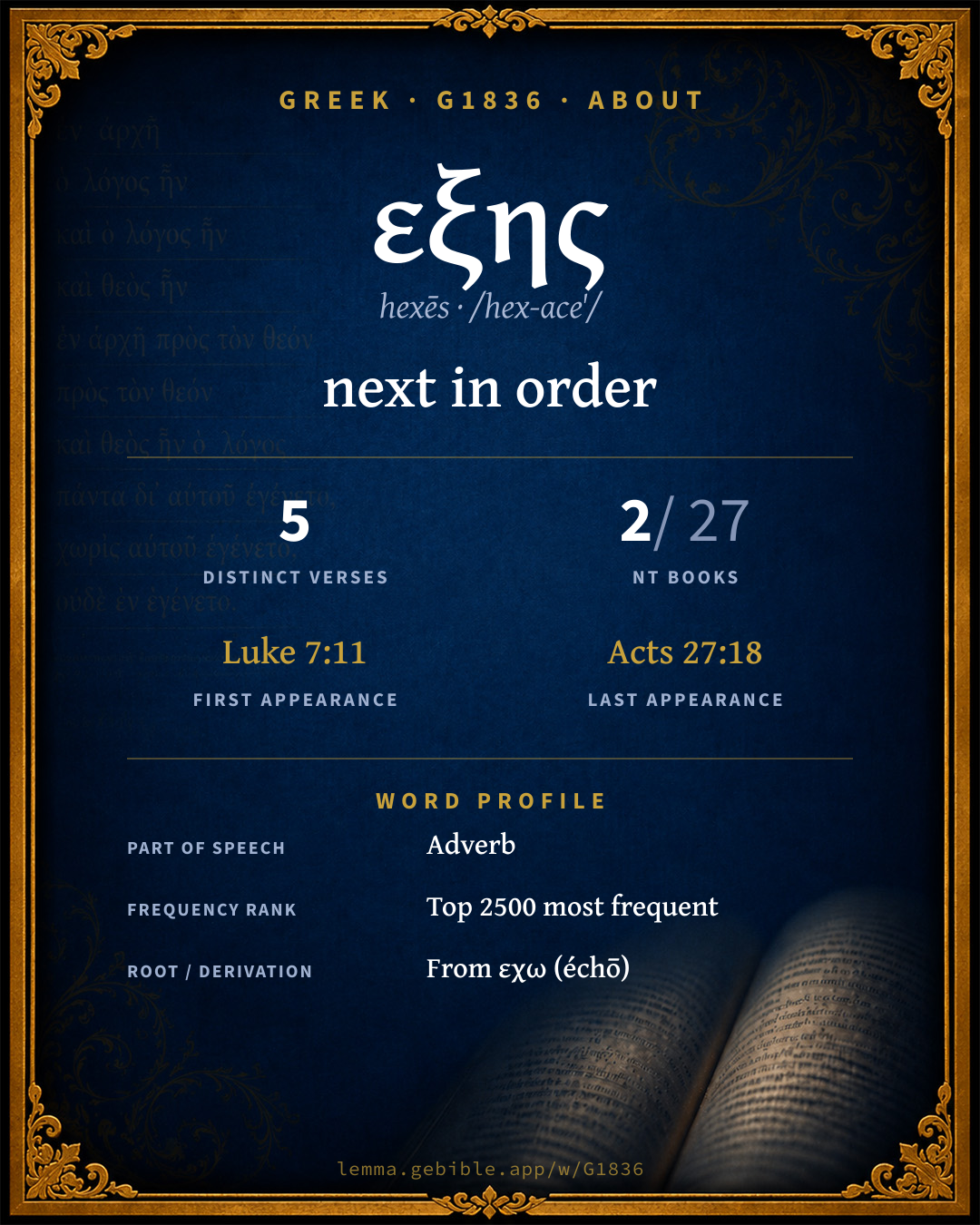
ἑξῆς
next in order
‘next in order’ is one of 2 main senses fuller range ↓
Full lexicon entry — Thayer's Greek Lexicon
From Thayer's Greek Lexicon
Where this word appears
Grammar key — what these labels mean
Part of speech
- Adverb
- A word that modifies a verb, adjective, or other adverb.
Every verse where G1836 appears — 5 distinct verses across 2 books. Click any verse to open its interlinear word-by-word view. Verse text shown in the World English Bible for context — . Each verse’s Greek form is shown with its reference; the English is not keyword-highlighted, since the data carries no word-level English alignment. Use “Compare translations” on any verse to read it across multiple English versions. This concordance covers the Greek New Testament; Septuagint (Greek Old Testament) occurrences of this word are not indexed here.
Luke 2 verses
Acts 3 verses
- Acts 21:1 ἑξῆς adv When it happened that we had parted from them and had set sail, we came with a straight course to Cos, and the next day to Rhodes, and from there to Patara.
- Acts 25:17 ἑξῆς adv When therefore they had come together here, I didn't delay, but on the next day sat on the judgment seat, and commanded the man to be brought.
- Acts 27:18 ἑξῆς adv As we labored exceedingly with the storm, the next day they began to throw things overboard.
About this entry
At a glance — auto-summarized from this page’s data, not written by a person. Every figure links to its source below. This summary describes the numbers; it doesn’t interpret them.
At its core, εξης (hexēs) means “next in order.” With only 5 verses it sits in the long tail of Greek New Testament vocabulary. Its uses cluster heavily in Acts (60% of all occurrences). Scripture first uses it in Luke 7:11. Ranging over 2 senses, it is not a single-sense word. Each statement above links to its evidence; the full detail follows below.
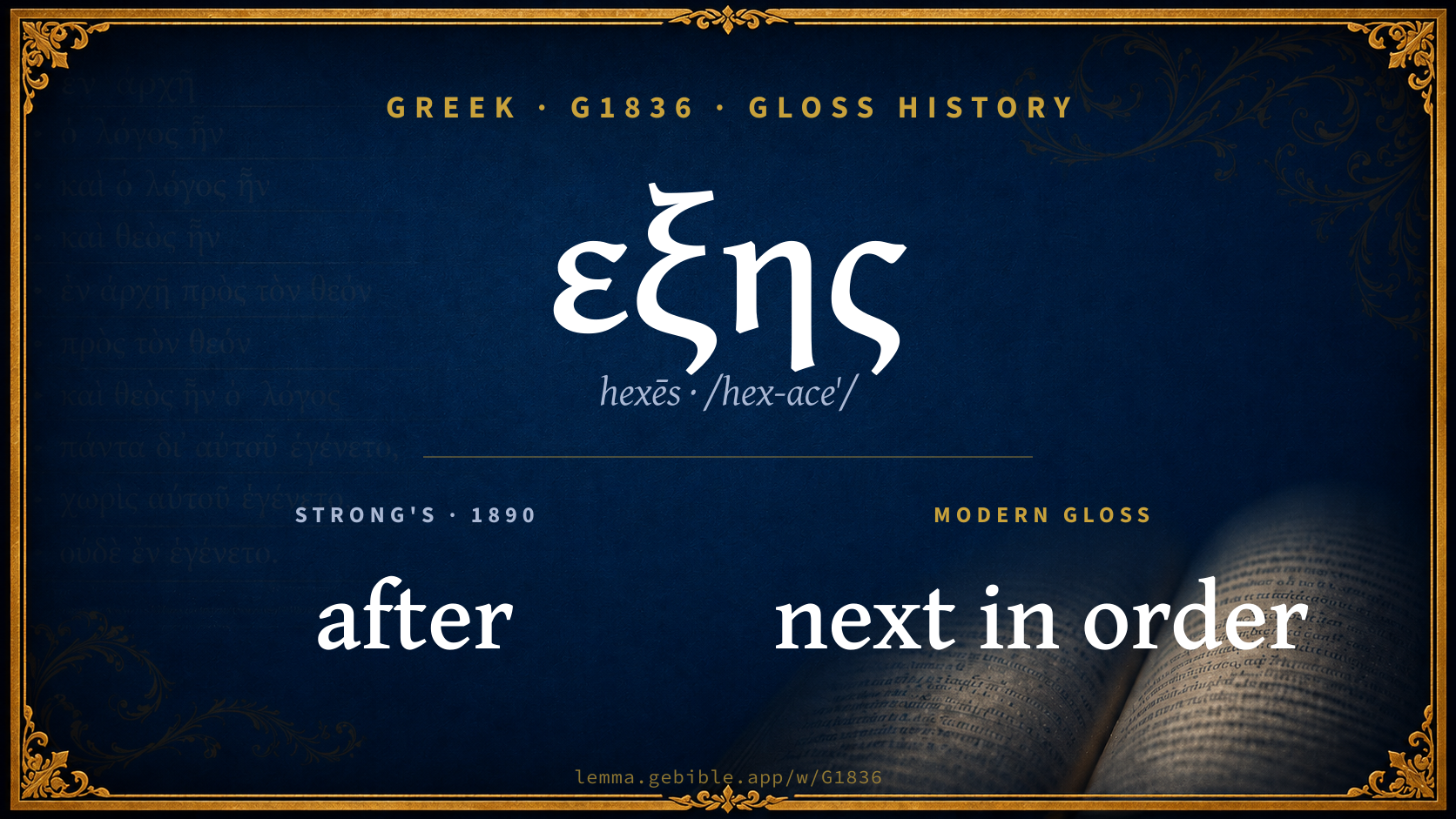
Gloss history
Strong's 1890 vs modern scholarship
About this word
Strong's G1836 catalogs a Greek word from the Greek New Testament.
These counts are not copied from any lexicon or concordance. They are computed here, from the morphology-tagged Greek New Testament. What Lemma adds →
- 5
- distinct verses
- The word appears in 5 distinct verses.
- 2 / 27
- NT books
- The word appears in 2 of 27 New Testament books.
- #1,648
- by frequency
- Top 2500 most frequent Greek words (rank 1,648 of 5,347 Greek words by occurrence).
View all 5 occurrences in the concordance →
By traditional corpus
Conventional, traditional groupings — biblical authorship is debated, so this is a traditional corpus grouping, not an authorship claim. Some books belong to more than one corpus (Luke is in both the Gospels and the Lukan corpus, and so on), so these shares overlap and need not total 100%. Each figure is a share of the word’s 5 distinct verses.
- Lukan (Luke–Acts) 5 verses · 100%
- Gospels 2 verses · 40%
How translations render this word
Counts come from each version’s own published word-to-Strong’s tagging or interlinear alignment — an approximate guide to how each version renders this word, not a word-level alignment the data otherwise carries. Because each total is that version’s own tagged count, the per-version totals vary from one another and need not match the appearance or distinct-verse counts above. These counts may also differ from a printed concordance because Lemma counts each distinctly tagged rendering and does not collapse phrase taggings into a single head-word total. This is a fixed set of word-tagged versions (KJV, ASV, BSB, ULT) and does not change with the reading translation you choose elsewhere. Each version’s license is shown beside its name below (and on Sources).
- King James Version: Next 2×
- American Standard Version: Next 3×
- Berean Standard Bible: Next 4×
- unfoldingWord Literal Text: Next day 4×
King James Version Public Domain
Renders G1836 across 5 tagged occurrences — most commonly:
Plus 3 renderings that appear only once — usually multi-word phrases or single function words the recovered tagging swept in, not distinct renderings.
American Standard Version Public Domain
Renders G1836 across 6 tagged occurrences — most commonly:
Plus 3 renderings that appear only once — usually multi-word phrases or single function words the recovered tagging swept in, not distinct renderings.
Berean Standard Bible Public Domain
Renders G1836 across 4 tagged occurrences — most commonly:
Not rendered by a distinct English word in 1 further occurrence.
unfoldingWord Literal Text CC BY-SA 4.0
Renders G1836 across 5 tagged occurrences — most commonly:
Plus 1 rendering that appears only once — usually multi-word phrases or single function words the recovered tagging swept in, not distinct renderings.
Senses in Thayer's
The 2 senses Thayer's distinguishes for this word, in lexicon order (not ranked by frequency or importance). The full entry — with sub-senses — is in the Lexicon Entry tab.
- successively in order
- the next following, the next in succession
Word origin
Derived from εχω (échō) (G2192) — to have.
From G2192 (in the sense of taking hold of that is adjoining ); successive : - after following X morrow next.
— Strong’s Exhaustive Concordance (1890), public domain.
Same root — word family
Other Thayer's entries built from the same root as G1836, grouped by Strong’s listed origin. These share a root / origin per the lexicon — not necessarily a shared meaning. Each links to that word’s own entry.
Derives from
Shares the same root
- εξις héxis G1838 habit
- εσχατος éschatos G2078 last
- ευνουχος eunoûchos G2135 eunuch
- ισχυς ischýs G2479 strength
- οχλος óchlos G3793 multitude
- οχυρωμα ochýrōma G3794 fortress
- σχεδον schedón G4975 near
- σχημα schēma G4976 appearance
- σχολη scholḗ G4981 leisure
Compare all same-root words → Showing 4 of 11 — not the complete family. They share a root, not necessarily a meaning.
Septuagint usage
The same Greek word εξης appears 3 times in the Greek Old Testament (Septuagint), across 3 verses in 2 books.
- 3
- LXX occurrences
- Tagged occurrences of this Greek word in the Septuagint.
- 3
- verses
- Distinct Septuagint verses containing this word.
- 2 / 39
- OT books
- The word appears in 2 of the 39 Old Testament books.
Sample Septuagint occurrences
- Exodus 10:1 ἑξῆς
- Deuteronomy 2:34 ἑξῆς
Septuagint occurrences (same lexeme)
Every verse where the same Strong’s number (G1836) appears in the Greek Septuagint. Verse text shown in the World English Bible for context; the Greek form is the matched word — the English is not keyword-highlighted.
- Exodus 10:1 ἑξῆς Yahweh said to Moses, "Go in to Pharaoh, for I have hardened his heart, and the heart of his servants, that I may show these my signs in the midst of them,
- Deuteronomy 2:34 ἑξῆς We took all his cities at that time, and utterly destroyed every inhabited city, with the women and the little ones; we left none remaining:
- Deuteronomy 3:6 ἑξῆς We utterly destroyed them, as we did to Sihon king of Heshbon, utterly destroying every inhabited city, with the women and the little ones.
These are occurrences of the same Greek lexeme (G1836) in the Septuagint — not a translation of any one Hebrew word. The store carries no word-level Hebrew↔Greek alignment, so no Hebrew original is asserted here. Counts come from the recovered LXX Strong's tagging — high-frequency vocabulary is well covered, while rare or late forms may be untagged — so they reflect tagged occurrences and may slightly undercount.