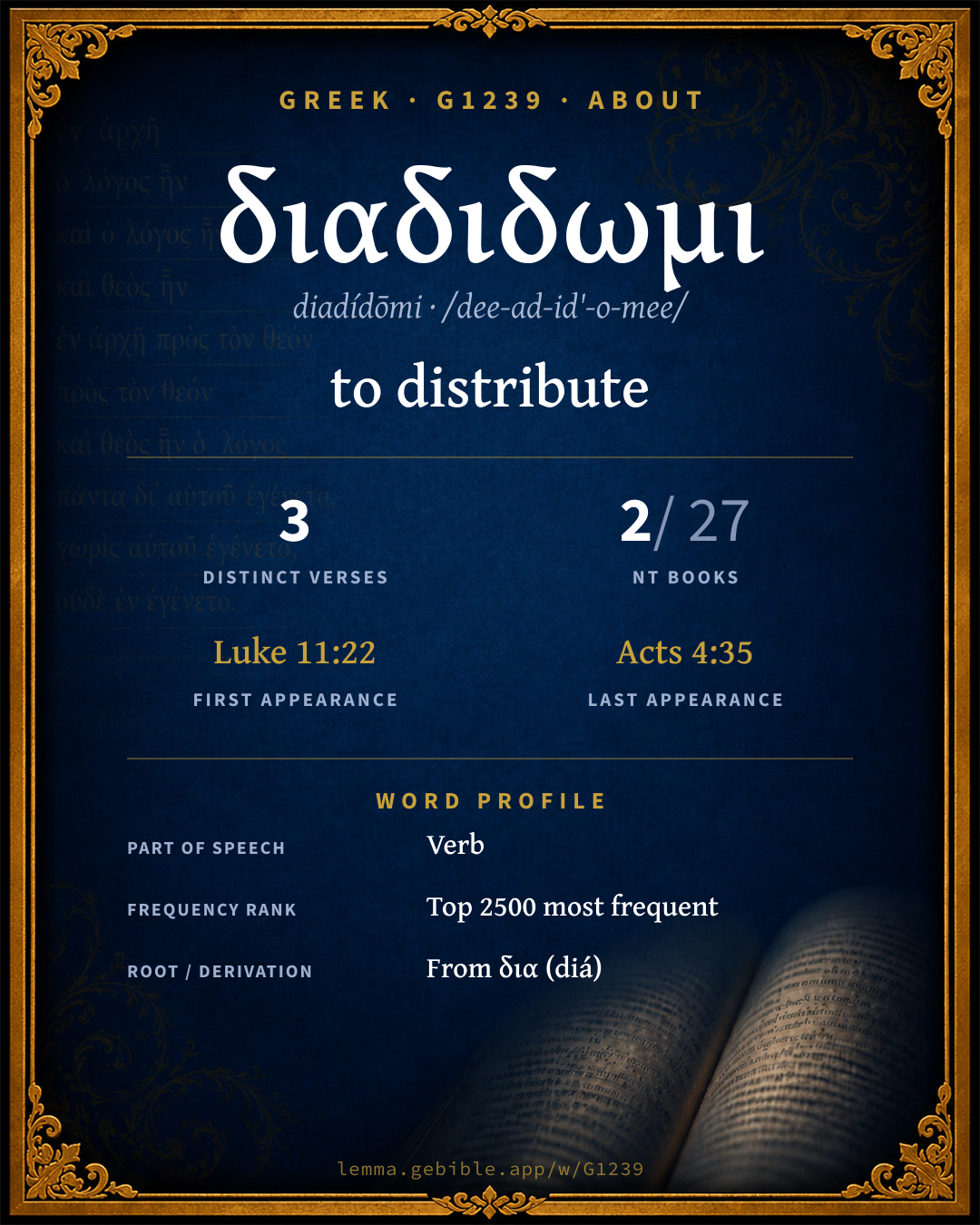
διαδίδωμι
to distribute
‘to distribute’ is one of 2 main senses fuller range ↓
Full lexicon entry — Thayer's Greek Lexicon
From Thayer's Greek Lexicon
Where this word appears
See every Aorist-tense verb in the Greek New Testament →
Grammar key — what these labels mean
Part of speech
- Verb
- An action or state-of-being word.
Tense
- Aorist
- Action viewed as a simple whole, without regard to duration — often past (perfective aspect).
- Imperfect
- Continuous or repeated action in past time (“was writing”).
- Present
- Ongoing or general action in present time (imperfective aspect).
Voice
- Active
- The subject performs the action.
- Passive
- The subject receives the action.
Mood
- Imperative
- Expresses a command or request.
- Indicative
- States a fact or asks a factual question (the mood of reality).
Person
- 2nd person
- The one addressed (“you”).
- 3rd person
- The one spoken about (“he / she / it / they”).
Number
- Singular
- One.
1 verse where G1239 appears in the Present tense in the Book of Luke. Filtered view — show all forms. Click any verse to open its interlinear word-by-word view. Verse text shown in the World English Bible for context — . Each verse’s Greek form is shown with its reference; the English is not keyword-highlighted, since the data carries no word-level English alignment. Use “Compare translations” on any verse to read it across multiple English versions. This concordance covers the Greek New Testament; Septuagint (Greek Old Testament) occurrences of this word are not indexed here.
Luke
About this entry
At a glance — auto-summarized from this page’s data, not written by a person. Every figure links to its source below. This summary describes the numbers; it doesn’t interpret them.
The Greek verb διαδιδωμι centers on the idea of “to distribute.” A scarce word — 3 verses in all of the Greek New Testament. The word gravitates to Luke (67%), then Acts. Its earliest occurrence is Luke 11:22. Thayer's distinguishes 2 senses for it. For the data behind this summary, explore the sense tree and the renderings breakdown below.
Gloss history
Strong's 1890 vs modern scholarship
About this word
Strong's G1239 catalogs a Greek word from the Greek New Testament.
These counts are not copied from any lexicon or concordance. They are computed here, from the morphology-tagged Greek New Testament. What Lemma adds →
- 3
- distinct verses
- The word appears in 3 distinct verses.
- 2 / 27
- NT books
- The word appears in 2 of 27 New Testament books.
- #2,203
- by frequency
- Top 2500 most frequent Greek words (rank 2,203 of 5,347 Greek words by occurrence).
View all 3 occurrences in the concordance →
By traditional corpus
Conventional, traditional groupings — biblical authorship is debated, so this is a traditional corpus grouping, not an authorship claim. Some books belong to more than one corpus (Luke is in both the Gospels and the Lukan corpus, and so on), so these shares overlap and need not total 100%. Each figure is a share of the word’s 3 distinct verses.
- Lukan (Luke–Acts) 3 verses · 100%
- Gospels 2 verses · 67%
How translations render this word
Counts come from each version’s own published word-to-Strong’s tagging or interlinear alignment — an approximate guide to how each version renders this word, not a word-level alignment the data otherwise carries. Because each total is that version’s own tagged count, the per-version totals vary from one another and need not match the appearance or distinct-verse counts above. These counts may also differ from a printed concordance because Lemma counts each distinctly tagged rendering and does not collapse phrase taggings into a single head-word total. This is a fixed set of word-tagged versions (KJV, ASV, BSB, ULT) and does not change with the reading translation you choose elsewhere. Each version’s license is shown beside its name below (and on Sources).
- King James Version: Distribute 1×, Distribution was made 1×, Divideth 1×
- American Standard Version: Distribute 1×, Distribution was made 1×, Divideth 1×
- Berean Standard Bible: Distributed 1×, Distribution 1×, Give 1×
- unfoldingWord Literal Text: Distribute 1×, Divide 1×, He gave them 1×
King James Version Public Domain
Renders G1239 across 5 tagged occurrences — most commonly:
American Standard Version Public Domain
Renders G1239 across 5 tagged occurrences — most commonly:
Berean Standard Bible Public Domain
Renders G1239 across 4 tagged occurrences — most commonly:
unfoldingWord Literal Text CC BY-SA 4.0
Renders G1239 across 4 tagged occurrences — most commonly:
Senses in Thayer's
The 2 senses Thayer's distinguishes for this word, in lexicon order (not ranked by frequency or importance). The full entry — with sub-senses — is in the Lexicon Entry tab.
- to distribute, divide among several
- to give over, deliver
Word origin
Derived from δια (diá) (G1223) — through.
Forms in the corpus
The 3 distinct written forms G1239 takes in the Greek New Testament, most frequent first — each parse links to that tense’s occurrences in the concordance.
| Form | Parsing | Example | Uses |
|---|---|---|---|
| διάδος diádos | Verb, Aorist, Active, Imperative, 2nd person, Singular | Luke 18:22 | 1 |
| διαδίδωσιν diadídōsin | Verb, Present, Active, Indicative, 3rd person, Singular | Luke 11:22 | 1 |
| διεδίδετο diedídeto | Verb, Imperfect, Passive, Indicative, 3rd person, Singular | Acts 4:35 | 1 |
Same root — word family
Other Thayer's entries built from the same root as G1239, grouped by Strong’s listed origin. These share a root / origin per the lexicon — not necessarily a shared meaning. Each links to that word’s own entry.
Derives from
Shares the same root
- διαβαινω diabaínō G1224 to pass through
- διαβαλλω diabállō G1225 to slander
- διαβεβαιοομαι diabebaióomai G1226 to affirm strongly
- διαβλεπω diablépō G1227 to look through
- διαγγελλω diangéllō G1229 to proclaim
- διαγινομαι diagínomai G1230 to continue
- διαγινωσκω diaginṓskō G1231 to ascertain
- διαγογγυζω diagongýzō G1234 to murmur
- διαγρηγορεω diagrēgoréō G1235 to watch through
- διαγω diágō G1236 to lead through
- διαδεχομαι diadéchomai G1237 to receive in succession
- διαδημα diádēma G1238 diadem
- διαζωννυμι diazṓnnymi G1241 to gird around
- διαιρεω diairéō G1244 to divide
- διακαθαριζω diakatharízō G1245 to cleanse thoroughly
- διακατελεγχομαι diakatelénchomai G1246 to confute
- διακουομαι diakoúomai G1251 to hear fully
- διακρινω diakrínō G1252 to distinguish
- διακωλυω diakōlýō G1254 to hinder
- διαλαλεω dialaléō G1255 to converse
- διαλεγομαι dialégomai G1256 to discuss
- διαλειπω dialeípō G1257 to intermit
- διαλλασσω diallássō G1259 to reconcile
- διαλογιζομαι dialogízomai G1260 to deliberate
+62 more words share this root (not shown).
Compare all same-root words → Showing 4 of 88 — not the complete family. They share a root, not necessarily a meaning.
Septuagint usage
The same Greek word διαδιδωμι appears 2 times in the Greek Old Testament (Septuagint), across 2 verses in 2 books.
- 2
- LXX occurrences
- Tagged occurrences of this Greek word in the Septuagint.
- 2
- verses
- Distinct Septuagint verses containing this word.
- 2 / 39
- OT books
- The word appears in 2 of the 39 Old Testament books.
Sample Septuagint occurrences
- Genesis 49:27 διαδίδωμι
- Joshua 13:6 διαδίδωμι
Septuagint occurrences (same lexeme)
Every verse where the same Strong’s number (G1239) appears in the Greek Septuagint. Verse text shown in the World English Bible for context; the Greek form is the matched word — the English is not keyword-highlighted.
- Genesis 49:27 διαδίδωμι "Benjamin is a ravenous wolf. In the morning he will devour the prey. At evening he will divide the spoil."
- Joshua 13:6 διαδίδωμι all the inhabitants of the hill-country from Lebanon to Misrephoth Maim, even all the Sidonians; them will I drive out from before the children of Israel: only allot you it to Israel for an inheritance, as I have commanded you.
These are occurrences of the same Greek lexeme (G1239) in the Septuagint — not a translation of any one Hebrew word. The store carries no word-level Hebrew↔Greek alignment, so no Hebrew original is asserted here. Counts come from the recovered LXX Strong's tagging — high-frequency vocabulary is well covered, while rare or late forms may be untagged — so they reflect tagged occurrences and may slightly undercount.