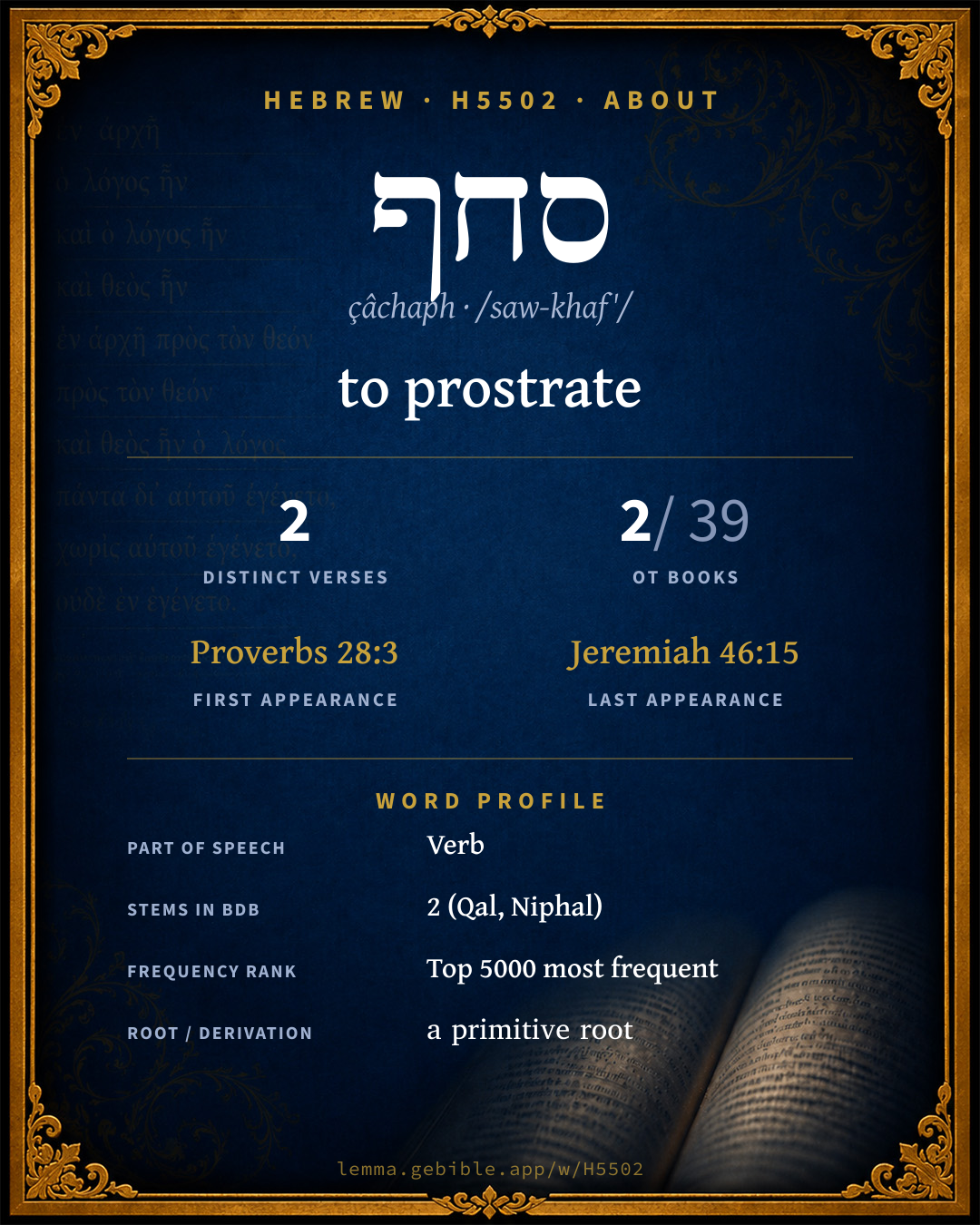
סָחַף
to prostrate
‘to prostrate’ is one of 3 main senses fuller range ↓
Full lexicon entry — Brown-Driver-Briggs (BDB)
From Brown-Driver-Briggs (BDB)
Where this word appears
See every Niphal verb in the Hebrew Bible →
Grammar key — what these labels mean
Part of speech
- Verb
- An action or state-of-being word.
Stem
- Niphal
- Usually the simple passive or reflexive of the Qal (“he was written”).
- Qal
- The basic, simple active stem — the plain form of the verb (“he wrote”).
Form
- Perfect
- A completed action or state — Hebrew marks aspect (completeness) more than strict tense (“he wrote”).
- Participle Active
- A verbal adjective expressing ongoing or characteristic action (“writing / one who writes”).
State
- Absolute
- The independent form of a noun, not bound to a following word.
Person
- 3rd Person
- The one spoken about (“he / she / it / they”).
Gender
- Masculine
- Grammatically masculine.
Number
- Singular
- One.
Grammatical forms
- Verb, Niphal, Perfect, 3rd Person, Masculine, Singular 1 time (50%)
- Verb, Qal, Participle Active, Masculine, Singular, Absolute 1 time (50%)
Parsed forms decoded from the imported morphology (morphhb / Westminster Leningrad Codex — WLC text public domain, morphhb tagging CC BY 4.0), counted across 2 parsed occurrences — not distinct verses.
Every verse where H5502 appears — 2 distinct verses across 2 books. Click any verse to open its interlinear word-by-word view. Verse text shown in the World English Bible for context — . Each verse’s Hebrew form is shown with its reference; the English is not keyword-highlighted, since the data carries no word-level English alignment. Use “Compare translations” on any verse to read it across multiple English versions. This concordance covers the Hebrew Bible; Septuagint (Greek Old Testament) occurrences are not indexed here.
Proverbs 1 verse
Jeremiah 1 verse
About this entry
At a glance — auto-summarized from this page’s data, not written by a person. Every figure links to its source below. This summary describes the numbers; it doesn’t interpret them.
סחף (çâchaph) is a Hebrew verb most often rendered “to prostrate.” It occurs a mere 2 verses across Scripture. It clusters heavily in Proverbs, which alone accounts for 50% of its uses. It first appears in Proverbs 28:3. Different stems carry different senses — BDB groups them under 2 stems, among them Qal and Niphal. The sections below give every sense, occurrence, and version rendering.
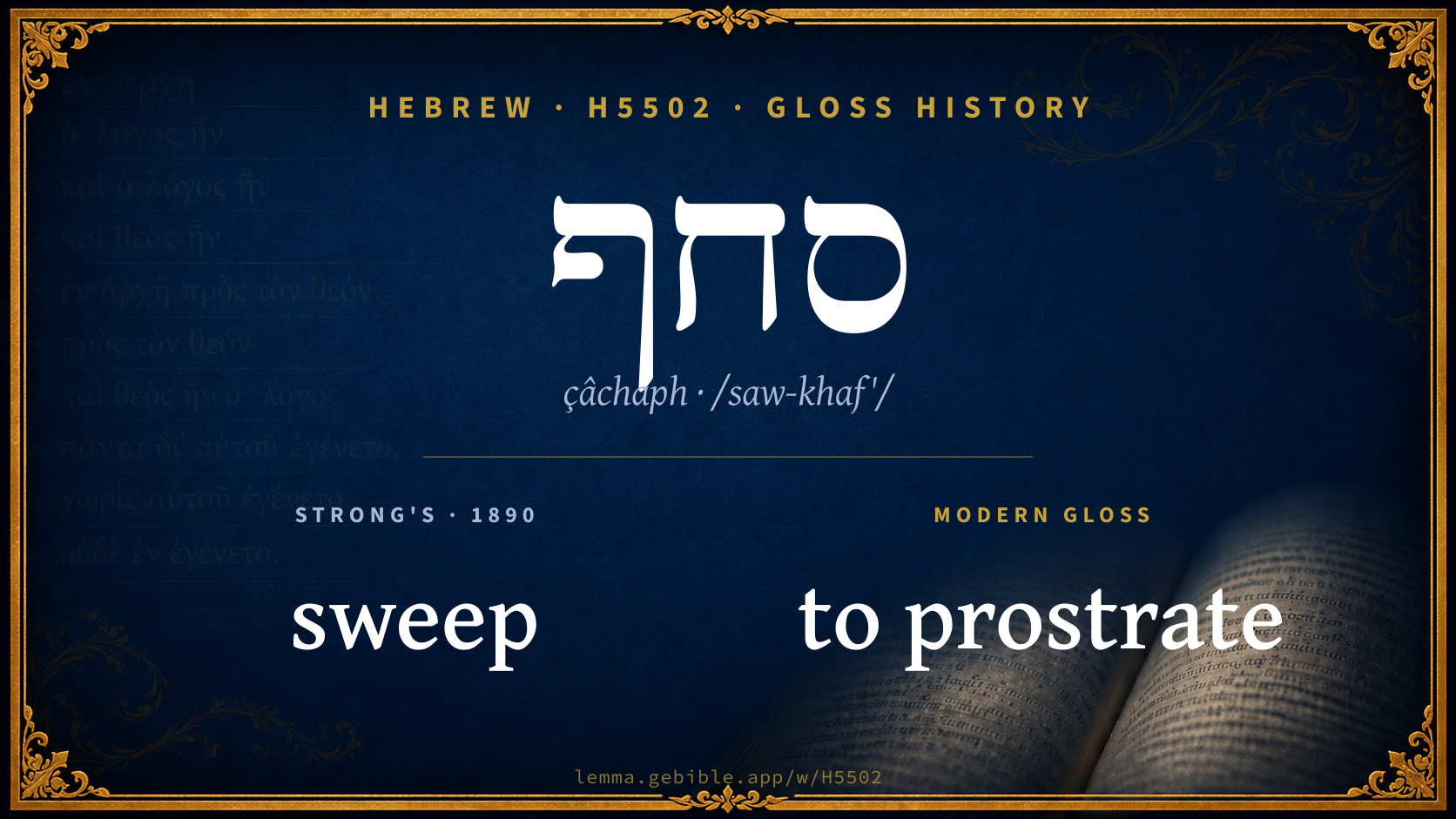
Gloss history
Strong's 1890 vs modern scholarship
About this word
Strong's H5502 catalogs a Hebrew word from the Hebrew Old Testament.
These counts are not copied from any lexicon or concordance. They are computed here, from the morphology-tagged Hebrew Old Testament. What Lemma adds →
- 2
- distinct verses
- The word appears in 2 distinct verses.
- 2 / 39
- OT books
- The word appears in 2 of 39 Old Testament books.
- #4,807
- by frequency
- Top 5000 most frequent Hebrew words (rank 4,807 of 8,640 Hebrew words by occurrence).
View all 2 occurrences in the concordance →
By traditional corpus
Conventional, traditional groupings — biblical authorship is debated, so this is a traditional corpus grouping, not an authorship claim. Each share is this word’s portion of its verses in that division of the Hebrew canon. Each figure is a share of the word’s 2 distinct verses.
- Prophets (Nevi'im) 1 verse · 50%
- Writings (Ketuvim) 1 verse · 50%
How translations render this word
Counts come from each version’s own published word-to-Strong’s tagging or interlinear alignment — an approximate guide to how each version renders this word, not a word-level alignment the data otherwise carries. Because each total is that version’s own tagged count, the per-version totals vary from one another and need not match the appearance or distinct-verse counts above. These counts may also differ from a printed concordance because Lemma counts each distinctly tagged rendering and does not collapse phrase taggings into a single head-word total. This is a fixed set of word-tagged versions (KJV, ASV, BSB, ULT) and does not change with the reading translation you choose elsewhere. Each version’s license is shown beside its name below (and on Sources).
BDB lists this Strong’s number as 3 distinct words (homographs). Each count above pools all of them and is not split by sense — see the Senses section below. A low-frequency rendering may belong to a different one of those words, not the primary meaning.
- King James Version†: Is like a sweeping 1×, Men swept away 1×
- American Standard Version†: Is like a sweeping 1×, Ones swept away 1×
- Berean Standard Bible†: Been laid low 1×, Is like a driving 1×
- unfoldingWord Literal Text†: Washes away 1×
King James Version Public Domain
Renders H5502 across 2† tagged occurrences — most commonly:
American Standard Version Public Domain
Renders H5502 across 2† tagged occurrences — most commonly:
Berean Standard Bible Public Domain
Renders H5502 across 2† tagged occurrences — most commonly:
unfoldingWord Literal Text CC BY-SA 4.0
Renders H5502 across 1† tagged occurrence — most commonly:
Senses in the full BDB
Hebrew verbs can shift meaning by stem (binyan): Qal is the basic action, Niphal is often passive or reflexive, Piel often intensifies or makes it factitive, and Hiphil is typically causative. The senses below are grouped under the stem BDB assigns to each.
What do BDB’s symbols mean?
BDB uses these scholarly abbreviations:
| Symbol | Meaning |
|---|---|
| 𝔊 | the Septuagint (the ancient Greek translation, LXX) |
| 𝔙 | the Vulgate (the Latin translation) |
| 𝔖 | the Syriac version (the Peshitta) |
| 𝔗 | the Targum (the Aramaic translation) |
| ψ | the Psalms |
| √ | root (the underlying root or stem) |
| ‖ | parallel passage (a synonymous or contrasted parallel) |
| † | the dagger: every passage where the word occurs is cited |
The 2 senses and sub-senses the full Brown-Driver-Briggs lexicon distinguishes for this word, in lexicon order (not ranked by frequency), with BDB’s own verbatim wording and sub-sense lettering. Shown in Hebrew script with BDB’s own scholarly abbreviations. The condensed entry is in the Lexicon Entry tab. See also the Forms in the corpus table below.
סחף I clean
סחף II ostrate (NH סחף, Aramaic סְחַף, ܣܚܰܦ (for ἐδαφίζω, Lk 19
Qal
- Pf. מָטָר סֹחֵף Pr 28:3 a prostrating rain (beating down grain), וְאֵין לָ֑חֶם and (so) there is no bread. e.g. Proverbs 28:3
Niphal
- Pf. 3 ms. נִסְחַף אַבִּירֶיךָ Je 46:15 why are thy mighty ones (or, why is thy bull, i.e. Apis, Hi Ew Gf) prostrated? but read perhaps נָס חָף אַבִּירְךָ לֹא עָמַד (𝔊 Mich Gie Co) why hath Apis fled, thy bull doth not stand? e.g. Jeremiah 46:15
Senses from the full Brown-Driver-Briggs lexicon (Brown, Driver, Briggs; Oxford 1906 — public domain), digitized via Sefaria, supplemented by the OpenScriptures HebrewLexicon (CC BY 4.0). Full attribution on Sources.
Word origin
II. adj. clean—only זַךְ אֲנִי בְּלִי֫ פָ֥שַׁע חַף אָנֹכִ֑י Jb 33:9 I am pure, without transgression, I am clean (in speech of Elihu).
I. vb. prostrate (NH סחף, Aramaic סְחַף, ܣܚܰܦ (for ἐδαφίζω, Lk 19:44); Assyrian saḫâpu, throw down, overwhelm);—
— Brown-Driver-Briggs (Oxford 1906, public domain), digitized via Sefaria, supplemented by the OpenScriptures HebrewLexicon (CC BY 4.0). See Sources.
Origin: a primitive root
Jastrow Dictionary
A second Hebrew/Aramaic lexicon for comparison, covering Aramaic and post-biblical (Talmudic, Targumic, Midrashic) usage that the biblical-Hebrew BDB does not. Matched by lemma rather than by Strong’s number, so a lemma may carry more than one Jastrow headword (shown separately below), and the entries cover usage well beyond the Bible.
סָחַף
- to rub, sweep. Pirké d’R. El. ch. XIV בעצבון … סוֹחֵף במעיו על הארץ in the pain of its growth, it (the serpent) shall sweep along (drag itself) with its belly on the ground.—Part. pass. סָחוּף, pl. סְחוּפִים, סְחוּפִין swept away, driven about. Tanḥ. P’kudé 3 like a dog שהוא ס׳ וכ׳ (some ed. חשוף, חצוף) that is pushed this way and that way. Yeb. 47ᵃ דוויים דחופים ס׳ ומטורפין broken down, pushed about, swept (from place to place) and tossed about; [Rashi: covered in mourning, v. חָפָה a. חָפַף I]. Yalk. Ps. 735, v. סָכַף.
- to be swept, be inundated, ruined by a flood. Keth. I, 6 (12ᵇ) נִסְתַּחֲפָה שדך (Y. a. Bab. ed. שדהו, euphemism) thy field has been ruined, i.e. it is thy misfortune, and I cannot be made to suffer for it. Ib. 2ᵃ נ׳ שדהו it is thy misfortune (that I was taken sick). Ib. VII, 8 האב … ונ׳ שדהו the father has to bring evidence that these blemishes arose while she was betrothed and therefore it was his (the husband’s) misfortune; a. e.
- to be swept away, struck down; (homilet. = נספח) to be smitten with leprosy (v. סַפַּחַת). Tanḥ. Thazr. 11; Yalk. Kings 229; Yalk. Zech. 586 (interpret. נסחף, Jer. XLVI, 15); Yalk. Lev. 555. e.g. Jeremiah 46:15
סְחַף I
- , to sweep away; to reject, despise. Targ. Prov. III, 34. Ib. X, 3 (h. text הדף).—Part. pass. סְחִיף hurried. Targ. Esth. VIII, 14 (h. text דחוף).
- to be swept away;to be inundated, ruined. Targ. Prov. XIV, 32 (h. text ידחה). Targ. Y. I Gen. XLIX, 4.
סְחַף II
- (v. חפף I) to put on as a cover; to tilt over, invert. Snh. 104ᵃ אוכלא (אובלא) … ס׳ ארישיה he inverted a fuller’s trough over his head. Ned. 51ᵃ וסַחְפֵּיה על רישיה and tilted it over &c. Sabb. 110ᵃ ולִיסְחוֹף דיקולא ארישיה (Ms. M. incorr. וליחסוף) and let him put a basket over his head. Ib. 121ᵇ. Ḥull. 8ᵇ לא ליס׳ … כפלי וכ׳ one must not cover up meat with groins; a. e.—Part. pass. סְחִיף; f. סְחִיפָא. Ab. Zar. 51ᵇ, v. מְשִׁיכְלָא. Ḥag, 15ᵃ כתרי כסי דסְחִיפֵי אהדדי (Rashi דסחופין, read: דסחי׳) like two cups inverted one over the other.—V. סְחִיפָא.
A Dictionary of the Targumim, the Talmud Babli and Yerushalmi, and the Midrashic Literature (Marcus Jastrow; London, Luzac, 1903) — Public Domain. Digitized via Sefaria. Digitized via Sefaria. Full attribution on Sources.
Forms in the corpus
The 2 distinct written forms H5502 takes in the Hebrew Bible, most frequent first — each parse links to that stem’s occurrences in the concordance. Hebrew forms include their vowel points and cantillation, so a single lemma takes many written forms.
| Form | Parsing | Example | Uses |
|---|---|---|---|
| נִסְחַ֣ף | Verb, Niphal, Perfect, 3rd Person, Masculine, Singular | Jeremiah 46:15 | 1 |
| סֹ֝חֵ֗ף | Verb, Qal, Participle Active, Masculine, Singular, Absolute | Proverbs 28:3 | 1 |
Septuagint verse parallels
This word appears in 1 verse that also exists in the Greek Old Testament (Septuagint), out of the 2 Hebrew verses it occurs in. You can read those verses in Greek by switching the Old Testament edition to the Septuagint.
Read these verses in the Septuagint
This is a verse-level parallel only — the same verses exist in both the Hebrew and Greek Old Testaments. No word-level Hebrew↔Greek correspondence is claimed: the data carries no such alignment, so no Greek word is shown as this Hebrew word’s translation. Coverage is not total — the Septuagint omits the deuterocanon and renumbers the Psalms, so some Hebrew verses have no direct Greek parallel.