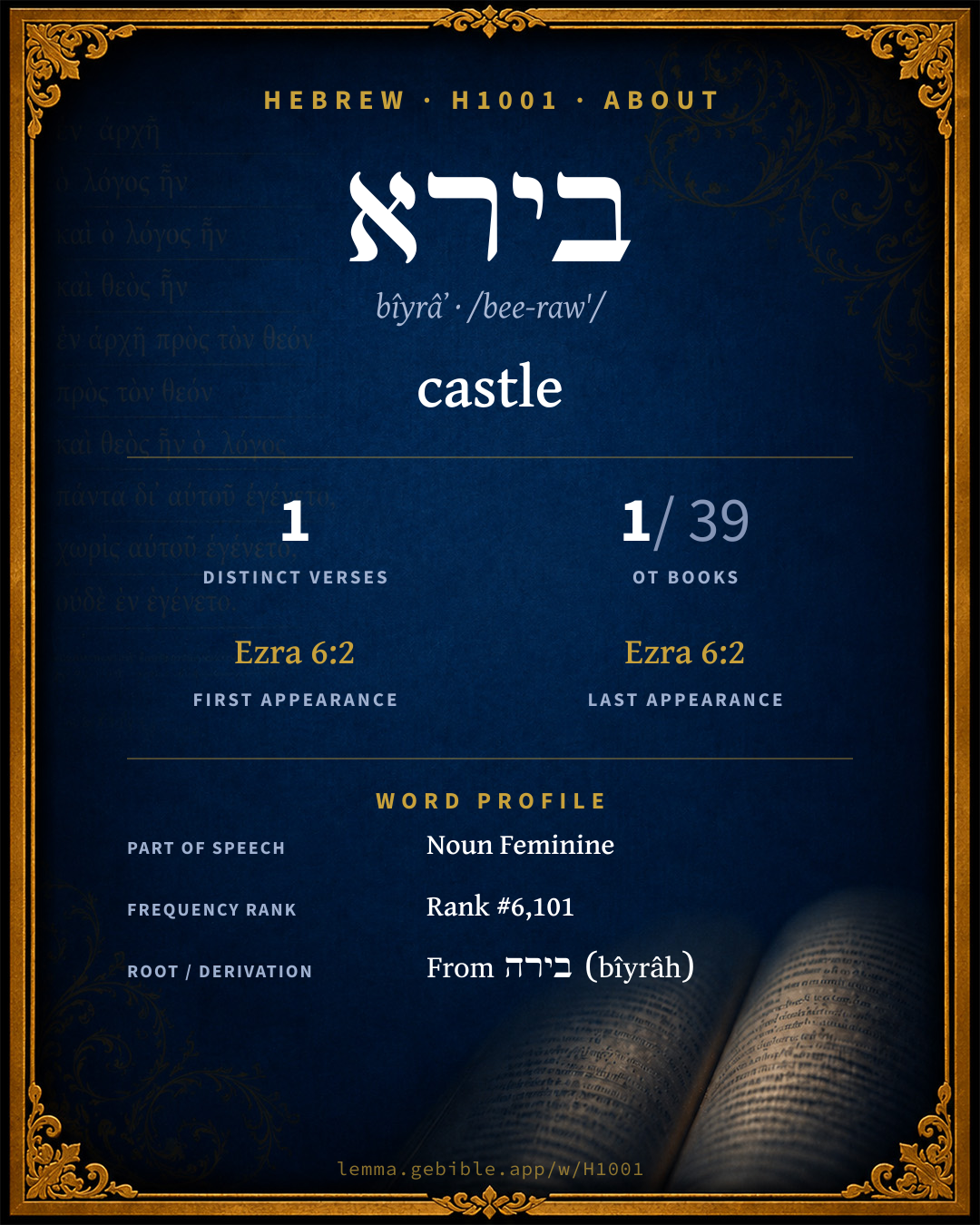
בִּירְתָא
castle
Full lexicon entry — Brown-Driver-Briggs (BDB)
From Brown-Driver-Briggs (BDB)
Where this word appears
Every verse where H1001 appears — 1 distinct verse across 1 book. Click any verse to open its interlinear word-by-word view. Verse text shown in the World English Bible for context — . Each verse’s Hebrew form is shown with its reference; the English is not keyword-highlighted, since the data carries no word-level English alignment. Use “Compare translations” on any verse to read it across multiple English versions. This concordance covers the Hebrew Bible; Septuagint (Greek Old Testament) occurrences are not indexed here.
Ezra 1 verse
About this entry
At a glance — auto-summarized from this page’s data, not written by a person. Every figure links to its source below. This summary describes the numbers; it doesn’t interpret them.
בירא — transliterated bîyrâʼ — is a Hebrew noun carrying the sense “castle.” It is rare — just 1 verse in the entire Hebrew Bible. More than three-quarters of its appearances fall in Ezra. Its lone occurrence is Ezra 6:2. Related forms include בירה and בירנית. See the sense tree, 1-verse concordance, and the renderings breakdown below.
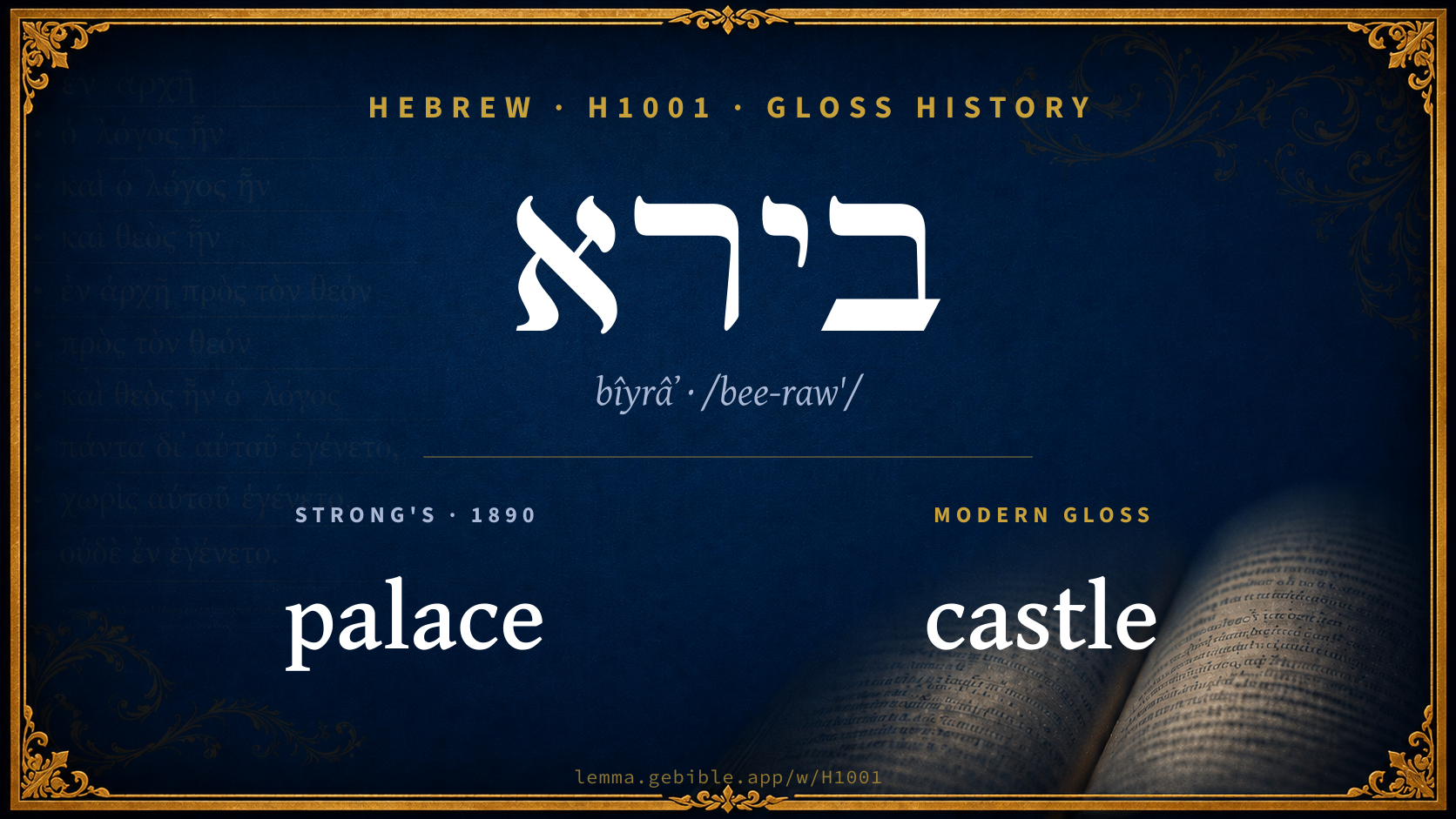
Gloss history
Strong's 1890 vs modern scholarship
About this word
Strong's H1001 catalogs a Hebrew word from the Hebrew Old Testament.
These counts are not copied from any lexicon or concordance. They are computed here, from the morphology-tagged Hebrew Old Testament. What Lemma adds →
- 1
- distinct verses
- The word appears in 1 distinct verse.
- 1 / 39
- OT books
- The word appears in 1 of 39 Old Testament books.
- #6,101
- by frequency
- Rank #6,101 (rank 6,101 of 8,640 Hebrew words by occurrence).
View all 1 occurrence in the concordance →
Most concentrated in
- Ezra 1 verse 100%
By section of the Old Testament
By traditional corpus
Conventional, traditional groupings — biblical authorship is debated, so this is a traditional corpus grouping, not an authorship claim. Each share is this word’s portion of its verses in that division of the Hebrew canon. Each figure is a share of the word’s 1 distinct verse.
- Writings (Ketuvim) 1 verse · 100%
How translations render this word
Counts come from each version’s own published word-to-Strong’s tagging or interlinear alignment — an approximate guide to how each version renders this word, not a word-level alignment the data otherwise carries. Because each total is that version’s own tagged count, the per-version totals vary from one another and need not match the appearance or distinct-verse counts above. These counts may also differ from a printed concordance because Lemma counts each distinctly tagged rendering and does not collapse phrase taggings into a single head-word total. This is a fixed set of word-tagged versions (KJV, ASV, BSB, ULT) and does not change with the reading translation you choose elsewhere. Each version’s license is shown beside its name below (and on Sources).
- King James Version: Palace 1×
- American Standard Version: Palace 1×
- Berean Standard Bible: Fortress 1×
- unfoldingWord Literal Text: Fortress 1×
King James Version Public Domain
Renders H1001 across 1 tagged occurrence — most commonly:
American Standard Version Public Domain
Renders H1001 across 1 tagged occurrence — most commonly:
Berean Standard Bible Public Domain
Renders H1001 across 1 tagged occurrence — most commonly:
unfoldingWord Literal Text CC BY-SA 4.0
Renders H1001 across 1 tagged occurrence — most commonly:
Senses in BDB
The 1 sense BDB distinguishes for this word, in lexicon order (not ranked by frequency or importance). The full entry — with sub-senses — is in the Lexicon Entry tab.
- castle, citadel, palace
Word origin
בִּירְתָא n.f. emph. castle;— Ezr 6:2.
— Brown-Driver-Briggs (Oxford 1906, public domain), digitized via Sefaria, supplemented by the OpenScriptures HebrewLexicon (CC BY 4.0). See Sources.
Derived from בירה (bîyrâh) (H1002) — palace.
Jastrow Dictionary
A second Hebrew/Aramaic lexicon for comparison, covering Aramaic and post-biblical (Talmudic, Targumic, Midrashic) usage that the biblical-Hebrew BDB does not. Matched by lemma rather than by Strong’s number, so a lemma may carry more than one Jastrow headword (shown separately below), and the entries cover usage well beyond the Bible.
יָרֵא
- (b. h.) to tremble, fear; to revere; to shun. Sabb. 88ᵃ (ref. to Ps. LXXVI, 9) אם יָרְאָה וכ׳ if she (the earth) trembled, how could she be at rest, &c.?—Ber. 16ᵇ ליִרְאָה את שמך so as to fear thy name.—(Usu. as participle or adjective) יָרֵא m. Ned. 8ᵇ (ref. to Mal. III, 20) אלו … שהן יְרֵאִין להוציא וכ׳ who are afraid to utter the name of the Lord in vain.—יְרֵא חֵטא shunning sin, of careful conduct, conscientious. Ab. II, 5. Ib. 8; a. fr.—יְרֵא שָׁמַיִם God-fearing, pious. Ber. 8ᵃ גדול … יותר מי׳ ש׳ he who lives on the (honest) labor of his hand, stands higher than the pious man. Succ. 49ᵇ, v. יָרַע; a. fr.—Fem. יְרֵאָה, constr. יְרֵאַת. Lam. R. to II, 13 (play on י̇ר̇ושׁל̇ם̇) הבת שי̇ר̇אה ומשׁול̇מ̇ת לי the daughter that fears (me) and is at peace with me. Ib. כשאת יְרֵיאָה את מושלמת לי Ar. (missing in ed.) when thou art God-fearing, thou art at peace with me. Yeb. 62ᵇ.—Part. pass. יָראוּי. Ber. 33ᵇ; Meg. 25ᵃ Ms. M. (v. Rabb. D. S. a. l. note). e.g. Psalms 76:9
- , fut. יִוָּרֵא to be feared. Koh. R. to IX, 7; Pesik. Ul’kaḥ., p. 183ᵇ, a. e. למען תִּוָּרֵא וכ׳ (Ps. CXXX, 4) ‘in order that thou mayest be feared’, that the fear of thee be put on mankind.—Part. נוֹרָא fearful, awe-inspiring. Ber. l. c. Yoma 69ᵇ לא אמר נ׳ Jeremiah did not say nora (only gadol a. gibbor, Jer. XXXII, 18).—Fem. pl. ניֹרָאוֹת awe-inspiring deeds. Ib. אתא … נכרים … איה נוֹרְאוֹתָיו came Jeremiah and said, Strangers dance on His temple ruins, where are His awful deeds?; Y. Ber. VII, 11ᶜ. Ib. לזה נאה לקרות נורא בנ׳ וכ׳ (Daniel said) Him it is becoming to call awe-inspiring for the awful deeds He performed for us &c.; Midr. Till. to Ps. XIX; a. fr. e.g. Psalms 130:4
- , Nithpa. נִתְיָירֵא
- 1. to be feared, revered. Zeb. 115ᵇ (ref. to Ps. LXVIII, 36) בשעה … מִתְיָירֵא ומתעלה וכ׳ when the Lord executes judgment on His saints, He is feared and praised &c.; Yalk. Lev. 525. e.g. Psalms 68:36
- 2. to be afraid. Ber. 61ᵇ אי אתה מתי׳ מפני וכ׳ art thou not afraid of the (Roman) government?—Midr. Till. l. c. שנכנסו … וכא נִתְיָירְאוּ the enemy entered His house and were not afraid (of the Lord). Ex. R. s. 29 אם המטרונה מִתְיָירֵאת וכ׳ if the queen is afraid, what shall the servants … do?; a. fr.
A Dictionary of the Targumim, the Talmud Babli and Yerushalmi, and the Midrashic Literature (Marcus Jastrow; London, Luzac, 1903) — Public Domain. Digitized via Sefaria. Digitized via Sefaria. Full attribution on Sources.
Same root — word family
Other BDB entries built from the same root as H1001, grouped by Strong’s listed origin. These share a root / origin per the lexicon — not necessarily a shared meaning. Each links to that word’s own entry.
Derives from
Shares the same root
Compare all same-root words → They share a root, not necessarily a meaning.
Septuagint verse parallels
This word appears in 1 verse that also exists in the Greek Old Testament (Septuagint), out of the 1 Hebrew verse it occurs in. You can read those verses in Greek by switching the Old Testament edition to the Septuagint.
Read these verses in the Septuagint
This is a verse-level parallel only — the same verses exist in both the Hebrew and Greek Old Testaments. No word-level Hebrew↔Greek correspondence is claimed: the data carries no such alignment, so no Greek word is shown as this Hebrew word’s translation. Coverage is not total — the Septuagint omits the deuterocanon and renumbers the Psalms, so some Hebrew verses have no direct Greek parallel.