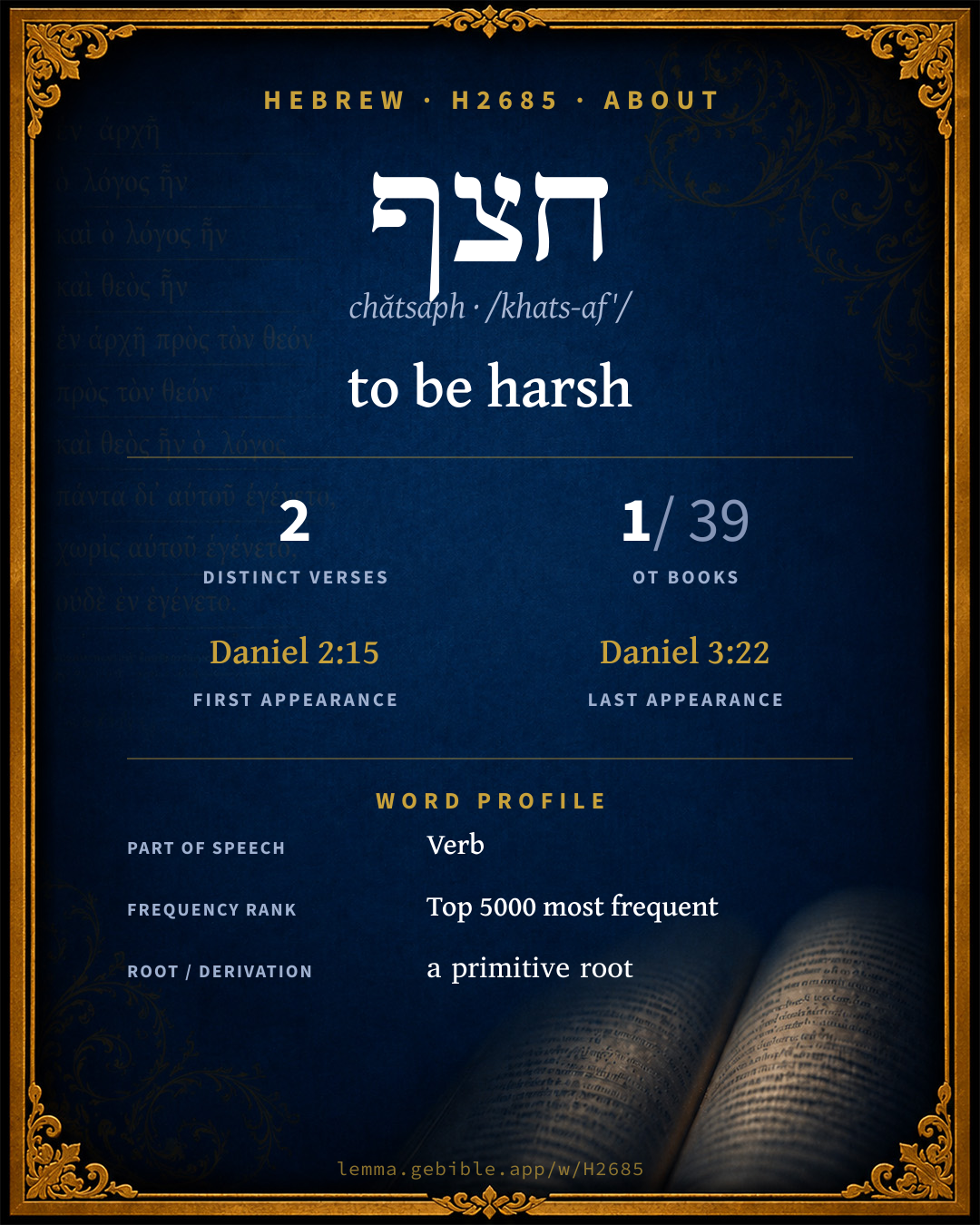
חֲצַף
to be harsh
Full lexicon entry — Brown-Driver-Briggs (BDB)
From Brown-Driver-Briggs (BDB)
Where this word appears
Grammar key — what these labels mean
Part of speech
- Verb
- An action or state-of-being word.
Stem
- Hiphil
- The causative active stem (“he caused / brought about”).
Form
- Participle Active
- A verbal adjective expressing ongoing or characteristic action (“writing / one who writes”).
State
- Absolute
- The independent form of a noun, not bound to a following word.
Gender
- Feminine
- Grammatically feminine.
Number
- Singular
- One.
Grammatical forms
- Verb, a, Participle Active, Feminine, Singular, Absolute 1 time (50%)
- Verb, Hiphil, Participle Active, Feminine, Singular, Absolute 1 time (50%)
Parsed forms decoded from the imported morphology (morphhb / Westminster Leningrad Codex — WLC text public domain, morphhb tagging CC BY 4.0), counted across 2 parsed occurrences — not distinct verses.
Every verse where H2685 appears — 2 distinct verses across 1 book. Click any verse to open its interlinear word-by-word view. Verse text shown in the World English Bible for context — . Each verse’s Hebrew form is shown with its reference; the English is not keyword-highlighted, since the data carries no word-level English alignment. Use “Compare translations” on any verse to read it across multiple English versions. This concordance covers the Hebrew Bible; Septuagint (Greek Old Testament) occurrences are not indexed here.
Daniel 2 verses
- Daniel 2:15 מְהַחְצְפָ֖ה Hiphil ptcp.act fs he answered Arioch the king's captain, Why is the decree so urgent from the king? Then Arioch made the thing known to Daniel.
- Daniel 3:22 מַחְצְפָ֔ה a ptcp.act fs Therefore because the king's commandment was urgent, and the furnace exceeding hot, the flame of the fire killed those men who took up Shadrach, Meshach, and Abednego.
About this entry
At a glance — auto-summarized from this page’s data, not written by a person. Every figure links to its source below. This summary describes the numbers; it doesn’t interpret them.
“to be harsh” is the headline sense of the Hebrew verb חצף (chătsaph). It is rare — just 2 verses in the entire Hebrew Bible. More than three-quarters of its appearances fall in Daniel. Its earliest occurrence is Daniel 2:15. The sections below give every sense, occurrence, and version rendering.
Gloss history
Strong's 1890 vs modern scholarship

About this word
Strong's H2685 catalogs a Hebrew word from the Hebrew Old Testament.
These counts are not copied from any lexicon or concordance. They are computed here, from the morphology-tagged Hebrew Old Testament. What Lemma adds →
- 2
- distinct verses
- The word appears in 2 distinct verses.
- 1 / 39
- OT books
- The word appears in 1 of 39 Old Testament books.
- #4,807
- by frequency
- Top 5000 most frequent Hebrew words (rank 4,807 of 8,640 Hebrew words by occurrence).
View all 2 occurrences in the concordance →
Most concentrated in
- Daniel 2 verses 100%
By section of the Old Testament
By traditional corpus
Conventional, traditional groupings — biblical authorship is debated, so this is a traditional corpus grouping, not an authorship claim. Each share is this word’s portion of its verses in that division of the Hebrew canon. Each figure is a share of the word’s 2 distinct verses.
- Writings (Ketuvim) 2 verses · 100%
How translations render this word
Counts come from each version’s own published word-to-Strong’s tagging or interlinear alignment — an approximate guide to how each version renders this word, not a word-level alignment the data otherwise carries. Because each total is that version’s own tagged count, the per-version totals vary from one another and need not match the appearance or distinct-verse counts above. These counts may also differ from a printed concordance because Lemma counts each distinctly tagged rendering and does not collapse phrase taggings into a single head-word total. This is a fixed set of word-tagged versions (KJV, ASV, BSB, ULT) and does not change with the reading translation you choose elsewhere. Each version’s license is shown beside its name below (and on Sources).
- King James Version: Hasty 1×, Was urgent 1×
- American Standard Version: Urgent 1×, Was urgent 1×
- Berean Standard Bible: Harsh 1×, Was so urgent 1×
- unfoldingWord Literal Text: Is 1×, Urgent 1×, Was urgent 1×
King James Version Public Domain
Renders H2685 across 2 tagged occurrences — most commonly:
American Standard Version Public Domain
Renders H2685 across 2 tagged occurrences — most commonly:
Berean Standard Bible Public Domain
Renders H2685 across 2 tagged occurrences — most commonly:
unfoldingWord Literal Text CC BY-SA 4.0
Renders H2685 across 3 tagged occurrences — most commonly:
Senses in BDB
The 1 sense BDB distinguishes for this word, in lexicon order (not ranked by frequency or importance). The full entry — with sub-senses — is in the Lexicon Entry tab.
- (Aphel) to be urgent, harsh, show insolence
Word origin
[ חֲצַף ] vb. Haph. shew insolence, harshness
— Brown-Driver-Briggs (Oxford 1906, public domain), digitized via Sefaria, supplemented by the OpenScriptures HebrewLexicon (CC BY 4.0). See Sources.
Origin: a primitive root
Jastrow Dictionary
A second Hebrew/Aramaic lexicon for comparison, covering Aramaic and post-biblical (Talmudic, Targumic, Midrashic) usage that the biblical-Hebrew BDB does not. Matched by lemma rather than by Strong’s number, so a lemma may carry more than one Jastrow headword (shown separately below), and the entries cover usage well beyond the Bible.
חָצַף
- (cmp. חָסַף a. P. Sm. 1353 חצפא = ch. חספא) to peel off, bare; part. pass. חָצוּף (sub. אפיים); f. חֲצוּפָה
- 1. barefaced, impudent, arrogant. Snh. 3ᵃ ב"ד ח׳ an arrogant court (two sitting in judgment instead of three). Y. Taan. III, 66ᵈ top אחת ח׳ ואחת כשירה one was unabashed, the other chaste. Ned. 20ᵇ; a. e.
- 2. undaunted, energetic, strong. Tanḥ. Vayera 23 הנפש ח׳ היא the instinct of life is strong. Ex. R. s. 42 ג׳ חֲצוּפִים הם ח׳ בחיה וכ׳ (Bets. 25ᵇ עז) three (creatures) are persevering (undaunted by failure or opposition), among beasts it is the dog &c. Y. Taan. IV, 69ᵇ מה חציפה וכ׳ (read: חצו׳) how irrepressible is the Land of Israel that it still is productive (after all devastations).—Pl. חֲצוּפִים, f. חֲצוּפוֹת. Ex. R. l. c., v. supra.—Y. Ber. V, 8ᵈ bot. שעות הח׳ וכ׳ those irresistible, hard and evil times.
- to bare (one’s face), to act irreverently. Koh. R. to IX, 18 כל המַחֲצִיף פניו וכ׳ whoever speaks irreverently of &c. Ib. III, 9 מַחֲצִיפִין אתם you embolden yourselves.
חֲצַף
- part. pass. חָצִיף q. v.
- as preced. Hif. Targ. Prov. VII, 13. Ib. XXI, 29. Targ. Ez. XIII, 6 מַחְצְפִין וכ׳ (Var. מְחַצְּפִין) they boldly insist upon it &c. [Dan. II, 15; III, 22 part. pass. insisted upon, urgent.] e.g. Daniel 2:15
A Dictionary of the Targumim, the Talmud Babli and Yerushalmi, and the Midrashic Literature (Marcus Jastrow; London, Luzac, 1903) — Public Domain. Digitized via Sefaria. Digitized via Sefaria. Full attribution on Sources.
Forms in the corpus
The 2 distinct written forms H2685 takes in the Hebrew Bible, most frequent first — each parse links to that stem’s occurrences in the concordance. Hebrew forms include their vowel points and cantillation, so a single lemma takes many written forms.
| Form | Parsing | Example | Uses |
|---|---|---|---|
| מְהַחְצְפָ֖ה | Verb, Hiphil, Participle Active, Feminine, Singular, Absolute | Daniel 2:15 | 1 |
| מַחְצְפָ֔ה | Verb, a, Participle Active, Feminine, Singular, Absolute | Daniel 3:22 | 1 |
Septuagint verse parallels
This word appears in 2 verses that also exist in the Greek Old Testament (Septuagint), out of the 2 Hebrew verses it occurs in. You can read those verses in Greek by switching the Old Testament edition to the Septuagint.
Read these verses in the Septuagint
This is a verse-level parallel only — the same verses exist in both the Hebrew and Greek Old Testaments. No word-level Hebrew↔Greek correspondence is claimed: the data carries no such alignment, so no Greek word is shown as this Hebrew word’s translation. Coverage is not total — the Septuagint omits the deuterocanon and renumbers the Psalms, so some Hebrew verses have no direct Greek parallel.