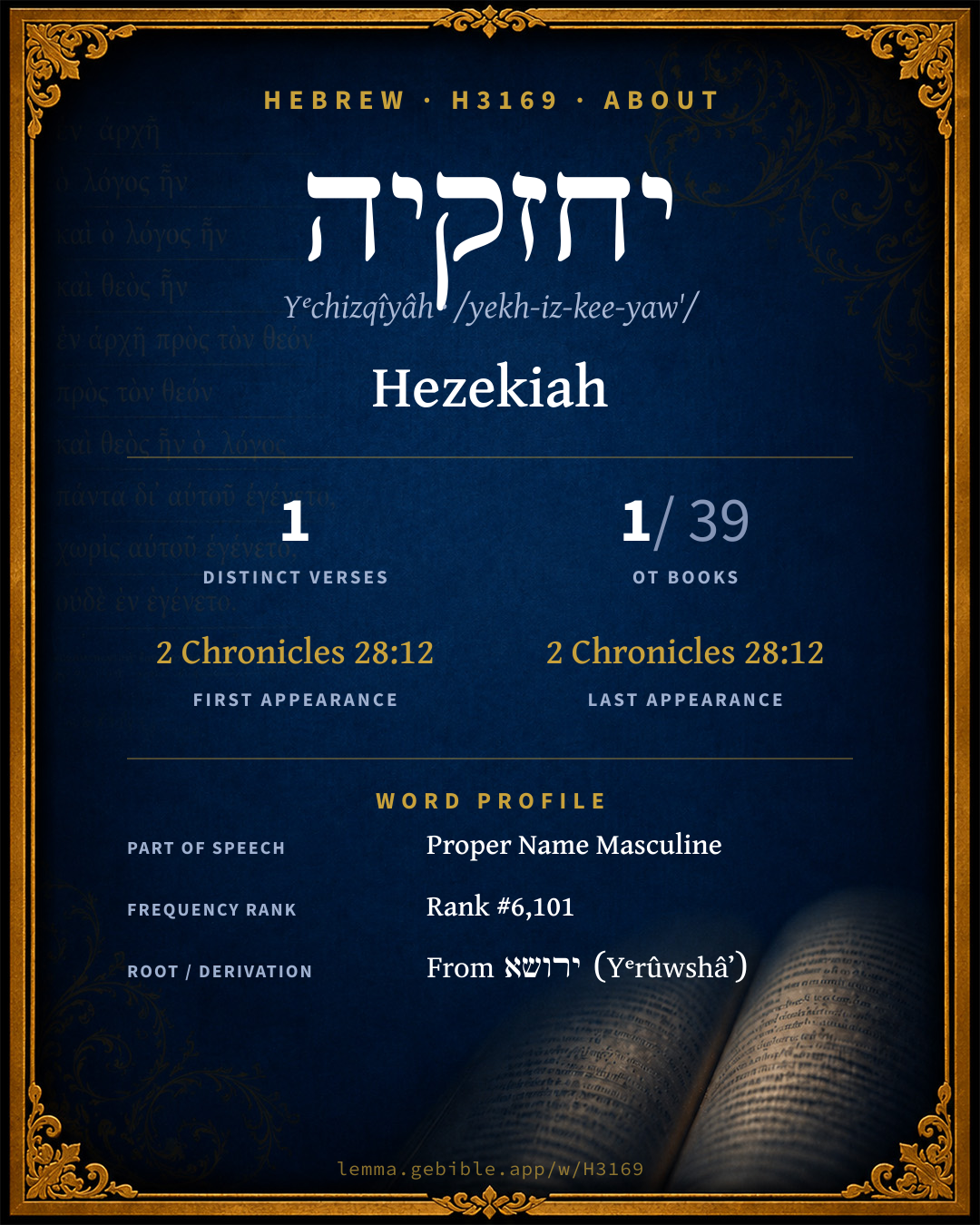
יְחִזְקִיָּה
Hezekiah
BDB lists 4 entries for ‘Hezekiah’ fuller range ↓
Full lexicon entry — Brown-Driver-Briggs (BDB)
From Brown-Driver-Briggs (BDB)
Where this word appears
Grammar key — what these labels mean
Noun type
- Proper
- A name of a specific person, place, or people (e.g. Abraham, Zion, Israel).
Every verse where H3169 appears — 1 distinct verse across 1 book. Click any verse to open its interlinear word-by-word view. Verse text shown in the World English Bible for context — . Each verse’s Hebrew form is shown with its reference; the English is not keyword-highlighted, since the data carries no word-level English alignment. Use “Compare translations” on any verse to read it across multiple English versions. This concordance covers the Hebrew Bible; Septuagint (Greek Old Testament) occurrences are not indexed here.
2 Chronicles 1 verse
About this entry
At a glance — auto-summarized from this page’s data, not written by a person. Every figure links to its source below. This summary describes the numbers; it doesn’t interpret them.
At its core, יחזקיה (Yᵉchizqîyâh) means “Hezekiah.” With only 1 verse it sits in the long tail of Hebrew Bible vocabulary. Its uses cluster heavily in 2 Chronicles (100% of all occurrences). Its lone occurrence is 2 Chronicles 28:12. Each statement above links to its evidence; the full detail follows below.
Gloss history
Strong's 1890 vs modern scholarship
About this word
Strong's H3169 catalogs a Hebrew word from the Hebrew Old Testament.
These counts are not copied from any lexicon or concordance. They are computed here, from the morphology-tagged Hebrew Old Testament. What Lemma adds →
- 1
- distinct verses
- The word appears in 1 distinct verse.
- 1 / 39
- OT books
- The word appears in 1 of 39 Old Testament books.
- #6,101
- by frequency
- Rank #6,101 (rank 6,101 of 8,640 Hebrew words by occurrence).
View all 1 occurrence in the concordance →
Most concentrated in
- 2 Chronicles 1 verse 100%
By section of the Old Testament
By traditional corpus
Conventional, traditional groupings — biblical authorship is debated, so this is a traditional corpus grouping, not an authorship claim. Each share is this word’s portion of its verses in that division of the Hebrew canon. Each figure is a share of the word’s 1 distinct verse.
- Writings (Ketuvim) 1 verse · 100%
How translations render this word
Counts come from each version’s own published word-to-Strong’s tagging or interlinear alignment — an approximate guide to how each version renders this word, not a word-level alignment the data otherwise carries. Because each total is that version’s own tagged count, the per-version totals vary from one another and need not match the appearance or distinct-verse counts above. These counts may also differ from a printed concordance because Lemma counts each distinctly tagged rendering and does not collapse phrase taggings into a single head-word total. This is a fixed set of word-tagged versions (KJV, ASV, BSB, ULT) and does not change with the reading translation you choose elsewhere. Each version’s license is shown beside its name below (and on Sources).
BDB lists this Strong’s number as 2 distinct words (homographs). Each count above pools all of them and is not split by sense — see the Senses section below. A low-frequency rendering may belong to a different one of those words, not the primary meaning.
- King James Version†: Hezekiah 37×
- American Standard Version†: Hezekiah 36×
- Berean Standard Bible†: Hezekiah 2×
- unfoldingWord Literal Text†: Jehizkiah 1×
King James Version Public Domain
Renders H3169 across 44† tagged occurrences — most commonly:
Plus 7 renderings that appear only once — usually multi-word phrases or single function words the recovered tagging swept in, not distinct renderings.
American Standard Version Public Domain
Renders H3169 across 44† tagged occurrences — most commonly:
Plus 8 renderings that appear only once — usually multi-word phrases or single function words the recovered tagging swept in, not distinct renderings.
Berean Standard Bible Public Domain
Renders H3169 across 4† tagged occurrences — most commonly:
Plus 2 renderings that appear only once — usually multi-word phrases or single function words the recovered tagging swept in, not distinct renderings.
unfoldingWord Literal Text CC BY-SA 4.0
Renders H3169 across 1† tagged occurrence — most commonly:
Senses in the full BDB
What do BDB’s symbols mean?
BDB uses these scholarly abbreviations:
| Symbol | Meaning |
|---|---|
| 𝔊 | the Septuagint (the ancient Greek translation, LXX) |
| 𝔙 | the Vulgate (the Latin translation) |
| 𝔖 | the Syriac version (the Peshitta) |
| 𝔗 | the Targum (the Aramaic translation) |
| ψ | the Psalms |
| √ | root (the underlying root or stem) |
| ‖ | parallel passage (a synonymous or contrasted parallel) |
| † | the dagger: every passage where the word occurs is cited |
The 5 senses and sub-senses the full Brown-Driver-Briggs lexicon distinguishes for this word, in lexicon order (not ranked by frequency), with BDB’s own verbatim wording and sub-sense lettering. Shown in Hebrew script with BDB’s own scholarly abbreviations. The condensed entry is in the Lexicon Entry tab.
יחזקיה I m. (י׳ hath strengthened, י׳ strengtheneth
- 1. 𝔊 Εζεκιας, son of Ahaz, King of Judah, seldom †חִזְקִיָּה 2 K 18:1, 10, 14(×2), 15, 16(×2), also אַנְשֵׁי ח׳ Pr 25:1 †; elsewhere in 2 K (except 20:10) חִזְקִיָּהוּ: 16:20; 18:9 + 34 times, 2 K 18–21 ‖ Is 36:1 + 31 times, Is 36–39; also †Je 26:18, 19 1 Ch 3:13 2 Ch 29:18, 27; 30:24; 32:15; in Ch usually יְחִזְקִיָּהוּ 1 Ch 4:41 2 Ch 28:27 + 35 times 2 Ch 29–33; also 2 K 20:10 Je 15:4, and in title Is 1:1; †יִחִזְקִיָּה Ho 1:1 Mi 1:1 †(if י in these three be not textual error for וְ). e.g. 2 Kings 18:1
- 2. חִזְקִיָּה great-great-grandfather of proph. Zephaniah Zp 1:1, 𝔊 τοῦ Εζεκιου, perhaps = 1. e.g. Zephaniah 1:1
- 3. 𝔊 Εζεκια(ς), חִזְקִיָּה man of royal Davidic line 1 Ch 3:23 prob. near time of Chr. e.g. 1 Chronicles 3:23
- 4. יְחִזְקִיָּה, 𝔊 Εζεκια(ς), head of a family of returned exiles Ezr 2:16 = חִזְקִיָּה Ne 7:21, cf. also ח׳ Ne 10:18. e.g. Ezra 2:16
- 5. יְחִזְקִיָּהוּ 𝔊 Εζεκιας, an Ephraimite, Ahaz’s time 2 Ch 28:12. e.g. 2 Chronicles 28:12
יחזקיה II (וּ) v. sub חזק.
Senses from the full Brown-Driver-Briggs lexicon (Brown, Driver, Briggs; Oxford 1906 — public domain), digitized via Sefaria, supplemented by the OpenScriptures HebrewLexicon (CC BY 4.0). Full attribution on Sources.
Word origin
n.pr.m. (י׳ hath strengthened, י׳ strengtheneth; = Assyrian Ḫazaḳi(i)au, Schr COT on 2 K 18:1 ff., Jäger BAS i, 469; cf. n.pr. יחזק on seal Gann JAs 1883 Feb.–Mar., 134 No. 7;—on format. v. LagBN 134)—
— Brown-Driver-Briggs (Oxford 1906, public domain), digitized via Sefaria, supplemented by the OpenScriptures HebrewLexicon (CC BY 4.0). See Sources.
Derived from ירושא (Yᵉrûwshâʼ) (H3388) — Jerushah.
Bible dictionary
Public-domain dictionary articles matched to this entry by name (Hezekiah). A biblical name can be shared by more than one person or place, so an article may treat several.
Easton's Bible Dictionary · M. G. Easton, 1897
Whom Jehovah has strengthened. (1.) Son of Ahaz (2 Kings 18:1; 2 Chr. 29:1), whom he succeeded on the throne of the kingdom of Judah. He reigned twenty-nine years (B.C. 726-697). The history of this king is contained in 2 Kings 18:20, Isa. 36-39, and 2 Chr. 29-32. He is spoken of as a great and good king. In public life he followed the example of his great-granfather Uzziah. He set himself to abolish idolatry from his kingdom, and among other things which he did for this end, he destroyed the "brazen serpent," which had been removed to Jerusalem, and had become an object of idolatrous worship (Num. 21:9). A great reformation was wrought in the kingdom of Judah in his day (2 Kings 18:4; 2 Chr. 29:3-36).
On the death of Sargon and the accession of his son Sennacherib to the throne of Assyria, Hezekiah refused to pay the tribute which his father had paid, and "rebelled against the king of Assyria, and served him not," but entered into a league with Egypt (Isa. 30; 31; 36:6-9). This led to the invasion of Judah by Sennacherib (2 Kings 18:13-16), who took forty cities, and besieged Jerusalem with mounds. Hezekiah yielded to the demands of the Assyrian king, and agreed to pay him three hundred talents of silver and thirty of gold (18:14).
But Sennacherib dealt treacherously with Hezekiah (Isa. 33:1), and a second time within two years invaded his kingdom (2 Kings 18:17; 2 Chr. 32:9; Isa. 36). This invasion issued in the destruction of Sennacherib's army. Hezekiah prayed to God, and "that night the angel of the Lord went out, and smote in the camp of the Assyrians 185,000 men." Sennacherib fled with the shattered remnant of his forces to Nineveh, where, seventeen years after, he was assassinated by his sons Adrammelech and Sharezer (2 Kings 19:37). (See SENNACHERIB.)
The narrative of Hezekiah's sickness and miraculous recovery is found in 2 Kings 20:1, 2 Chr. 32:24, Isa. 38:1. Various ambassadors came to congratulate him on his recovery, and among them Merodach-baladan, the viceroy of Babylon (2 Chr. 32:23; 2 Kings 20:12). He closed his days in peace and prosperity, and was succeeded by his son Manasseh. He was buried in the "chiefest of the sepulchres of the sons of David" (2 Chr. 32:27-33). He had "after him none like him among all the kings of Judah, nor any that were before him" (2 Kings 18:5). (See ISAIAH.)
Smith's Bible Dictionary · William Smith, 1863
(the might of Jehovah).
+ Twelfth king of Judah, son of the apostate Ahaz and Abi or Abijah, ascended the throne at the age of 25, B.C. 726. Hezekiah was one of the three most perfect kings of Judah. (2 Kings 18:5) Ecclus. 49:4. His first act was to purge and repair and reopen with splendid sacrifices and perfect ceremonial the temple. He also destroyed a brazen serpent, said to have been the one used by Moses in the miraculous healing of the Israelites, (Numbers 21:9) which had become an object of adoration. When the kingdom of Israel had fallen, Hezekiah invited the scattered inhabitants to a peculiar passover, which was continued for the unprecedented period of fourteen days. (2 Chronicles 29:30,31) At the head of a repentant and united people, Hezekiah ventured to assume the aggressive against the Philistines and in a series of victories not only rewon the cities which his father had lost, (2 Chronicles 28:18) but even dispossessed them of their own cities except Gaza, (2 Kings 18:8) and Gath. He refused to acknowledge the supremacy of Assyria. (2 Kings 18:7) Instant war was imminent and Hezekiah used every available means to strengthen himself. (2 Kings 20:20) It was probably at this dangerous crisis in his kingdom that we find him sick and sending for Isaiah, who prophesies death as the result. (2 Kings 20:1) Hezekiah's prayer for longer life is heard. The prophet had hardly left the palace when he was ordered to return and promise the king immediate recovery and fifteen years more of life. (2 Kings 20:4) An embassy coming from Babylon ostensibly to compliment Hezekiah on his convalescence, but really to form an alliance between the two powers, is favorably received by the king, who shows them the treasures which he had accumulated. For this Isaiah foretells the punishment that shall befall his house. (2 Kings 20:17) The two invasions of Sennacherib occupy the greater part of the scripture records concerning the reign of Hezekiah. The first of these took place in the third year of Sennacherib, B.C. 702, and occupies only three verses. (2 Kings 18:13-16) Respecting the commencement of the second invasion we have full details in (2 Kings 18:17) seq.; 2Chr 32:9 seq.; Isai 36:1 ... Sennacherib sent against Jerusalem an army under two officers and his cupbearer, the orator Rabshakeh, with a blasphemous and insulting summons to surrender; but Isaiah assures the king he need not fear, promising to disperse the enemy. (2 Kings 19:6,7) Accordingly that night "the angel of the Lord went out, and smote in the camp of the Assyrians a hundred fourscore and five thousand." Hezekiah only lived to enjoy for about one year more his well-earned peace and glory. He slept with his fathers after a reign of twenty-nine years, in the 56th year of his age, B.C. 697. + Son of Neariah, one of the descendants of the royal family of Judah. (1 Chronicles 3:23) + The same name, though rendered in the Authorized Version Hizkiah, is found in (Zephaniah 1:1) + Ater of Hezekiah. [Ater]
Hitchcock's Bible Names Dictionary · Roswell D. Hitchcock, 1869
strength of the Lord
Classic public-domain reference works; full attribution on Sources.
Septuagint verse parallels
This word appears in 1 verse that also exists in the Greek Old Testament (Septuagint), out of the 1 Hebrew verse it occurs in. You can read those verses in Greek by switching the Old Testament edition to the Septuagint.
Read these verses in the Septuagint
This is a verse-level parallel only — the same verses exist in both the Hebrew and Greek Old Testaments. No word-level Hebrew↔Greek correspondence is claimed: the data carries no such alignment, so no Greek word is shown as this Hebrew word’s translation. Coverage is not total — the Septuagint omits the deuterocanon and renumbers the Psalms, so some Hebrew verses have no direct Greek parallel.