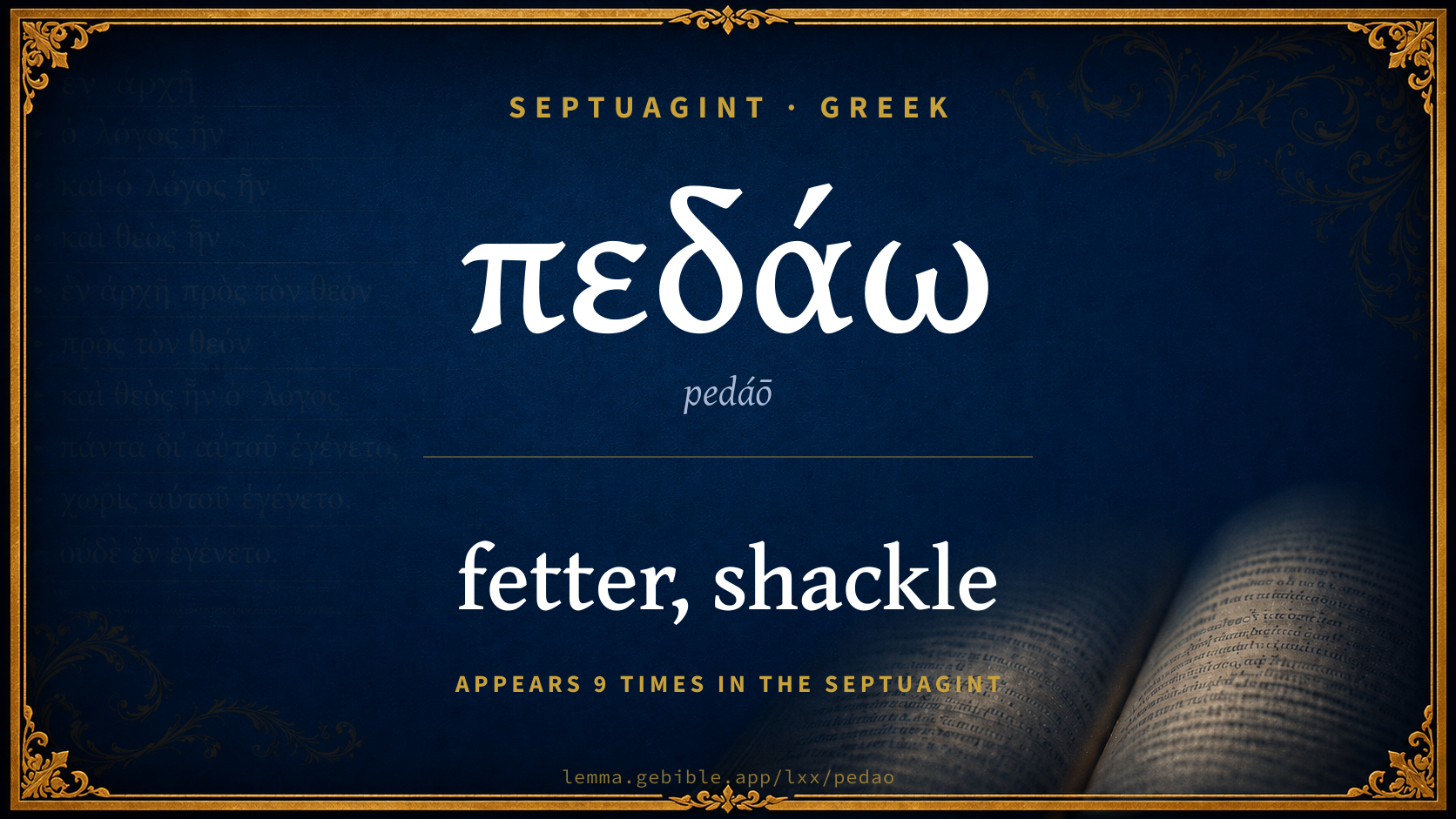
πεδάω
fetter, shackle
Where this word appears
Every passage where πεδάω appears in the Greek Septuagint — 9 occurrences in all. Click any verse to open its interlinear word-by-word view. Verse text is shown in the LXX2012 (modern English Septuagint) for context; the Greek form is the matched word — the English is not keyword-highlighted.
- Job 36:8 πεδάω But they that are bound in fetters shall be holden in cords of poverty.
- Psalms 67:7 πεδάω O God, when you went forth before your people, when you went through the wilderness; Pause:
- Psalms 68:34 πεδάω Let the heavens and the earth raise him, the sea, and all things moving in them.
- Psalms 78:11 πεδάω Let the groaning of the prisoners come in before you; according to the greatness of your arm preserve the sons of the slain ones.
- Psalms 89:12 πεδάω and who knows how to number his days because of the fear of your wrath? So manifest your right hand, and those that are instructed in wisdom in the heart.
- Psalms 101:21 πεδάω to proclaim the name of the Lord in Sion, and his praise in Jerusalem;
- Psalms 106:10 πεδάω even them that sit in darkness and the shadow of death, fettered in poverty and iron;
- Psalms 145:7 πεδάω who executes judgment for the wronged: who gives food to the hungry. The Lord looses the fettered ones:
- Daniel 4:26 πεδάω After a twelvemonth, as he walked in his palace in Babylon,
About this word
About this word
πεδάω (pedáō), “fetter, shackle,” is a word from the Greek Septuagint — the ancient Greek translation of the Hebrew Old Testament. It does not occur in the Greek New Testament, so it carries no Strong’s number from Thayer’s (New-Testament) lexicon; the gloss shown here is a curated modern-English sense rather than a Strong’s definition. It appears 9 times across the Septuagint — open the Appearances tab to read it in context.
The gloss above is Lemma’s own curated sense — this word carries no Strong’s number, so no lexicon we ship has an entry for it. The transliteration and this passage list are computed here from the tagged Septuagint text. What Lemma adds →