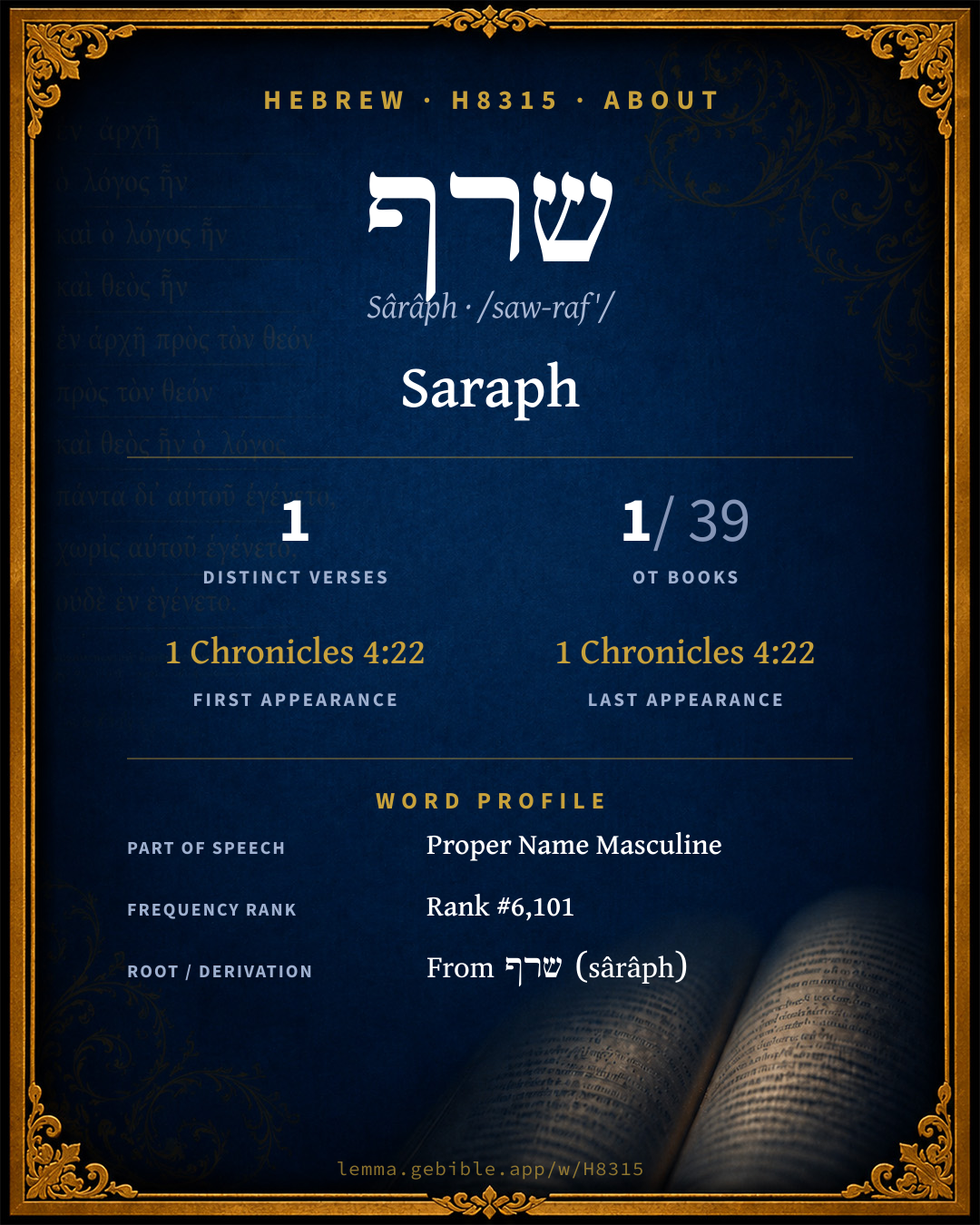
שָׂרָף
Saraph
BDB lists 2 entries for ‘Saraph’ fuller range ↓
Full lexicon entry — Brown-Driver-Briggs (BDB)
From Brown-Driver-Briggs (BDB)
Where this word appears
Grammar key — what these labels mean
Noun type
- Proper
- A name of a specific person, place, or people (e.g. Abraham, Zion, Israel).
Every verse where H8315 appears — 1 distinct verse across 1 book. Click any verse to open its interlinear word-by-word view. Verse text shown in the World English Bible for context — . Each verse’s Hebrew form is shown with its reference; the English is not keyword-highlighted, since the data carries no word-level English alignment. Use “Compare translations” on any verse to read it across multiple English versions. This concordance covers the Hebrew Bible; Septuagint (Greek Old Testament) occurrences are not indexed here.
1 Chronicles 1 verse
About this entry
At a glance — auto-summarized from this page’s data, not written by a person. Every figure links to its source below. This summary describes the numbers; it doesn’t interpret them.
“Saraph” is the headline sense of the Hebrew name שרף (Sârâph). With only 1 verse it sits in the long tail of Hebrew Bible vocabulary. More than three-quarters of its appearances fall in 1 Chronicles. A true hapax — its single appearance is 1 Chronicles 4:22. See 1-verse concordance and the renderings breakdown below.
Gloss history
Strong's 1890 vs modern scholarship
About this word
Strong's H8315 catalogs a Hebrew word from the Hebrew Old Testament.
These counts are not copied from any lexicon or concordance. They are computed here, from the morphology-tagged Hebrew Old Testament. What Lemma adds →
- 1
- distinct verses
- The word appears in 1 distinct verse.
- 1 / 39
- OT books
- The word appears in 1 of 39 Old Testament books.
- #6,101
- by frequency
- Rank #6,101 (rank 6,101 of 8,640 Hebrew words by occurrence).
View all 1 occurrence in the concordance →
Most concentrated in
- 1 Chronicles 1 verse 100%
By section of the Old Testament
By traditional corpus
Conventional, traditional groupings — biblical authorship is debated, so this is a traditional corpus grouping, not an authorship claim. Each share is this word’s portion of its verses in that division of the Hebrew canon. Each figure is a share of the word’s 1 distinct verse.
- Writings (Ketuvim) 1 verse · 100%
How translations render this word
Counts come from each version’s own published word-to-Strong’s tagging or interlinear alignment — an approximate guide to how each version renders this word, not a word-level alignment the data otherwise carries. Because each total is that version’s own tagged count, the per-version totals vary from one another and need not match the appearance or distinct-verse counts above. These counts may also differ from a printed concordance because Lemma counts each distinctly tagged rendering and does not collapse phrase taggings into a single head-word total. This is a fixed set of word-tagged versions (KJV, ASV, BSB, ULT) and does not change with the reading translation you choose elsewhere. Each version’s license is shown beside its name below (and on Sources).
BDB lists this Strong’s number as 3 distinct words (homographs). Each count above pools all of them and is not split by sense — see the Senses section below. A low-frequency rendering may belong to a different one of those words, not the primary meaning.
- King James Version†: Saraph 1×
- American Standard Version†: Saraph 1×
- Berean Standard Bible†: Saraph 1×
- unfoldingWord Literal Text†: Saraph 1×
King James Version Public Domain
Renders H8315 across 1† tagged occurrence — most commonly:
American Standard Version Public Domain
Renders H8315 across 1† tagged occurrence — most commonly:
Berean Standard Bible Public Domain
Renders H8315 across 1† tagged occurrence — most commonly:
unfoldingWord Literal Text CC BY-SA 4.0
Renders H8315 across 1† tagged occurrence — most commonly:
Senses in BDB
The 2 senses BDB distinguishes for this word, in lexicon order (not ranked by frequency or importance). The full entry — with sub-senses — is in the Lexicon Entry tab.
- Saraph = "to burn"
- a Judaite, son of Shelah who ruled in Moab
Word origin
I. n.m. Is 14:29 fiery, serpent, usually venomous (poss. from above √, from burning effect of poison);—abs. שׂ׳ Nu 21:8 (JE; on Arabic parallels v. JacobAr. Dichter ii. 93, iv. 10 f.), appos. נָחָשׁ שׂ׳ Dt 8:15, pl. הַנְּחָשִׁים הַשְּׂרָפִים Nu 21:6; a flying serpent, or dragon, שָׂרָף מְעוֹפֵף Is 14:29; 30:6.
II. n.m. Is 6:2 pl. שְׂרָפִים seraphim (prob. akin to i. שׂ׳, as beings orig. mythically conceived with serpents’ bodies (serpent-deities, cf. Is 14:29; 30:6), or (CheComm.) personif. of lightning, cf. arts. Seraphim, StrachanHast. DB. CheEncy. Bib.; Di Marti al. cp. also Egyptian guardian-griffins, called Šerref; v. also כְּרוּב; on Assyrian Šarrapu, epith. of god Nergal, connected by DlWB; with √ שָׂרַף, v. שָׂרָב, ZimKAT.3 415);—in OT. majestic beings with six wings, and human hands and voices, attendant upon י׳ Is 6:2, 6.
III. n.pr.m. a Judahite;—1 Ch 4:22; Σαια, A 𝔊L Σαραφ.
— Brown-Driver-Briggs (Oxford 1906, public domain), digitized via Sefaria, supplemented by the OpenScriptures HebrewLexicon (CC BY 4.0). See Sources.
Derived from שרף (sârâph) (H8314) — seraphim.
Jastrow Dictionary
A second Hebrew/Aramaic lexicon for comparison, covering Aramaic and post-biblical (Talmudic, Targumic, Midrashic) usage that the biblical-Hebrew BDB does not. Matched by lemma rather than by Strong’s number, so a lemma may carry more than one Jastrow headword (shown separately below), and the entries cover usage well beyond the Bible.
שָׂרַף I
- onomatop.) [to sip, absorb, v. שָׂרַף II,] to consume, burn. Pes. I, 4 ושׂוֹרְפִין … שש and the burning (of leavened matter) must take place at the beginning of the sixth hour. Ab. Zar. 11ᵃ שׂורְפִין על המלכים we do burning at the burial of kings; ומה הן שורפין וכ׳ and what is burnt? Their couch and their objects of service (armor &c.); Tosef. Snh. IV, 3; Tosef. Sabb. VII (VIII), 18; a. fr.—Part. pass. שָׂרוּף; f. שְׂרוּפָה &c. Nidd. 24ᵇ עצמותיו שְׂרוּפִין, v. שְׁתִיָּה I; a. e.
- to be burnt. Num. R. s. 236 ונ׳ על שמעל וכ׳ and he (Achan) was burned (after being stoned), because he had misappropriated devoted things. Pes. 34ᵇ יִשָּׂרֵף מיד must be burned at once. Tosef. ib. V, 8 כשם … אינו נִשְׂרָף וכ׳ as the wooden spit (on which the Passover lamb is roasted) does not burn, so the metal spit does not get hot. Zeb. XII, 5 בזמן שהם נִשְׂרָפִין כמצותן נשרפין וכ׳ when they are burned according to the law concerning them (and not because of a disqualification), they are burned in the ash-house. Ib. a. fr. פרים הנִשְׂרָפִים וכ׳ the bullock sacrifices which the law requires to be burned; a. fr.—[Y. Taan. I, 64ᵇ top תשרף, read תשרה, v. שָׁרָה I.]
שְׂרַף
- Targ. O. Gen. XI, 3 (some ed. ונוקדי׳, v. יְקַד).
- to be burned. Zeb. 16ᵃ שפיר אִישְׂתָּרוּף they would have been burned according to law; Yalk. Lev. 534. Gen. R. s. 38 (ref. to Gen. XI, 3) עתידין … מִשְׂתָּרְפָה מן וכ׳ these people are destined to be burned out of the world; Yalk. ib. 62; a. e.—Y. Sabb. IV, 7ᵃ top [read:] מצדתא הוו פריסן והוון מִשְׂטָרְפָן וכ׳ nets were spread, and they were burned in the sun. e.g. Genesis 11:3
שָׂרַף II
- (v.שָׂרַף I) to absorb, quaff, sip, suck. Ab. Zar. II, 5 (29ᵇ) שׂורְפָהּ חיה (not שורפו) sucks it (the maw) out raw, v. גְּמִי I; Cant. R. to I, 2.
שְׂרַף ²
- Naz. 36ᵇ אי דקא שָׂרֵיף ליה מִישְׂרַף if he quaffed it (swallowed it, instead of striking it on bread); Pes. 44ᵃ אי בעיניה דקשריף וקאכיל ליה (Ms. M. בעיניה קאכיל ליה) if he swallowed it in its natural condition, opp. שטר. Ker. 22ᵃ בשעה … מישרף שריף with the last breath of the animal, it (the heart) absorbs (the blood from the blood vessels). Taan. 24ᵇ ש׳ פינכא וכ׳ (Ms. M. טעים מידי, v. Rabb. D. S. a. l. note) he swallowed a dishful of grist. Ib. אי שְׂרִיף מר וכ׳ (v. Rabb. D. S. a. l. note 300) if you had swallowed &c. Ber. 62ᵃ כדלא ש׳ תבשילא as if he had never sipped a dish (never had had marital intercourse; Ḥag. 5ᵇ כמאן דלא טעים וכ׳).
שָׂרַף III
- Pi. שֵׂירֵף (denom. of שְׂרָף) to cover with resin. Tosef. Mikv. VI (VII), 21 שֵׂירְפָהּ בשרף (not שו׳; Var. סֵירְפָהּ) if he covered it (the handle of a saw) with resin.
שָׂרָף I
- burning, venomous serpent (v. Sm. Dict. s. v. Dipsas). Gen. R. s. 44; Lev. R. s. 13 (ref. to Deut. VIII, 15) ש׳ זו מדי saraf refers to Media; a. e.—Pl. שְׂרָפִים. Num. R. s. 1922 הנחשים הש׳ ששורפים את הנפש they are called burning serpents, because they burn the life out (with thirst); Yalk. ib. 764; Tanḥ. Ḥuck. 19. Num. R. s. 23, beg.; a. e. e.g. Deuteronomy 8:15
שָׂרָף II
- (b. h.) Seraph, an angel.—Pl. שְׂרָפִים. Ḥag. 12ᵇ. Pirké d’R. El. ch. IV. Deut. R. s. 11 בשעה שראו … ושַׂרְפֵי להבה וכ׳ when the wheels of the chariot and the flaming Seraphim saw &c. Pesik. R. s. 20; a. fr.
שָׂרָף
- same, v. סַרְפַיָּא.
שָׂרָף III
- (b. h.) pr. n. m. Saraph. B. Bath. 91ᵇ
שְׂרָף
- (שָׂרַף I) acrid substance, esp. vegetable sap made thick by inspissation; resin, gum (secreted by the heat of the sun). Ber. 44ᵃ כל סעודה שאין בה ש׳ וכ׳ Ms. M. (ed. שָׂרִיף) a meal without an acrid substance (bitter herbs &c.) is no meal. Pes. 39ᵃ, v. מַר II. Tosef. ib. I (II), 33 כל שיש בו ש׳ וכ׳ any plant which contains an acrid sap is fit to be used on the Passover night. Orl. I, 7 שְׂרַף העלים the sap of leaves; ש׳ העקרים of roots; ש׳ הפגים of unripe grapes. Y. ib. I, 61ᵇ bot. למה ש׳ פרי פגין פרי why (this difference in the law between resin and juice of unripe fruits)? resin is fruit and grapes are fruit. Ib. קטף בטל ע"י שִׂרְפּוֹ resin ceases to exist when its sap is pressed out; Y. Shebi. VII, end, 37ᶜ. Ib. אילן אינו בטל ע"ג שרפו the tree does not cease to exist when its sap is tapped. Ker. 6ᵃ; Sabb. 26ᵃ צרי אינו אלא ש׳ וכ׳ balsam is only a gum that drips from the balsam tree. Y. ib. II, 4ᵈ אין … מפני שהוא ש׳ you must not use balsam for the Sabbath light, because it is a gum. Gen. R. s. 94, v. סָפַג; Tanḥ. B’midbar 16 השבט (corr. acc.); a. e.—Trnsf. secretion, matter. Nidd. 10ᵇ זו שִׂירְפָּה מצוי וכ׳ with the one (the newly married virgin) secretion (from a wound caused by first coition) is frequent &c.; [oth. opin.: with the wife of older standing secretion is frequent].—Pl. שְׂרָפִים, שְׂרָפִין. Sabb. 23ᵃ כל הש׳ יפין וכ׳ all gums are good for ink, but the gum of the balsam tree is the best.
שְׂרַף II
- , esp. balsam. Targ. Y. Gen. XXXVII, 25 (h. text צרי). Ib. XLIII, 11 (h. text צרי).
A Dictionary of the Targumim, the Talmud Babli and Yerushalmi, and the Midrashic Literature (Marcus Jastrow; London, Luzac, 1903) — Public Domain. Digitized via Sefaria. Digitized via Sefaria. Full attribution on Sources.
Bible dictionary
Public-domain dictionary articles matched to this entry by name (Saraph). A biblical name can be shared by more than one person or place, so an article may treat several.
Smith's Bible Dictionary · William Smith, 1863
(burning) mentioned in (1 Chronicles 4:22) among the descendants of Judah.
Classic public-domain reference works; full attribution on Sources.
Septuagint verse parallels
This word appears in 1 verse that also exists in the Greek Old Testament (Septuagint), out of the 1 Hebrew verse it occurs in. You can read those verses in Greek by switching the Old Testament edition to the Septuagint.
Read these verses in the Septuagint
This is a verse-level parallel only — the same verses exist in both the Hebrew and Greek Old Testaments. No word-level Hebrew↔Greek correspondence is claimed: the data carries no such alignment, so no Greek word is shown as this Hebrew word’s translation. Coverage is not total — the Septuagint omits the deuterocanon and renumbers the Psalms, so some Hebrew verses have no direct Greek parallel.