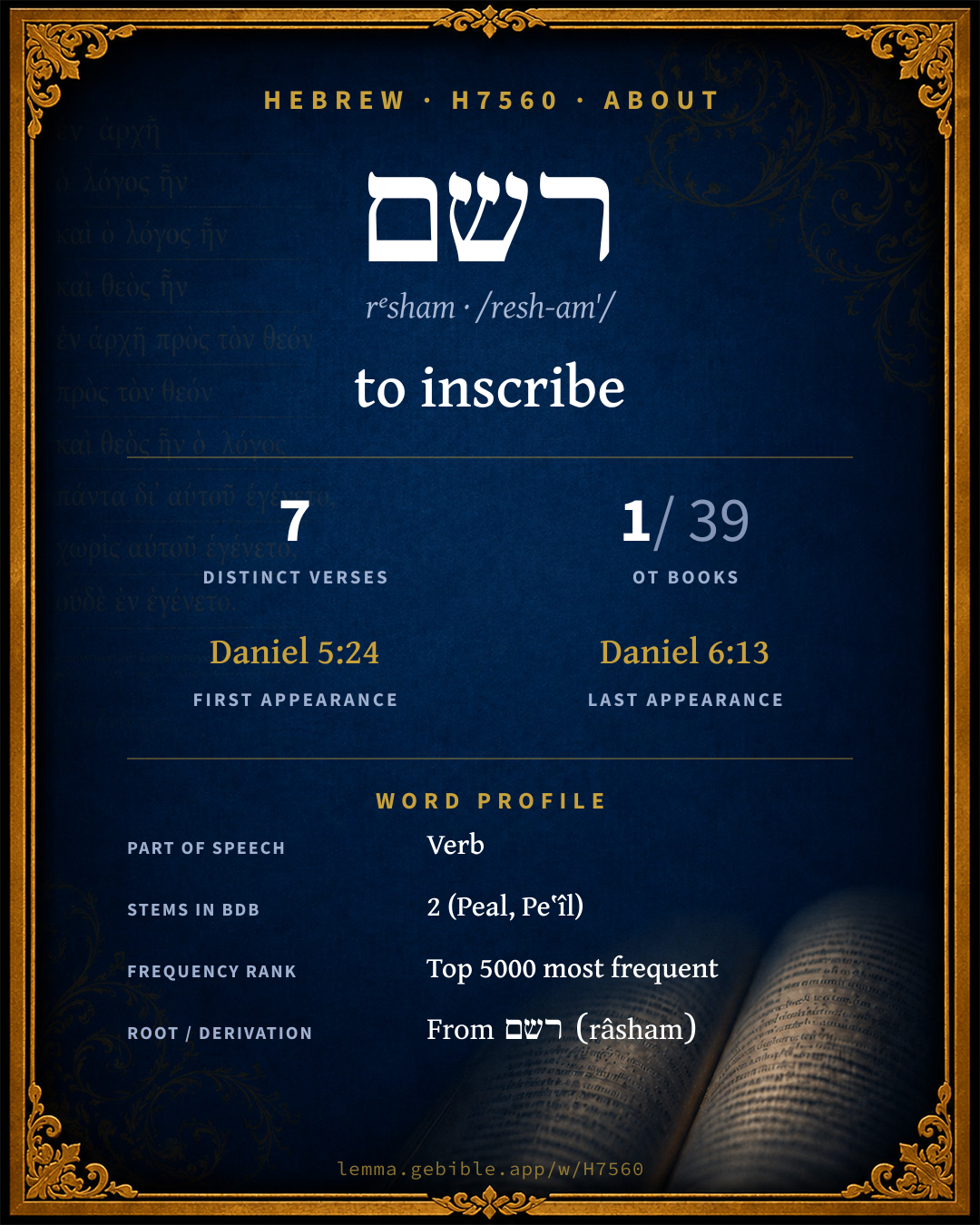
רְשַׁם
to inscribe
‘to inscribe’ is one of 2 main senses fuller range ↓
Full lexicon entry — Brown-Driver-Briggs (BDB)
From Brown-Driver-Briggs (BDB)
Where this word appears
See every Qal verb in the Hebrew Bible →
Grammar key — what these labels mean
Part of speech
- Verb
- An action or state-of-being word.
Stem
- Qal Passive
- An archaic passive of the Qal, preserved in a few forms.
- Qal
- The basic, simple active stem — the plain form of the verb (“he wrote”).
Form
- Perfect
- A completed action or state — Hebrew marks aspect (completeness) more than strict tense (“he wrote”).
- Imperfect
- An incomplete, ongoing, or future action (“he will / would write”).
Person
- 3rd Person
- The one spoken about (“he / she / it / they”).
- 2nd Person
- The one addressed (“you”).
Gender
- Masculine
- Grammatically masculine.
Number
- Singular
- One.
Grammatical forms
- Verb, Qal Passive, Perfect, 3rd Person, Masculine, Singular 3 times (43%)
- Verb, Qal, Perfect, 2nd Person, Masculine, Singular 2 times (29%)
- Verb, Qal, Imperfect, 2nd Person, Masculine, Singular 1 time (14%)
- Verb, Qal, Perfect, 3rd Person, Masculine, Singular 1 time (14%)
Parsed forms decoded from the imported morphology (morphhb / Westminster Leningrad Codex — WLC text public domain, morphhb tagging CC BY 4.0), counted across 7 parsed occurrences — not distinct verses.
Every verse where H7560 appears — 7 distinct verses across 1 book. Click any verse to open its interlinear word-by-word view. Verse text shown in the World English Bible for context — . Each verse’s Hebrew form is shown with its reference; the English is not keyword-highlighted, since the data carries no word-level English alignment. Use “Compare translations” on any verse to read it across multiple English versions. This concordance covers the Hebrew Bible; Septuagint (Greek Old Testament) occurrences are not indexed here.
Daniel 7 verses
- Daniel 5:24 רְשִֽׁים Qal Passive pf 3ms Then was the part of the hand sent from before him, and this writing was inscribed.
- Daniel 5:25 רְשִׁ֑ים Qal Passive pf 3ms This is the writing that was inscribed: MENE, MENE, TEKEL, UPHARSIN.
- Daniel 6:8 וְ/תִרְשֻׁ֣ם conj + Qal impf 2ms Now, O king, establish the interdict, and sign the writing, that it not be changed, according to the law of the Medes and Persians, which doesn't alter.
- Daniel 6:9 רְשַׁ֥ם Qal pf 3ms Therefore king Darius signed the writing and the interdict.
- Daniel 6:10 רְשִׁ֤ים Qal Passive pf 3ms When Daniel knew that the writing was signed, he went into his house (now his windows were open in his chamber toward Jerusalem) and he kneeled on his knees three times a day, and prayed, and gave thanks before his God, as he did before.
- Daniel 6:12 רְשַׁ֗מְתָּ Qal pf 2ms Then they came near, and spoke before the king concerning the king's interdict: Haven't you signed an interdict, that every man who shall make petition to any god or man within thirty days, save to you, O king, shall be cast into the den of lions? The king answered, The thing is true, according to the law of the Medes and Persians, which doesn't alter.
- Daniel 6:13 רְשַׁ֑מְתָּ Qal pf 2ms Then answered they and said before the king, That Daniel, who is of the children of the captivity of Judah, doesn't regard you, O king, nor the interdict that you have signed, but makes his petition three times a day.
About this entry
At a glance — auto-summarized from this page’s data, not written by a person. Every figure links to its source below. This summary describes the numbers; it doesn’t interpret them.
רשם — transliterated rᵉsham — is a Hebrew verb carrying the sense “to inscribe.” More than three-quarters of its appearances fall in Daniel. It appears 7 verses across 1 book of the Hebrew Bible, among its uncommon vocabulary. Debuting at Daniel 5:24, it then recurs through the corpus. Across 2 stems, its meaning turns on the binyan (Peal, Pe‛îl). Each statement above links to its evidence; the full detail follows below.
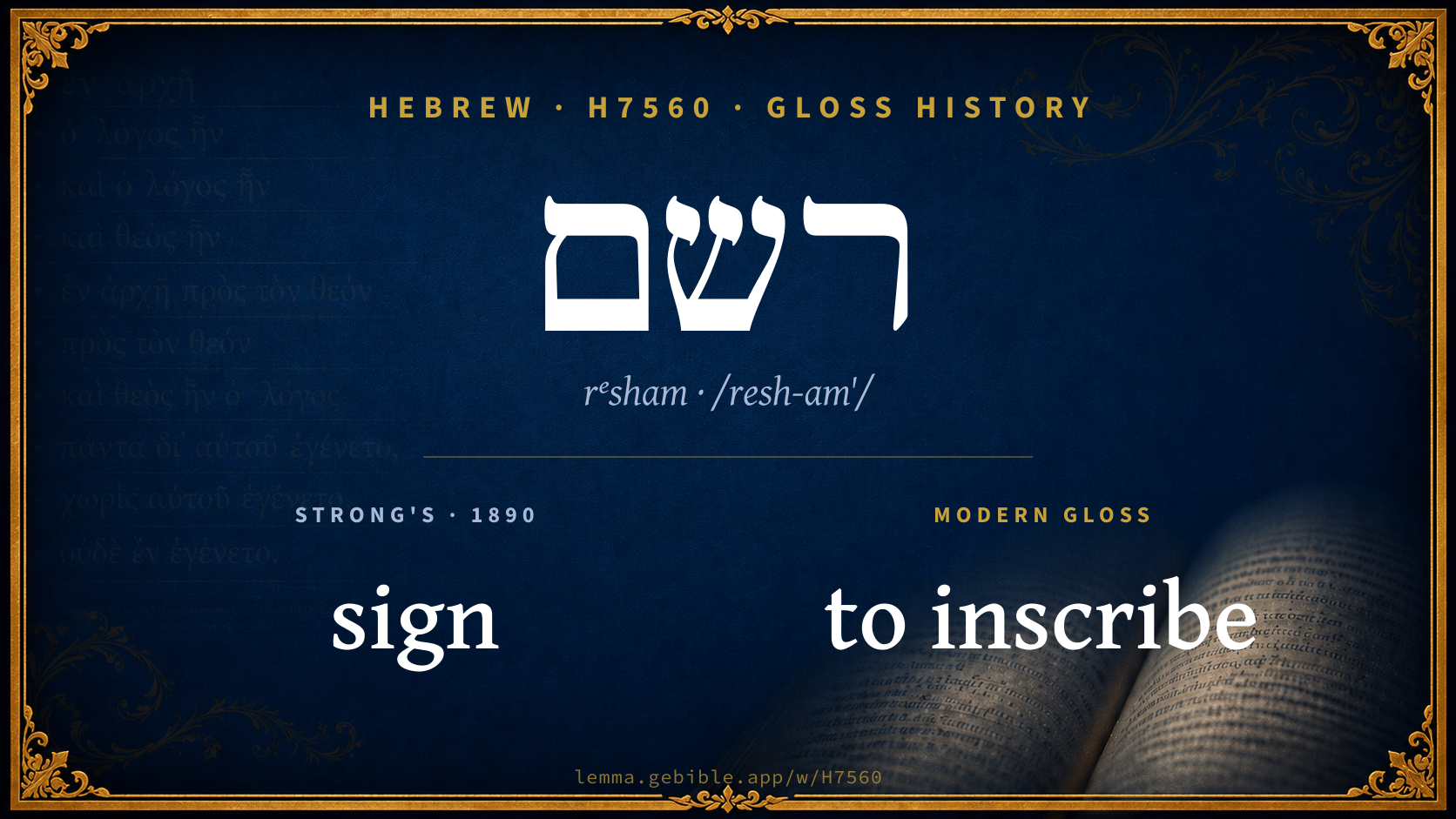
Gloss history
Strong's 1890 vs modern scholarship
About this word
Strong's H7560 catalogs a Hebrew word from the Hebrew Old Testament.
These counts are not copied from any lexicon or concordance. They are computed here, from the morphology-tagged Hebrew Old Testament. What Lemma adds →
- 7
- distinct verses
- The word appears in 7 distinct verses.
- 1 / 39
- OT books
- The word appears in 1 of 39 Old Testament books.
- #2,835
- by frequency
- Top 5000 most frequent Hebrew words (rank 2,835 of 8,640 Hebrew words by occurrence).
View all 7 occurrences in the concordance →
Most concentrated in
- Daniel 7 verses 100%
By section of the Old Testament
By traditional corpus
Conventional, traditional groupings — biblical authorship is debated, so this is a traditional corpus grouping, not an authorship claim. Each share is this word’s portion of its verses in that division of the Hebrew canon. Each figure is a share of the word’s 7 distinct verses.
- Writings (Ketuvim) 7 verses · 100%
How translations render this word
Counts come from each version’s own published word-to-Strong’s tagging or interlinear alignment — an approximate guide to how each version renders this word, not a word-level alignment the data otherwise carries. Because each total is that version’s own tagged count, the per-version totals vary from one another and need not match the appearance or distinct-verse counts above. These counts may also differ from a printed concordance because Lemma counts each distinctly tagged rendering and does not collapse phrase taggings into a single head-word total. This is a fixed set of word-tagged versions (KJV, ASV, BSB, ULT) and does not change with the reading translation you choose elsewhere. Each version’s license is shown beside its name below (and on Sources).
- King James Version: Signed 2×, Was written 2×
- American Standard Version: Signed 2×, Was inscribed 2×
- Berean Standard Bible: Sign 2×
- unfoldingWord Literal Text: Sign 2×, Was inscribed 2×
King James Version Public Domain
Renders H7560 across 7 tagged occurrences — most commonly:
Plus 3 renderings that appear only once — usually multi-word phrases or single function words the recovered tagging swept in, not distinct renderings.
American Standard Version Public Domain
Renders H7560 across 7 tagged occurrences — most commonly:
Plus 3 renderings that appear only once — usually multi-word phrases or single function words the recovered tagging swept in, not distinct renderings.
Berean Standard Bible Public Domain
Renders H7560 across 7 tagged occurrences — most commonly:
Plus 5 renderings that appear only once — usually multi-word phrases or single function words the recovered tagging swept in, not distinct renderings.
unfoldingWord Literal Text CC BY-SA 4.0
Renders H7560 across 8 tagged occurrences — most commonly:
Plus 4 renderings that appear only once — usually multi-word phrases or single function words the recovered tagging swept in, not distinct renderings.
Senses in the full BDB
Hebrew verbs can shift meaning by stem (binyan): Qal is the basic action, Niphal is often passive or reflexive, Piel often intensifies or makes it factitive, and Hiphil is typically causative. The senses below are grouped under the stem BDB assigns to each. This entry also uses Peal (the basic Aramaic stem, parallel to Qal) and Peil (the passive Aramaic stem).
What do BDB’s symbols mean?
BDB uses these scholarly abbreviations:
| Symbol | Meaning |
|---|---|
| 𝔊 | the Septuagint (the ancient Greek translation, LXX) |
| 𝔙 | the Vulgate (the Latin translation) |
| 𝔖 | the Syriac version (the Peshitta) |
| 𝔗 | the Targum (the Aramaic translation) |
| ψ | the Psalms |
| √ | root (the underlying root or stem) |
| ‖ | parallel passage (a synonymous or contrasted parallel) |
| † | the dagger: every passage where the word occurs is cited |
The 3 senses and sub-senses the full Brown-Driver-Briggs lexicon distinguishes for this word, in lexicon order (not ranked by frequency), with BDB’s own verbatim wording and sub-sense lettering. Shown in Hebrew script with BDB’s own scholarly abbreviations. The condensed entry is in the Lexicon Entry tab. See also the Forms in the corpus table below.
Peal
- . inscribe (prob. with one’s name, i.e.) sign
Pe‛îl
- 1. be inscribed, written
- 2. be signed
Senses from the full Brown-Driver-Briggs lexicon (Brown, Driver, Briggs; Oxford 1906 — public domain), digitized via Sefaria, supplemented by the OpenScriptures HebrewLexicon (CC BY 4.0). Full attribution on Sources.
Word origin
רְשַׁם vb. inscribe, sign
— Brown-Driver-Briggs (Oxford 1906, public domain), digitized via Sefaria, supplemented by the OpenScriptures HebrewLexicon (CC BY 4.0). See Sources.
Derived from רשם (râsham) (H7559) — to inscribe.
Jastrow Dictionary
A second Hebrew/Aramaic lexicon for comparison, covering Aramaic and post-biblical (Talmudic, Targumic, Midrashic) usage that the biblical-Hebrew BDB does not. Matched by lemma rather than by Strong’s number, so a lemma may carry more than one Jastrow headword (shown separately below), and the entries cover usage well beyond the Bible.
רָשַׁם
- (late b. h.)to mark, draw. Y. Gitt. II, 44ᵇ רוֹשֵׁם לפניהן בדיו וכ׳ one may draw (the signatures of illiterate witnesses) for them with ink, and they write them over with red paint (contrad. to קרע). Ib.; Y. Sabb. XII, 13ᵈ הרושם … כתבנית וכ׳ if one draws on a skin figures like writing. Sabb. XII, 4 ובכל דבר שהוא רוֹשֵׁם and with any material which marks; Gitt. II, 3 (19ᵃ), v. קַיָּימָא. Ḥull. X, 3 צריך שיִרְשׁוֹם he must mark the animal. Tanḥ. Tsav 5 האדם … רושם עליו מיתה וכ׳ when a man sins, the Lord makes the mark of death upon him; if he repents, the writ is cancelled. Sabb. 55ᵃ (ref. to Ez. IX, 4) לך ורְשׁוֹם על וכ׳ go and mark the foreheads of the righteous with a sign of ink …, and the foreheads of the wicked with blood; a. fr.—Part. pass. רָשׁוּם; f. רְשׁוּמָה; pl. רְשׁוּמִים, רְשׁוּמִין; רְשׁוּמוֹת. Y. Succ. IV, 54ᶜ top עד שלא … היתה ר׳ ברקיע וכ׳ so long as the Israelites were not redeemed from Egypt, it (the sapphire brick) was placed as a mark in heaven &c.; Lev. R. s. 23; Cant. R. to IV, 8. Gen. R. s. 81 (ref. to Dan. X, 21) אם ר׳ למה אמת … למה ר׳ if marked (for future action), why real writing (decree), and if real writing why marked? (Answ.) ר׳ עד שלא נגזרה וכ׳ marked, before the divine decree was signed; Cant. R. to I, 9; a. e.—Esp. דורשי רשומות those who interpret the Law metaphorically. B. Kam. 82ᵃ; Snh. 104ᵇ; Ber. 24ᵃ Ms. M. (ed. חמורות, v. Rashi a. l.). e.g. Ezekiel 9:4
- same.—Part. pass. מְרוּשָּׁם. Num. R. s. 95 וילדה בן מ׳ למה וכ׳ and she gave birth to a young that was marked; why? Because its mother was burnt (cauterized).
- to be marked, engraven. Midr. Till. to Ps. LXXVIII, 41 המכות היו נִרְשָׁמוֹת בגופן the plagues were engraven on their bodies (by ref. to Ps. l. c. 43).
רְשַׁם I
- , to mark; to record. Targ. Y. Gen. IV, 15. Targ. Ez. IX, 4. Targ. Is. X, 1 (h. text חקק).
- 1. same.Targ. Jud. V, 14 (h. text מחקק׳).
- 2. to make incisions. Targ. Y. Lev. XXI, 5 (h. text קרח).
- to be wrinkled. Targ. Ez. XXVII, 35 (h. text רעמו; prob. to be read: אִתְרְעִימוּ, v. רְעַם I.).
רְשַׁם II
- (preced.) incision, wound. Targ. Y. Ex. XXI, 25 Ar. (Ms. Ar. רושם; ed. הלכשיש; h. text חַבּוּרָה). Targ. Y. Lev. XIX, 28, v. רוּשְׁמָא.
רשֶׁם
- , v. רוֹשֶׁם
A Dictionary of the Targumim, the Talmud Babli and Yerushalmi, and the Midrashic Literature (Marcus Jastrow; London, Luzac, 1903) — Public Domain. Digitized via Sefaria. Digitized via Sefaria. Full attribution on Sources.
Forms in the corpus
The 7 distinct written forms H7560 takes in the Hebrew Bible, most frequent first — each parse links to that stem’s occurrences in the concordance. Hebrew forms include their vowel points and cantillation, so a single lemma takes many written forms.
| Form | Parsing | Example | Uses |
|---|---|---|---|
| וְ/תִרְשֻׁ֣ם | Verb, Qal, Imperfect, 2nd Person, Masculine, Singular | Daniel 6:8 | 1 |
| רְשִׁ֑ים | Verb, Qal Passive, Perfect, 3rd Person, Masculine, Singular | Daniel 5:25 | 1 |
| רְשִׁ֤ים | Verb, Qal Passive, Perfect, 3rd Person, Masculine, Singular | Daniel 6:10 | 1 |
| רְשִֽׁים | Verb, Qal Passive, Perfect, 3rd Person, Masculine, Singular | Daniel 5:24 | 1 |
| רְשַׁ֑מְתָּ | Verb, Qal, Perfect, 2nd Person, Masculine, Singular | Daniel 6:13 | 1 |
| רְשַׁ֗מְתָּ | Verb, Qal, Perfect, 2nd Person, Masculine, Singular | Daniel 6:12 | 1 |
| רְשַׁ֥ם | Verb, Qal, Perfect, 3rd Person, Masculine, Singular | Daniel 6:9 | 1 |
Septuagint verse parallels
This word appears in 5 verses that also exist in the Greek Old Testament (Septuagint), out of the 7 Hebrew verses it occurs in. You can read those verses in Greek by switching the Old Testament edition to the Septuagint.
Read these verses in the Septuagint
This is a verse-level parallel only — the same verses exist in both the Hebrew and Greek Old Testaments. No word-level Hebrew↔Greek correspondence is claimed: the data carries no such alignment, so no Greek word is shown as this Hebrew word’s translation. Coverage is not total — the Septuagint omits the deuterocanon and renumbers the Psalms, so some Hebrew verses have no direct Greek parallel.