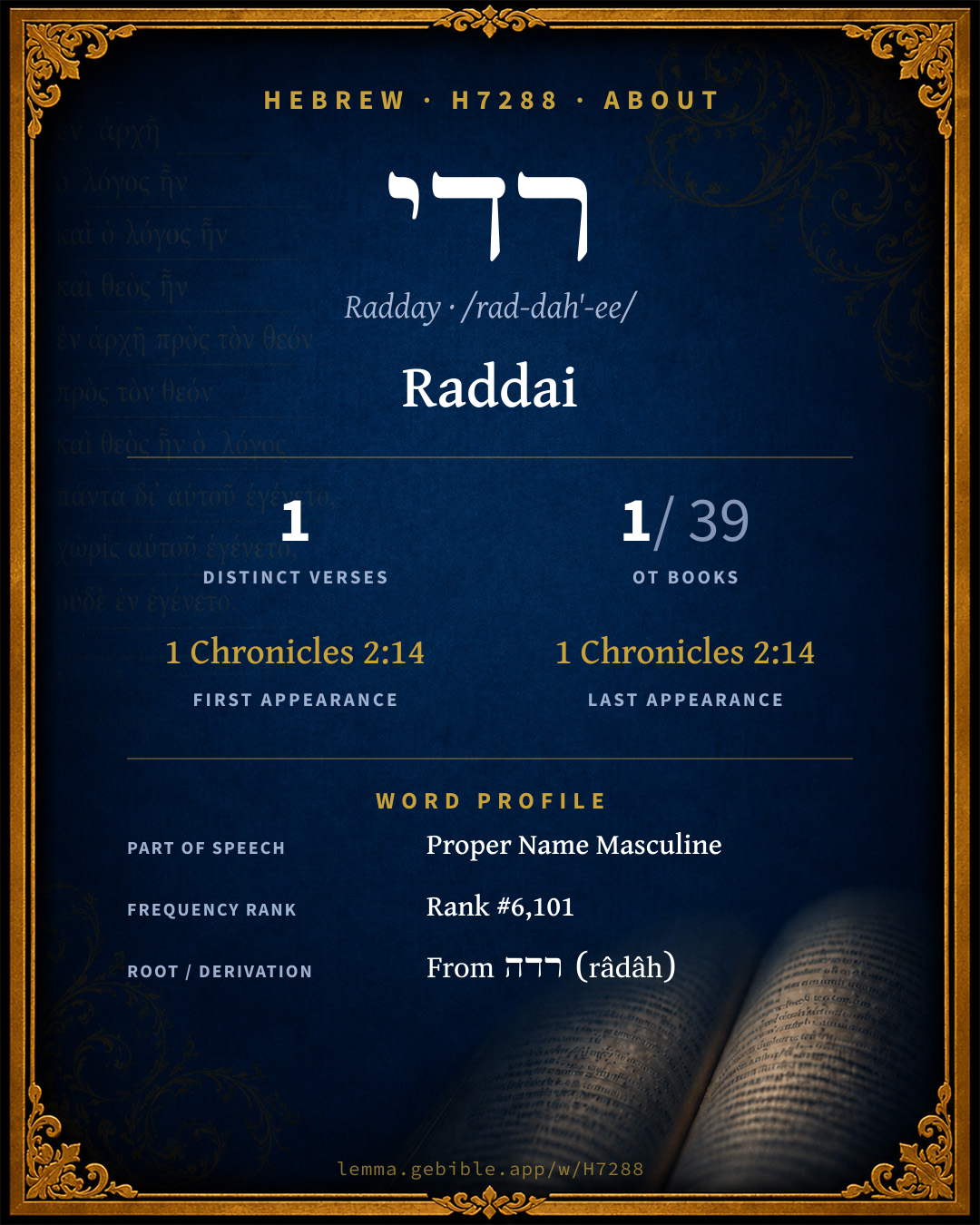
רַדַּי
Raddai
BDB lists 2 entries for ‘Raddai’ fuller range ↓
Full lexicon entry — Brown-Driver-Briggs (BDB)
From Brown-Driver-Briggs (BDB)
Where this word appears
Grammar key — what these labels mean
Part of speech
- Noun
- A naming word — a person, place, thing, or idea.
Noun type
- Proper
- A name of a specific person, place, or people (e.g. Abraham, Zion, Israel).
Every verse where H7288 appears — 1 distinct verse across 1 book. Click any verse to open its interlinear word-by-word view. Verse text shown in the World English Bible for context — . Each verse’s Hebrew form is shown with its reference; the English is not keyword-highlighted, since the data carries no word-level English alignment. Use “Compare translations” on any verse to read it across multiple English versions. This concordance covers the Hebrew Bible; Septuagint (Greek Old Testament) occurrences are not indexed here.
1 Chronicles 1 verse
About this entry
At a glance — auto-summarized from this page’s data, not written by a person. Every figure links to its source below. This summary describes the numbers; it doesn’t interpret them.
At its core, רדי (Radday) means “Raddai.” With only 1 verse it sits in the long tail of Hebrew Bible vocabulary. Its uses cluster heavily in 1 Chronicles (100% of all occurrences). A true hapax — its single appearance is 1 Chronicles 2:14. Dig into 1-verse concordance and the renderings breakdown below.
Gloss history
Strong's 1890 vs modern scholarship
About this word
Strong's H7288 catalogs a Hebrew word from the Hebrew Old Testament.
These counts are not copied from any lexicon or concordance. They are computed here, from the morphology-tagged Hebrew Old Testament. What Lemma adds →
- 1
- distinct verses
- The word appears in 1 distinct verse.
- 1 / 39
- OT books
- The word appears in 1 of 39 Old Testament books.
- #6,101
- by frequency
- Rank #6,101 (rank 6,101 of 8,640 Hebrew words by occurrence).
View all 1 occurrence in the concordance →
Most concentrated in
- 1 Chronicles 1 verse 100%
By section of the Old Testament
By traditional corpus
Conventional, traditional groupings — biblical authorship is debated, so this is a traditional corpus grouping, not an authorship claim. Each share is this word’s portion of its verses in that division of the Hebrew canon. Each figure is a share of the word’s 1 distinct verse.
- Writings (Ketuvim) 1 verse · 100%
How translations render this word
Counts come from each version’s own published word-to-Strong’s tagging or interlinear alignment — an approximate guide to how each version renders this word, not a word-level alignment the data otherwise carries. Because each total is that version’s own tagged count, the per-version totals vary from one another and need not match the appearance or distinct-verse counts above. These counts may also differ from a printed concordance because Lemma counts each distinctly tagged rendering and does not collapse phrase taggings into a single head-word total. This is a fixed set of word-tagged versions (KJV, ASV, BSB, ULT) and does not change with the reading translation you choose elsewhere. Each version’s license is shown beside its name below (and on Sources).
BDB lists this Strong’s number as 2 distinct words (homographs). Each count above pools all of them and is not split by sense — see the Senses section below. A low-frequency rendering may belong to a different one of those words, not the primary meaning.
- King James Version†: Raddai 1×
- American Standard Version†: Raddai 1×
- Berean Standard Bible†: Raddai 1×
- unfoldingWord Literal Text†: Raddai 1×
King James Version Public Domain
Renders H7288 across 1† tagged occurrence — most commonly:
American Standard Version Public Domain
Renders H7288 across 1† tagged occurrence — most commonly:
Berean Standard Bible Public Domain
Renders H7288 across 1† tagged occurrence — most commonly:
unfoldingWord Literal Text CC BY-SA 4.0
Renders H7288 across 1† tagged occurrence — most commonly:
Senses in BDB
The 2 senses BDB distinguishes for this word, in lexicon order (not ranked by frequency or importance). The full entry — with sub-senses — is in the Lexicon Entry tab.
- Raddai = "trampling"
- the 5th son of Jesse and brother of David
Word origin
n.pr.m. fifth son of Jesse, according to 1 Ch 2:14; Ζαδδαι, A Ραδδαι, 𝔊L Ρεδαι.
— Brown-Driver-Briggs (Oxford 1906, public domain), digitized via Sefaria, supplemented by the OpenScriptures HebrewLexicon (CC BY 4.0). See Sources.
Derived from רדה (râdâh) (H7287) — to rule.
Jastrow Dictionary
A second Hebrew/Aramaic lexicon for comparison, covering Aramaic and post-biblical (Talmudic, Targumic, Midrashic) usage that the biblical-Hebrew BDB does not. Matched by lemma rather than by Strong’s number, so a lemma may carry more than one Jastrow headword (shown separately below), and the entries cover usage well beyond the Bible.
רדי
- [to stamp, tread,]
- 1. (cmp. בָּעַט) to rebel, be contumacious. Yoma 40ᵇ אל … למינין לִרְדּוֹת Ms. M. (ed. לצדוקים) give the heretics no occasion to rebel (to argue in favor of their heresy); Tosef. ib. III (II), 2 לרדות אחריכם ed. Zuck. (Var. לרדותן אחריהם, corr. acc.) to rebel after you are gone; Par. III, 3; Sifra Vayikra, N’dab., ch. II, Par. 2.
- 2. to chastise. Mekh. Mishp. s. 4 הרוֹדֶה בבנו ובתלמידו he who chastises his son or his pupil (and kills him); Macc. II, 2 הרב הרודה את וכ׳ the teacher that punishes his pupil. Gen. R. s. 50, end בקש לִרְדוֹתָן and wanted to punish them; a. fr.
- 3. to subjugate, rule, govern. Gen. R. s. 8 (ref. to ורדו, Gen. I, 28) אם זכה רְדוּ ואם לאו יֵרְדוּ if man is good, (God says,) ‘rule’, if not, (God says,) ‘let them go down’; ib. (ref. to וירדו, ib. 26 את שהוא … יִרְדּוּ את שאינו … יֵרְדוּ (not ורדו) concerning such as are ‘in our image and likeness’ (I say,) ‘they shall rule’ &c. Ib. יבא … ויִרְדֶּה למי וכ׳ let ‘our image and likeness’ (the good man) rule over him who is not &c.; Yalk. ib. 14.—[Tosef. Ter. IX, 12 ed. Zuck. ירדנו, v. עִרְעֵד III.] e.g. Genesis 1:28
- 1. to drive, chase. Ex. R. s. 20 עד שאֲרַדֶּה אותן וכ׳ until I drive them into the sea.
- 2. to chastise. Ex. R. s. 1 לא רִידָּהוּ he did not chastise him. Ib. ולא רידהו ביסורין he did not punish him with sufferings. Ib. (play on ארדון, I Chr. II, 18, as a surname of Caleb) שר׳ את יצרו he chastised (or subjugated, v. supra) his evil inclination. Yalk. Prov. 959 אֲרַדֶּה אותך וכ׳ (or אֶרְדֶּה) I shall punish thee with them; a. e. e.g. 1 Chronicles 2:18
- 3. to stamp. M. Kat. 7ᵃ, v. רָדַד.
- 4. (cmp. כָּבַשׁ) to dam, make passable. Erub. 104ᵃ חצר … תבּן ומְרַדֶּה בה (Alf. מדדה, v. Rabb. D. S. a. l. note 40) if a court has been made impassable through rain, he may bring straw and make a path with it; ib. וכשהוא מרדה אינו מרדה וכ׳ and when he makes the path, he must not do so by carrying the straw in a basket &c.
רְדֵי
- 1. to chastise. Targ. I Kings XII, 11. Targ. Prov. III, 12. Ib. XXXI, 1. Targ. Ps. XII, 7 רָדָאן (ed. Wil. דדאן, corr. acc.); a. fr.
- 2. to drive, rule. Ib. CX, 2. Targ. Lev. XXVI, 17; a. e.
- to be chastened; to be instructed. Targ. Jer. VI, 8. Targ. Prov. XXIX, 19. Targ. Y. Lev. XX, 5; a. fr.
רדי ²
- to take down; to detach, break off, esp. a) to take honey out of the bee-hive. Ukts. III, 10 כוורת … והרוֹדֶה ממנה וכ׳ a bee-hive … is regarded as landed estate …, and he who breaks honey out of it on the Sabbath &c.; Shebi. X, 7; B. Bath. 66ᵃ; 80ᵇ. B. Mets. 64ᵃ ההולך … לִרְדוֹת את כוורתו if a person goes to take the honey out of his bee-hive; מה שכוורתי רוֹדָה כך וכך וכ׳ whatever my bee-hive may yield shall be thine for such and such an amount; a. fr.—2) ר׳ (פת) to detach bread from where it sticks to the oven, to shovel out. Sabb. 4ᵃ הדביק … התירו לו לִרְדוֹתָהּ וכ׳ if a person stuck a loaf to the wall of an oven (on the Sabbath), would you permit him to take it out (before it is baked) &c.? Makhsh. III, 3. Yoma 38ᵃ; Tosef. ib. II, 5 אינן בקיעין לִרְדוֹתָם they were not skilled in taking them off (without breaking); a. fr.—Y. Pes. III, 30ᵃ bot. יִרְדֶּנָּה let him detach it (the piece dedicated as Ḥallah) from the loaf.
- to be detached, taken out of the oven. Tosef. Yoma l. c. והיה נאפה ונ׳ מבפנים (Var. והיא נִרְדֵּית) it was baked in, and taken out from the interior of the oven; Cant. R. to III, 6 נִרְדִּת.
רְדֵי ²
- , Pa. רַדֵּי same. Targ. Y. Lev. XXVI, 26 ומְרַדְּיָין (some ed. ומדדין, corr. acc.).
רְדִי
- (cmp. רדי I) [to subjugate the ground; cmp. Gen. I, 28; cmp. נִיר I], to plough. Targ. Ps. CXXIX, 3 רָדוּ (ed. Lag. רָאדוּ, v. דְּאַר). Targ. Hos. X, 11. Targ. I Kings XIX, 19; a. fr.—Y. Shebi. IV, 35ᵃ bot. מֵירְדֵי; Y. Snh. III, 21ᵇ top מֵרְדָה, v. הָאַסְטוּ. Y. Ber. II, 5ᵃ top הוה קאים רָדֵי (not רדי) was ploughing; Lam. R. to I, 16 הוה קא רדי. Y. B. Mets. IX, beg. 12ᵃ לתלוש … פוק רְדִיתָהּ (not דריתה) where it is customary to pluck, and the tenant cut the grain, we say to him, go out and plough the field (for the owner); a. fr. e.g. Genesis 1:28
- to be ploughed. Targ. Am. VI, 12. Targ. Mic. III, 12; a. e.
A Dictionary of the Targumim, the Talmud Babli and Yerushalmi, and the Midrashic Literature (Marcus Jastrow; London, Luzac, 1903) — Public Domain. Digitized via Sefaria. Digitized via Sefaria. Full attribution on Sources.
Bible dictionary
Public-domain dictionary articles matched to this entry by name (Raddai). A biblical name can be shared by more than one person or place, so an article may treat several.
Smith's Bible Dictionary · William Smith, 1863
(trampling), one of David's brothers, fifth son of Jesse. (1 Chronicles 2:14)
Hitchcock's Bible Names Dictionary · Roswell D. Hitchcock, 1869
ruling; coming down
Classic public-domain reference works; full attribution on Sources.
Septuagint verse parallels
This word appears in 1 verse that also exists in the Greek Old Testament (Septuagint), out of the 1 Hebrew verse it occurs in. You can read those verses in Greek by switching the Old Testament edition to the Septuagint.
Read these verses in the Septuagint
This is a verse-level parallel only — the same verses exist in both the Hebrew and Greek Old Testaments. No word-level Hebrew↔Greek correspondence is claimed: the data carries no such alignment, so no Greek word is shown as this Hebrew word’s translation. Coverage is not total — the Septuagint omits the deuterocanon and renumbers the Psalms, so some Hebrew verses have no direct Greek parallel.