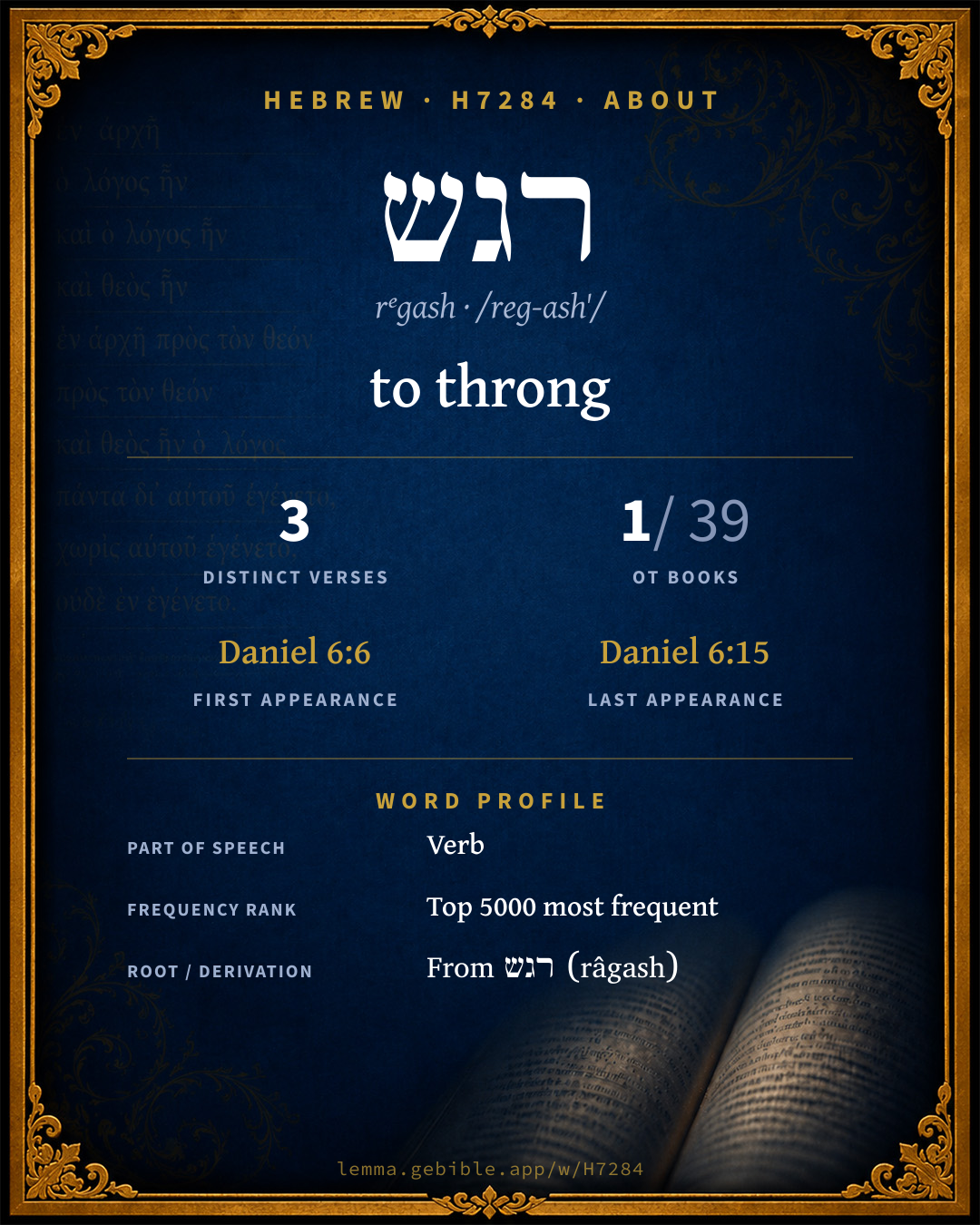
רְגַשׁ
to throng
‘to throng’ is one of 2 main senses fuller range ↓
Full lexicon entry — Brown-Driver-Briggs (BDB)
From Brown-Driver-Briggs (BDB)
Where this word appears
Grammar key — what these labels mean
Part of speech
- Verb
- An action or state-of-being word.
Stem
- Hiphil
- The causative active stem (“he caused / brought about”).
Form
- Perfect
- A completed action or state — Hebrew marks aspect (completeness) more than strict tense (“he wrote”).
Person
- 3rd Person
- The one spoken about (“he / she / it / they”).
Gender
- Masculine
- Grammatically masculine.
Number
- Plural
- More than one (in Hebrew, generally three or more).
Every verse where H7284 appears — 3 distinct verses across 1 book. Click any verse to open its interlinear word-by-word view. Verse text shown in the World English Bible for context — . Each verse’s Hebrew form is shown with its reference; the English is not keyword-highlighted, since the data carries no word-level English alignment. Use “Compare translations” on any verse to read it across multiple English versions. This concordance covers the Hebrew Bible; Septuagint (Greek Old Testament) occurrences are not indexed here.
Daniel 3 verses
- Daniel 6:6 הַרְגִּ֖שׁוּ Hiphil pf 3mp Then these presidents and satraps assembled together to the king, and said thus to him, King Darius, live forever.
- Daniel 6:11 הַרְגִּ֔שׁוּ Hiphil pf 3mp Then these men assembled together, and found Daniel making petition and supplication before his God.
- Daniel 6:15 הַרְגִּ֖שׁוּ Hiphil pf 3mp Then these men assembled together to the king, and said to the king, Know, O king, that it is a law of the Medes and Persians, that no interdict nor statute which the king establishes may be changed.
About this entry
At a glance — auto-summarized from this page’s data, not written by a person. Every figure links to its source below. This summary describes the numbers; it doesn’t interpret them.
רגש (rᵉgash) is a Hebrew verb most often rendered “to throng.” With only 3 verses it sits in the long tail of Hebrew Bible vocabulary. Daniel dominates its distribution — 3 of 3 verses. Scripture first uses it in Daniel 6:6. Ranging over 2 senses, it is not a single-sense word. The sections below give every sense, occurrence, and version rendering.
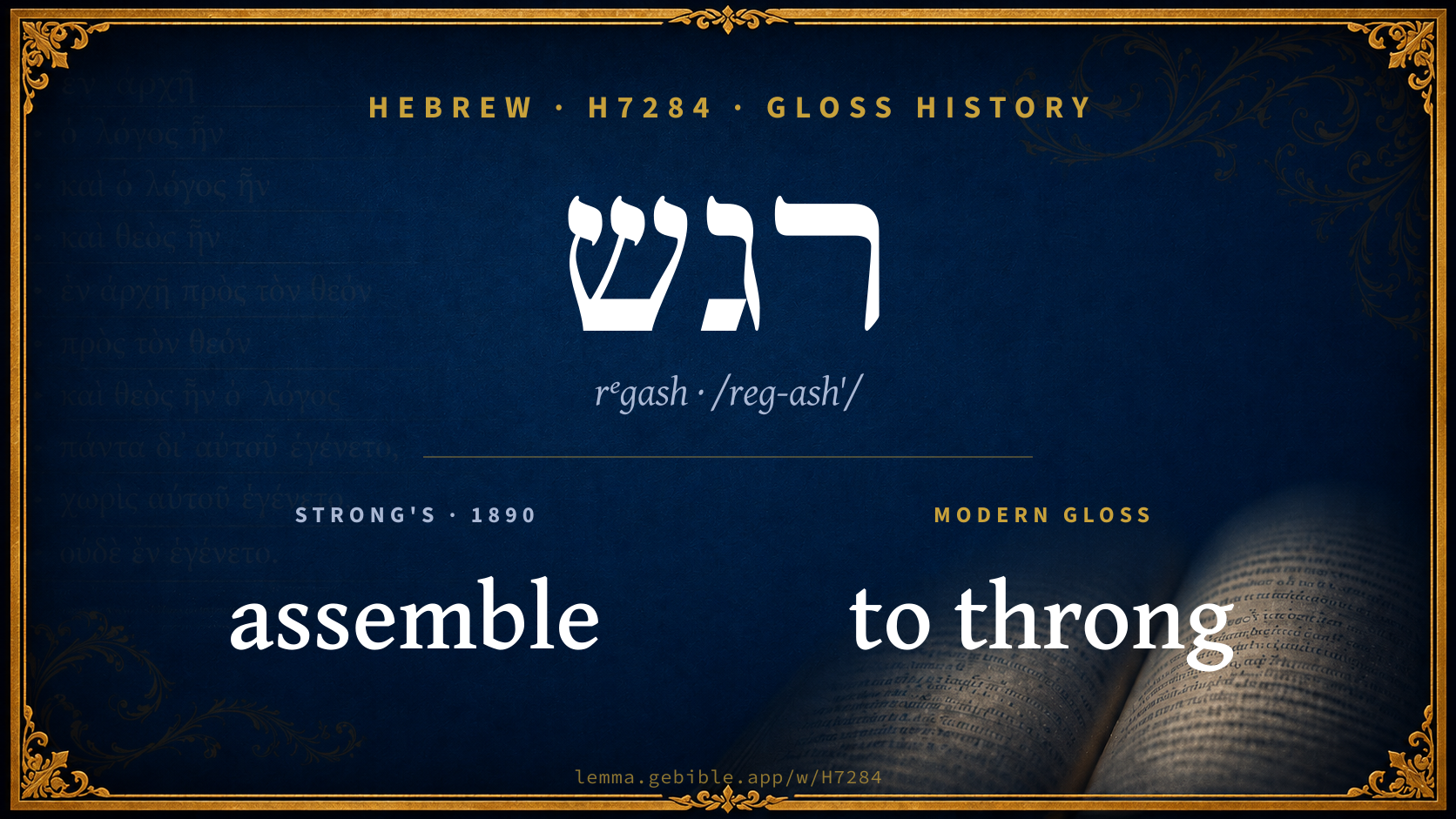
Gloss history
Strong's 1890 vs modern scholarship
About this word
Strong's H7284 catalogs a Hebrew word from the Hebrew Old Testament.
These counts are not copied from any lexicon or concordance. They are computed here, from the morphology-tagged Hebrew Old Testament. What Lemma adds →
- 3
- distinct verses
- The word appears in 3 distinct verses.
- 1 / 39
- OT books
- The word appears in 1 of 39 Old Testament books.
- #4,179
- by frequency
- Top 5000 most frequent Hebrew words (rank 4,179 of 8,640 Hebrew words by occurrence).
View all 3 occurrences in the concordance →
Most concentrated in
- Daniel 3 verses 100%
By section of the Old Testament
By traditional corpus
Conventional, traditional groupings — biblical authorship is debated, so this is a traditional corpus grouping, not an authorship claim. Each share is this word’s portion of its verses in that division of the Hebrew canon. Each figure is a share of the word’s 3 distinct verses.
- Writings (Ketuvim) 3 verses · 100%
How translations render this word
Counts come from each version’s own published word-to-Strong’s tagging or interlinear alignment — an approximate guide to how each version renders this word, not a word-level alignment the data otherwise carries. Because each total is that version’s own tagged count, the per-version totals vary from one another and need not match the appearance or distinct-verse counts above. These counts may also differ from a printed concordance because Lemma counts each distinctly tagged rendering and does not collapse phrase taggings into a single head-word total. This is a fixed set of word-tagged versions (KJV, ASV, BSB, ULT) and does not change with the reading translation you choose elsewhere. Each version’s license is shown beside its name below (and on Sources).
- King James Version: Assembled 2×
- American Standard Version: Assembled 2×
- Berean Standard Bible: Approached 1×, Went as a group 1×, Went together 1×
- unfoldingWord Literal Text: Went as a group 3×
King James Version Public Domain
Renders H7284 across 3 tagged occurrences — most commonly:
Plus 1 rendering that appears only once — usually multi-word phrases or single function words the recovered tagging swept in, not distinct renderings.
American Standard Version Public Domain
Renders H7284 across 3 tagged occurrences — most commonly:
Plus 1 rendering that appears only once — usually multi-word phrases or single function words the recovered tagging swept in, not distinct renderings.
Berean Standard Bible Public Domain
Renders H7284 across 3 tagged occurrences — most commonly:
unfoldingWord Literal Text CC BY-SA 4.0
Renders H7284 across 3 tagged occurrences — most commonly:
Senses in BDB
The 2 senses BDB distinguishes for this word, in lexicon order (not ranked by frequency or importance). The full entry — with sub-senses — is in the Lexicon Entry tab.
- to be in tumult
- (Aphel) to gather in a tumultuous throng, show tumultuousness, come thronging
Word origin
[ רְגַשׁ ] vb. be in tumult
— Brown-Driver-Briggs (Oxford 1906, public domain), digitized via Sefaria, supplemented by the OpenScriptures HebrewLexicon (CC BY 4.0). See Sources.
Derived from רגש (râgash) (H7283) — to tumult.
Jastrow Dictionary
A second Hebrew/Aramaic lexicon for comparison, covering Aramaic and post-biblical (Talmudic, Targumic, Midrashic) usage that the biblical-Hebrew BDB does not. Matched by lemma rather than by Strong’s number, so a lemma may carry more than one Jastrow headword (shown separately below), and the entries cover usage well beyond the Bible.
רָגַשׁ
- (b. h.) to tremble, shake; to rage.
- 1. to stir up, gather in a crowd. Midr. Till. to Ps. CXVIII, 10 שהוא עתיד להַרְגִּישׁ וכ׳ he shall stir up all nations and bring them to Jerusalem; a. e.
- 2. to be affected, feel, perceive. Ex. R. s. 14 היו נוטלין … ולא היינו מַרְגִּישִׁין they might have taken all our belongings in the days of darkness, and we should not have noticed it. Ex. R. s. 15 הביא … ולא ה׳ פרעה God brought plagues upon the Egyptians, but Pharaoh did not care; כיון … התחיל מַרְגִּישׁ וכ׳ when the plague touched his own body, he began to feel it and cry &c. Meg. 15ᵇ אולי יַרְגִּישׁ המקום וכ׳ (Esther, in inviting Haman, thought,) perhaps God will feel (compassion at my self-humiliation), and do a miracle for us. Sabb. 13ᵇ אין בשר המת מרגיש באיזמל dead flesh feels not the knife (we have grown indolent through the frequency of persecutions); אין … שבחי מרגיש וכ׳ the dead flesh in a living body feels not &c.; Y. Taan. III, 66ᵈ bot. Y. Ber. V, 9ᵃ bot. לא הִרְגַּשְׁתָּ didst thou not feel (the lizard’s bite)? יבא עלי … אם הִרְגַּשְׁתִּי may evil befall me, if, in my devotion …, I felt it. Y. Erub. I, 19ᵇ שאילו ישמט הוא מרגיש if it should slip off, he would find it out. Gen. R. s. 47 ה׳ ונצטער he felt (the pain of circumcision) and suffered. Pesik. R. s. 11 כל הפירות … מַרְגִּישִׁים … וכילם … ומרגישים of all fruits in a bag, you take some, and the others are not affected, but in the case of nuts … all are in heavy commotion; כך ישראל … וכילם מרגישים so is it with Israel: one man sins, and all feel the effect of it; Yalk. Cant. 992; a. fr.
- to create excitement. Lam. R. to II, 7 קול צרות מְרַגְּשׁוֹת the noise of exciting troubles.
- to come in crowds, rush forth, storm. Tanḥ. Lekh 9 עתידין … להִתְרַגֵּשׁ עליהם all kings shall come in a rage against them. Y. Ber. V, 8ᵈ bot. those hard times (v. חָצַף) היוצאות המִתְרַגְּשׁות לבא לעולם which go forth, which rush to enter the world. B. Kam. 80ᵇ ושאר פורעניות המתרגשות ובאות וכ׳ and other calamities which break forth and visit a community; Taan. 14ᵃ; a. e.
רְגַשׁ
- , to tremble, shake, be agitated; to moan. Targ. Ps. LXXII, 16 יִרְגּוֹשׁ Ms. (ed. יַרְגִּישׁ; h. text ירעש). Ib. XXXVIII, 9 רְגִישִׁית (h. text שאג׳). Ib. LV, 3; a. fr.—Part. pass. רָגִישׁ affected; felt. Yeb. 117ᵇ דר׳ לה צערא the annoyance of family troubles has been felt by her before (Ar. גִּישׁ, q. v.). Gen. R. s. 32 (ref. to בעצם, Gen. VII, 13) (Noah went into the ark in broad day-light) דר׳ ליה ימלל (a proverbial expression) let him whom it hurts speak out, i.e. let him who objects to my doings come forward; ib. s. 47 (ref. to בעצם, Gen. XVII, 23) דרָגֵשׁ ליה וכ׳ (some ed. דרַגְשָׁה); Cant. R. to IV, 6 דרגשה. e.g. Genesis 7:13
- 1. to stir up, shake, trouble; to set in motion. Targ. Ps. LX, 4. Targ. Job XXXIX, 20. Targ. Josh. VII, 3 (h. text תְּיַגַּע). Targ. Y. I Deut. XXXIV, 5; a. fr.—Snh. 95ᵃ (quoted fr. Targ. Is. X, 32) הלא דא … אַרְגְּשִׁית כל וכ׳ (Targ. l. c. אַרְגֵּישִׁית) is this the city of Jerusalem for which I set all my camps in motion?; Yalk. Is. 284.—Trnsf. (with אפא) to make bold, have the hardihood to. Pesik. Ănokhi, p. 138ᵇ הא אַרְגִּישְׁתּוּן אפכון have you dared (to come back)? Ib. הא אַרְגְּשַׁת אפך hast thou the hardihood (to come back to me)?; v. גּוּשׁ I.—2) to be excited, rage. Targ. Ps. XLII, 12; XLIII, 5 (ed. Wil. תִּרְגְּ׳; Ms. תתרגושי; h. text תהמי). Ib. LXXII, 16, v. supra; a. e.—Gen. R. s. 17 א׳ בה וכ׳ he was angry with her (scolded her) the first day, the second day &c.
- 3. to be affected, feel; to be troubled. Sabb. 129ᵃ א׳ בנפשיה he felt himself (felt weak). Yoma 22ᵇ; B. Kam. 20ᵇ ולא מַרְגֵּישׁ, v. חֲלִי.
- 4. to feel the scent of, trace, track. Targ. Y. Ex. II, 3.
- ; Ithpa. אִתְרַגֵּשׁ to be shaken, troubled; to be excited, noisy. Targ. II Sam. XXII, 8; Targ. Ps. XVIII, 8. Ib. XLII, 12; XLIII, 5, v. supra. Ib. II, 1. Ib. LIX, 7; a. e.
רֶגֶשׁ
- preced.) commotion, vibration. Yalk. Ps. 620 כל רִגְשָׁן של וכ׳ all the commotion of the wicked and all their toil are in vain; Midr. Till. to Ps. II רִיגּוּשָׁן (ed. Bub. רִגּוּשָׁן). Yalk. Ex. 299 (ref. to Ex. XX, 18) אדם … הוא שומע ר׳ קולו וכ׳ if a man speaks to his fellowman, the latter hears the sound of his voice, but does not see a light proceeding from it, but the Israelites heard … and saw the voice. e.g. Exodus 20:18
A Dictionary of the Targumim, the Talmud Babli and Yerushalmi, and the Midrashic Literature (Marcus Jastrow; London, Luzac, 1903) — Public Domain. Digitized via Sefaria. Digitized via Sefaria. Full attribution on Sources.
Forms in the corpus
The 2 distinct written forms H7284 takes in the Hebrew Bible, most frequent first — each parse links to that stem’s occurrences in the concordance. Hebrew forms include their vowel points and cantillation, so a single lemma takes many written forms.
| Form | Parsing | Example | Uses |
|---|---|---|---|
| הַרְגִּ֖שׁוּ | Verb, Hiphil, Perfect, 3rd Person, Masculine, Plural | Daniel 6:6 | 2 |
| הַרְגִּ֔שׁוּ | Verb, Hiphil, Perfect, 3rd Person, Masculine, Plural | Daniel 6:11 | 1 |
Same root — word family
Other BDB entries built from the same root as H7284, grouped by Strong’s listed origin. These share a root / origin per the lexicon — not necessarily a shared meaning. Each links to that word’s own entry.
Derives from
Shares the same root
Compare all same-root words → They share a root, not necessarily a meaning.
Septuagint verse parallels
This word appears in 3 verses that also exist in the Greek Old Testament (Septuagint), out of the 3 Hebrew verses it occurs in. You can read those verses in Greek by switching the Old Testament edition to the Septuagint.
Read these verses in the Septuagint
This is a verse-level parallel only — the same verses exist in both the Hebrew and Greek Old Testaments. No word-level Hebrew↔Greek correspondence is claimed: the data carries no such alignment, so no Greek word is shown as this Hebrew word’s translation. Coverage is not total — the Septuagint omits the deuterocanon and renumbers the Psalms, so some Hebrew verses have no direct Greek parallel.