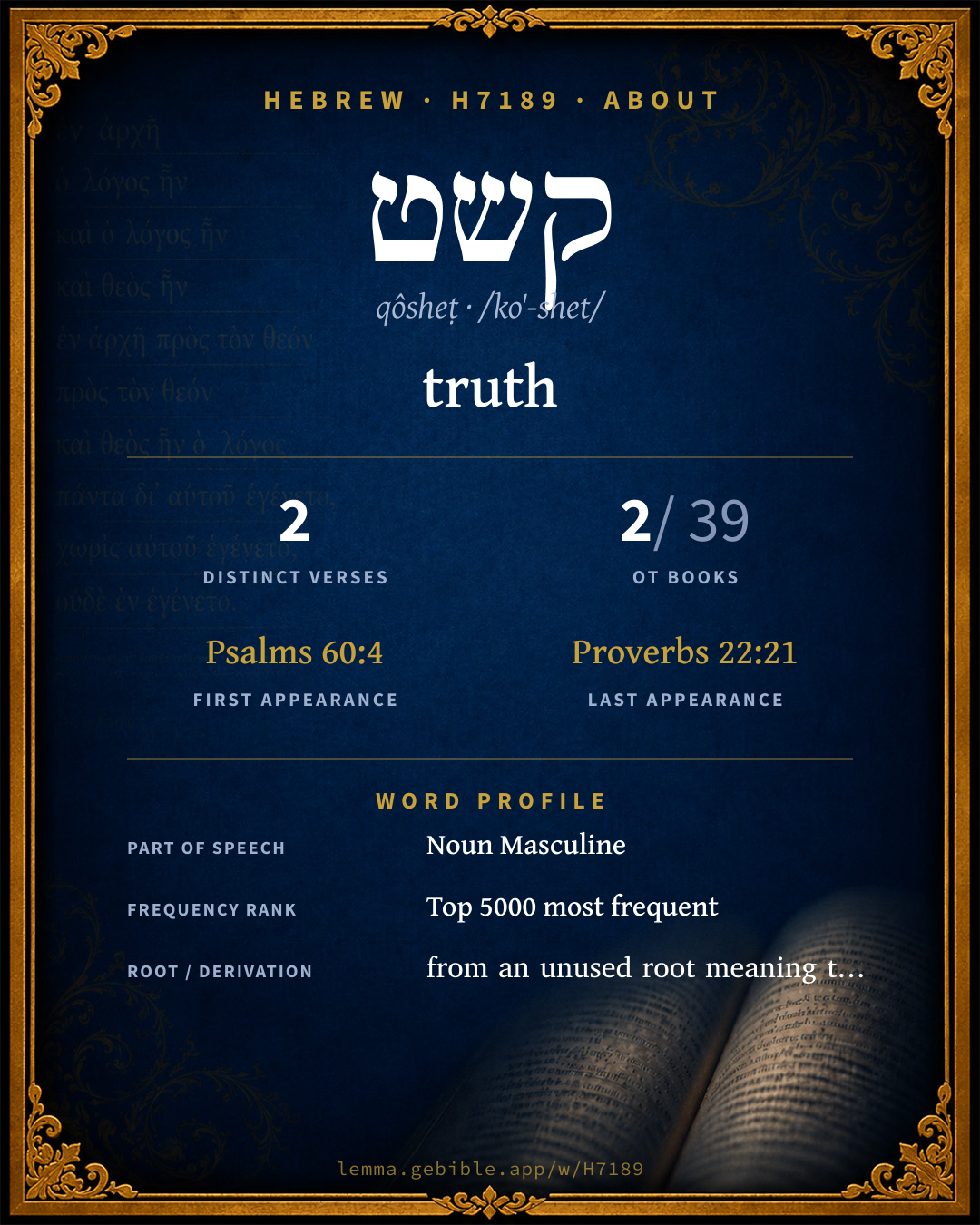
קשט
truth
‘truth’ is one of 2 main senses fuller range ↓
Full lexicon entry — Brown-Driver-Briggs (BDB)
From Brown-Driver-Briggs (BDB)
Where this word appears
Grammar key — what these labels mean
Part of speech
- Noun
- A naming word — a person, place, thing, or idea.
Noun type
- Common
- A common noun — a general class of person, place, or thing (“king,” “city,” “water”), not a specific name.
State
- Absolute
- The independent form of a noun, not bound to a following word.
- Construct
- A noun bound to a following noun in a possessive / “of” relationship (the construct chain).
Gender
- Masculine
- Grammatically masculine.
Number
- Singular
- One.
Every verse where H7189 appears in the Book of Psalms — 1 distinct verse. Click any verse to open its interlinear word-by-word view. Verse text shown in the World English Bible for context — . Each verse’s Hebrew form is shown with its reference; the English is not keyword-highlighted, since the data carries no word-level English alignment. Use “Compare translations” on any verse to read it across multiple English versions. This concordance covers the Hebrew Bible; Septuagint (Greek Old Testament) occurrences are not indexed here.
Psalms
About this entry
At a glance — auto-summarized from this page’s data, not written by a person. Every figure links to its source below. This summary describes the numbers; it doesn’t interpret them.
קשט (qôsheṭ) is a Hebrew noun most often rendered “truth.” With only 2 verses it sits in the long tail of Hebrew Bible vocabulary. It clusters heavily in Psalms, which alone accounts for 50% of its uses. It first appears in Psalms 60:4. Its lexical range runs to 2 senses. The sections below give every sense, occurrence, and version rendering.
Gloss history
Strong's 1890 vs modern scholarship
About this word
Strong's H7189 catalogs a Hebrew word from the Hebrew Old Testament.
These counts are not copied from any lexicon or concordance. They are computed here, from the morphology-tagged Hebrew Old Testament. What Lemma adds →
- 2
- distinct verses
- The word appears in 2 distinct verses.
- 2 / 39
- OT books
- The word appears in 2 of 39 Old Testament books.
- #4,807
- by frequency
- Top 5000 most frequent Hebrew words (rank 4,807 of 8,640 Hebrew words by occurrence).
View all 2 occurrences in the concordance →
By traditional corpus
Conventional, traditional groupings — biblical authorship is debated, so this is a traditional corpus grouping, not an authorship claim. Each share is this word’s portion of its verses in that division of the Hebrew canon. Each figure is a share of the word’s 2 distinct verses.
- Writings (Ketuvim) 2 verses · 100%
How translations render this word
Counts come from each version’s own published word-to-Strong’s tagging or interlinear alignment — an approximate guide to how each version renders this word, not a word-level alignment the data otherwise carries. Because each total is that version’s own tagged count, the per-version totals vary from one another and need not match the appearance or distinct-verse counts above. These counts may also differ from a printed concordance because Lemma counts each distinctly tagged rendering and does not collapse phrase taggings into a single head-word total. This is a fixed set of word-tagged versions (KJV, ASV, BSB, ULT) and does not change with the reading translation you choose elsewhere. Each version’s license is shown beside its name below (and on Sources).
BDB lists this Strong’s number as 2 distinct words (homographs). Each count above pools all of them and is not split by sense — see the Senses section below. A low-frequency rendering may belong to a different one of those words, not the primary meaning.
- King James Version†: Certainty 1×, Truth 1×
- American Standard Version†: Certainty 1×, Truth 1×
- Berean Standard Bible†: Bow 1×, True 1×
- unfoldingWord Literal Text†: Bow 1×, Truth of 1×
King James Version Public Domain
Renders H7189 across 2† tagged occurrences — most commonly:
American Standard Version Public Domain
Renders H7189 across 2† tagged occurrences — most commonly:
Berean Standard Bible Public Domain
Renders H7189 across 2† tagged occurrences — most commonly:
unfoldingWord Literal Text CC BY-SA 4.0
Renders H7189 across 2† tagged occurrences — most commonly:
Senses in the full BDB
What do BDB’s symbols mean?
BDB uses these scholarly abbreviations:
| Symbol | Meaning |
|---|---|
| 𝔊 | the Septuagint (the ancient Greek translation, LXX) |
| 𝔙 | the Vulgate (the Latin translation) |
| 𝔖 | the Syriac version (the Peshitta) |
| 𝔗 | the Targum (the Aramaic translation) |
| ψ | the Psalms |
| √ | root (the underlying root or stem) |
| ‖ | parallel passage (a synonymous or contrasted parallel) |
| † | the dagger: every passage where the word occurs is cited |
The 0 senses and sub-senses the full Brown-Driver-Briggs lexicon distinguishes for this word, in lexicon order (not ranked by frequency), with BDB’s own verbatim wording and sub-sense lettering. Shown in Hebrew script with BDB’s own scholarly abbreviations. The condensed entry is in the Lexicon Entry tab. See also the Forms in the corpus table below.
קשט I [m.?] bow
קשט II truth
Senses from the full Brown-Driver-Briggs lexicon (Brown, Driver, Briggs; Oxford 1906 — public domain), digitized via Sefaria, supplemented by the OpenScriptures HebrewLexicon (CC BY 4.0). Full attribution on Sources.
Word origin
I. n.[m.?] bow;—ψ 60:6, Aramaic form of קֶשֶׁת, q.v. (ט for ת after ק).
I. n.m. truth;—Pr 22:21 (according to Toy Aramaic gloss to foll. אִמְרֵי אֱמֶת).
— Brown-Driver-Briggs (Oxford 1906, public domain), digitized via Sefaria, supplemented by the OpenScriptures HebrewLexicon (CC BY 4.0). See Sources.
Origin: from an unused root meaning to balance
Jastrow Dictionary
A second Hebrew/Aramaic lexicon for comparison, covering Aramaic and post-biblical (Talmudic, Targumic, Midrashic) usage that the biblical-Hebrew BDB does not. Matched by lemma rather than by Strong’s number, so a lemma may carry more than one Jastrow headword (shown separately below), and the entries cover usage well beyond the Bible.
קָשַׁט
- (b. h.) [to be straight, strong,]
- 1. to go in a straight line, to shoot forth. Num. R. s. 12 יש מזיק … וקוֹשֵׁט כחץ some demon flies like a bird and shoots through the air like an arrow; Midr. Till. to Ps. XCI; Yalk. ib. 842 וקוֹשֵׁת; Tanḥ. Naso 23 וקושש (corr. acc.); ed. Bub. 28.—Y. Meg. I, 72ᵇ מאיכן ק׳ הקוֹשֵׁט הזה וכ׳ whence did this archer shoot (whence did he derive the opinion) that &c. (cmp. יָרָה Hif.).
- 2. to correct. B. Mets. 107ᵇ, v. infra.
- 1. to shoot, aim, direct. Tosef. Erub. IX (VI), 26 ביבין המְקַשְּׁטִין וכ׳ ed. Zuck. (Var. המשקטין, המְקַשְׁקְשִׁין, v. קִשְׁקֵשׁ II) gutters which gush under the houses (cmp. קָלַח). Lam. R. to III, 12 מקושטים בה Ar. s. v. קורה, read: מְקַשְּׁטִים (Ar. ed. Koh. מְקוֹשְׁשִׁים; ed. מוֹרִים), v. חֵץ.—Part. pass. מְקוּשָּׁט; f. מְקוּשֶּׁטֶת; pl. מְקוּשָּׁטִים, מְקוּשָּׁטִין; מְקוּשָּׁטוֹת. Pesik. R. s. 40 (play on מוריה, with ref. to ירה יירה, Ex. XIX, 13) שהיתה מק׳ כנגד וכ׳ it (the holy land) was aimed towards (directly under) the heavenly altar (v. כּוּן); Yalk. Cant. 988. Ib. כשם שגודלת הזו … להיות מקושטים וכ׳ (not מקושטת) as the hair-dresser dressing the bride puts every ornament in its proper place, so must the words of the Law be aimed, every word in its due place. e.g. Exodus 19:13
- 2. (cmp. תקן) to dress, adorn, prepare. Ib. שמְקַשֶּׁטֶת לכלה, v. supra. Gen. R. s. 8 מְקַשֵּׁט כלות he (the Lord) attires brides; Koh. R. to VII, 2. Ib.; Gen. R. s. 18 משקִשְּׁטָהּ וכ׳ after having fitted her out with twenty-four kinds of ornaments; a. fr.—Part. pass. as ab. Sabb. 25ᵇ מטה מוצעת ואשה מק׳ לתלמיד חכם the scholar’s happiness when the couch is spread and the wife dressed (for the Sabbath). Ib. 153ᵃ כשהן מק׳ in festive dress, opp. מלוכלכין; a. fr.—Trnsf. to set right, correct. Snh. 18ᵃ (ref. to התקוששו וקושו, Zeph. II, 1) קַשֵּׁט … קשט אחרים first correct thyself, then correct others; ib. 19ᵃ; B. Bath. 60ᵇ; B. Mets. 107ᵇ קְשׁוֹט וכ׳; Yalk. Jer. 302; Midr. Till. to Ps. LIII אם תרצה לקַשֵּׁט אחרים וכ׳ if thou wishest to correct others, correct thyself first. e.g. Zephaniah 2:1
- to prepare, make ready. Gen. R. s. 28 הקב"ה היפך … והִקְשִׁיטָן וכ׳ the Lord turned day into night and prepared them for visitations; (Yalk. Job 920 והתקינן).
- 1. to dress, adorn one’s self. Num. R. s. 2 אבן יקרה שמִתְקַשְּׁטוֹת וכ׳ a precious stone with which women adorn themselves; a. e.
- 2. to be verified, justified (cmp. קְשׁוֹט). Gen. R. s. 55 בשביל שתִּתְקַשֵּׁט וכ׳, v. קוֹשֶׁט; Yalk. ib. 95; Yalk. Ps. 777.
קְשַׁט
- —Pa. קַשֵּׁט
- 1. to straighten, correct. Targ. I Chr. XXIX, 18.
- 2. to go in a straight line, to shoot forth. Targ. Hos. VI, 3 מְקַשֵּׁיט (not מִ׳; ed. Lag. מקשט; h. text נכון).
- 3. to prepare. Yeb. 63ᵇ (of a bad wife) מְקַשְּׁטָא … ומקשטא וכ׳ has a tray ready for him, and has her mouth ready for him (to scold); מק׳ … ומחדרא וכ׳ prepares a tray for him, and turns her back to him.
- 1. to be shot. Targ. Y. II, Ex. XIX, 13 (ed. Vien. יתקשתין).
- 2. to be dressed, prepared. Targ. Is. LXI, 10. Targ. Am. IV, 12 (h. text הכין).—Taan. 23ᵇ כי מִיקַּשְּׁטָא is well dressed; a. e.
קַשָּׁט
- (preced.) shooter, archer.—Pl. קַשָּׁטִים, קשָּׁטִין. Y. Taan. IV, 69ᵇ bot. בחרבן הראשׁון … ק׳ וכ׳ at the destruction of the first Temple she (Tadmor-Palmyra) furnished eighty thousand archers &c.; Gen. R. s. 56 קַשָּׁתִים (Var. קשט׳); Lam. R. to II, 2 קשת׳.—V. קשָּׁת.
A Dictionary of the Targumim, the Talmud Babli and Yerushalmi, and the Midrashic Literature (Marcus Jastrow; London, Luzac, 1903) — Public Domain. Digitized via Sefaria. Digitized via Sefaria. Full attribution on Sources.
Forms in the corpus
The 2 distinct written forms H7189 takes in the Hebrew Bible, most frequent first — each parse links to that state’s occurrences in the concordance. Hebrew forms include their vowel points and cantillation, so a single lemma takes many written forms.
| Form | Parsing | Example | Uses |
|---|---|---|---|
| קֹ֣שֶׁט | Noun, Common, Masculine, Singular, Absolute | Psalms 60:4 | 1 |
| קֹ֭שְׁטְ | Noun, Common, Masculine, Singular, Construct | Proverbs 22:21 | 1 |
Same root — word family
Other BDB entries built from the same root as H7189, grouped by Strong’s listed origin. These share a root / origin per the lexicon — not necessarily a shared meaning. Each links to that word’s own entry.
Derived from this word
Compare all same-root words → They share a root, not necessarily a meaning.
Septuagint verse parallels
This word appears in 2 verses that also exist in the Greek Old Testament (Septuagint), out of the 2 Hebrew verses it occurs in. You can read those verses in Greek by switching the Old Testament edition to the Septuagint.
Read these verses in the Septuagint
This is a verse-level parallel only — the same verses exist in both the Hebrew and Greek Old Testaments. No word-level Hebrew↔Greek correspondence is claimed: the data carries no such alignment, so no Greek word is shown as this Hebrew word’s translation. Coverage is not total — the Septuagint omits the deuterocanon and renumbers the Psalms, so some Hebrew verses have no direct Greek parallel.