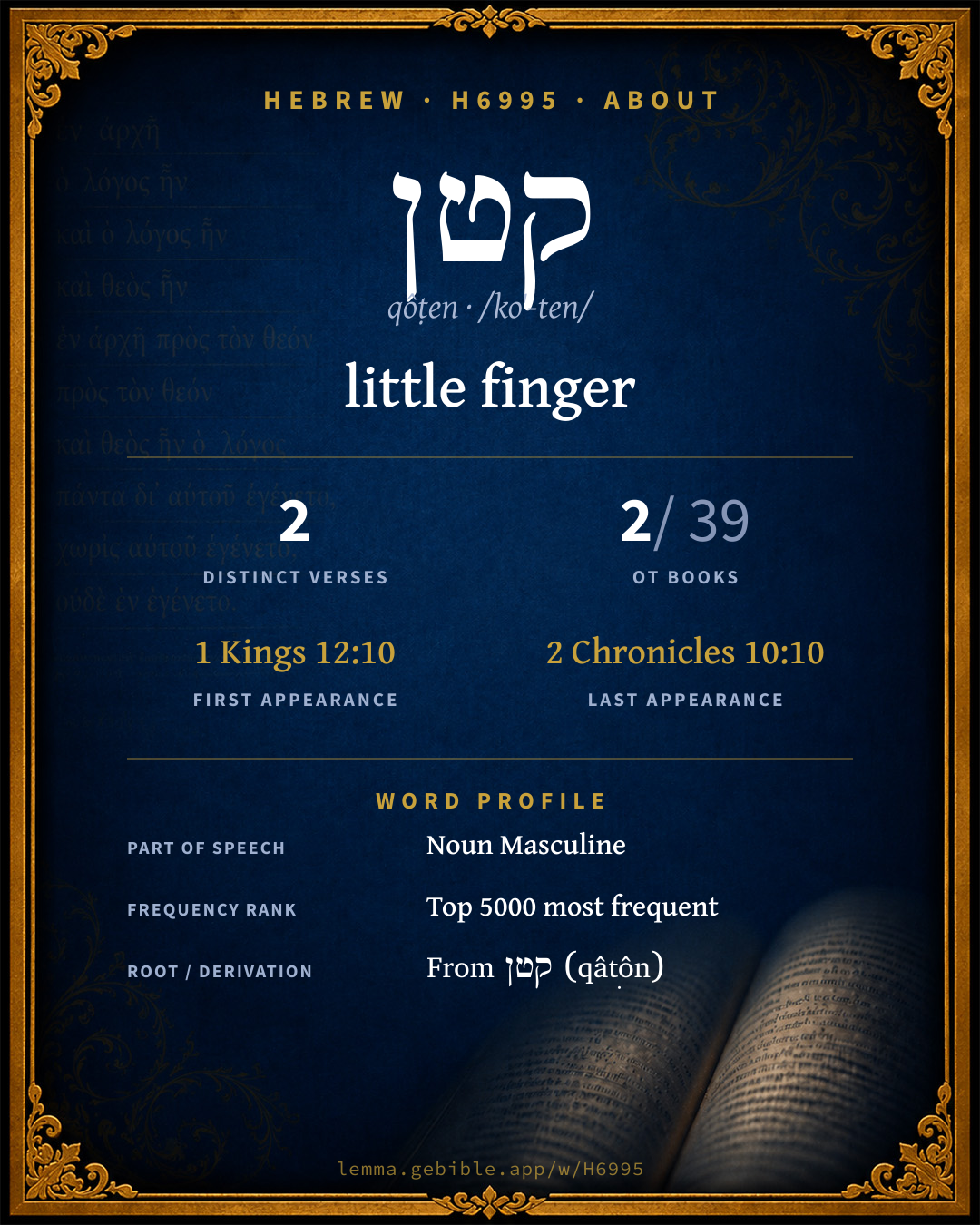
קְטֹן
little finger
Full lexicon entry — Brown-Driver-Briggs (BDB)
From Brown-Driver-Briggs (BDB)
Where this word appears
Grammar key — what these labels mean
Part of speech
- Noun
- A naming word — a person, place, thing, or idea.
Noun type
- Common
- A common noun — a general class of person, place, or thing (“king,” “city,” “water”), not a specific name.
State
- Construct
- A noun bound to a following noun in a possessive / “of” relationship (the construct chain).
Gender
- Masculine
- Grammatically masculine.
Number
- Singular
- One.
Every verse where H6995 appears in the Book of 1 Kings — 1 distinct verse. Click any verse to open its interlinear word-by-word view. Verse text shown in the World English Bible for context — . Each verse’s Hebrew form is shown with its reference; the English is not keyword-highlighted, since the data carries no word-level English alignment. Use “Compare translations” on any verse to read it across multiple English versions. This concordance covers the Hebrew Bible; Septuagint (Greek Old Testament) occurrences are not indexed here.
1 Kings
About this entry
At a glance — auto-summarized from this page’s data, not written by a person. Every figure links to its source below. This summary describes the numbers; it doesn’t interpret them.
At its core, קטן (qôṭen) means “little finger.” A scarce word — 2 verses in all of the Hebrew Bible. The word gravitates to 1 Kings (50%), then 2 Chronicles. Scripture first uses it in 1 Kings 12:10. It clusters with קטן and יקטן under a shared root. Each statement above links to its evidence; the full detail follows below.
Gloss history
Strong's 1890 vs modern scholarship
About this word
Strong's H6995 catalogs a Hebrew word from the Hebrew Old Testament.
These counts are not copied from any lexicon or concordance. They are computed here, from the morphology-tagged Hebrew Old Testament. What Lemma adds →
- 2
- distinct verses
- The word appears in 2 distinct verses.
- 2 / 39
- OT books
- The word appears in 2 of 39 Old Testament books.
- #4,807
- by frequency
- Top 5000 most frequent Hebrew words (rank 4,807 of 8,640 Hebrew words by occurrence).
View all 2 occurrences in the concordance →
Most concentrated in
- 1 Kings 1 verse 50%
- 2 Chronicles 1 verse 50%
By section of the Old Testament
By traditional corpus
Conventional, traditional groupings — biblical authorship is debated, so this is a traditional corpus grouping, not an authorship claim. Each share is this word’s portion of its verses in that division of the Hebrew canon. Each figure is a share of the word’s 2 distinct verses.
- Prophets (Nevi'im) 1 verse · 50%
- Writings (Ketuvim) 1 verse · 50%
How translations render this word
Counts come from each version’s own published word-to-Strong’s tagging or interlinear alignment — an approximate guide to how each version renders this word, not a word-level alignment the data otherwise carries. Because each total is that version’s own tagged count, the per-version totals vary from one another and need not match the appearance or distinct-verse counts above. These counts may also differ from a printed concordance because Lemma counts each distinctly tagged rendering and does not collapse phrase taggings into a single head-word total. This is a fixed set of word-tagged versions (KJV, ASV, BSB, ULT) and does not change with the reading translation you choose elsewhere. Each version’s license is shown beside its name below (and on Sources).
- King James Version: Little 2×
- American Standard Version: Shalt thou say unto them 1×, Shalt thou speak unto them 1×
- Berean Standard Bible: Little finger 2×
- unfoldingWord Literal Text: Little finger 2×
King James Version Public Domain
Renders H6995 across 2 tagged occurrences — most commonly:
American Standard Version Public Domain
Renders H6995 across 2 tagged occurrences — most commonly:
Berean Standard Bible Public Domain
Renders H6995 across 2 tagged occurrences — most commonly:
unfoldingWord Literal Text CC BY-SA 4.0
Renders H6995 across 2 tagged occurrences — most commonly:
Senses in BDB
The 1 sense BDB distinguishes for this word, in lexicon order (not ranked by frequency or importance). The full entry — with sub-senses — is in the Lexicon Entry tab.
- little finger
Word origin
[ קְטֹן ] n.m. little (finger)
— Brown-Driver-Briggs (Oxford 1906, public domain), digitized via Sefaria, supplemented by the OpenScriptures HebrewLexicon (CC BY 4.0). See Sources.
Derived from קטן (qâṭôn) (H6994) — to diminish.
Jastrow Dictionary
A second Hebrew/Aramaic lexicon for comparison, covering Aramaic and post-biblical (Talmudic, Targumic, Midrashic) usage that the biblical-Hebrew BDB does not. Matched by lemma rather than by Strong’s number, so a lemma may carry more than one Jastrow headword (shown separately below), and the entries cover usage well beyond the Bible.
קטן
- , Yalk. Sam. 124, ק׳ השמן, read: קִיתוֹן.
קֹטֶן
- , v. קוֹטֶן
קָטֹן
- (b. h.) to be short, small, inferior. Gen. R. s. 76 (expl. קטנתי, Gen. XXXII, 11) איני כדאי … כדאי אני אכל קָטֹנְתִּי מכל וכ׳ I am not deserving (of any of the mercies &c.); R. L. says, I am deserving, but I am too small for (unworthy of) all the mercies &c. e.g. Genesis 32:11
- 1. to make small; to subordinate. B. Bath. 90ᵇ מַקְטִינֵי איפה those who make the Ephah (measure) small (Am. VIII, 5). Y. Sot. IX, 24ᵇ Samuel was surnamed ‘the small’, לפי שהוא מַקְטִין את עצמו because he made himself small (bore himself humbly). Gen. R. s. 37 (play on יקטן, Gen. X, 25) מקטין את עסקיו made his affairs small (was contented with subordinate services); מקטין את עצמו ואת עסקיו subordinated himself and his affairs, v. צָעַר. Meg. 11ᵃ, v. קַטְנוּת; a. e. e.g. Amos 8:5
- 2. to grow smaller, be narrower. Lev. R. s. 31 מַקְטִינוֹת, v. רָחב; Pesik. Ḳumi, p. 145ᵃ; ib. 145ᵇ מקיטנות (corr. acc.).
- to shrink. Snh. 81ᵇ עד שיוּקְטָן, v. מַעְיָן.
- to be reduced, become less. Tosef. Sot. XV, 5 Var. משמת … נִתְקַטְּנָה חסידות וכ׳ when Abba José ben Ḳiṭnith died, piety became rare in Israel; v. קִיטּוּנְתָּא.
קָטָן
- preced.) small, young; inferior. Y. Kil. IV, beg. 29ᵃ. Ab. IV, 19, a. fr. שמואל הק׳ Samuel the junior; Y. Sot. IX, 24ᵇ, v. preced. Yeb. II, 8 הק׳ a younger brother. Gen. R. s. 37 ומה אם הק׳ שהוא מקטין וכ׳ if an inferior person that is contented with a subordinate position (v. preced.) is thus rewarded, how much more a great man &c. Gen. R. s. 93 קְטַנָּן של שבטים one of the youngest of the tribes; Yalk. ib. 152 (not קטנו); Yalk. Ps. 762; a. fr.—Esp. minor, a boy under thirteen, a girl under twelve years. Gitt. 65ᵃ שלש מדות בק׳ וכ׳ there are three legal stages of a minor: when he throws away a pebble &c., v. צְרוֹר II; וכנגדן בק׳ מתקדשת וכ׳ and in the corresponding stage a girl may be betrothed subject to protest (מִיאוּן). Ib. II, 6 קבל הק׳ והגדיל if he received a letter of divorce (as a carrier) while he was a minor, and reached majority before delivery. Ber. 47ᵇ; a. fr.—Sot. 22ᵃ (among those who are a ruin to the world) ק׳ שלא כלו לו וכ׳ a child whose months are not complete (a prematurely born child), expl. ib. ‘a student who disregards his teacher’, or ‘a student who constitutes himself a teacher before regular ordination.’—Pl. קְטַנִּים; קְטַנּוֹת. Tosef. Snh. XIII, 1 קטנים בני רשעי ארץ ed. Zuck. (Var. קְטַנֵּי) children of the wicked of the land that died in childhood; Snh. 110ᵇ; Y. Shebi. IV, end, 35ᶜ ק׳ ישראל children of Israelites (that died); ק׳ גוים of gentiles. Keth. II, 3 ק׳ היינו we were minors (when we signed as witnesses). Ib. VII, 9 מומין הק׳ minor physical blemishes. Sot. 48ᵇ ק׳ אמנה, v. אֲמָנָה. Ib. 49ᵇ מק׳ חסידים of the youngest (last) of the pious men (v. next w.); a. fr.—Euphem. קְטַנִּים (sub. נקבים) the minor functions of the body, urinating. Ber. 23ᵇ; a. fr.
A Dictionary of the Targumim, the Talmud Babli and Yerushalmi, and the Midrashic Literature (Marcus Jastrow; London, Luzac, 1903) — Public Domain. Digitized via Sefaria. Digitized via Sefaria. Full attribution on Sources.
Same root — word family
Other BDB entries built from the same root as H6995, grouped by Strong’s listed origin. These share a root / origin per the lexicon — not necessarily a shared meaning. Each links to that word’s own entry.
Derives from
Proper names from this root
People and places named from this root — a name, not an additional meaning of the word.
Compare all same-root words → 1 of the same-root words is a proper name (a person or place). They share a root, not necessarily a meaning.
Septuagint verse parallels
This word appears in 2 verses that also exist in the Greek Old Testament (Septuagint), out of the 2 Hebrew verses it occurs in. You can read those verses in Greek by switching the Old Testament edition to the Septuagint.
Read these verses in the Septuagint
This is a verse-level parallel only — the same verses exist in both the Hebrew and Greek Old Testaments. No word-level Hebrew↔Greek correspondence is claimed: the data carries no such alignment, so no Greek word is shown as this Hebrew word’s translation. Coverage is not total — the Septuagint omits the deuterocanon and renumbers the Psalms, so some Hebrew verses have no direct Greek parallel.