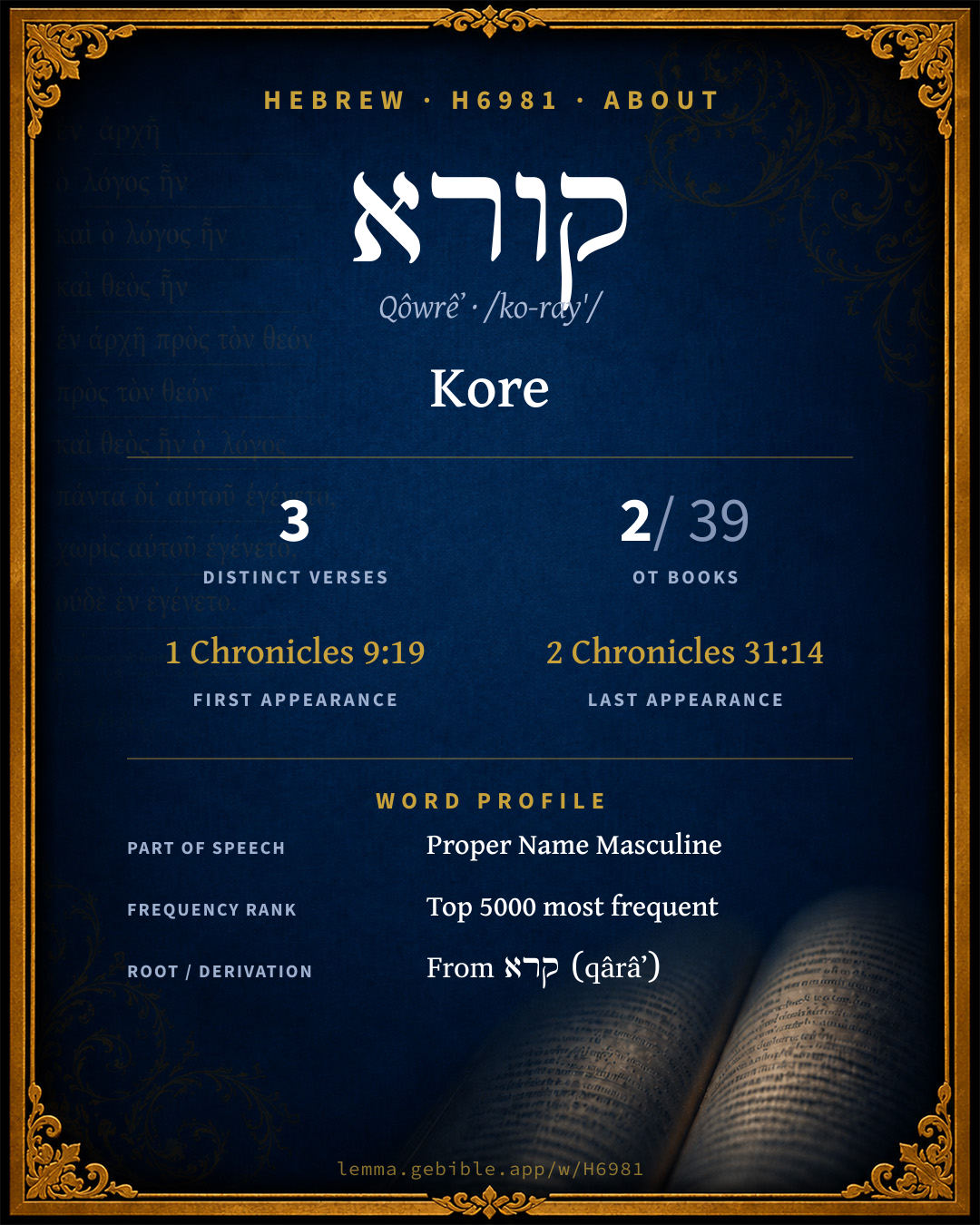
קוֹרֵא
Kore
BDB lists 3 entries for ‘Kore’ fuller range ↓
Full lexicon entry — Brown-Driver-Briggs (BDB)
From Brown-Driver-Briggs (BDB)
Where this word appears
Grammar key — what these labels mean
Part of speech
- Noun
- A naming word — a person, place, thing, or idea.
Noun type
- Proper
- A name of a specific person, place, or people (e.g. Abraham, Zion, Israel).
Every verse where H6981 appears in the Book of 2 Chronicles — 1 distinct verse. Click any verse to open its interlinear word-by-word view. Verse text shown in the World English Bible for context — . Each verse’s Hebrew form is shown with its reference; the English is not keyword-highlighted, since the data carries no word-level English alignment. Use “Compare translations” on any verse to read it across multiple English versions. This concordance covers the Hebrew Bible; Septuagint (Greek Old Testament) occurrences are not indexed here.
2 Chronicles
About this entry
At a glance — auto-summarized from this page’s data, not written by a person. Every figure links to its source below. This summary describes the numbers; it doesn’t interpret them.
קורא — transliterated Qôwrêʼ — is a Hebrew name carrying the sense “Kore.” It is rare — just 3 verses in the entire Hebrew Bible. More than two-thirds of its appearances fall in 1 Chronicles. Debuting at 1 Chronicles 9:19, it then recurs through the corpus. See 3-verse concordance and the renderings breakdown below.
Gloss history
Strong's 1890 vs modern scholarship
About this word
Strong's H6981 catalogs a Hebrew word from the Hebrew Old Testament.
These counts are not copied from any lexicon or concordance. They are computed here, from the morphology-tagged Hebrew Old Testament. What Lemma adds →
- 3
- distinct verses
- The word appears in 3 distinct verses.
- 2 / 39
- OT books
- The word appears in 2 of 39 Old Testament books.
- #4,179
- by frequency
- Top 5000 most frequent Hebrew words (rank 4,179 of 8,640 Hebrew words by occurrence).
View all 3 occurrences in the concordance →
Most concentrated in
- 1 Chronicles 2 verses 67%
- 2 Chronicles 1 verse 33%
By section of the Old Testament
By traditional corpus
Conventional, traditional groupings — biblical authorship is debated, so this is a traditional corpus grouping, not an authorship claim. Each share is this word’s portion of its verses in that division of the Hebrew canon. Each figure is a share of the word’s 3 distinct verses.
- Writings (Ketuvim) 3 verses · 100%
How translations render this word
Counts come from each version’s own published word-to-Strong’s tagging or interlinear alignment — an approximate guide to how each version renders this word, not a word-level alignment the data otherwise carries. Because each total is that version’s own tagged count, the per-version totals vary from one another and need not match the appearance or distinct-verse counts above. These counts may also differ from a printed concordance because Lemma counts each distinctly tagged rendering and does not collapse phrase taggings into a single head-word total. This is a fixed set of word-tagged versions (KJV, ASV, BSB, ULT) and does not change with the reading translation you choose elsewhere. Each version’s license is shown beside its name below (and on Sources).
BDB lists this Strong’s number as 2 distinct words (homographs). Each count above pools all of them and is not split by sense — see the Senses section below. A low-frequency rendering may belong to a different one of those words, not the primary meaning.
- King James Version†: Kore 3×
- American Standard Version†: Kore 3×
- Berean Standard Bible†: Kore 3×
- unfoldingWord Literal Text†: Kore 3×
King James Version Public Domain
Renders H6981 across 3† tagged occurrences — most commonly:
American Standard Version Public Domain
Renders H6981 across 3† tagged occurrences — most commonly:
Berean Standard Bible Public Domain
Renders H6981 across 3† tagged occurrences — most commonly:
unfoldingWord Literal Text CC BY-SA 4.0
Renders H6981 across 3† tagged occurrences — most commonly:
Senses in BDB
The 3 senses BDB distinguishes for this word, in lexicon order (not ranked by frequency or importance). The full entry — with sub-senses — is in the Lexicon Entry tab.
- Kore = "crier"
- a Korahite Levite, ancestor of Shallum and Meshelemiah, chief porters in the reign of David
- a Levite, son of Imnah, in the reign of king Hezekiah of Judah
Word origin
I. or קֹוֵא n.pr.terr. Ḳuë in Cilicia (cf. KAT2. 257); מִקֹּוֶה from Ḳuë, for MT מִקְוֵה 1 K 10:28(×2) and ‖ מִקְוֵא 2 Ch 1:16(×2); so Wkl Alttest. Unters. 173 Gr Benz Kit, cf. 𝔊 ἐκ Θεκουε (also ἐκ Κωα Field Hexapla i. 616), 𝔙 de Coa, Κωδ LagOnom. 273, Jer Coa id. ibid. 111.
I. n.m. Je 17:11 usually partridge (from calling; v. Gray in FFP 123 PostHastings DB s.v. TristrMoab 129, 144 f.; otherwise BoHieroz. Pt. 2, 81 ff.; ed. Rosenm. vol. ii. 632 ff.);—1 S 26:20; Je 17:11, cf. עֵין הַקּוֹ׳ Ju 15:19.
— Brown-Driver-Briggs (Oxford 1906, public domain), digitized via Sefaria, supplemented by the OpenScriptures HebrewLexicon (CC BY 4.0). See Sources.
Derived from קרא (qârâʼ) (H7121) — to call.
Jastrow Dictionary
A second Hebrew/Aramaic lexicon for comparison, covering Aramaic and post-biblical (Talmudic, Targumic, Midrashic) usage that the biblical-Hebrew BDB does not. Matched by lemma rather than by Strong’s number, so a lemma may carry more than one Jastrow headword (shown separately below), and the entries cover usage well beyond the Bible.
קוֹרָא I
- Targ. Gen. VIII, 22 (O. ed. Berl. קוּ׳). Targ. Job XXIV, 7. Targ. Ps. CXLVII, 17; a. e.
קוֹרָא II
- = h. קוֹר I. Ber. 36ᵃ דקלא … אדעתא דק׳ people do not plant palms with the view of using the ‘heart’ (by the cutting of which the tree is ruined); Erub. 28ᵇ דקורה. Y. Ber. VI, 10ᵇ bot. Bab. Ber. 43ᵇ (prov.) תלה ליה ק׳ לדבר אחר וכ׳ hang the heart of a palm tree on a swine, and it will do its own (drag it in the mud). Lev. R. s. 15, end (prov.) [read:] דאכיל בהדין ק׳ ילקי בהדא קילא he who eats of the palm’s heart, will be smitten with the stick (of the dried up palm), i.e. if you enjoy the emoluments of an office, you must not shirk its obligations; Yalk. Esth. 1056 הא קורה והא קילה אכלתון קורה לקון בקילה (not כילה, בכ׳) here is the palm-heart, and here the stick; you have eaten the heart, therefore be smitten with the stick (having done wrong, you must suffer the consequences); Midr. Till. to Ps. XXII הא ק׳ והא קולתא … לקון וכ׳ ed. Bub. (oth. ed. לקתון, corr. acc.).—בר ק׳ a young palm tree. Sabb. 30ᵇ, v. נְבָרָא.—Pl. קוֹרַיָּא. B. Kam. 92ᵃ אייתי לי מִקּוֹרַיְיהוּ bring me of their hearts to eat (let the palms perish) (Ms. F. מוֹקְרַיְיהוּ, v. מוֹקְרָא II; oth. opin. in comment. מְקוֹרַיְיהוּ roots, substance, v. מָקוֹר).
קוֹרָא III
- (נְקַר I) [picker,]
- 1. heron. Gen. R. s. 64, end; Yalk. ib. 111, v. מַקּוֹרָא.—
- *2. young bird.—Pl. קוֹרִין. Targ. Is. XXXIV, 15.
קוֹרָא IV
- = h. קוֹרָה, beam. Tam. 30ᵃ ק׳ עבדא וכ׳ it will produce a (trunk fit for a) beam, but no fruits.—Kel. XI, 2, v. קוֹרָה III.
קוֹרֵא
- partridge. Ḥull. XII, 2 ק׳ זכר a male partridge (which is believed to join the female in brooding). Ib. 140ᵇ ק׳ נקבה a female partridge. Tanḥ. Ki Thetsé 2 הק׳ הזה מביא וכ׳ the partridge brings eggs of other birds and hatches them; a. e.
A Dictionary of the Targumim, the Talmud Babli and Yerushalmi, and the Midrashic Literature (Marcus Jastrow; London, Luzac, 1903) — Public Domain. Digitized via Sefaria. Digitized via Sefaria. Full attribution on Sources.
Forms in the corpus
The 3 distinct written forms H6981 takes in the Hebrew Bible, most frequent first — each parse links to that state’s occurrences in the concordance. Hebrew forms include their vowel points and cantillation, so a single lemma takes many written forms.
| Form | Parsing | Example | Uses |
|---|---|---|---|
| וְ/קוֹרֵ֨א | Noun, Proper | 2 Chronicles 31:14 | 1 |
| ק֠וֹרֵא | Noun, Proper | 1 Chronicles 9:19 | 1 |
| קֹרֵ֖א | Noun, Proper | 1 Chronicles 26:1 | 1 |
Same root — word family
Other BDB entries built from the same root as H6981, grouped by Strong’s listed origin. These share a root / origin per the lexicon — not necessarily a shared meaning. Each links to that word’s own entry.
Derives from
Shares the same root
- מקרא miqrâʼ H4744 convocation
- קרא qᵉrâʼ H7123 to call
- קרא qôrêʼ H7124 partridge
- קריא qârîyʼ H7148 called
- קריאה qᵉrîyʼâh H7150 proclamation
Compare all same-root words → Showing 4 of 7 — not the complete family. They share a root, not necessarily a meaning.
Bible dictionary
Public-domain dictionary articles matched to this entry by name (Kore). A biblical name can be shared by more than one person or place, so an article may treat several.
Easton's Bible Dictionary · M. G. Easton, 1897
Partridge. (1.) A Levite and temple-warder of the Korahites, the son of Asaph. He was father of Shallum and Meshelemiah, temple-porters (1 Chr. 9:19; 26:1).
(2.) A Levitical porter at the east gate of the temple (2 Chr. 31:14).
(3.) In 1 Chr. 26:19 the word should be "Korahites," as in the Revised Version.
Smith's Bible Dictionary · William Smith, 1863
(partridge).
+ A Korahite, ancestor of Shallum and Meshelemiah, chief porters in the reign of David. (1 Chronicles 9:19; 26:1) (B.C. 1014.) + Son of Imnah, a Levite in the reign of Hezekiah. He had charge of the offerings. (2 Chronicles 31:14) (B.C. 726.) + In the Authorized Version of (1 Chronicles 26:19) "the sons of Kore" (following the Vulgate Core) should properly be "the sons of the Korhite."
Classic public-domain reference works; full attribution on Sources.
Septuagint verse parallels
This word appears in 3 verses that also exist in the Greek Old Testament (Septuagint), out of the 3 Hebrew verses it occurs in. You can read those verses in Greek by switching the Old Testament edition to the Septuagint.
Read these verses in the Septuagint
This is a verse-level parallel only — the same verses exist in both the Hebrew and Greek Old Testaments. No word-level Hebrew↔Greek correspondence is claimed: the data carries no such alignment, so no Greek word is shown as this Hebrew word’s translation. Coverage is not total — the Septuagint omits the deuterocanon and renumbers the Psalms, so some Hebrew verses have no direct Greek parallel.