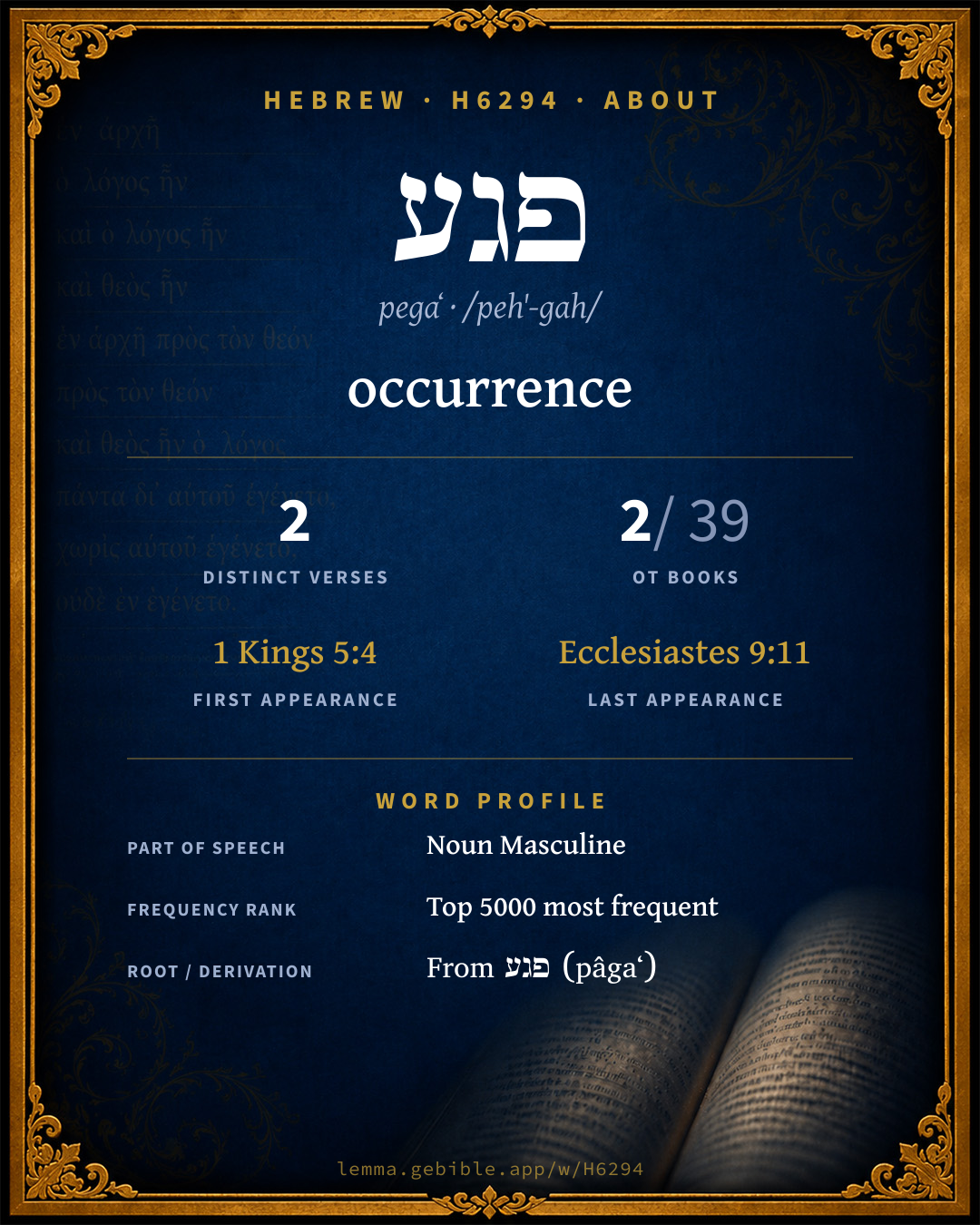
פֶּ֫גַע
occurrence
Full lexicon entry — Brown-Driver-Briggs (BDB)
From Brown-Driver-Briggs (BDB)
Where this word appears
Grammar key — what these labels mean
Part of speech
- Noun
- A naming word — a person, place, thing, or idea.
Noun type
- Common
- A common noun — a general class of person, place, or thing (“king,” “city,” “water”), not a specific name.
State
- Absolute
- The independent form of a noun, not bound to a following word.
Gender
- Masculine
- Grammatically masculine.
Number
- Singular
- One.
Every verse where H6294 appears in the Book of Ecclesiastes — 1 distinct verse. Click any verse to open its interlinear word-by-word view. Verse text shown in the World English Bible for context — . Each verse’s Hebrew form is shown with its reference; the English is not keyword-highlighted, since the data carries no word-level English alignment. Use “Compare translations” on any verse to read it across multiple English versions. This concordance covers the Hebrew Bible; Septuagint (Greek Old Testament) occurrences are not indexed here.
Ecclesiastes
About this entry
At a glance — auto-summarized from this page’s data, not written by a person. Every figure links to its source below. This summary describes the numbers; it doesn’t interpret them.
At its core, פגע (pegaʻ) means “occurrence.” It is rare — just 2 verses in the entire Hebrew Bible. Its uses cluster heavily in 1 Kings (50% of all occurrences). Scripture first uses it in 1 Kings 5:4. Sharing its root, it stands alongside פגע, מפגע and פגעיאל. Each statement above links to its evidence; the full detail follows below.
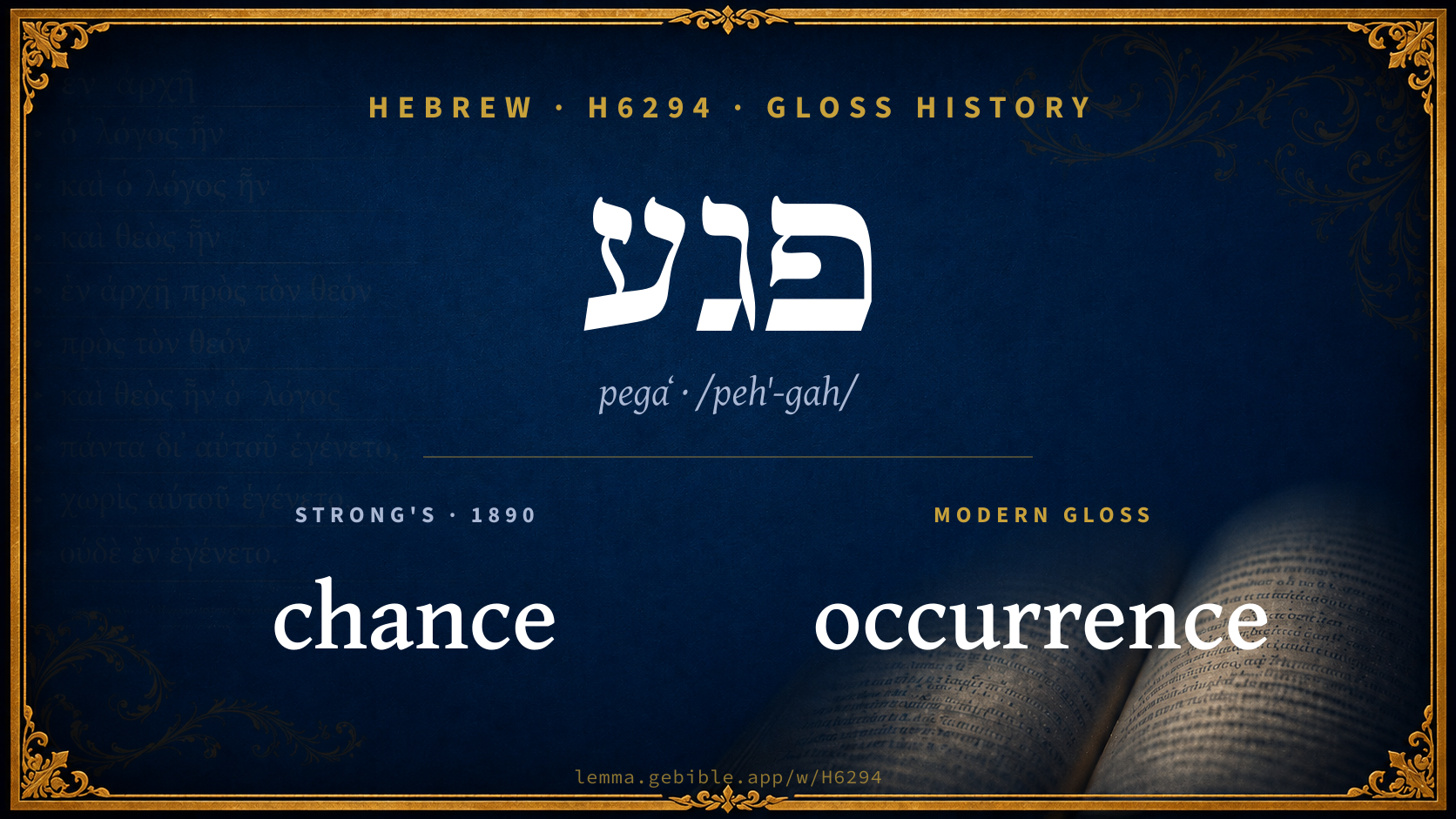
Gloss history
Strong's 1890 vs modern scholarship
About this word
Strong's H6294 catalogs a Hebrew word from the Hebrew Old Testament.
These counts are not copied from any lexicon or concordance. They are computed here, from the morphology-tagged Hebrew Old Testament. What Lemma adds →
- 2
- distinct verses
- The word appears in 2 distinct verses.
- 2 / 39
- OT books
- The word appears in 2 of 39 Old Testament books.
- #4,807
- by frequency
- Top 5000 most frequent Hebrew words (rank 4,807 of 8,640 Hebrew words by occurrence).
View all 2 occurrences in the concordance →
Most concentrated in
- 1 Kings 1 verse 50%
- Ecclesiastes 1 verse 50%
By section of the Old Testament
By traditional corpus
Conventional, traditional groupings — biblical authorship is debated, so this is a traditional corpus grouping, not an authorship claim. Each share is this word’s portion of its verses in that division of the Hebrew canon. Each figure is a share of the word’s 2 distinct verses.
- Prophets (Nevi'im) 1 verse · 50%
- Writings (Ketuvim) 1 verse · 50%
How translations render this word
Counts come from each version’s own published word-to-Strong’s tagging or interlinear alignment — an approximate guide to how each version renders this word, not a word-level alignment the data otherwise carries. Because each total is that version’s own tagged count, the per-version totals vary from one another and need not match the appearance or distinct-verse counts above. These counts may also differ from a printed concordance because Lemma counts each distinctly tagged rendering and does not collapse phrase taggings into a single head-word total. This is a fixed set of word-tagged versions (KJV, ASV, BSB, ULT) and does not change with the reading translation you choose elsewhere. Each version’s license is shown beside its name below (and on Sources).
- King James Version: Chance 1×, Occurrent 1×
- American Standard Version: Chance 1×, Occurrence 1×
- Berean Standard Bible: Chance 1×, Or crisis 1×
- unfoldingWord Literal Text: Occurrence 2×
King James Version Public Domain
Renders H6294 across 2 tagged occurrences — most commonly:
American Standard Version Public Domain
Renders H6294 across 2 tagged occurrences — most commonly:
Berean Standard Bible Public Domain
Renders H6294 across 2 tagged occurrences — most commonly:
unfoldingWord Literal Text CC BY-SA 4.0
Renders H6294 across 2 tagged occurrences — most commonly:
Senses in BDB
The 1 sense BDB distinguishes for this word, in lexicon order (not ranked by frequency or importance). The full entry — with sub-senses — is in the Lexicon Entry tab.
- occurrence, happening, chance
Word origin
n.m. occurrence, chance;—abs. פ׳ 1 K 5:18 evil occurrence; Ec 9:11 time and chance.
— Brown-Driver-Briggs (Oxford 1906, public domain), digitized via Sefaria, supplemented by the OpenScriptures HebrewLexicon (CC BY 4.0). See Sources.
Derived from פגע (pâgaʻ) (H6293) — to meet.
Jastrow Dictionary
A second Hebrew/Aramaic lexicon for comparison, covering Aramaic and post-biblical (Talmudic, Targumic, Midrashic) usage that the biblical-Hebrew BDB does not. Matched by lemma rather than by Strong’s number, so a lemma may carry more than one Jastrow headword (shown separately below), and the entries cover usage well beyond the Bible.
פָּגַע
- (b. h.)
- 1. to strike against, come in contact with, meet; (in a hostile sense) to attack, strike. Tanḥ. Vayishl. 4 כיון שפ׳ בעשו when he met Esau. Gen. R. s. 75 פ׳ בלובשי ברזל he met those clad in iron armor. Succ. 52ᵇ, a. e. אם פ׳ בך מנוול זה, v. נָוַול. Y. Kidd. III, 64ᵈ bot. ולמה לא פָּגַעְתָּה בו (not ביה) why didst thou not connect thyself with him? Num. R. s. 5 כדי שלא תִפְגַּע בכולם מדת הדין וכ׳ (not יפגע) in order that divine justice might not strike all of them, he took half of his name (the letter ה) &c. Ex. R. s. 5, end בקשה … לִפְגּוֹעַ במשה divine justice wanted to strike Moses. Koh. R. to IX, 11 עת היא שפּוֹגַעַת באדם וכ׳ (not האדם), v. עִרְעֵר III.
- 2. to beseech, entreat. Gen. R. s. 68 (ref. to Gen. XXVIII, 11) וַיִּפְגַּע במקום … מפני מה וכ׳ ‘and he entreated the Lord’ … why is the Lord surnamed maḳom? (v. מָקוֹם). Ib. מהו ויפגע במקום צלי וכ׳ what does vayifgʿa bammaḳom mean? He prayed on the site of the Temple; a. e.—Part. pass. פָּגוּעַ; pl. פְּגוּעִין stricken, afflicted (with insanity). Y. Sabb. VI, 8ᵇ top, v. פֶּגַע. e.g. Genesis 28:11
- to be stricken; to suffer. Ib. משנ׳ after one has been stricken; Y. Erub. X, 26ᶜ bot. Ḥag. 14ᵇ; Tosef. ib. II, 3 הציץ ונ׳ he looked (into the divine secrets, v. פַּרְדֵּס) and became demented; Y. ib. II, 77ᵇ top. Sabb. 13ᵇ אין שוטה נ׳ a maniac cannot be stricken with dementia (one overladen with sorrows becomes indifferent to new afflictions); a. e.
- 1. to cause suffering, afflict, v. מַפְגִּיעַ.
- 2. to suffer. Koh. R. l. c. עת … והוא מַפְגִּיעַ time strikes man …, and he suffers, v. עִרְעֵר III.
- 3. to entreat. Ib. פעמים שאדם מפגיע וכ׳ at times man prays and is answered &c.
פְּגַע I
- 1. to meet. Targ. Prov. XVII, 12 (h. text פגוש). Ib. XXIX, 13 (Var. פגיחו); a. e.—Gen. R. s. 36, beg. פ׳ ביה שידא וכ׳ the demon Sh’madon met him; Yalk. ib. 61; Lev. R. s. 5 פ׳ ליה וכ׳ (corr. acc.). B. Kam. 99ᵇ פַּגְעוּ ביה … גברא R. K. and R. A. met that man. Ber. 58ᵇ. Y. Kidd. III, 64ᵈ bot. יאות עביד דלא פ׳ ביה he did right not to connect himself with that man. Ib. top דלא תִפְגַּע בהון, v. פְּסוּלָא I; a. fr.
- 2. to plague. Gen. R. s. 58; Yalk. ib. 102 פַּגְעוּנֵיה, v. סְרַס.
- to intercede, pray. Targ. Esth. IV, 14.
- to happen. Y. Ber. II, 5ᶜ bot. ומִתְפְּגַע ביה and it happened to him (he died).
פֶּגַע
- preced.) contact, accident, (evil) occurence; affliction, plague. Ber. 17ᵃ ותצילני מפ׳ רע and save me from meeting with evil; a. e.—Pl. פְּגָעִים, פְּגָעִין evil spirits. Shebu. 15ᵇ (expl. בשיר, Mish. ib. II, 2) the song of thanksgiving (Ps. XXX) ושיר של פ׳ וכ׳ and the song referring to evil spirits (Ps. XCI, 1—9), and some call it song of n’gaʿim (plagues, with ref. to ונגע, ib. 10); Y. Erub. X, 26ᶜ bot. אומרין היו שיר של פ׳ וכ׳ they used to recite the ‘song of demons’ in Jerusalem (in the Temple, when one was threatened with insanity); Y. Sabb. VI, 8ᵇ top שיר פגועין, the song for the stricken. Midr. Till. to Ps. XCI שיר של פ׳ היה אומר משה וכ׳ Moses recited the ninety-first psalm on ascending the heavens, when he said &c. e.g. Psalms 91:1
פְּגַע II
- 1. evil occurrence, plague. Targ. I Kings V, 18.—Pl. פְּגָעִין. Ruth R. to I, 16 (ref. to אל תפגעי ib., as if it were תִּפָּגְעִי) לא תחטא עלי לא תסבין פ׳ מני (not פגעיך) do not commit a sin through me, do not suffer afflictions on my account (by dissuading me from embracing the Jewish faith).
- 2. pl. evil spirits. Targ. II Esth. I, 2.
A Dictionary of the Targumim, the Talmud Babli and Yerushalmi, and the Midrashic Literature (Marcus Jastrow; London, Luzac, 1903) — Public Domain. Digitized via Sefaria. Digitized via Sefaria. Full attribution on Sources.
Forms in the corpus
The 2 distinct written forms H6294 takes in the Hebrew Bible, most frequent first — each parse links to that state’s occurrences in the concordance. Hebrew forms include their vowel points and cantillation, so a single lemma takes many written forms.
| Form | Parsing | Example | Uses |
|---|---|---|---|
| וָ/פֶ֖גַע | Noun, Common, Masculine, Singular, Absolute | Ecclesiastes 9:11 | 1 |
| פֶּ֥גַע | Noun, Common, Masculine, Singular, Absolute | 1 Kings 5:4 | 1 |
Same root — word family
Other BDB entries built from the same root as H6294, grouped by Strong’s listed origin. These share a root / origin per the lexicon — not necessarily a shared meaning. Each links to that word’s own entry.
Derives from
Shares the same root
Proper names from this root
People and places named from this root — a name, not an additional meaning of the word.
Compare all same-root words → 1 of the same-root words is a proper name (a person or place). They share a root, not necessarily a meaning.
Septuagint verse parallels
This word appears in 2 verses that also exist in the Greek Old Testament (Septuagint), out of the 2 Hebrew verses it occurs in. You can read those verses in Greek by switching the Old Testament edition to the Septuagint.
Read these verses in the Septuagint
This is a verse-level parallel only — the same verses exist in both the Hebrew and Greek Old Testaments. No word-level Hebrew↔Greek correspondence is claimed: the data carries no such alignment, so no Greek word is shown as this Hebrew word’s translation. Coverage is not total — the Septuagint omits the deuterocanon and renumbers the Psalms, so some Hebrew verses have no direct Greek parallel.