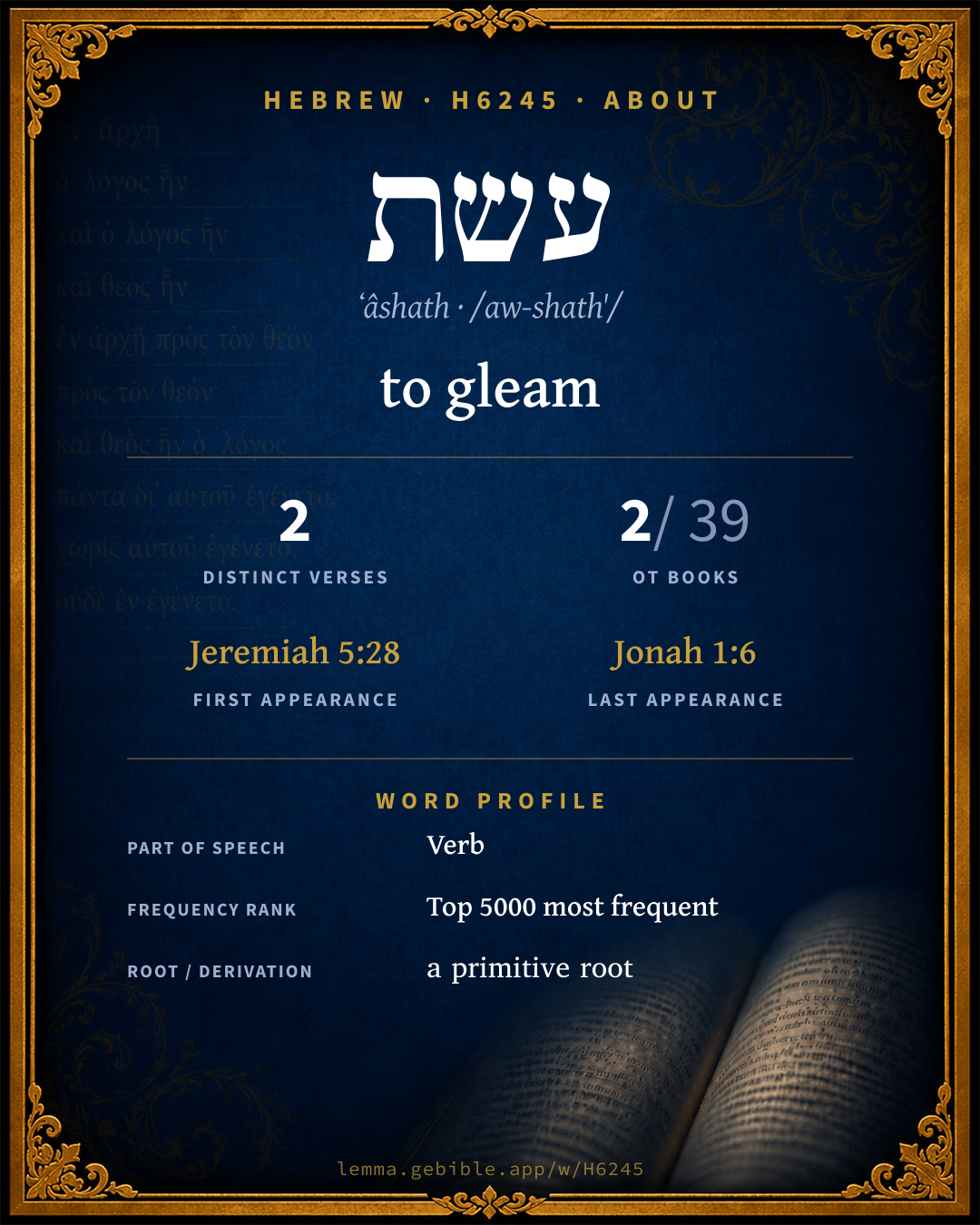
עָשַׁת
to gleam
‘to gleam’ is one of 2 main senses fuller range ↓
Full lexicon entry — Brown-Driver-Briggs (BDB)
From Brown-Driver-Briggs (BDB)
Where this word appears
See every Hithpael verb in the Hebrew Bible →
Grammar key — what these labels mean
Part of speech
- Verb
- An action or state-of-being word.
Stem
- Qal
- The basic, simple active stem — the plain form of the verb (“he wrote”).
- Hithpael
- The reflexive or reciprocal stem (the subject acts on itself).
Form
- Perfect
- A completed action or state — Hebrew marks aspect (completeness) more than strict tense (“he wrote”).
- Imperfect
- An incomplete, ongoing, or future action (“he will / would write”).
Person
- 3rd Person
- The one spoken about (“he / she / it / they”).
Gender
- Common
- Either gender — not distinguished for this form.
- Masculine
- Grammatically masculine.
Number
- Plural
- More than one (in Hebrew, generally three or more).
- Singular
- One.
1 distinct verse where H6245 appears in the Qal stem, across 1 book. Filtered view — show all forms. Click any verse to open its interlinear word-by-word view. Verse text shown in the World English Bible for context — . Each verse’s Hebrew form is shown with its reference; the English is not keyword-highlighted, since the data carries no word-level English alignment. Use “Compare translations” on any verse to read it across multiple English versions. This concordance covers the Hebrew Bible; Septuagint (Greek Old Testament) occurrences are not indexed here.
Jeremiah 1 verse
About this entry
At a glance — auto-summarized from this page’s data, not written by a person. Every figure links to its source below. This summary describes the numbers; it doesn’t interpret them.
“to gleam” is the headline sense of the Hebrew verb עשת (ʻâshath). It is rare — just 2 verses in the entire Hebrew Bible. More than half of its appearances fall in Jeremiah. First canonically at Jeremiah 5:28, it enters the text early. Catalogued under 2 senses, its meaning is not single-sense. The sections below give every sense, occurrence, and version rendering.
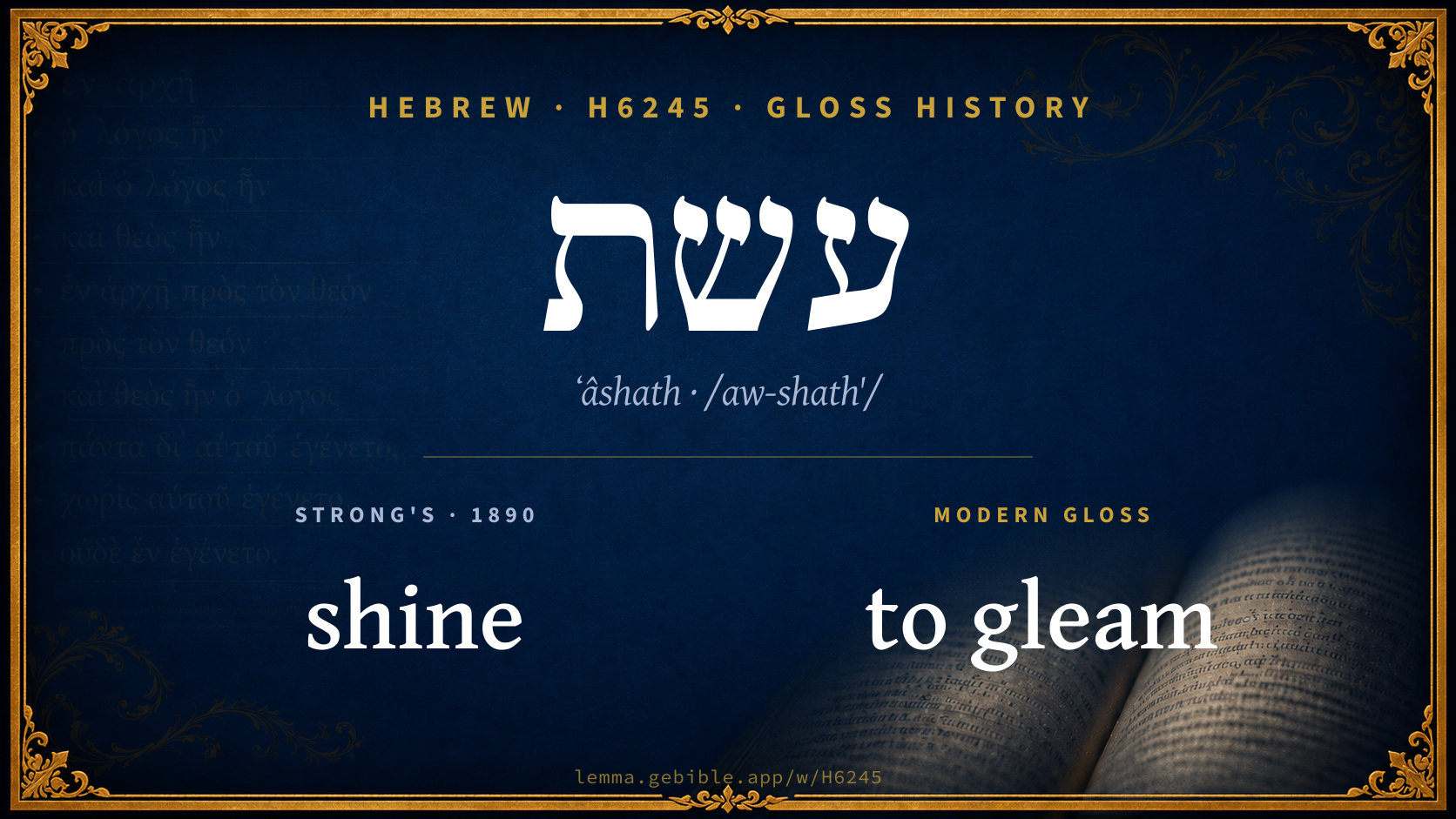
Gloss history
Strong's 1890 vs modern scholarship
About this word
Strong's H6245 catalogs a Hebrew word from the Hebrew Old Testament.
These counts are not copied from any lexicon or concordance. They are computed here, from the morphology-tagged Hebrew Old Testament. What Lemma adds →
- 2
- distinct verses
- The word appears in 2 distinct verses.
- 2 / 39
- OT books
- The word appears in 2 of 39 Old Testament books.
- #4,807
- by frequency
- Top 5000 most frequent Hebrew words (rank 4,807 of 8,640 Hebrew words by occurrence).
View all 2 occurrences in the concordance →
By traditional corpus
Conventional, traditional groupings — biblical authorship is debated, so this is a traditional corpus grouping, not an authorship claim. Each share is this word’s portion of its verses in that division of the Hebrew canon. Each figure is a share of the word’s 2 distinct verses.
- Prophets (Nevi'im) 2 verses · 100%
How translations render this word
Counts come from each version’s own published word-to-Strong’s tagging or interlinear alignment — an approximate guide to how each version renders this word, not a word-level alignment the data otherwise carries. Because each total is that version’s own tagged count, the per-version totals vary from one another and need not match the appearance or distinct-verse counts above. These counts may also differ from a printed concordance because Lemma counts each distinctly tagged rendering and does not collapse phrase taggings into a single head-word total. This is a fixed set of word-tagged versions (KJV, ASV, BSB, ULT) and does not change with the reading translation you choose elsewhere. Each version’s license is shown beside its name below (and on Sources).
BDB lists this Strong’s number as 2 distinct words (homographs). Each count above pools all of them and is not split by sense — see the Senses section below. A low-frequency rendering may belong to a different one of those words, not the primary meaning.
- King James Version†: They shine 1×, Will think 1×
- American Standard Version†: They shine 1×, Will think 1×
- Berean Standard Bible†: Sleek 1×, Will consider 1×
- unfoldingWord Literal Text†: They are sleek 1×, Will notice 1×
King James Version Public Domain
Renders H6245 across 2† tagged occurrences — most commonly:
American Standard Version Public Domain
Renders H6245 across 2† tagged occurrences — most commonly:
Berean Standard Bible Public Domain
Renders H6245 across 2† tagged occurrences — most commonly:
unfoldingWord Literal Text CC BY-SA 4.0
Renders H6245 across 2† tagged occurrences — most commonly:
Senses in the full BDB
What do BDB’s symbols mean?
BDB uses these scholarly abbreviations:
| Symbol | Meaning |
|---|---|
| 𝔊 | the Septuagint (the ancient Greek translation, LXX) |
| 𝔙 | the Vulgate (the Latin translation) |
| 𝔖 | the Syriac version (the Peshitta) |
| 𝔗 | the Targum (the Aramaic translation) |
| ψ | the Psalms |
| √ | root (the underlying root or stem) |
| ‖ | parallel passage (a synonymous or contrasted parallel) |
| † | the dagger: every passage where the word occurs is cited |
The 0 senses and sub-senses the full Brown-Driver-Briggs lexicon distinguishes for this word, in lexicon order (not ranked by frequency), with BDB’s own verbatim wording and sub-sense lettering. Shown in Hebrew script with BDB’s own scholarly abbreviations. The condensed entry is in the Lexicon Entry tab. See also the Forms in the corpus table below.
עשת I be smooth, shiny
עשת II think
Senses from the full Brown-Driver-Briggs lexicon (Brown, Driver, Briggs; Oxford 1906 — public domain), digitized via Sefaria, supplemented by the OpenScriptures HebrewLexicon (CC BY 4.0). Full attribution on Sources.
Word origin
I. עָשַׁת be smooth or shiny (?)
II. עָשַׁת Hithp. think
— Brown-Driver-Briggs (Oxford 1906, public domain), digitized via Sefaria, supplemented by the OpenScriptures HebrewLexicon (CC BY 4.0). See Sources.
Origin: a primitive root
Jastrow Dictionary
A second Hebrew/Aramaic lexicon for comparison, covering Aramaic and post-biblical (Talmudic, Targumic, Midrashic) usage that the biblical-Hebrew BDB does not. Matched by lemma rather than by Strong’s number, so a lemma may carry more than one Jastrow headword (shown separately below), and the entries cover usage well beyond the Bible.
עֲשַׁת
- (cmp. עשש) to make strong, harden, forge.—[Dan. VI, 4 עֲשִׁית firmly determined.] e.g. Daniel 6:4
- (denom. of תעשת = next w.) to forge; trnsf. (cmp. חָרַשׁ) to plan, devise. Targ. Is. XXXII, 6. Ib. XXXIII, 11. Targ. Jer. V, 26. Targ. II Sam. XX, 15.
עֶשֶׁת
- , v. עֲשָׁשִׁית) wrought metal, bar; polished block. Kel. XI, 3, opp. to חֲרָרָה. Tosef. Ḥull. I, 18; Tosef. Men. IX, 18 מנורה … אלא מן הע׳ the candlestick in the Temple is not fit unless made out of a (gold) bar, opp. גְּרוּטָאוֹת; Men. 28ᵃ מן הע׳ ומן הזהב out of a bar and out of gold; Yalk. Ex. 369 מן הע׳ מן הזהב. Ib.; Men. l. c. חצוצרות מן הע׳ מן הכסף the trumpets were made out of silver bars; Tosef. l. c. 19 [read:] אלא מן הע׳ מן הכסף, contrad. to גוש raw ore. Cant. R. to V, 14 מה ע׳ שן זו עושין ממנה כמה יתדות וכ׳ (not זה) as out of a bar of shen (marble?) you make ever so many pegs, spears &c. Yalk. Cant. 991 (ref. to Cant. l. c.) אלו ספרי תורה … לע׳ שן וכ׳ (some ed. לעשות, corr. acc.) this refers to the scrolls of the Law which resemble a column of marble which is adorned with sapphires.—Pl. עַשְׁתּוֹת. Sifré Num. 160 השליך עליו ע׳ וגולמים if he threw at him metal balls or lumps, opp. to כלי; Yalk. ib. 787.
A Dictionary of the Targumim, the Talmud Babli and Yerushalmi, and the Midrashic Literature (Marcus Jastrow; London, Luzac, 1903) — Public Domain. Digitized via Sefaria. Digitized via Sefaria. Full attribution on Sources.
Forms in the corpus
The 2 distinct written forms H6245 takes in the Hebrew Bible, most frequent first — each parse links to that stem’s occurrences in the concordance. Hebrew forms include their vowel points and cantillation, so a single lemma takes many written forms.
| Form | Parsing | Example | Uses |
|---|---|---|---|
| יִתְעַשֵּׁ֧ת | Verb, Hithpael, Imperfect, 3rd Person, Masculine, Singular | Jonah 1:6 | 1 |
| עָשְׁת֗וּ | Verb, Qal, Perfect, 3rd Person, Common, Plural | Jeremiah 5:28 | 1 |
Same root — word family
Other BDB entries built from the same root as H6245, grouped by Strong’s listed origin. These share a root / origin per the lexicon — not necessarily a shared meaning. Each links to that word’s own entry.
Derived from this word
- עשות ʻâshôwth H6219 smooth
- עשת ʻăshith H6246 to think
- עשת ʻesheth H6247 plate
- עשתות ʻashtûwth H6248 thought
- עשתנה ʻeshtônâh H6250 thought
Compare all same-root words → Showing 4 of 6 — not the complete family. They share a root, not necessarily a meaning.
Septuagint verse parallels
This word appears in 2 verses that also exist in the Greek Old Testament (Septuagint), out of the 2 Hebrew verses it occurs in. You can read those verses in Greek by switching the Old Testament edition to the Septuagint.
Read these verses in the Septuagint
This is a verse-level parallel only — the same verses exist in both the Hebrew and Greek Old Testaments. No word-level Hebrew↔Greek correspondence is claimed: the data carries no such alignment, so no Greek word is shown as this Hebrew word’s translation. Coverage is not total — the Septuagint omits the deuterocanon and renumbers the Psalms, so some Hebrew verses have no direct Greek parallel.